

Kent McMillan, post: 397076, member: 3 wrote: BTW, if you haven't read Powell's report, it's worth a look as a very good summary of the history and status of official recognition of both Kuechler's work in 1878 and McCombs's resurvey that generated the interlined calls in red added to Kuechler's original notes.
Powell provides a memorandum of agreement between himself and Commissioner Walker regarding how his resurvey of the T&P lands was to proceed.
http://www.glo.texas.gov/ncu/SCANDOCS/archives_webfiles/arcmaps/webfiles/arcmaps/pdfs/2//2247.pdf
Thank you for the link, I have read through it a couple times this morning, good info.

The historical background to McCombs' resurvey is that while it was made after the act of February 3, 1883 (9 Gammel's Laws 310) that validated all of the surveys of school land "heretofore surveyed by railroads or corporations, or any company or any person in this State, for the benefit of the public free schools of the State, by virtue of any certificate, valid or invalid, void or voidable", there was no statutory mechanism in place to actually identify those same surveys on the ground and correct errors in their field notes as originally returned to the General Land Office.
It wasn't until 1887 that an act (9 Gammel's Laws 905) was passed that "for the purpose of ascertaining the conflicts and errors in and making proper corrections of surveys of land made for the common school, university, or asylum funds, or other surveys in thieh the State may be interested, either directly or indirectly" invested the Commissioner of the General Land Office with "full power and authority to have such surveys made as he may deem necessary" and to employ State Surveyors to accomplish the work.
Here are the links to the statutes I mentioned above:
(9 Gammel's Laws 310)
https://texashistory.unt.edu/ark:/67531/metapth6729/m1/312/?q=310
(9 Gammel's Laws 905)
https://texashistory.unt.edu/ark:/67531/metapth6729/m1/907/?q=905

Anybody currently working in Block 45, PSL?
Ah. I figured out who it is and sent him an email.
Andy Nold, post: 398303, member: 7 wrote: Anybody currently working in Block 45, PSL?
I am not sure what part of 45 you are in, we have not done any work inside of block 45 yet but I did hear it mentioned from someone that there is some evidence of a vacancy between the west line of 45 and the east line of the PSL blocks.
Dodd has a dangle in his angle as he moved across the south boundary of Block 45, PSL Survey straddling the Reeves/Culberson County line. He is north of where (I believe) the south line should be which puts the west line west of where it should be. Rider built his work on Dod's recovered corner. Owens built the west boundary of Block 45 from 11 recovered Parker monuments (and Parker was the first surveyor on the ground since Corwin never left his office in Austin for the original survey). Owens also set corners for Section 18 when he was laying out a mineral survey. The east line of Block 45 is easy to retrace from McCombs work following up Kuechler. I am partial to the Randolph Monument on the North block line between the Holden scrap file and 45. The unfortunate thing is that Rider set so many pipes and Booker filed corrected field notes holding Rider's pipes. Rider's construction is askew.
There are many interests working in this area. You have 3 different LSLSs involved with 2 different opinions and enough field work has been done to map Indonesia 6 times over. I think it would behoove all parties involved if the various RPLSs and LSLSs all get together in a room and come to an agreeable solution so that we are not stepping on each other's toes and the owners can develop their interests without additional uncertainty.

I was partial to that same Randolph Stone but Armstrong held Riders(1926) iron pipes. But I think the stone set in 1909 should have had more weight than the 1926 iron pipes. Especially when you consider the north south distance bust by Rider. Had he actually chained correctly he would have been in pretty close agreement with Randolph.
Anyway...
So when is the big meeting? I'm pretty excited to meet a bunch of other (probably miserable) surveyors to hash this out.
Sent from my SAMSUNG-SM-N920A using Tapatalk
No meeting is yet planned. I am waiting to read LSLS opinions but haven't received a report yet.
Andy Nold, post: 398510, member: 7 wrote: Dodd has a dangle in his angle as he moved across the south boundary of Block 45, PSL Survey straddling the Reeves/Culberson County line. He is north of where (I believe) the south line should be which puts the west line west of where it should be. Rider built his work on Dod's recovered corner. Owens built the west boundary of Block 45 from 11 recovered Parker monuments (and Parker was the first surveyor on the ground since Corwin never left his office in Austin for the original survey). Owens also set corners for Section 18 when he was laying out a mineral survey. The east line of Block 45 is easy to retrace from McCombs work following up Kuechler. I am partial to the Randolph Monument on the North block line between the Holden scrap file and 45. The unfortunate thing is that Rider set so many pipes and Booker filed corrected field notes holding Rider's pipes. Rider's construction is askew..
Well, I'm unfamiliar with the details of the history of this block, but, for starters, which of the above surveyors actually had the authority to define any of the lines in question? I'm guessing none did and that whatever merit any of them has lies in either :
(a) being substantially correct, i.e. not being able to be shown to be significantly incorrect,
(b) having followed a scheme of construction at the insistence of some Commissioner of the GLO in a way that might bind the State in the absence of some great detriment to the State's interest,
(c) having been based upon compelling evidence of which others did not have advantage. or
(d) the practical consideration of which makes the least mess.
Ultimately, if the State isn't a party to any resolution, what's the value of the result?
Andy Nold, post: 398510, member: 7 wrote: Owens built the west boundary of Block 45 from 11 recovered Parker monuments (and Parker was the first surveyor on the ground since Corwin never left his office in Austin for the original survey).
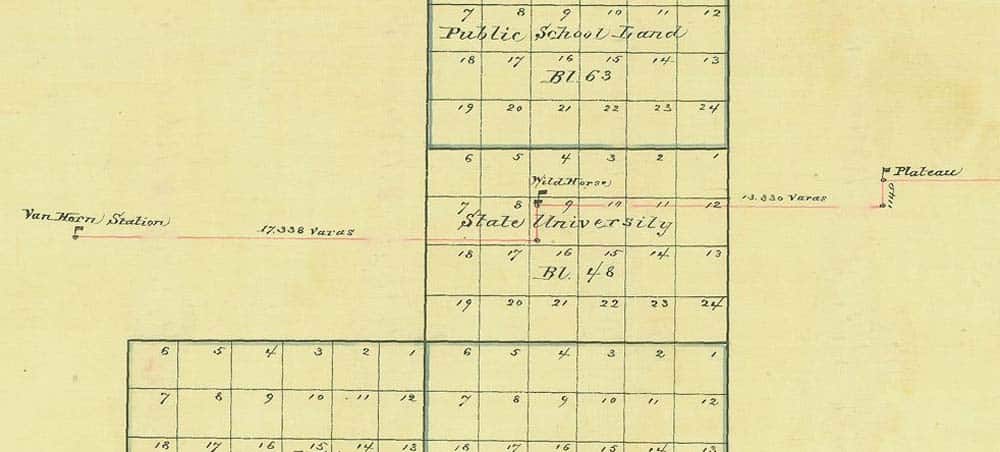
Just out of curiosity, what is the significance of the traverse to Van Horn Station that Dennis Corwin plotted on the map of his survey filed in the GLO as Map #2434? A portion of that map appears below. Taken at face value, it would appear to represent the means by which the index correction to Corwin's "North" by which the PSL blocks were laid out could be derived. I assume that this isn't a novel question, but that others have considered it.
One interesting detail is that reported in the bio sketches of the sheriffs of Travis County, Texas, of which Dennis Corwin was one:
"Dennis Corwin was born in Canada in 1834. At the age of nineteen he came to Austin where he established his home and profession. He served with the Confederate forces and became a major in the service. IN 1859, he became the County Surveyor of Travis County. He later held this position from 1903 to 1905. As a surveyor, Corwin surveyed the lands now controlled by the University of Texas as well as the route of the Southern Pacific railroad from San Antonio to El Paso. He was Sheriff of Travis County from 1876 to 1881 and was the first president of the Sheriff's Association. He died at his home in Austin in 1911."
By "Southern Pacific", I'd ordinarily think that the writer meant the G.H.& S.A. Rwy Co, whose route did not pass through present Reeves County, but possibly Corwin really worked on the survey for the route of the Texas & Pacific and that is the traverse plotted on his map.
http://www.traviscountyhistory.org/a-history-of-the-travis-county-sheriffs-office/
This affidavit given by Dennis Corwin in 1891 provides a bit of the history of Corwin's travels through the Trans-Pecos. Evidently, what was at issue then in some matter was the identity of San Martine Spring and the Apachie [sic] Mountains.
"As to the the 'Apachie Mountains' I have never been able to locate them. I have traversed all that country between Pecos and Rio Grande first in the capacity of Scout for Sibleys Brig. of Confederates and afterwards, and many times as surveyor, and am sure that I have seen all of the mountains and prominent peaks, but have not found any that I could identify as the "Apachies" (except on maps)"
Dennis Corwin
June 1, 1891"
http://www.glo.texas.gov/ncu/SCANDOCS/archives_webfiles/arcmaps/webfiles/arcmaps/pdfs/5/3//53226.pdf
I wonder if Dennis Corwin's 1884 map of the blocks located by him for the State Land Board and Board of Regents was mostly based upon the 1883 map of Paul McCombs' survey as Special Surveyor for the State Land Board. It would make perfect sense that it would have been, and that in fact the State Land Board would have urged him to do just that.
Probably the obvious way to test the hypothesis (if Mr. Corwin isn't already on record that that was how he compiled his 1884 map) would be to digitally overlay one upon the other to compare the points mapped on both.
Dennis Corwin's 1884 map:
http://www.glo.texas.gov/history/archives/map-store/index.cfm#item/2434
Paul McCombs 1883 map:
http://www.glo.texas.gov/history/archives/map-store/index.cfm#item/2299
The decision in State v. Flick 180 S.W.2d 371 (Tex. Civ. App. 1943) also recites some interesting history of Dennis Corwin's 1884 work for the State Land Board.
Kent McMillan, post: 398828, member: 3 wrote: One interesting detail is that reported in the bio sketches of the sheriffs of Travis County, Texas, of which Dennis Corwin was one:
"Dennis Corwin was born in Canada in 1834. At the age of nineteen he came to Austin where he established his home and profession. He served with the Confederate forces and became a major in the service. IN 1859, he became the County Surveyor of Travis County. He later held this position from 1903 to 1905. As a surveyor, Corwin surveyed the lands now controlled by the University of Texas as well as the route of the Southern Pacific railroad from San Antonio to El Paso. He was Sheriff of Travis County from 1876 to 1881 and was the first president of the Sheriff's Association. He died at his home in Austin in 1911."
By "Southern Pacific", I'd ordinarily think that the writer meant the G.H.& S.A. Rwy Co, whose route did not pass through present Reeves County, but possibly Corwin really worked on the survey for the route of the Texas & Pacific and that is the traverse plotted on his map.
http://www.traviscountyhistory.org/a-history-of-the-travis-county-sheriffs-office/
I'm not sure we're ready to make any final decisions as we are still gathering research and field work is being performed. And thank you for the contributions especially where Corwin is involved. With regard to the Southern Pacific reference in relation to Corwin, I am aware of the various names of the proposed Southern Transcontinental line. I recently was reviewing this https://www.loc.gov/resource/g4051p.rr004290/ 1867 map showing the routing of the H&TC (which was only built to South of Bryan at the time the map was compiled) and the centerline of the T&P labeled as the Southern Pacific RR in the vicinity of Midland. Also note the label to the north, "THE STAKED PLAIN", " Elevated Table Lands without wood or water, Across which a Route was marked by small stakes driven into the ground." The only inconsistency that I would point out is the the route of the Southern Pacific railroad which became the T&P was never routed through San Antonio. But that may well be shown to be confusion of the names on the part of Corwin's biographer.
The traverse you have shown is significantly south of where the statutory centerline was staked and looks like it generally follows along the tracks, or the "engineer's" centerline of the actual tracks. The statutory centerline predates Kuechler's work by a decade and since Kuechler tied his work to the Texas/New Mexico State Line and not the statutory centerline (which WAS held east of the 103rd meridian), the statutory centerline is not controlling and the "engineer's" centerline is irrelevant.
I am still taking in a lot of new data and I will share your links with the other parties. Thanks for the contributions.
Andy Nold, post: 398865, member: 7 wrote: I
The traverse you have shown is significantly south of where the statutory centerline was staked and looks like it generally follows along the tracks, or the "engineer's" centerline of the actual tracks.
Yes, the traverse that Corwin represented in the detail that I posted above runs from the stations known as "Plateau", "Wild Horse", and "Van Horn" on the Texas & Pacific line that has been reduced to Northing and Easting components for purposes of calculations. The record of Dennis Corwin's work in 1884 suggests that he actually did run a traverse along the T&P Railway Company's track as stated in his connecting line in Crane County Sketch File 3c
http://www.glo.texas.gov/history/archives/map-store/index.cfm#item/19559
Note also that Corwin's map of his work West of the Pecos does show identifiable monuments on the ground such as the large stone marked "Dennis Corwin, 1884" (or something similar). If one considers the historical setting of Corwin's work, i.e. the reason for his survey, it seems fairly clear that it was a scheme based upon some surveying by him. The question in my mind is whether he borrowed some of Paul McCombs's work from 1883 in preparing his map of the PSL and University blocks and, if Corwin had no authority to make the survey that he did in the first place (as the court discussed in State v. Flick), what the real effect of his work was.
Still reading the links provided in between finalizing an ALTA survey. In the affadavit, I'm having trouble deciphering the script where it says who he resided with in Austin. Robert ????
Edit: Looks like Robert Creuzbauer.
Andy Nold, post: 398899, member: 7 wrote: Edit: Looks like Robert Creuzbauer.
Yes, it's Robert Creuzbauer. The style of drafting of Dennis Corwin's 1884 map looks oddly familiar. My first thought was to compare it to Presidio County Rolled Sketch 7, compiled by John Cambell to represent an extensive series of surveys located by L.E. Edwards. Both Corwin and Cambell were some of the Travis County residents who were part of the roving band of Texas surveyors of the late 19th century.
Kent,
FWIW, the UT Investments, Trusts, and Lands Office Records from 1880-1968 are archived at the Briscoe Center.
http://www.lib.utexas.edu/taro/utcah/03296/cah-03296.html
A quick search of the index returns 3 hits for Corwin and search for dates in the vicinity of Corwin's work returns 1 hit for "Information on surveying (of) land, September 8, 1884"
I reckon I'll be making a trip back down I-35 soon.