

Is there any way to get a Chicago Rod. The Chicago rod is available with three or four sections that, instead of
sliding, are joined at the end to each other like a fishing rod. Very stable.
Historic boundaries and conservation efforts.

Those wooden rods are something of the past and mostly only found in some auction on occasion.
They show up on EBay along with the metal replacement face.
I did run across a shop that had a few in their inventory, you can always check, one may be collecting dust in a warehouse of some supply company.
When we ran transmissions lines we only had a 12ft rod and we would trig level and/or step level into the deep ravines we would cross or that would be out to the side of line.
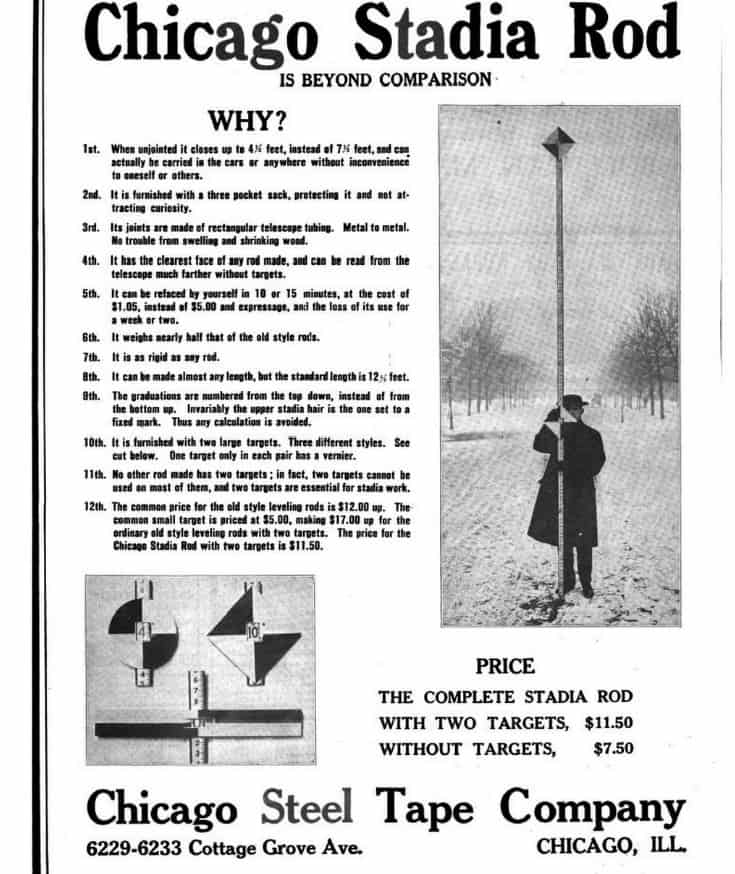
Historic boundaries and conservation efforts.

That looks very similar to what I heard referred to as a "Philly" (as in Philadelphia) Rod. I never saw the targets for one though.

Dave Lindell, post: 389593, member: 55 wrote: "The rod needs to be perpendicular to the zenith..."
Like horizontal?
That would make it difficult to read stadia, right there.
John, post: 389608, member: 791 wrote: That looks very similar to what I heard referred to as a "Philly" (as in Philadelphia) Rod. I never saw the targets for one though.
The Philadelphia Rod has two sliding sections. They lock together when fully extended by means of a knurled knob.
The target was sometimes a vernier to enable reading to the thousandth of a foot. The rod person was supposed to adjust
the target to align with the height of the sight line and then read the vernier.
Historic boundaries and conservation efforts.

So I have to read some settlement platforms weekly at the end of a 40' fill for a bridge end. Nothing to put a BM on except a culvert headwall at the bottom of said 40' fill. Preferable to use a 25' fiberglass rod, rock it, and take 1 turn, or use a shorter rod and take 3-4 turns every time?

eddycreek, post: 389614, member: 501 wrote: So I have to read some settlement platforms weekly at the end of a 40' fill for a bridge end. Nothing to put a BM on except a culvert headwall at the bottom of said 40' fill. Preferable to use a 25' fiberglass rod, rock it, and take 1 turn, or use a shorter rod and take 3-4 turns every time?
Sometimes you have to use the 25 footer, that's all there is to it.
Not long back I was inspecting some of the crew's equipment and noticed the little spring loaded tabs on the back of an older 25' fiberglass rod were "wallered" out quite a bit. I laid the rod down fully extended in the hallway at the office and placed it up against a wall and pushed on the top a bit to imitate gravity as if the rod was vertical. Then I measured it with a 25' Lufkin roll up tape. The 25' mark on the rod was actually at 24.95'. The bottom plate was also well worn.
Take note that fiberglass rods do have an expiration date.

In OZ we have always had bubbles for our level staffs, Well at least back to early 1960's. We were taught how to check the accuracy and adjust if necessary a level bubble. technically it should be done before you start the leveling project, while doing a two peg test on the level. I would rarely ask for the rod to be rocked unless it was the cross hair just intersecting a line mark on the rod.

I like both ways.
As said the one holding the staff (rod) need to know what they're doing. And not just rock it about without caring what's happening at foot end.
For the instrument reader I find it helps in those split hair decisions, but also makes one more aware of what you're actually reading (or booking).
It can help eliminate those common reading errors that occasionally plague us.
(ah. I see my other Aussie namesake says similar re split hair, line)

Rob O'Malley, post: 389583, member: 154 wrote: I don't rock the rod and I have my assistant learn to balance the rod. I understand that there are areas that require a huge delta in rod readings, but if you're using a fiberglass rod for leveling, you're not worried about closing within a few hundredths. If you're worried about a good closure, you're not using a 25' fiberglass rod.....
In the Midwest you rarely saw a Philly. The terrain made them all but worthless. We ran our control with 25' mound city rods. You would be amazed how tight you can work with one with a little care.

These days the only thing I use my 25-footer for these days is dipping manholes. All other verticals are done with a total station or GPS, except when I have to meet geodetic specs. Then it's a digital level and an invar rod.
Jim Frame, post: 389631, member: 10 wrote: These days the only thing I use my 25-footer for these days is dipping manholes.
🙂
[MEDIA=youtube]a4hPeYhRUBQ[/MEDIA]

I always have the crew rock the rod. And i don't have (too many) grey hairs yet.
Sent from my SM-G900P using Tapatalk
Relatively flat here in Houston, a 25' rod doesn't get used often, but with that, using the same rod for bs and fs isn't a compensating factor, even if you rock it.