

Dan Patterson, post: 334517, member: 1179 wrote: Always clockwise here. When you see a counterclockwise one around here it looks like the person doesn't know what they're doing. (Akin to contours through a building).
If I'm doing a subdivision with a new line in the middle for example I just put one label for the line. (For one lot I guess it would be counterclockwise). However, in the legal description both will be described using clockwise bearings. I suppose that's a little weird because the one bearing will not appear on the plat, but double labels would be a pain with all the other garbage they make us show.
As RFC mentioned, if you run the traverse counter clockwise, you can easily check your angular closure without having to calculate the complementary angles... (N-2*180)

"Yes, plats and legals should read the same, but if a PLS has difficulty reading that is a B I G problem."
It's not for the benefit of the PLS so much as for the technicians.
"Convention is like the shell to the chick, a protection till he is strong enough to break it through." Learned Hand
FWIW, I've heard the "we've always done it that way" line many times in all sorts of situations and it always aggravates me. But at a point in a persons development, at a certain level of knowledge, it's actually a good thing. We just hope that such a person will "break it through" at some point.

I recently completed a large boundary survey of a parcel that included one contiguous upland parcel and two separate submerged parcels that shared several hundred concurrent calls along the mean high water line separating the uplands from the submerged lands. In order to prevent having every single mhw line be represented by two separate line calls (one for each direction) I wrote the upland parcel clockwise and the two submerged parcels counterclockwise. Legal descriptions took up 1 entire sheet 24X36 and the line table about 1/3 of a sheet.

Norman Oklahoma, post: 334560, member: 9981 wrote: ... We just hope that such a person will "break it through" at some point.
This has nothing to do with cw or ccw description direction, but Mark's comment reminded me of something that had happened years ago.
I had, for a while and out of necessity, became an instrument man/ party chief. Being the gunner on the crew I found myself "in charge" when the PC up and quit. We were staking subdivisions for construction I was of course overwhelmed. After a few weeks a new PC was hired and touted to be a whizz.
Hoping to meet his expectations the rest of us were all on point. About halfway through the day we were beginning to realize this guy didn't know doo-doo from DynaShine. The last straw was when he had us layout a long street curve. EVERY POINT on the curve was chained from the PC at the gun, approaching 700 or 800 feet in some instances. When I mentioned there was actually was an easier way to do it he had to show me a (circa 1960) rudimentary zerox copy of a New Mexico State Highway Department Handbook that had an example of how to put a point on a curve. Of course their was only one point, and the distance was calculated from the PC. He was using that same formula to calc the "long chord" for every station and it was taking forever...Not wanting to "buck" the pecking order we did just as he wanted. I later explained to the boss what we were doing. The new PC was scrutinized and after a few days he was sent packing.
I believe that was my "breakout" moment when I realized I knew more than the PC. That was probably the point in history when young Paden became a very dangerous surveyor...:snarky:

The convention around here is that they typically run clockwise. There is no reason, mathematical or legal, to do them one way or the other. I've run some descriptions widdershins intentionally so that they could have the first few courses in common to ensure that there wasn't a confusion as to the intention by a later interpreter of my description.
I realize that having a convention is nice so that things seem consistent. However, there are times when breaking from convention is the right way to do it. And I will never balk at breaking from convention.
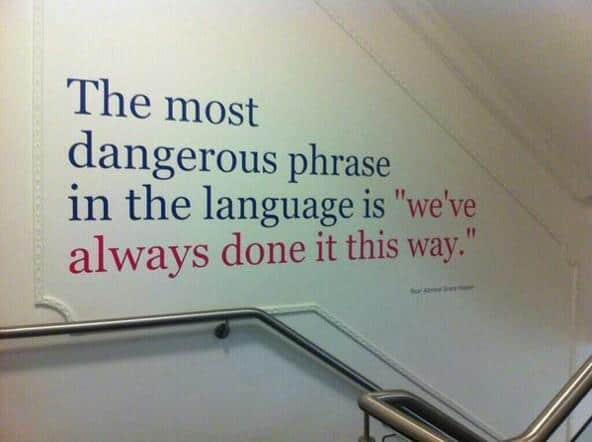
I can't see the source of the quote, but I have this image posted at my desk just in case others around the office aren't sure how I operate.

Maps/Plats/Exhibit sketches: I try to match the record title (and show the record data in parentheses). That makes it easier to compare apples to oranges.
Legals: I begin at a logical monument or point of record, usually the same PoB as record. Then, as the first course determines the Basis of Bearings, along a logical course of record, preferably monumented (and show the record data in parentheses).
prepare the Plat first, prepare Legal from it (add data/calls/etc. as needed), finally Closure Calcs...
I honestly never paid any attention to the direction of rotation. Whatever software was used to do a closure check after the plat was done... it always seemed to work, and did not dictate my work.
In the field I just try to run away from the sun or wind if either are intense. It is all just numbers, no big deal (if you keep good notes and don't let a data collector routine dictate your work method)

I was taught to measure counter clock wise. Easier to check angle closure (N - 1) x 90 = sum of angles.
and for
Drawings and property descriptions to read clockwise.

I prefer to use a clockwise direction when preparing descriptions but do on occasion run them counter clockwise. This usually occurs when I'm writing several descriptions for a project and try to utilize the same point of commencement and beginning. You have know when to be flexible.
As for mapping, I try to go with direction on the description.

I'm curious how the "purist "view of RFC's =2 question handles 2 or 3 adjoining lot traverses?
If clockwise then once the contiguous lot boundary was reached you'd be going anticlockwise down those legs of the traverse.
Here we label bearings and distances around all lots.
I generally try for no real reason other than consistency to label clockwise but then some lots end up opposite sides running same way.
There's no way of avoiding such in multilot plan drawing.

My habits and preferences have no 'bearing' on the subject. I prepare my descriptions to honor the manner in which title was established and has been maintained. Sometimes that's clockwise, others counter. Many times they include no distances or directions at all.

Wow...Who knew?...
I think one thing I've learned for sure around here is that just about any question anyone has ever or will ever ask here could be answered the same way:
"It Depends!" 😀
paden cash, post: 334570, member: 20 wrote: About halfway through the day we were beginning to realize this guy didn't know doo-doo from DynaShine.
I'd know better than to argue with the venerable Paden, but....
Isn't the appropriate colloquialism something slightly different?
https://en.wiktionary.org/wiki/know_shit_from_Shinola

And I have worked in jurisdictions where the norm is to show platted bearings to always be northeast or northwest. After all, the descriptions will henceforth be "Lot # of Adam Acres, filed in Book X of Plats, Page Y".
rfc, post: 334616, member: 8882 wrote: I'd know better than to argue with the venerable Paden, but....
Isn't the appropriate colloquialism something slightly different?
(I was tryin' to be polite....)
I was taught to run traverse counter clockwise and to show bearings on drawings and property descriptions as clockwise.
Mathematically, it all comes out the same. Much of the early ways of doing things made computing angular closure a matter of adding all of the angles turned and comparing that to (N-2) x 180.
When we chained, we chained once clockwise and then turned it counter clockwise for the second chaining and averaged those distances.
😉

UMMMM, what about (N+2)180 for CW traverses? Just sayin'....
A Harris, post: 334626, member: 81 wrote: I was taught to run traverse counter clockwise and to show bearings on drawings and property descriptions as clockwise.
Mathematically, it all comes out the same. Much of the early ways of doing things made computing angular closure a matter of adding all of the angles turned and comparing that to (N-2) x 180.
When we chained, we chained once clockwise and then turned it counter clockwise for the second chaining and averaged those distances.
😉
I was waiting for that word. 'Mathematically' you are correct. Controlling calls is another matter.
Honor the manner in which title was created....
My .02, Tom

Virginia standards are clockwise.
Sergeant Schultz, post: 334634, member: 315 wrote: UMMMM, what about (N+2)180 for CW traverses? Just sayin'....
Now that is thinking outside the box.

rfc, post: 334497, member: 8882 wrote: Here's a deep one for the intelligencia:
1. When drawing surveys, is it always proper to call them in a clockwise manner?
2. Is it usual to survey in one direction or another? Does it matter?
Law in QLD, AUS that bearings are clockwise around subject lot. You run into trouble when you have 2 subject lots that share a common boundary, cant be clockwise on both... so you chose a 'main' subject lot (usually the bigger one.)
For single lot though, always clockwise. You will get a requisition if you don't.