

Kent McMillan, post: 378803, member: 3 wrote: I have at least a couple of questions. The first has to do with graphical standards. The sheets sizes are 18" x 26". Does this mean that the maps are scanned at that size and are to be plotted same size as well or are the minimum light widths and text sizes chosen for microfilming or plotting at a smaller format?
What particularly catches my eye is how the usual heirarchy of line widths appears to be turned over to line types instead. For example the centerline of the street that appears to be the same line width as the right-of-way lines is unexpected.
Is the variety of monument symbols used one that is required? In Texas (where of course the land you surveyed isn't located), it makes more sense to differentiate
- original land grant corners,
- replacements of original land grant corners
- original monuments of record that either directly or indirectly control the boundary subject of survey,
- monuments that are found but that don't control a boundary,
- replacements of boundary monuments as made by the subject survey, and
- miscellaneous markers that aren't boundary monuments.That way, the top down heirarchy of most to least controlling is fairly easy to see from just the monument symbols. If they are all original controlling monuments, its possible that several completely different types of markers would all get the same symbol, for example.
I forgot you asked about the sheet size.
In a nutshell, 18"x26" with 1" borders is the statutory sheet size for filed maps in California. It's been like that for a long time. I realize it is a weird size to everyone except for us, for us it is just normal.

Dave Karoly, post: 378867, member: 94 wrote: I forgot you asked about the sheet size.
In a nutshell, 18"x26" with 1" borders is the statutory sheet size for filed maps in California. It's been like that for a long time. I realize it is a weird size to everyone except for us, for us it is just normal.
But when you purchase copies of maps of record, are they customarily supplied in some smaller format and is that what accounts for the large text sizes?

Kent McMillan, post: 378869, member: 3 wrote: But when you purchase copies of maps of record, are they customarily supplied in some smaller format and is that what accounts for the large text sizes?
The options vary by county, but I almost always opt for 18x26 when buying paper copies.
Jim Frame, post: 378871, member: 10 wrote: The options vary by county, but I almost always opt for 18x26 when buying paper copies.
Is the general idea that microfilming standards from years ago are what control the minimum text heights used in maps for record?

Thanks for posting these. It's always helpful to see how someone else presents the findings from a survey. The wording of the notes, the monument descriptions, the record information - lots of information there. Well presented.
I printed these out and I'll study them some more. I'll probably end up pirating some of these methods.
This is is one of many threads on this site that will improve my practice. Thanks.
Btw, what is a T-bar? I'm not familiar with that term.
Did Kent post a plat recently? I missed it. Someone care to link to it?
John Thompson, post: 378875, member: 9631 wrote: Thanks for posting these. It's always helpful to see how someone else presents the findings from a survey. The wording of the notes, the monument descriptions, the record information - lots of information there. Well presented.
I printed these out and I'll study them some more. I'll probably end up pirating some of these methods.
This is is one of many threads on this site that will improve my practice. Thanks.
Btw, what is a T-bar? I'm not familiar with that term.
Did Kent post a plat recently? I missed it. Someone care to link to it?
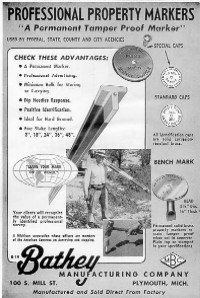
T-bar was a product sold by Bathey, it is T-shaped like a fence post with a drill hole in the T intersection. They sold stainless steel caps on which you could have your LS number pre-stamped. A small nail was driven through the hole in the cap into the t-bar.
Kent's thread:
https://surveyorconnect.com/community/threads/an-uncommon-common-lot-line-at-the-lake.327300/

Kent McMillan, post: 378872, member: 3 wrote: Is the general idea that microfilming standards from years ago are what control the minimum text heights used in maps for record?
Both Oregon's and Washington's statute specify that 0.08 is to be the minimum text height. Those rules go back to long before scanning, even long before microfilming.
But I have heard said that 0.04 is about as small as can be read by most people, and 0.08 plotted half size is 0.04.
Kent McMillan, post: 378869, member: 3 wrote: when you purchase copies of maps of record, are they customarily supplied in some smaller format
I haven't purchased a copy of a map in several years. Download pdfs is the thing. But back in the day, copies where full, original sized.
Mark Mayer, post: 378877, member: 424 wrote: Both Oregon's and Washington's statute specify that 0.08 is to be the minimum text height. Those rules go back to long before scanning, even long before microfilming.
So Oregon and Washington laws specify minimum text heights equivalent to 2.0mm? Do they also specify an aspect ratio for fonts, or can condensed fonts be used as long as they satisfy the height requirement?
Presumably these same minimum heights do not apply to pretty much all other documents filed for record if upper and lower case 12-point fonts can be used, so I'd think that old microfilming requirements have to be the explanation for using a different standard for maps.
But I have heard said that 0.04 is about as small as can be read by most people, and 0.08 plotted half size is 0.04.
I'd think 1.5mm (0.06 in.) would be the smallest text height I'd want to use without needing a magnifying glass and only upper case at that.
Mark Mayer, post: 378879, member: 424 wrote: I haven't purchased a copy of a map in several years. Download pdfs is the thing.
I live in a mostly rural county that's way behind the curve when it comes to modernization in local government. The county does have all of its maps in digital form, but has failed to prioritize a means of distributing those files. So when I want a copy of a map, I have to drive to the county seat and buy paper. It's pathetic, frankly, especially since the more urban counties around us have such efficient online resources.
We have a new ACE (Assessor Clerk Recorder) though, and I'm hopeful that he'll bring the Recorder's office into the 21st century.
Kent McMillan, post: 378889, member: 3 wrote: I'd think 1.5mm (0.06 in.) would be the smallest text height I'd want to use without needing a magnifying glass and only upper case at that.
I use 0.05 in. for labeling utility lines on topo maps, but those don't get filed for public record. And mostly they don't even get printed any more except as background for civil design sheets.

Kent McMillan, post: 378889, member: 3 wrote: Oregon and Washington laws specify minimum text heights equivalent to 2.0mm? Do they also specify an aspect ratio for fonts, or can condensed fonts be used as long as they satisfy the height requirement?
Condensed fonts are fine, just a height requirement.

I like the way that the locations of the monuments in the adjoining subdivision were given with a table of ties from ...NW 1/64th...that's a creative way to tell someone where they are but not have to resolve these interior lot lines, haven't seen anything quite like that. Nice
roger_LS, post: 378895, member: 11550 wrote: I like the way that the locations of the monuments in the adjoining subdivision were given with a table of ties from ...NW 1/64th...that's a creative way to tell someone where they are but not have to resolve these interior lot lines, haven't seen anything quite like that. Nice
We tied those monuments but ultimately didn't need them. Caltrans needed them, however. However, we are a public agency so we share our data with the public. My solution was to add the radial ties to provide that information to the surveyors working in Adams Springs.

Dave Karoly, post: 378876, member: 94 wrote: T-bar was a product sold by Bathey, it is T-shaped like a fence post with a drill hole in the T intersection. They sold stainless steel caps on which you could have your LS number pre-stamped. A small nail was driven through the hole in the cap into the t-bar.https://surveyorconnect.com/community/threads/an-uncommon-common-lot-line-at-the-lake.327300/&apos ;">327300/
Caltrans used to use a lot of these for control points and sometimes R/W markers. I've found the t-bar with a conventional brass tag set by private firms in the 60's. The SST cap makes a great marker.
http://www.bathey.com/categories/id-caps.html
I also like the presentation of the monument positions with offset to line combined with the purpose statement that it is a survey of the general location of the Westerly line. Good way to provide all mathematical info without calling stuff off, I don't think it's confusing at all. And it allows future surveyors to come in there and get stupid fighting over a couple tenths here or there without necessarily being in conflict with your survey.

[USER=94]@Dave Karoly[/USER]
Dave,
A nice looking plat. Only question: The difference in your seal (LLS) and County Surveyor Haggett (PLS)? Is this similar to Texas' RPLS and LSLS?
Thanks,
Dan B. Robison, RLS, RPLS, PLS, PS, DDSM:copyright::restricted:
(the BOR has changed my title over the years...so I made up my own)
:beer::beer::beer:
Dan B. Robison, post: 378986, member: 34 wrote: [USER=94]@Dave Karoly[/USER]
Dave,
A nice looking plat. Only question: The difference in your seal (LLS) and County Surveyor Haggett (PLS)? Is this similar to Texas' RPLS and LSLS?
Thanks,
Dan B. Robison, RLS, RPLS, PLS, PS, DDSM:copyright::restricted:
(the BOR has changed my title over the years...so I made up my own)
:beer::beer::beer:
No they are identical, it's a matter of preference.
I just want to say Gordon Haggitt would be a great name for a Country-Western star.