Reading RPLS is free for the whole profession. Members post, reply, and get the members-only rooms.

Notifications
Clear all
Strictly Surveying
24
Posts
9
Users
0
Reactions
2,107
Views

Topic starter
Translate
▼
English
Spanish
French
German
Italian
Portuguese
Russian
Chinese
Japanese
Korean
Arabic
Hindi
Dutch
Polish
Turkish
Vietnamese
Thai
Swedish
Danish
Finnish
Norwegian
Czech
Hungarian
Romanian
Greek
Hebrew
Indonesian
Malay
Ukrainian
Bulgarian
Croatian
Slovak
Slovenian
Serbian
Lithuanian
Latvian
Estonian
This is one of the more interesting problems I've dealt with. The basic situation was that a tract of land on Lake Travis, a flood control lake with a highly variable level, was subdivided into lots in August, 1950 according to a plat known as "BROOKS HOLLOW" prepared by a civil engineer named Doak Rainey. At the time that the plat was executed during a prolonged period of drought, the average level of the lake was reported by the Lower Colorado River Authority to have been 638 MSL, more than 43 ft. below the anticipated normal operating level and approximately 32 ft. below the lowest point on the ground surface along the lakeward boundary of the subdivision.
The land subdivided consisted of four certain tracts, the largest of which, and the one that actually fronted on Lake Travis, was a 15.15 acre tract that was bounded on its lakeward side by "a contour which is 670 feet above Mean Sea Level as established from U.S. Geological Survey Benchmarks" along which the deed also recited courses and distances following the meanders of said contour. The normal operating level of Lake Travis is nominally 681 feet, so when the lake is full, the boundary of the 15.15 acre tract would be 11 feet below it.
The significance of the 670 ft. contour was that in 1938 the subdivider's predecessor in title, a widow named Susan Clifton, had conveyed a inundation easement to the L.C.R.A. over that portion of a certain 180.5 acre tract "not exceeding 670 feet above mean sea level as determined from the United States Geological Survey benchmarks". A later owner of the 180.5 acres subject to the inundation easement had conveyed a certain 15.15 acre part of the 180.5 acres lying above the 670 ft. contour.
So, in 1950 Engineer Rainey evidently made a office plot of the four tracts owned by the subdivider using the the descriptions contained in the various deeds of record, attempting to piece them together, and drawing a scheme of subdivision using the results of his office plot. The subdivision boundary labeled "670' Contour" was clearly drawn from the courses and distances along the 670' contour as set forth in the 1938 deed to L.C.R.A. and repeated in the later deed of the 15.15 acre part above the 67 ft. contour.
Note that Lots 3 and 5 touch at exactly one point, their common corner, as shown upon the 1950 plat.
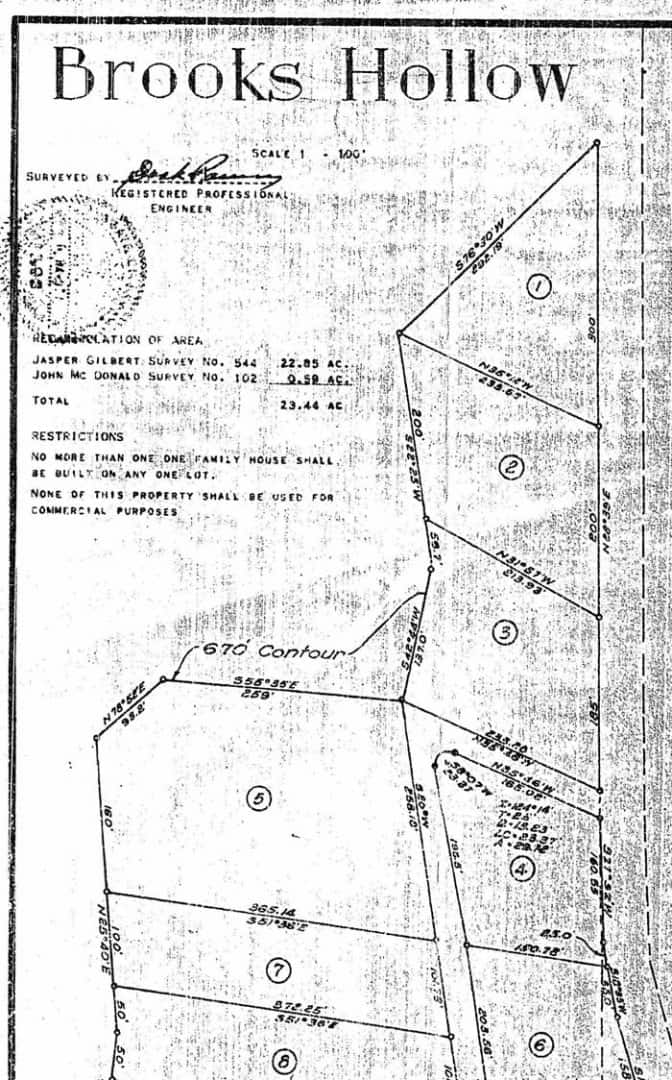
No lots were sold by reference to that 1950 plat, however. It was not until 1953 that Lake Travis actually refilled and there was some demand for the lots of BROOKS HOLLOW, none of which had previously sold. At any rate, in December, 1953, before selling any lots, the subdivider executed a resubdivision plat of the same four tracts of land known as "BROOKS HOLLOW SUBDIVISION". There is reason to think that Doak Rainey did send a field party out to actually stake lots in the subdivision as shown upon the resubdivision plat and that a number of the stakes placed by him or his assistants can actually be found.
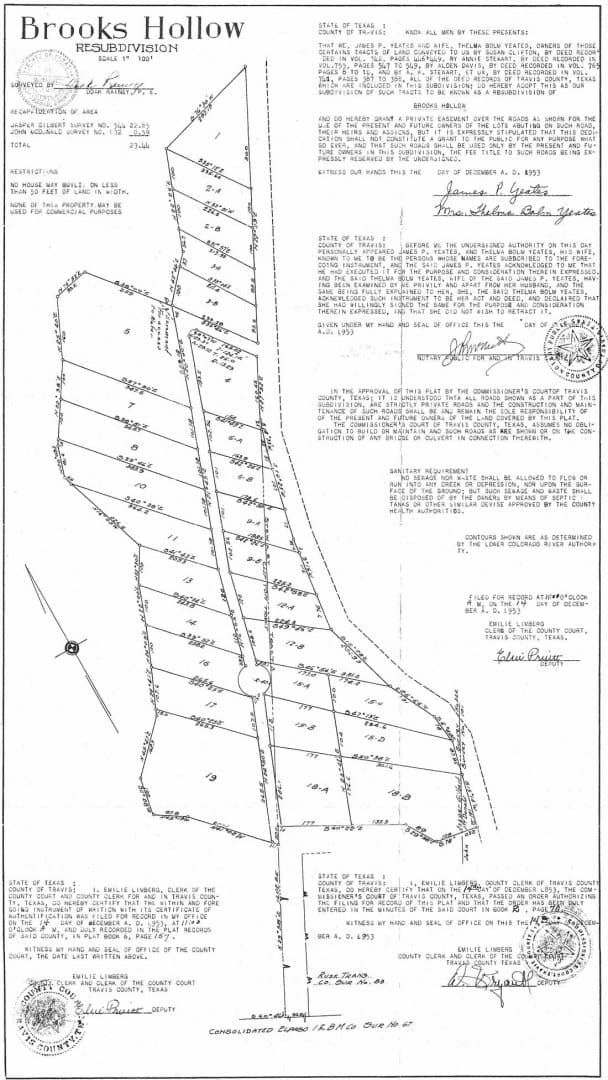
Note that Lot 3 was resubdivided into two parts by the 1953 resub plat, but continued to share exactly one common corner with Lot 5. While the lakeward boundary of the subdivision is not explicity labeled "670' contour" as was done on the original plat, it would appear that the subdivider's intention was to subdivide the entire 15.15 acres that the 670 ft. contour bounded.
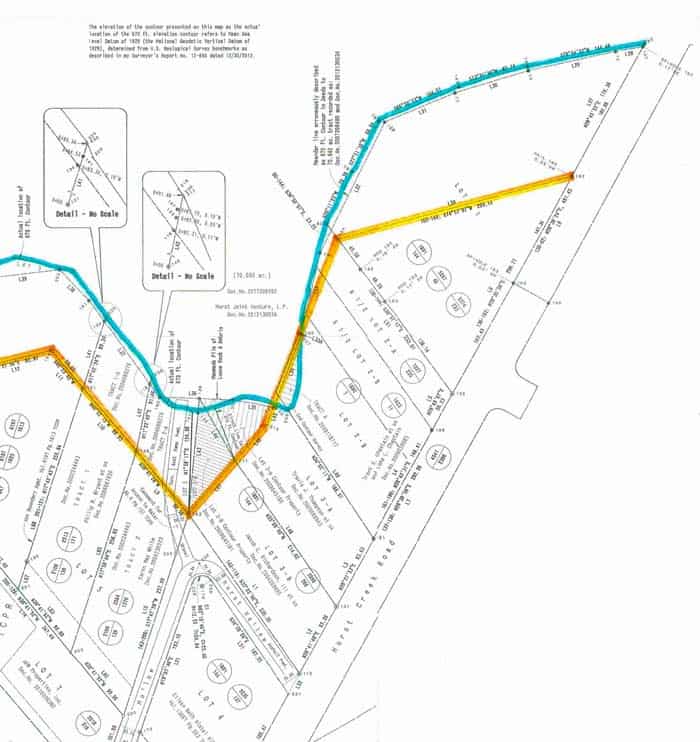
The problem arose when surveyors later discovered that the common corner of Lots 3-B and 5 was not in fact on the 670 ft. contour, but more than 124 ft. from it at the nearest point. The situation is shown in the detail below.
The blue line is the actual location of the contour with an elevation of 670 ft. above mean sea level as determined from the United States Geological Survey benchmarks" described in the 1938 easement deed to L.C.R.A. and in the 1945 deed by which the 15.15 acre tract was originally conveyed to separate ownership.
The orange line is the boundary of the subdivision as delineated upon the 1953 plat of BROOKS HOLLOW RESUBDIVISION.
In a nutshell, the question was where the common line of Lots 3-B and 5 actually ran to reach the boundary of the 15.15 ac. A dispute had arisen between the adjoining landowners fueled in part by the differing opinions of several land surveyors.
Posted : June 22, 2016 1:28 pm

Translate
▼
English
Spanish
French
German
Italian
Portuguese
Russian
Chinese
Japanese
Korean
Arabic
Hindi
Dutch
Polish
Turkish
Vietnamese
Thai
Swedish
Danish
Finnish
Norwegian
Czech
Hungarian
Romanian
Greek
Hebrew
Indonesian
Malay
Ukrainian
Bulgarian
Croatian
Slovak
Slovenian
Serbian
Lithuanian
Latvian
Estonian
I would think pro-rated frontage would apply, but that is what we used to deal with movement of the Pecos River several hundred feet away from it's location when surveyed in 1870s. I assume there is another installment to your story?
Posted : June 22, 2016 1:40 pm
Topic starter
Translate
▼
English
Spanish
French
German
Italian
Portuguese
Russian
Chinese
Japanese
Korean
Arabic
Hindi
Dutch
Polish
Turkish
Vietnamese
Thai
Swedish
Danish
Finnish
Norwegian
Czech
Hungarian
Romanian
Greek
Hebrew
Indonesian
Malay
Ukrainian
Bulgarian
Croatian
Slovak
Slovenian
Serbian
Lithuanian
Latvian
Estonian
Proration produces some very wacky results, though, if consistently applied to all of the lake front lots.
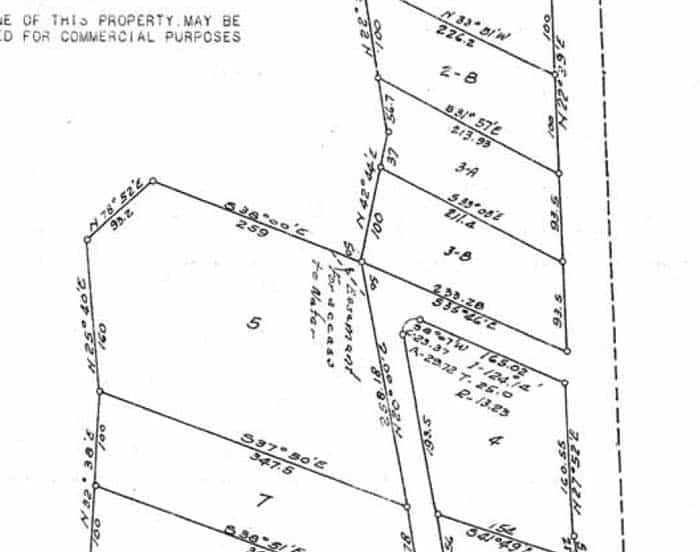
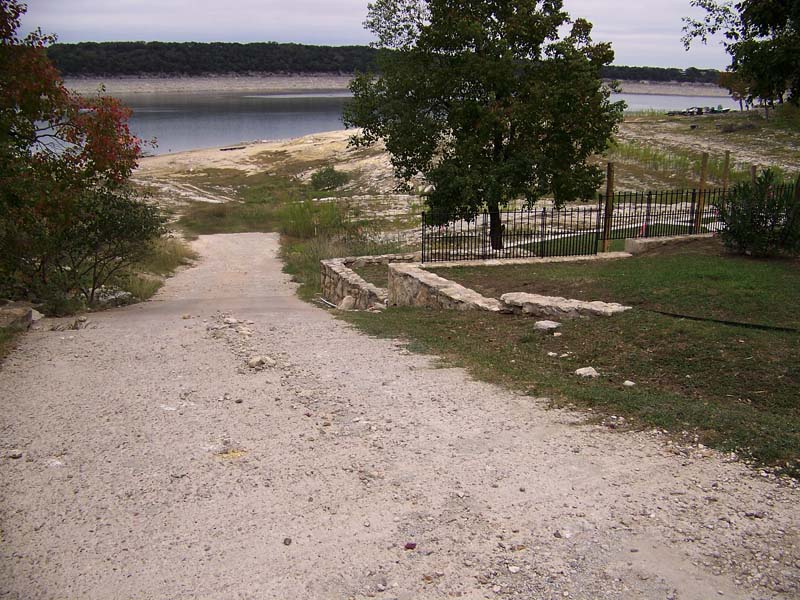
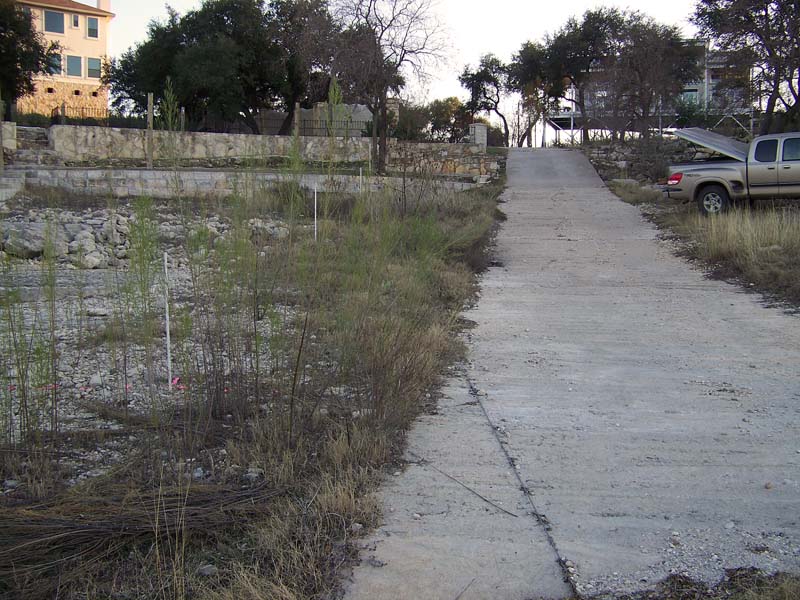
Note that one feature of the subdivision scheme is the easement across Lot 5 on the resub plat labeled "Easement for Access to Water" This is used by subdivison lot owners to launch boats and to travel by vehicle down to the lake at levels below 670 ft. That is, there is an old concrete-paved boat ramp that runs from the platted line of Lot 5 down to the 670 ft. contour following a natural fold in the land, in the direction of maximum slope.
Posted : June 22, 2016 1:59 pm
Topic starter
Translate
▼
English
Spanish
French
German
Italian
Portuguese
Russian
Chinese
Japanese
Korean
Arabic
Hindi
Dutch
Polish
Turkish
Vietnamese
Thai
Swedish
Danish
Finnish
Norwegian
Czech
Hungarian
Romanian
Greek
Hebrew
Indonesian
Malay
Ukrainian
Bulgarian
Croatian
Slovak
Slovenian
Serbian
Lithuanian
Latvian
Estonian
Here are two photos showing the concrete boat ramp in place running from Lot 5 toward the lake and ending at approximately the 670 ft. contour. These were taken at a time when the lake was very far down and would look quite different today.
Posted : June 22, 2016 2:51 pm
Topic starter
Translate
▼
English
Spanish
French
German
Italian
Portuguese
Russian
Chinese
Japanese
Korean
Arabic
Hindi
Dutch
Polish
Turkish
Vietnamese
Thai
Swedish
Danish
Finnish
Norwegian
Czech
Hungarian
Romanian
Greek
Hebrew
Indonesian
Malay
Ukrainian
Bulgarian
Croatian
Slovak
Slovenian
Serbian
Lithuanian
Latvian
Estonian
And here is the final report upon that survey as submitted for mediation.
Posted : June 22, 2016 3:47 pm

Translate
▼
English
Spanish
French
German
Italian
Portuguese
Russian
Chinese
Japanese
Korean
Arabic
Hindi
Dutch
Polish
Turkish
Vietnamese
Thai
Swedish
Danish
Finnish
Norwegian
Czech
Hungarian
Romanian
Greek
Hebrew
Indonesian
Malay
Ukrainian
Bulgarian
Croatian
Slovak
Slovenian
Serbian
Lithuanian
Latvian
Estonian
I don't know what the big deal is.... It is not like any of that land has any value.
Posted : June 22, 2016 4:06 pm
Topic starter
Translate
▼
English
Spanish
French
German
Italian
Portuguese
Russian
Chinese
Japanese
Korean
Arabic
Hindi
Dutch
Polish
Turkish
Vietnamese
Thai
Swedish
Danish
Finnish
Norwegian
Czech
Hungarian
Romanian
Greek
Hebrew
Indonesian
Malay
Ukrainian
Bulgarian
Croatian
Slovak
Slovenian
Serbian
Lithuanian
Latvian
Estonian
BrandonA, post: 378658, member: 11837 wrote: It is not like any of that land has any value.
Right. There is only so much water frontage on Lake Travis and as more and more people move to Central Texas and want to live or own property at the lake, it only goes down in value. Lake Austin is exactly the same way. Not.
Posted : June 22, 2016 4:11 pm
Translate
▼
English
Spanish
French
German
Italian
Portuguese
Russian
Chinese
Japanese
Korean
Arabic
Hindi
Dutch
Polish
Turkish
Vietnamese
Thai
Swedish
Danish
Finnish
Norwegian
Czech
Hungarian
Romanian
Greek
Hebrew
Indonesian
Malay
Ukrainian
Bulgarian
Croatian
Slovak
Slovenian
Serbian
Lithuanian
Latvian
Estonian
Kent McMillan, post: 378661, member: 3 wrote: Right. There is only so much water frontage on Lake Travis and as more and more people move to Central Texas and want to live or own property at the lake, it only goes down in value. Lake Austin is exactly the same way. Not.
Haha, that is for sure. I did some surveying on that lake when I was just starting out working for LCRA, but we didn't have a problem like the one you have, that is good.
Posted : June 22, 2016 4:15 pm
Translate
▼
English
Spanish
French
German
Italian
Portuguese
Russian
Chinese
Japanese
Korean
Arabic
Hindi
Dutch
Polish
Turkish
Vietnamese
Thai
Swedish
Danish
Finnish
Norwegian
Czech
Hungarian
Romanian
Greek
Hebrew
Indonesian
Malay
Ukrainian
Bulgarian
Croatian
Slovak
Slovenian
Serbian
Lithuanian
Latvian
Estonian
Kent McMillan, post: 378647, member: 3 wrote: Note that one feature of the subdivision scheme is the easement across Lot 5 on the resub plat labeled "Easement for Access to Water" This is used by subdivison lot owners to launch boats and to travel by vehicle down to the lake at levels below 670 ft. That is, there is an old concrete-paved boat ramp that runs from the platted line of Lot 5 down to the 670 ft. contour following a natural fold in the land, in the direction of maximum slope.
Yes, I missed the easement. I think the construction you presented is a reasonable solution. Hopefully the land owners are agreeable.
Posted : June 22, 2016 4:27 pm
Topic starter
Translate
▼
English
Spanish
French
German
Italian
Portuguese
Russian
Chinese
Japanese
Korean
Arabic
Hindi
Dutch
Polish
Turkish
Vietnamese
Thai
Swedish
Danish
Finnish
Norwegian
Czech
Hungarian
Romanian
Greek
Hebrew
Indonesian
Malay
Ukrainian
Bulgarian
Croatian
Slovak
Slovenian
Serbian
Lithuanian
Latvian
Estonian
Andy Nold, post: 378665, member: 7 wrote: Yes, I missed the easement. I think the construction you presented is a reasonable solution. Hopefully the land owners are agreeable.
They did agree to settle the lawsuit. My client was happy.
On a more general point, the idea of proportionment of frontage on a lake falls apart in the case of a variable level lake with the sort of topography that Lake Travis does. If the equity lies in each lot sharing the waterfront at all levels of the lake in proportion to the record frontage of the lot as shown upon some subdivision plat, then you end up having to do the proportioning along multiple contours, ending up with highly irregular side lines that don't most likely work in the way that people who own lake lots on variable level lakes expect them to.
On a variable level lake, one key element is that you can maintain a boat dock by moving it in and out as the lake rises and falls. a lot that facilitates anchorage and dockage works. One that merely gives some water front without regard to use, isn't necessarily even an equitable solution.
It's a different sort of problem than distributing accretions, for example.
Posted : June 22, 2016 4:33 pm
Translate
▼
English
Spanish
French
German
Italian
Portuguese
Russian
Chinese
Japanese
Korean
Arabic
Hindi
Dutch
Polish
Turkish
Vietnamese
Thai
Swedish
Danish
Finnish
Norwegian
Czech
Hungarian
Romanian
Greek
Hebrew
Indonesian
Malay
Ukrainian
Bulgarian
Croatian
Slovak
Slovenian
Serbian
Lithuanian
Latvian
Estonian
Well, I assumed the extended property line would stop at the correct elevation contour. Beyond that it would be a matter of access across lake property. I can't imagine how complex a line extended to variable depths would look. If you're suggesting the property line depends on the level of the water in the lake, that is unlike most lakes I have surveyed on.
Posted : June 22, 2016 5:11 pm
Topic starter
Translate
▼
English
Spanish
French
German
Italian
Portuguese
Russian
Chinese
Japanese
Korean
Arabic
Hindi
Dutch
Polish
Turkish
Vietnamese
Thai
Swedish
Danish
Finnish
Norwegian
Czech
Hungarian
Romanian
Greek
Hebrew
Indonesian
Malay
Ukrainian
Bulgarian
Croatian
Slovak
Slovenian
Serbian
Lithuanian
Latvian
Estonian
Andy Nold, post: 378671, member: 7 wrote: Well, I assumed the extended property line would stop at the correct elevation contour. Beyond that it would be a matter of access across lake property. I can't imagine how complex a line extended to variable depths would look. If you're suggesting the property line depends on the level of the water in the lake, that is unlike most lakes I have surveyed on.
The essential ingredient of lake lots is frontage on the lake. So, if the lake recedes and the effect of that is to decrease the lake frontage, ordinary equity (without considering other things) would suggest that the lot owners lose or gain frontage on the lake at its new level in proportion to their frontages as platted. On a variable level lake, where lots are platted at a higher elevation (which was about elevation 681 ft. in the example I posted), but the lots actually extend to a lower elevation (which was elevation 670 ft. in the same example), that loss or gain would occur at all stages of the lake between those two levels. It would be a continuous process of loss or gain of frontage and so the sidelines would trace out the supposed equitable solutions along the way.
Posted : June 22, 2016 5:22 pm

Translate
▼
English
Spanish
French
German
Italian
Portuguese
Russian
Chinese
Japanese
Korean
Arabic
Hindi
Dutch
Polish
Turkish
Vietnamese
Thai
Swedish
Danish
Finnish
Norwegian
Czech
Hungarian
Romanian
Greek
Hebrew
Indonesian
Malay
Ukrainian
Bulgarian
Croatian
Slovak
Slovenian
Serbian
Lithuanian
Latvian
Estonian
Is the changing lake elevations manmade or a act of nature?
Posted : June 22, 2016 5:31 pm
Topic starter
Translate
▼
English
Spanish
French
German
Italian
Portuguese
Russian
Chinese
Japanese
Korean
Arabic
Hindi
Dutch
Polish
Turkish
Vietnamese
Thai
Swedish
Danish
Finnish
Norwegian
Czech
Hungarian
Romanian
Greek
Hebrew
Indonesian
Malay
Ukrainian
Bulgarian
Croatian
Slovak
Slovenian
Serbian
Lithuanian
Latvian
Estonian
bridger48, post: 378673, member: 6251 wrote: Is the changing lake elevations manmade or a act of nature?
It is mainly the result of droughts not delivering enough water to fill the lake. The dam was constructed to retain flood waters up to elevation 715 ft., with a normal pool level of 681 ft., with lake levels dropping depending upon inflows.
Posted : June 22, 2016 5:35 pm
Topic starter
Translate
▼
English
Spanish
French
German
Italian
Portuguese
Russian
Chinese
Japanese
Korean
Arabic
Hindi
Dutch
Polish
Turkish
Vietnamese
Thai
Swedish
Danish
Finnish
Norwegian
Czech
Hungarian
Romanian
Greek
Hebrew
Indonesian
Malay
Ukrainian
Bulgarian
Croatian
Slovak
Slovenian
Serbian
Lithuanian
Latvian
Estonian
In case there is any interest in possibly the longest description of an agreed line running for just a little over 125 ft., I've attached a copy below. Basically, the point of the description is to document evidence that likely won't exist ten years from now, and provide a large surplus of information from which the line in question, which will typically be mostly submerged under the lake, can be re-established without scuba gear.
Posted : June 22, 2016 5:40 pm

Translate
▼
English
Spanish
French
German
Italian
Portuguese
Russian
Chinese
Japanese
Korean
Arabic
Hindi
Dutch
Polish
Turkish
Vietnamese
Thai
Swedish
Danish
Finnish
Norwegian
Czech
Hungarian
Romanian
Greek
Hebrew
Indonesian
Malay
Ukrainian
Bulgarian
Croatian
Slovak
Slovenian
Serbian
Lithuanian
Latvian
Estonian
Kent McMillan, post: 378650, member: 3 wrote: Here are two photos showing the concrete boat ramp in place running from Lot 5 toward the lake and ending at approximately the 670 ft. contour. These were taken at a time when the lake was very far down and would look quite different today.
2 questions-
Are the white pvc/conduit your line markers?
Is the shoreline susceptible to wave-caused erosion?
Posted : June 22, 2016 6:25 pm
Topic starter
Translate
▼
English
Spanish
French
German
Italian
Portuguese
Russian
Chinese
Japanese
Korean
Arabic
Hindi
Dutch
Polish
Turkish
Vietnamese
Thai
Swedish
Danish
Finnish
Norwegian
Czech
Hungarian
Romanian
Greek
Hebrew
Indonesian
Malay
Ukrainian
Bulgarian
Croatian
Slovak
Slovenian
Serbian
Lithuanian
Latvian
Estonian
Rankin_File, post: 378678, member: 101 wrote: 2 questions-
Are the white pvc/conduit your line markers?Is the shoreline susceptible to wave-caused erosion?
The white PVC laths are mine to make the preliminary line readily visible. Most of them were in ground that required a hole with a 3/4" rock bit before driving the PVC lath.
The amount of erosion on the shore between 1953 and the present would be quite minimal considering that top soils are very shallow and are underlain by limestone of some form.
Posted : June 22, 2016 6:33 pm

Translate
▼
English
Spanish
French
German
Italian
Portuguese
Russian
Chinese
Japanese
Korean
Arabic
Hindi
Dutch
Polish
Turkish
Vietnamese
Thai
Swedish
Danish
Finnish
Norwegian
Czech
Hungarian
Romanian
Greek
Hebrew
Indonesian
Malay
Ukrainian
Bulgarian
Croatian
Slovak
Slovenian
Serbian
Lithuanian
Latvian
Estonian
Forgive me, but what is shown on the original plat, does not state that the 670 contour line is the property line, how can it be a controling factor. Wouldn't the calls and monuments control.
Posted : June 22, 2016 6:53 pm
Translate
▼
English
Spanish
French
German
Italian
Portuguese
Russian
Chinese
Japanese
Korean
Arabic
Hindi
Dutch
Polish
Turkish
Vietnamese
Thai
Swedish
Danish
Finnish
Norwegian
Czech
Hungarian
Romanian
Greek
Hebrew
Indonesian
Malay
Ukrainian
Bulgarian
Croatian
Slovak
Slovenian
Serbian
Lithuanian
Latvian
Estonian
Ron Lang, post: 378681, member: 6445 wrote: Forgive me, but what is shown on the original plat, does not state that the 670 contour line is the property line, how can it be a controling factor. Wouldn't the calls and monuments control.
Nevermind I should have read you survey report, didn't realize there was a deed specifying the 670 contour as a property line.
Posted : June 22, 2016 6:59 pm

Translate
▼
English
Spanish
French
German
Italian
Portuguese
Russian
Chinese
Japanese
Korean
Arabic
Hindi
Dutch
Polish
Turkish
Vietnamese
Thai
Swedish
Danish
Finnish
Norwegian
Czech
Hungarian
Romanian
Greek
Hebrew
Indonesian
Malay
Ukrainian
Bulgarian
Croatian
Slovak
Slovenian
Serbian
Lithuanian
Latvian
Estonian
So the principle difference between the old survey and yours was 0.4 ft difference between the datum they used and NGVD29?
One has to ponder the relative weight of a retraceable 60+ year old survey with some found monuments on the ground versus words on paper.
Posted : June 22, 2016 7:03 pm
Page 1 / 2
Next