

FrancisH, post: 419799, member: 10211 wrote: Again never used invar rods in my life. Weight alone based on specs is 2x or 3x heavier than fiberglass staves.
I have 2 barcode rods: a GKNL4F 3-section fiberglass rod for general work, and a GPCL2 invar rod for geodetic work. The invar rod weighs almost half a pound less than the fiberglass rod.
Most geodetic leveling is done with 3-meter rods, which weigh about a pound and a half more than my 2-meter GPCL2, but being in the flatlands I can get away with the short one.
FrancisH, post: 419799, member: 10211 wrote: I have a feeling that those regulations were written by office sitting pencil pusher surveyors.
On the contrary, they were written by men who through experience and determined -- one might say obsessive -- experimentation were able to codify the requirements of achieving reliable accuracies.
If you ever get a couple of spare days, I highly recommend the NGS geodetic leveling class.

On the contrary, they were written by men who through experience and determined -- one might say obsessive -- experimentation were able to codify the requirements of achieving reliable accuracies.
you have proof of this? once had to do bathymetry survey that client wanted to get both MSL and MLLW elevations. So had to run off a 1st/2nd order BM to connect tide gauge mark. The bathymetry crew then used RTK in measuring the bottom profiles. Guess what, vertical errors where in the 2-5 cm, sonar had a ping resonance of 0.1m (hard surface) so if it was mud bottom, no one knows what the reading represented. Tidal gauge for measuring MLLW recorded in 0.01 m values.
So all the levelling from 1st order using 1st order standards had no meaning because the bathymetry part had errors introduced due to equipment limitations that would result in greater allowance than 1st order standards.

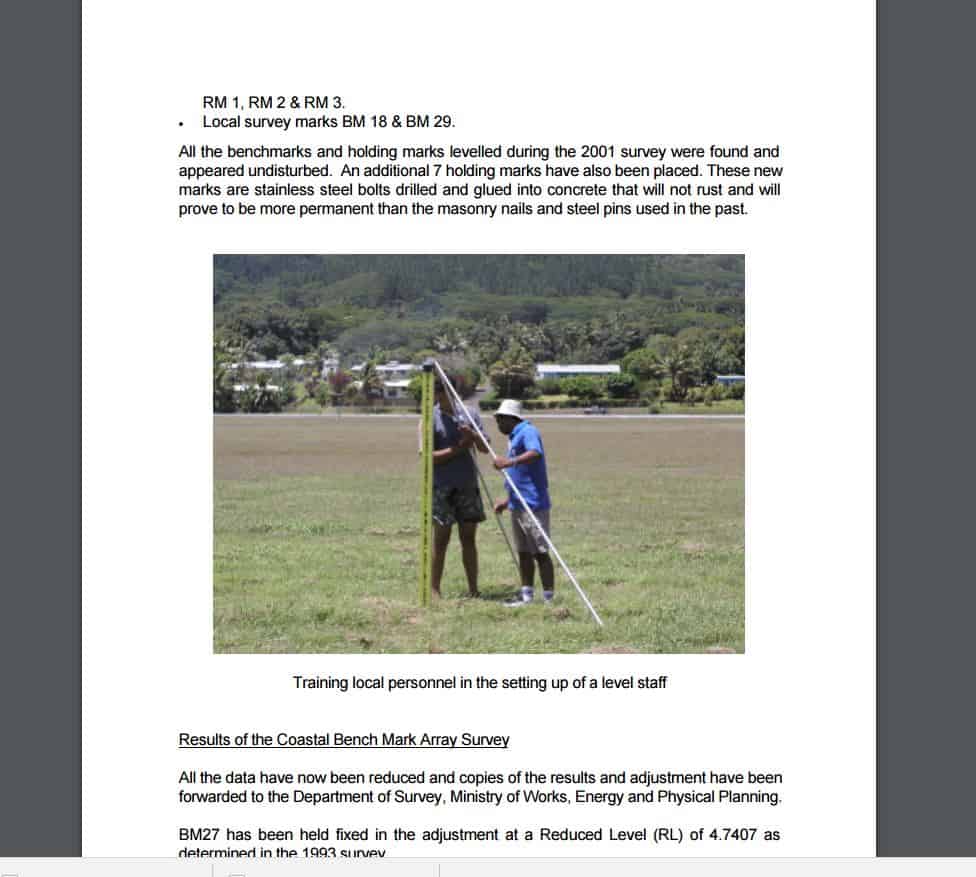
I saw a similar scene below here in Fiji from the sea level rise monitoring in the southwest Pacific. From memory the guy I saw was probably Australian and from internet research was doing a maybe 2km loop as part of the process of checking whether the sea is rising or the land at the gauge is dropping. I saw him on two consecutive days, and I think he'd advanced maybe 500m. Serious stuff.

For first order and second order class I the rods also have to be calibrated at a lab (not manufacturer), and temperature profiles (high and low thermistors on the tripod) need to be measured and recorded for each shot. Yes, I get good closures with fiberglass, but I would never say that is actual first or second order work.
And if you are NOT balanced on each setup, forget it. That is one of the most basic requirements for geodetic leveling. It is absolutely possible to balance sight lengths going up and down hill. This conversation is exactly the reason I made the statement that I have heard surveyors say that leveling is easy, nothing to it. The Finnish Geodetic Institute, among others, has done a lot of research into temperature profiles, etc, and have published a number of papers.
I will admit that for small leveling projects (10-20 km), the temperature profiles probably don't matter much. But for large projects, it minimizes a systematic error. If you don't do the profiles, then it is second order class II. Also, if your invar rods have not been calibrated (SLAC is one place), then it is second order class II according to the specs.
The longest bluebooked line I did was 130 miles, and that was in the days before digital levels. Along the line we found a bust in the NGS 1980's Basic Net A releveling, of course they were skeptical, they sent a crew out to check where we found the bust, and they confirmed it. The bust was due to them using a spacer on a BM one day, and then not using it the next day when they came of of the BM. Another long section where they had no BM's (about 40 miles) we had to run 3 times because it did not check the end BM's (they took a different, longer route), but our three running agreed well, so there may have been another bust in their route.
As for weight: What does weigh a lot are the struts. I am in my late 50's, and not a large person, I can still handle the rod with struts (and the turning plate, and turning pin with small sledge), but I will admit it gets tiring after a full day of doing it. But using the struts is a big help, especially if it is at all windy. We do second order leveling every year at a project on Lake Erie, there is often a constant wind. Even with struts you have to keep an eye on the rod, it can still blow over. But much easier than trying to keep it vertical without them. And the level tripod with thermistors attached weighs quite a bit as well

My issue is that physical benchmarks are disappearing very quickly, and there is no effort to put them back.

Joe the Surveyor, post: 419820, member: 118 wrote: My issue is that physical benchmarks are disappearing very quickly, and there is no effort to put them back.
No intent to bring them back.
Paul in PA
I should add that SLAC has done a lot of research on digital levels, and have published a number of papers. And, they will calibrate invar rods for no charge.
One final thought...saying your level run is first or second order without following specs is like saying your loop traverse around a block with a topcon total station is first order just because it closed 0.01 feet.
Joe the Surveyor, post: 419820, member: 118 wrote: My issue is that physical benchmarks are disappearing very quickly, and there is no effort to put them back.
Not only that, but they MOVE. I reluctantly use concrete post type BM's only if nothing else is available and if they do not appear to have heaved or subsided, but they need to be verified.
One of our yearly subsidence surveys uses steel rods driven to 100' depth, and there is one small area that subsides at a relatively constant rate, a few mm's a year. That is due to mining 2000' down, so even the most stable marks can move. And these particular marks move as a group (about 500' radius area, with 4 bm's).
Just ask someone in coastal louisiana. That is an area where you can't trust any ground marks, the only way to get "real" elevations is to use GPS off of CORS

To comply with the NGS bench mark reset procedures, which are third order, the leveling rods MUST be one piece. By default, this means invar. The NGS BM reset document does not specifically state the 1 piece rod requirement, but references the FGCS specifications for digital bar code leveling, which does. As several have already clearly and correctly stated, meeting the spec (order) is more than a closure number/run distance calculation.

John Hamilton, post: 419827, member: 640 wrote: Just ask someone in coastal louisiana. That is an area where you can't trust any ground marks, the only way to get "real" elevations is to use GPS off of CORS
LSU Center for GeoInformatics has told me the average subsidence rate in south Louisiana is 10mm per year, with much higher values in the coastal areas such as New Orleans.
The USGS has a website dedicated to the California Central Valley drought indicators, which includes historical and recent subsidence data. John Putnam mentioned the High Speed Rail. There are areas along that alignment that subsided over 2 feet in a 24 month period between 2008-2010 and that was BEFORE the drought started.
https://ca.water.usgs.gov/land_subsidence/central-valley-subsidence-data.html

Perhaps a more specific reference is: https://water.usgs.gov/ogw/pubs/fs00165/
It includes the famous image of Dr Pollard in the San Joaquin valley in California, the site of maximum subsidence in the US. The linked document also shows other less well-known areas undergoing subsidence due to withdrawal from aquifers. Other geophysical processes are also implicated. Do a search for articles on subsidence by the late Dr. Roy Dokka of LSU.
As for the the general issues raised by this thread, the monumented network of benchmarks in the US is not verified as it is not maintained It will NOT be re-leveled. The physical monuments, as noted, are subject to all manner of processes both natural and man made.
As for the specifications in the US, they provide guidance on how one meets a standard. As noted the specifications detail a wide range of procedures and equipment characteristics. As Mr Hamilton stated, leveling is simple until you try to do it rigorously.
When we talk of geodetic leveling I always recollect the statement in "Physical Geodesy" by Heiskanen and Mortiz who state that: "Leveling without gravity measurements, although applied in practice, is meaningless from a rigorous point of view, for the use of leveled heights as such leads to contradictions..."
The issue of inappropriate accuracy demands (the example posited of a bathy survey requiring a first-order tie) is the result of uninformed contract specification writers.
I always hated involvement on large leveling projects. It was dull, repetitive work that required careful attention to detail. I was lucky to move to more interesting tasks.
The move to GNSS-derived ellipsoid heights plus a high-resolution geoid model is the proper path. If you want to see the monumented network re-leveled and monitored, who is going to pay for it? The scale of the job is beyond the resources of national agencies. The cost would be enormous.
Cheers,
DMM

In Illinois they actually updated benchmarks with level runs across the entire state. Of course this was done at the state level not the federal level.
David Livingstone, post: 419894, member: 431 wrote: In Illinois they actually updated benchmarks with level runs across the entire state. Of course this was done at the state level not the federal level.
Glad to hear of this effort. Any idea of the level of accuracy achieved? Did Illinois get a replacement for Dr. Pearson?
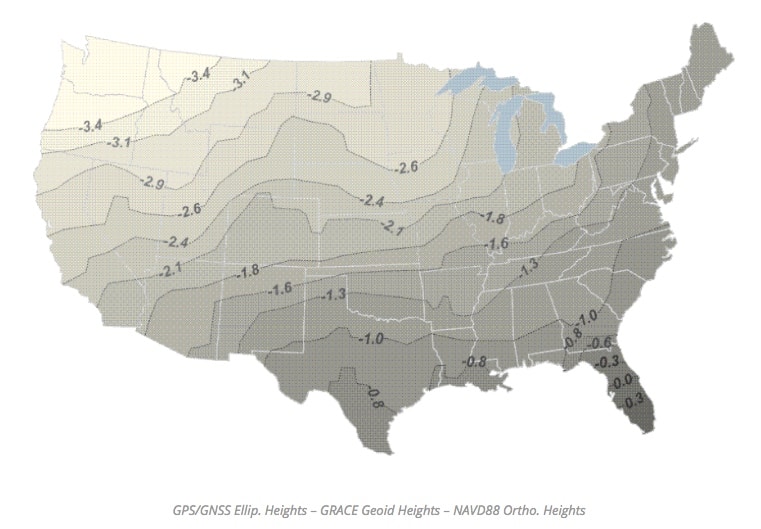
My interest is more on the CONUS-scale issues discussed in articles like this: http://www.spar3d.com/blogs/from-scratch/replacement-north-american-vertical-datum/
Note the systematic tilt in the following image:
John Hamilton, post: 419826, member: 640 wrote: I should add that SLAC has done a lot of research on digital levels, and have published a number of papers. And, they will calibrate invar rods for no charge.
Just don't expect to have them calibrated quickly. I'm not complaining, mind -- the price is unbeatable -- but SLAC has to fit calibration requests into its schedule, and it can take quite awhile to get your rod(s) and level back. They had my gear for about a month when I had it done.
They did ours pretty quickly-but shipping is a problem. Too long for UPS/Fedex. Had to go common carrier.
I assume, and am pretty sure it was all first order stuff. They came through our town but I never saw them. I think the marks are published on the NGS site. They did get a replacement for Chris Pearson as the NGS advisor. He covers several states though. He talked at the recent Illinois surveyors conference and seemed pretty sharp but I don't remember his name. Maybe John Ellingson?
Yes, John is the regional advisor that includes Illinois.
https://geodesy.noaa.gov/ADVISORS/
I think most of the leveling there was a part of their ongoing height modernization efforts and I believe much of the funding initiated with the Feds.
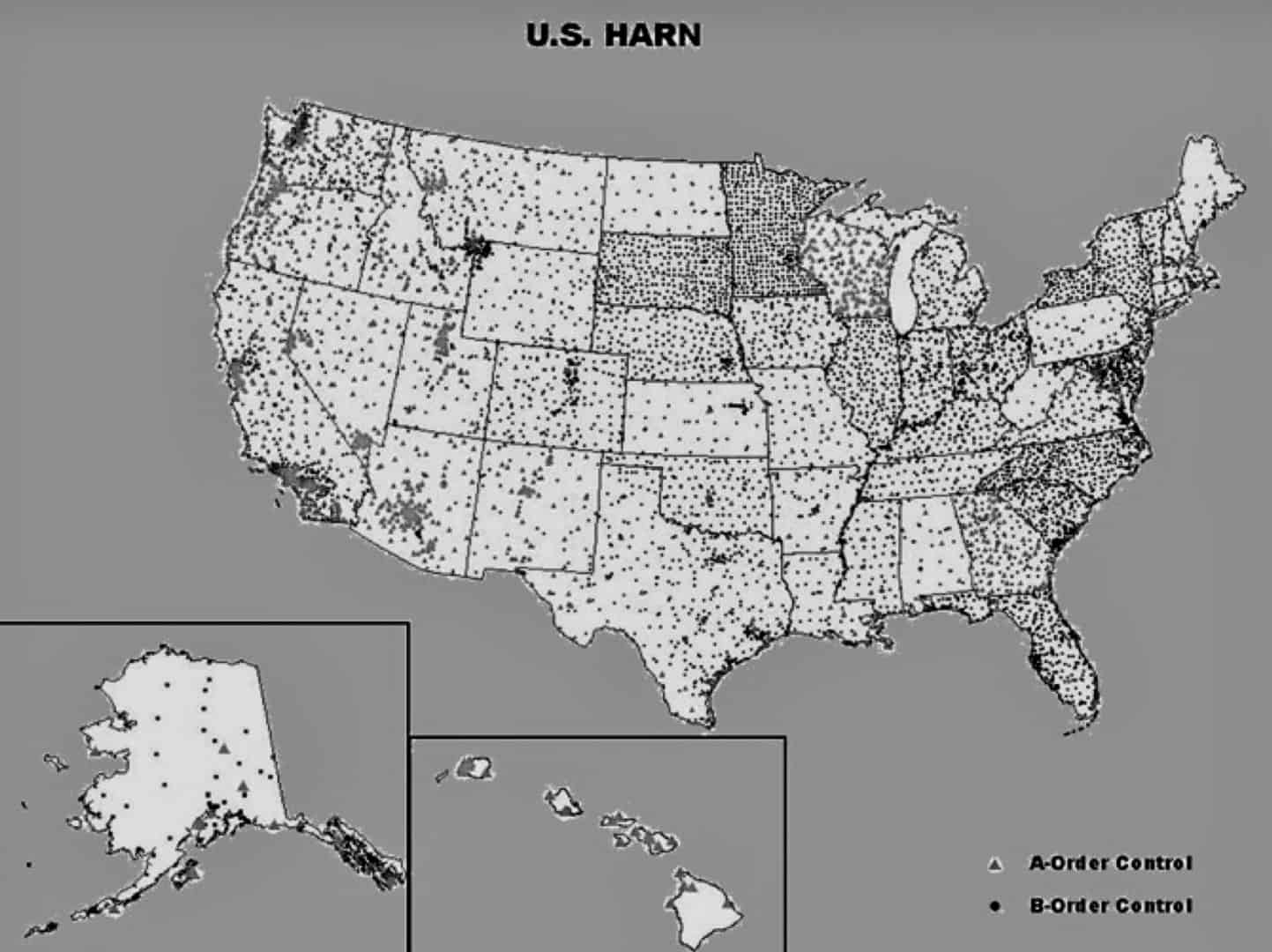
Glad to hear that Illinois has seized the initiative. Unfortunately most states will not. Looking at this map of the highest horizontal accuracy ground monuments in the US shows great variation in the interest and capability of states when it comes to their geodetic infrastructure. Vertical control is even harder to get done.
Dr Pearson must have found Illinois not challenging enough ; ) If you are interested in some of his post-Illinois activities, here are some links. The first is a summary of his efforts to assist Nepal in dealing with changes to their infrastructure due to the earthquake; the second is his blog on his travels to Nepal.
Octagon on the South Island is a lovely place. Overall NZ is well worth a visit. Dunedin reminds me a lot of Scotland. Gets pretty cold and damp and windy.
https://www.odt.co.nz/news/dunedin/nepalese-project-deemed-success
http://www.otago.ac.nz/surveying/news/archives/otago123048.html
Small world, we have a new employee that is from Nepal. She is 29 years old and her husband teaches at the local university. She told me the story on how she survived the earthquake. She got out of her house seconds before it collapased.
Vertical benchmarks were getting pretty scarce in Illinois and there were and still are some huge holes out there. I thought the DOT was the driving force for the height modernazation in Illinois but I'm not sure. Some of them also have good horizontal coordinates on them but most don't.