Reading RPLS is free for the whole profession. Members post, reply, and get the members-only rooms.


Notifications
Clear all

Topic starter
Translate
▼
English
Spanish
French
German
Italian
Portuguese
Russian
Chinese
Japanese
Korean
Arabic
Hindi
Dutch
Polish
Turkish
Vietnamese
Thai
Swedish
Danish
Finnish
Norwegian
Czech
Hungarian
Romanian
Greek
Hebrew
Indonesian
Malay
Ukrainian
Bulgarian
Croatian
Slovak
Slovenian
Serbian
Lithuanian
Latvian
Estonian
As I continue the (seemingly never ending) quest for precision within my control network, I contemplate the following:
At sea, I used to determine a line of position perpendicular to a celestial object. There was no "azimuth determination" as there is on land, because there's no azimuth reference to go by...only vertical reference (the horizon). Choose three objects around the horizon somewhat contemporaneously (remember, you're moving while doing this), and you know where you are.
Early surveyors used astro with great precision to determine azimuth, but I find no reference to anyone ever using it as it has been used at sea.
It's understood that the typical sextant has graduations of minutes, with interpolation to tens of seconds possible; today's total stations can do much better than that. Plus, with dual compensation, and D&R sets, you'd have your "horizon". No "dip" to worry about either. I don't know whether ephemerides have improved over time, but they're certainly easier to use. And on land, you're not moving and can take advantage of multiple observations of the same and different objects, and adjust them in Star*net.
So, what's the problem with determining location using this technique? I've spent a good deal of time looking at the "great spherical triangle" involved, and can't come up with a reason. There must be some fundamental reason (based in astrophysics), why this is not possible to do.
Posted : May 30, 2016 6:24 pm

Translate
▼
English
Spanish
French
German
Italian
Portuguese
Russian
Chinese
Japanese
Korean
Arabic
Hindi
Dutch
Polish
Turkish
Vietnamese
Thai
Swedish
Danish
Finnish
Norwegian
Czech
Hungarian
Romanian
Greek
Hebrew
Indonesian
Malay
Ukrainian
Bulgarian
Croatian
Slovak
Slovenian
Serbian
Lithuanian
Latvian
Estonian
Look for;
US Coast & Geodetic Survey Special Publication No. 14
"Determination of Time, Longitude, Latitude, and Azimuth"
By William Bowie
I have the Fifth Edition (1917), so I'm sure there are other editions out there.
Loyal
Posted : May 30, 2016 7:19 pm

Translate
▼
English
Spanish
French
German
Italian
Portuguese
Russian
Chinese
Japanese
Korean
Arabic
Hindi
Dutch
Polish
Turkish
Vietnamese
Thai
Swedish
Danish
Finnish
Norwegian
Czech
Hungarian
Romanian
Greek
Hebrew
Indonesian
Malay
Ukrainian
Bulgarian
Croatian
Slovak
Slovenian
Serbian
Lithuanian
Latvian
Estonian
Not sure about celestial navigation, but astro-geodetic methods were fairly common decades ago, e.g.:
https://www.fig.net/resources/proceedings/fig_proceedings/fig2006/papers/ps05_06/ps05_06_05_yilmaz_karaali_0554.pdf
These methods are just not practical anymore, esp. compared to satellite geodesy.
It's still good for attitude (orientation) determination, e.g., star trackers and the zenith camera.
-FGN.
Posted : May 30, 2016 7:21 pm

Translate
▼
English
Spanish
French
German
Italian
Portuguese
Russian
Chinese
Japanese
Korean
Arabic
Hindi
Dutch
Polish
Turkish
Vietnamese
Thai
Swedish
Danish
Finnish
Norwegian
Czech
Hungarian
Romanian
Greek
Hebrew
Indonesian
Malay
Ukrainian
Bulgarian
Croatian
Slovak
Slovenian
Serbian
Lithuanian
Latvian
Estonian
Don't understand your point. The determination of latitude, longitude and azimuth via terrestrial observations to astronomical bodies has been done for centuries. That's what Mason and Dixon did.
Organizations like the US NGS, formerly the USC&GS had Astro parties through the 1970s perhaps later. There is a thorough treatment of how to do the observations and reduce them in the aptly named "Manual of Geodetic Astronomy" aka USC&GS Special Publication 237. This SP was published in 1947. Available here: http://docs.lib.noaa.gov/rescue/cgs_specpubs/
The requirement to use specialized equipment to obtain high precision and the expertise needed to make the observations most likely prevent the average surveyor from trying to do it. I do recollect seeing a Wild T-4 for sale on eBay recently. Not to say you cannot try making the observations with an ordinary optical instrument.
Given the time and effort required to determine these quantities, most surveyors tried to find triangulation or traverse stations with published values. Or used assumed coordinates.
I recollect one of my first involvements with GPS decades ago came about while working in the boonies of Wyoming. We found a number of federal non-NGS stations which were not internally consistent. The boss decided a GPS tie from a site a few hundred miles away was the solution. It was. The days of weeks-long triangulation or traverse became a thing of the past. Regrettably, I no longer had the opportunity to hike and climb to remote triangulation stations with beautiful views.
Posted : May 30, 2016 7:37 pm

Translate
▼
English
Spanish
French
German
Italian
Portuguese
Russian
Chinese
Japanese
Korean
Arabic
Hindi
Dutch
Polish
Turkish
Vietnamese
Thai
Swedish
Danish
Finnish
Norwegian
Czech
Hungarian
Romanian
Greek
Hebrew
Indonesian
Malay
Ukrainian
Bulgarian
Croatian
Slovak
Slovenian
Serbian
Lithuanian
Latvian
Estonian
Using Astro azimuths from stars in all quadrants, it becomes a resection problem.
Or, Astro latitude by observing the altitude of a star/sun at meridian transit. And longitude by the time of a star/sun's meridian transit. Which requires a striding level for the trunnion.
Longitude by UTC time of LAN works (local apparent noon) striding level too.
You can use LOPs too. That still works. You can get to a couple of hundred meters, or better.
But accuracy by today's standard, with anything short of a T3 or T4, wouldn't be as good as a google earth mouse pick.
Traverse from Gulf Stream to your site. Nothing wrong with that. We used to run 30-50 mile traverses, SOP.
Posted : May 30, 2016 7:47 pm
Translate
▼
English
Spanish
French
German
Italian
Portuguese
Russian
Chinese
Japanese
Korean
Arabic
Hindi
Dutch
Polish
Turkish
Vietnamese
Thai
Swedish
Danish
Finnish
Norwegian
Czech
Hungarian
Romanian
Greek
Hebrew
Indonesian
Malay
Ukrainian
Bulgarian
Croatian
Slovak
Slovenian
Serbian
Lithuanian
Latvian
Estonian
NGS Astro Party 1970s... Showing Wild T4 note the stand, observing stools and platform to isolate instrument from observer movement.
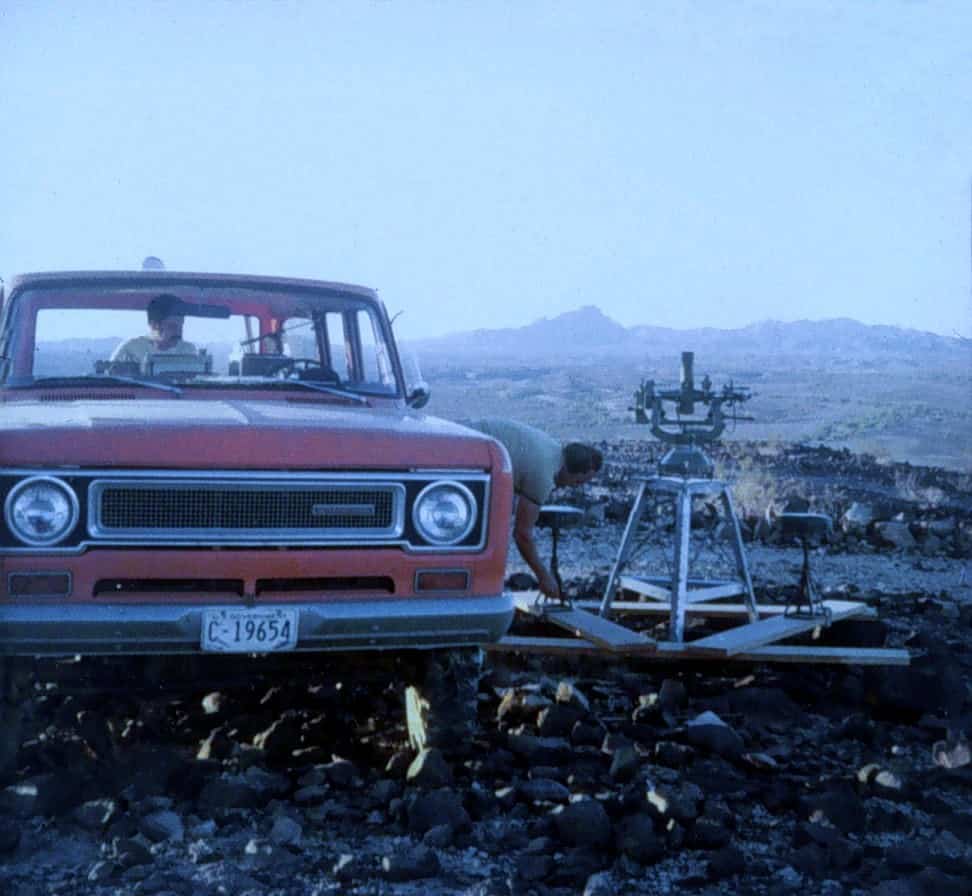
Posted : May 30, 2016 8:06 pm

Translate
▼
English
Spanish
French
German
Italian
Portuguese
Russian
Chinese
Japanese
Korean
Arabic
Hindi
Dutch
Polish
Turkish
Vietnamese
Thai
Swedish
Danish
Finnish
Norwegian
Czech
Hungarian
Romanian
Greek
Hebrew
Indonesian
Malay
Ukrainian
Bulgarian
Croatian
Slovak
Slovenian
Serbian
Lithuanian
Latvian
Estonian
With a one second instrument and a lot of work you can get close to the accuracy of a recreational gps.
One second of latitude is about a hundred feet so you would need a bunch of redundant observations. Then refraction is on the order of a minute so you have to balance your sights in various directions to cancel it as well as possible. Deflection of the vertical (geoid undulation) can be several seconds which needs to be known to convert astro to geodetic.
Mason and Dixon did weeks of astro work to check their latitude and were probably within 200 ft of the desired astro latitude. A better instrument miht have made it less work but wouldn' have greatly improved the results. Deflection of the vertical was a new idea they helped explore but could not correct for on the famous line, so it wanders up to 900 ft from a geodetic latitude.
Longitude of course requires some form of accurat time reference as well as dealing with the other issues.
Posted : May 30, 2016 8:10 pm
Translate
▼
English
Spanish
French
German
Italian
Portuguese
Russian
Chinese
Japanese
Korean
Arabic
Hindi
Dutch
Polish
Turkish
Vietnamese
Thai
Swedish
Danish
Finnish
Norwegian
Czech
Hungarian
Romanian
Greek
Hebrew
Indonesian
Malay
Ukrainian
Bulgarian
Croatian
Slovak
Slovenian
Serbian
Lithuanian
Latvian
Estonian
WOW, a cornbinder!
We had those at the USFS (GSA vehicles) back in the day too.
Loyal
Posted : May 30, 2016 8:11 pm
Translate
▼
English
Spanish
French
German
Italian
Portuguese
Russian
Chinese
Japanese
Korean
Arabic
Hindi
Dutch
Polish
Turkish
Vietnamese
Thai
Swedish
Danish
Finnish
Norwegian
Czech
Hungarian
Romanian
Greek
Hebrew
Indonesian
Malay
Ukrainian
Bulgarian
Croatian
Slovak
Slovenian
Serbian
Lithuanian
Latvian
Estonian
In my favorite 1925 Brit survey text is described longitude by star transit and UT time transfer by telegraph. You have an app for that.
Posted : May 30, 2016 8:55 pm
Translate
▼
English
Spanish
French
German
Italian
Portuguese
Russian
Chinese
Japanese
Korean
Arabic
Hindi
Dutch
Polish
Turkish
Vietnamese
Thai
Swedish
Danish
Finnish
Norwegian
Czech
Hungarian
Romanian
Greek
Hebrew
Indonesian
Malay
Ukrainian
Bulgarian
Croatian
Slovak
Slovenian
Serbian
Lithuanian
Latvian
Estonian
Your mention of zenith cameras brought to mind the Digital Astronomical Deflection Measuring (DIADEM) system used in the US NGS Geoid Slope Validation Surveys (in Texas and Iowa). This system is based on earlier systems but incorporates digital photography techniques using a CCD camera. Accuracy is < 0.2 arc seconds!
It is used to directly measure deflection of the vertical. It does so by observing imaging stars and computing astronomical latitude and longitude using star catalogs. It combines these positions with GPS-derived ellipsoidal coordinates. I am making it sound too easy.
Check out a PhD dissertation including a lot of nice details about the system as well as related issues like the ICRF, ITRF, time systems, star catalogs, etc is available here: http://e-collection.library.ethz.ch/eserv/eth:31025/eth-31025-02.pdf
The author studied at ETH Zurich.
While the dissertation is +200 pages, much of the text describes projects on which it was used. I found it clearly written with only a few language glitches (a problem with even native-English authors).
BTW, the NGS borrowed this equipment. It does not have its own.
Posted : May 30, 2016 10:38 pm
Translate
▼
English
Spanish
French
German
Italian
Portuguese
Russian
Chinese
Japanese
Korean
Arabic
Hindi
Dutch
Polish
Turkish
Vietnamese
Thai
Swedish
Danish
Finnish
Norwegian
Czech
Hungarian
Romanian
Greek
Hebrew
Indonesian
Malay
Ukrainian
Bulgarian
Croatian
Slovak
Slovenian
Serbian
Lithuanian
Latvian
Estonian
On a more whimsical note, but related to gravity, see this little video about a road in Ireland where cars roll up hill.
http://www.bbc.com/autos/story/20160530-andrew-mccarthy-goes-in-search-of-irelands-magic-road
Cheers,
DMM
Posted : May 30, 2016 11:00 pm

Translate
▼
English
Spanish
French
German
Italian
Portuguese
Russian
Chinese
Japanese
Korean
Arabic
Hindi
Dutch
Polish
Turkish
Vietnamese
Thai
Swedish
Danish
Finnish
Norwegian
Czech
Hungarian
Romanian
Greek
Hebrew
Indonesian
Malay
Ukrainian
Bulgarian
Croatian
Slovak
Slovenian
Serbian
Lithuanian
Latvian
Estonian
Peder Horrebow and Andrew Talcott (in a secondary way) were involved in determination of latitude and longitude by astronomic measurements
Posted : May 31, 2016 2:30 am

Translate
▼
English
Spanish
French
German
Italian
Portuguese
Russian
Chinese
Japanese
Korean
Arabic
Hindi
Dutch
Polish
Turkish
Vietnamese
Thai
Swedish
Danish
Finnish
Norwegian
Czech
Hungarian
Romanian
Greek
Hebrew
Indonesian
Malay
Ukrainian
Bulgarian
Croatian
Slovak
Slovenian
Serbian
Lithuanian
Latvian
Estonian
This was often done to provide an origin for a geodetic datum in remote locations, such as an island. In fact, the coordinate used at MEADES RANCH as the origin for NAD was an astronomic position. Then additional astronomic observations were made at selected stations in the triangulation network (laplace stations) to control "swing" (azimuth drift).
The key point is that this provides astronomic coordinates, which can be as much as 60" (in extreme cases) different than geodetic positions. And, at the very best they are accurate to å±0.2" of arc, so about 20 feet. Unless one has a zenith camera as mentioned by GeeOddMike, the observations were long and the computations very tedious. An inexpensive WAAS capable GPS handheld will get much better than that in a few seconds.
HOWEVER, these observations are still useful for determining the slope of the geoid (as was done in the NGS Geoid Slope Validation Surveys). I would imagine that the capability of performing accurate astronomic observations with, say, a T4, is becoming a lost art.
Posted : May 31, 2016 5:57 am
Topic starter
Translate
▼
English
Spanish
French
German
Italian
Portuguese
Russian
Chinese
Japanese
Korean
Arabic
Hindi
Dutch
Polish
Turkish
Vietnamese
Thai
Swedish
Danish
Finnish
Norwegian
Czech
Hungarian
Romanian
Greek
Hebrew
Indonesian
Malay
Ukrainian
Bulgarian
Croatian
Slovak
Slovenian
Serbian
Lithuanian
Latvian
Estonian
Wow. Guess I have my homework cut out for me.:stakeout:
Thanks!
Posted : May 31, 2016 6:01 am
Translate
▼
English
Spanish
French
German
Italian
Portuguese
Russian
Chinese
Japanese
Korean
Arabic
Hindi
Dutch
Polish
Turkish
Vietnamese
Thai
Swedish
Danish
Finnish
Norwegian
Czech
Hungarian
Romanian
Greek
Hebrew
Indonesian
Malay
Ukrainian
Bulgarian
Croatian
Slovak
Slovenian
Serbian
Lithuanian
Latvian
Estonian
Most hand held GPS have an averaging mode. My Garmin and antique Trimble do. You can accumulate days of averaging. The catch is the UTM output is a meter. I've set them on NGS marks for 8 hrs even with SA turned on. Does a good job, for a reliable meter. Astro for a meter is very high order, nights and nights of work.
Try an LOP.
Posted : May 31, 2016 6:58 am
Translate
▼
English
Spanish
French
German
Italian
Portuguese
Russian
Chinese
Japanese
Korean
Arabic
Hindi
Dutch
Polish
Turkish
Vietnamese
Thai
Swedish
Danish
Finnish
Norwegian
Czech
Hungarian
Romanian
Greek
Hebrew
Indonesian
Malay
Ukrainian
Bulgarian
Croatian
Slovak
Slovenian
Serbian
Lithuanian
Latvian
Estonian
There are currently two Wild T4 instruments for sale on eBay. Prices in US dollars are $28.5K and $38.5K. Neither include the tripod. Shipping costs vary from $250-450 (economy) without accounting for customs charges, etc.
Looking at my checkbook and the remaining space in my garage, I'll not be bidding. I recollect that at least one of them has been offered before.
Posted : May 31, 2016 8:15 am
Topic starter
Translate
▼
English
Spanish
French
German
Italian
Portuguese
Russian
Chinese
Japanese
Korean
Arabic
Hindi
Dutch
Polish
Turkish
Vietnamese
Thai
Swedish
Danish
Finnish
Norwegian
Czech
Hungarian
Romanian
Greek
Hebrew
Indonesian
Malay
Ukrainian
Bulgarian
Croatian
Slovak
Slovenian
Serbian
Lithuanian
Latvian
Estonian
Larry Scott, post: 374741, member: 8766 wrote:
Astro for a meter is very high order, nights and nights of work.
Try an LOP.
Uhh....I think I'm good. I've got a list of things to do/learn a mile long. I'll never get to them if I try this.
Plus, if I had the budget for a T4, I'd probably buy two or three of those Javads!
Instead, I'll spend the time reading about it and wait for someone to lend me an old L1 system I can park on my main control point for a week. 😉
Posted : May 31, 2016 8:25 am