Reading RPLS is free for the whole profession. Members post, reply, and get the members-only rooms.


Notifications
Clear all
GNSS & Geodesy
14
Posts
6
Users
0
Reactions
2,016
Views

Topic starter
Translate
▼
English
Spanish
French
German
Italian
Portuguese
Russian
Chinese
Japanese
Korean
Arabic
Hindi
Dutch
Polish
Turkish
Vietnamese
Thai
Swedish
Danish
Finnish
Norwegian
Czech
Hungarian
Romanian
Greek
Hebrew
Indonesian
Malay
Ukrainian
Bulgarian
Croatian
Slovak
Slovenian
Serbian
Lithuanian
Latvian
Estonian
Hey geodetic-heads, one of my favorite things to do is to come on here and show my ignorance, so here we go again. I was reviewing a PowerPoint done via a webinar by Dave Doyle (one of my favorite people btw) and am confused about a formula depicting the ÛÏrightÛ way to reduce a State Plane distance to ground (or ground to SP). The slide is below. The reduction formula for ÛÏRÛ which he calls the radius of the earth, but I am pretty sure he is talking about the Radius of the ellipsoid @ your particular latitude. He gives N/(1-eÛªå?coså?(latitude)coså?(alpha)) alpha is the azimuth of the line. My question is ÛÏam I reading this wrong, or what does the azimuth of the line you are reducing have to do with the radius of the earth (or ellipsoid)?Û What if I want to just calculate the Radius of the Earth @ a particular Lat/Long?
What's that saying? "Better to remain silent and be thought a fool than to speak out and remove all doubt." Often attributed to Abraham Lincoln
Posted : May 31, 2016 1:17 pm

Translate
▼
English
Spanish
French
German
Italian
Portuguese
Russian
Chinese
Japanese
Korean
Arabic
Hindi
Dutch
Polish
Turkish
Vietnamese
Thai
Swedish
Danish
Finnish
Norwegian
Czech
Hungarian
Romanian
Greek
Hebrew
Indonesian
Malay
Ukrainian
Bulgarian
Croatian
Slovak
Slovenian
Serbian
Lithuanian
Latvian
Estonian
On an ellipsoid the azimuth of the line is to calculate the geodesic.
However, an average value can used for practical distance reduction to grid, like a couple of thousand feet. In North America 20,906,000 ft. is common and sufficient.
But: Everything Vermont:
http://www.ngs.noaa.gov/web/science_edu/presentations_archive/files/vt_state_plane.ppt
Posted : May 31, 2016 1:27 pm
Topic starter
Translate
▼
English
Spanish
French
German
Italian
Portuguese
Russian
Chinese
Japanese
Korean
Arabic
Hindi
Dutch
Polish
Turkish
Vietnamese
Thai
Swedish
Danish
Finnish
Norwegian
Czech
Hungarian
Romanian
Greek
Hebrew
Indonesian
Malay
Ukrainian
Bulgarian
Croatian
Slovak
Slovenian
Serbian
Lithuanian
Latvian
Estonian
Thank you Mr. Scott.....so it sounds like the project area is generally a NW/SE direction I might use 315å¡ or 135å¡? What if I plug 90å¡ in there? that would make the numerator be "1-0"...?
Yes...I always have used 20,906,000....however our Trimble TBO software uses something else. I was going check it against whatever they use. Also, I just kind of wanted to understand the formulae.
Thanks for the powerpoint. I'll look @ that.
Posted : May 31, 2016 2:00 pm

Translate
▼
English
Spanish
French
German
Italian
Portuguese
Russian
Chinese
Japanese
Korean
Arabic
Hindi
Dutch
Polish
Turkish
Vietnamese
Thai
Swedish
Danish
Finnish
Norwegian
Czech
Hungarian
Romanian
Greek
Hebrew
Indonesian
Malay
Ukrainian
Bulgarian
Croatian
Slovak
Slovenian
Serbian
Lithuanian
Latvian
Estonian
Because the ellipsoid is not a sphere (for our purposes) the radius varies with azimuth and latitude. In fact it differs even on the reverse azimuth by a few meters.
To complicate matters the slide actually has nothing to do with state plane... yet.
Ground distance to ellipsoid distance to state plane distance.
Posted : May 31, 2016 2:02 pm
Translate
▼
English
Spanish
French
German
Italian
Portuguese
Russian
Chinese
Japanese
Korean
Arabic
Hindi
Dutch
Polish
Turkish
Vietnamese
Thai
Swedish
Danish
Finnish
Norwegian
Czech
Hungarian
Romanian
Greek
Hebrew
Indonesian
Malay
Ukrainian
Bulgarian
Croatian
Slovak
Slovenian
Serbian
Lithuanian
Latvian
Estonian
The azimuth will not make a numerator of 1 or 0. A geodesic is the true ellipsoidal distance, and orientation of the line is part of that calculation. But for a project area an average radius will work, unless your shooting miles. Just as important is geoid height. The NGS ppt has a good cross section view of grid reduction.
Posted : May 31, 2016 2:11 pm

Translate
▼
English
Spanish
French
German
Italian
Portuguese
Russian
Chinese
Japanese
Korean
Arabic
Hindi
Dutch
Polish
Turkish
Vietnamese
Thai
Swedish
Danish
Finnish
Norwegian
Czech
Hungarian
Romanian
Greek
Hebrew
Indonesian
Malay
Ukrainian
Bulgarian
Croatian
Slovak
Slovenian
Serbian
Lithuanian
Latvian
Estonian
Normally we use the azimuth-independent Gaussian radius of curvature:
https://en.wikipedia.org/wiki/Earth_radius#Gaussian
If you need an azimuth-dependent value, then use Euler's formula:
https://en.wikipedia.org/wiki/Earth_radius#Directional
-FGN.
Posted : May 31, 2016 2:17 pm
Topic starter
Translate
▼
English
Spanish
French
German
Italian
Portuguese
Russian
Chinese
Japanese
Korean
Arabic
Hindi
Dutch
Polish
Turkish
Vietnamese
Thai
Swedish
Danish
Finnish
Norwegian
Czech
Hungarian
Romanian
Greek
Hebrew
Indonesian
Malay
Ukrainian
Bulgarian
Croatian
Slovak
Slovenian
Serbian
Lithuanian
Latvian
Estonian
Scott Zelenak, post: 374817, member: 327 wrote: Because the ellipsoid is not a sphere (for our purposes) the radius varies with azimuth and latitude. In fact it differs even on the reverse azimuth by a few meters.
To complicate matters the slide actually has nothing to do with state plane... yet.
Ground distance to ellipsoid distance to state plane distance.
I'm getting that the radius varies with the latitude....not quite reconciling what it has to do with the "azimuth". If I have a line between two points, I'm not sure what the azimuth of that line has to do with the radius of the ellipsoid. Or is there some other "azimuth" they are referring to? I have a project @ latitude 38å¡51' 36"......Can't I figure a radius @ that latitude? Wouldn't it be the same Radius whether I was sighting to the east or the north to another point? Maybe I don't understand what "azimuth" is in this context.
Posted : May 31, 2016 2:19 pm
Translate
▼
English
Spanish
French
German
Italian
Portuguese
Russian
Chinese
Japanese
Korean
Arabic
Hindi
Dutch
Polish
Turkish
Vietnamese
Thai
Swedish
Danish
Finnish
Norwegian
Czech
Hungarian
Romanian
Greek
Hebrew
Indonesian
Malay
Ukrainian
Bulgarian
Croatian
Slovak
Slovenian
Serbian
Lithuanian
Latvian
Estonian
Tom Adams, post: 374824, member: 7285 wrote: I'm getting that the radius varies with the latitude....not quite reconciling what it has to do with the "azimuth". If I have a line between two points, I'm not sure what the azimuth of that line has to do with the radius of the ellipsoid. Or is there some other "azimuth" they are referring to? I have a project @ latitude 38å¡51' 36"......Can't I figure a radius @ that latitude? Wouldn't it be the same Radius whether I was sighting to the east or the north to another point? Maybe I don't understand what "azimuth" is in this context.
There are two principal radii of curvature, along the north-south (meridional) and east-west (prime-vertical) directions:
https://en.wikipedia.org/wiki/Earth_radius#Principal_sections
Euler's fomula interpolates between those two values for arbitrary azimuths.
-FGN.
Posted : May 31, 2016 2:28 pm

Translate
▼
English
Spanish
French
German
Italian
Portuguese
Russian
Chinese
Japanese
Korean
Arabic
Hindi
Dutch
Polish
Turkish
Vietnamese
Thai
Swedish
Danish
Finnish
Norwegian
Czech
Hungarian
Romanian
Greek
Hebrew
Indonesian
Malay
Ukrainian
Bulgarian
Croatian
Slovak
Slovenian
Serbian
Lithuanian
Latvian
Estonian
While the rigorous way to do it would be to use the azimuth of the line, for normal work it makes little difference. A much more critical error is when people use height above MSL or NAVD88 or NGVD29 or whatever rather than height above ellipsoid. An error in that value (which is added to the radius) makes a difference of about 1 ppm per 30 feet.
Posted : May 31, 2016 2:29 pm

Translate
▼
English
Spanish
French
German
Italian
Portuguese
Russian
Chinese
Japanese
Korean
Arabic
Hindi
Dutch
Polish
Turkish
Vietnamese
Thai
Swedish
Danish
Finnish
Norwegian
Czech
Hungarian
Romanian
Greek
Hebrew
Indonesian
Malay
Ukrainian
Bulgarian
Croatian
Slovak
Slovenian
Serbian
Lithuanian
Latvian
Estonian
Conceptualization:
One way to visualize the problem is to imagine yourself standing on the ellipsoid equator. If you were looking east or west, the radius would be that of the equatorial circle. Looking north or south, the radius would be much shorter; the radius of curvature of the ellipse determined at the extreme of the semi-major diameter. As you would change your orientation, that is the observation azimuth, from east-west to north-south, the radius of curvature would have to transition from that of the equatorial circle to that of the ellipse radius of curvature at the extreme of the semi-major diameter. Any where you might locate yourself on the ellipsoid, similar conditions would apply.
Note that the radius of curvature at the extreme of the semi-major diameter for an ellipse is NOT the same as that of the semi-major diameter. Respectively, this is true also for the semi-minor diameter. Along the ellipse and from the semi-major diameter extreme to the semi-minor extreme, the value of the radius of curvature varies inversely.
Posted : May 31, 2016 2:36 pm
Translate
▼
English
Spanish
French
German
Italian
Portuguese
Russian
Chinese
Japanese
Korean
Arabic
Hindi
Dutch
Polish
Turkish
Vietnamese
Thai
Swedish
Danish
Finnish
Norwegian
Czech
Hungarian
Romanian
Greek
Hebrew
Indonesian
Malay
Ukrainian
Bulgarian
Croatian
Slovak
Slovenian
Serbian
Lithuanian
Latvian
Estonian
An ellipse has a major and minor radius at right angles. Any azimuth other than 0, 90, or 270 and you have to account for that.
Azimuth allows you to calculate the radius of that specific line.
Posted : May 31, 2016 2:41 pm
Topic starter
Translate
▼
English
Spanish
French
German
Italian
Portuguese
Russian
Chinese
Japanese
Korean
Arabic
Hindi
Dutch
Polish
Turkish
Vietnamese
Thai
Swedish
Danish
Finnish
Norwegian
Czech
Hungarian
Romanian
Greek
Hebrew
Indonesian
Malay
Ukrainian
Bulgarian
Croatian
Slovak
Slovenian
Serbian
Lithuanian
Latvian
Estonian
Felipe, Maurice, Scott, Larry, John: thank you.....I can visualize it now. Hey Wendell.....we need an emoticon of a light-bulb turning on.
Posted : May 31, 2016 3:10 pm
Translate
▼
English
Spanish
French
German
Italian
Portuguese
Russian
Chinese
Japanese
Korean
Arabic
Hindi
Dutch
Polish
Turkish
Vietnamese
Thai
Swedish
Danish
Finnish
Norwegian
Czech
Hungarian
Romanian
Greek
Hebrew
Indonesian
Malay
Ukrainian
Bulgarian
Croatian
Slovak
Slovenian
Serbian
Lithuanian
Latvian
Estonian
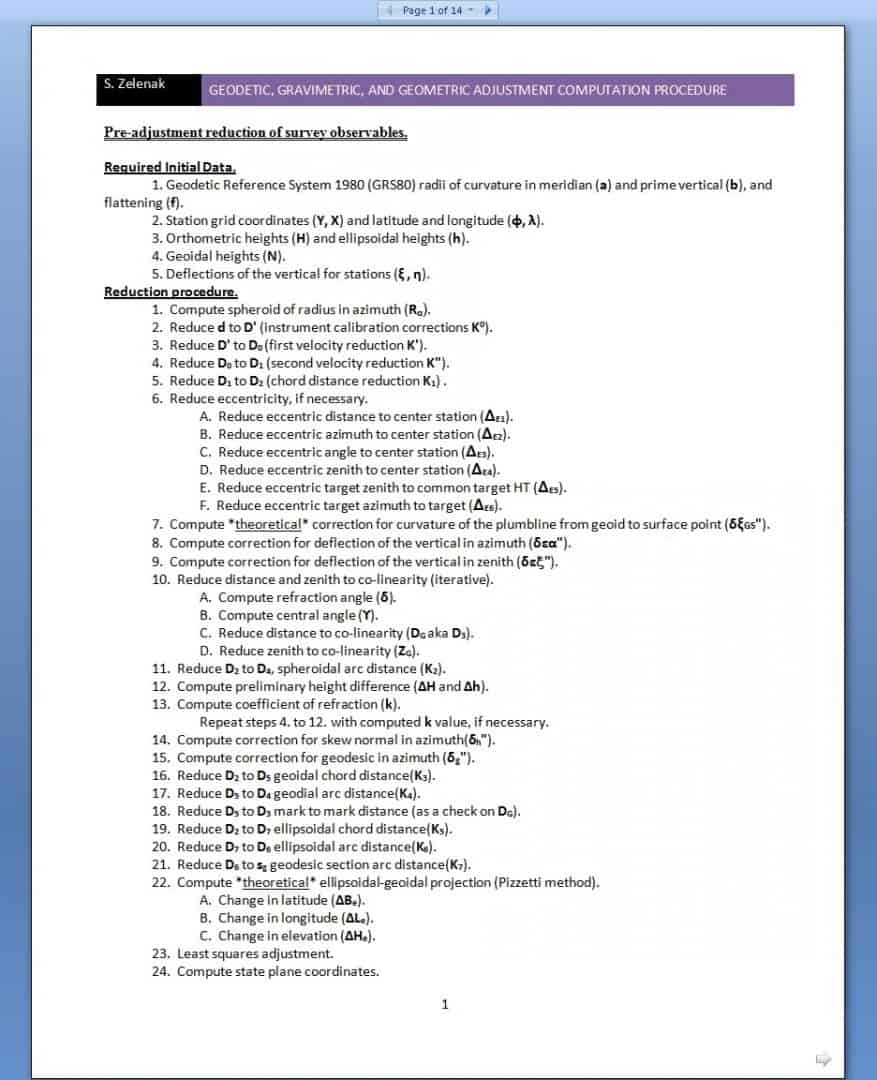
I've been working on developing an SOP for myself and this is the way I see a complete pre-adjustment of observables "reduced".
Note the long path to actual state plane coordinates...
Posted : June 1, 2016 7:10 am
Translate
▼
English
Spanish
French
German
Italian
Portuguese
Russian
Chinese
Japanese
Korean
Arabic
Hindi
Dutch
Polish
Turkish
Vietnamese
Thai
Swedish
Danish
Finnish
Norwegian
Czech
Hungarian
Romanian
Greek
Hebrew
Indonesian
Malay
Ukrainian
Bulgarian
Croatian
Slovak
Slovenian
Serbian
Lithuanian
Latvian
Estonian
Scott: my SOP is to reduce (and store) all observed distances to M-M distances (Dg), which is what is used for all subsequent comps (3D). I also reduce and store the mark-to-mark zenith distances.
Posted : June 1, 2016 7:19 am