

Kent McMillan, post: 383580, member: 3 wrote: does that mean that you've tested the centering accuracy of your rover pole in bipod and found that it has a standard error below 1mm?
I've tested the pole in a tripod. The bubble accuracy doesn't change when I move it to a bipod.

Jim Frame, post: 383589, member: 10 wrote: I've tested the pole in a tripod. The bubble accuracy doesn't change when I move it to a bipod.
Just to be clear: you were able to center a pole in a tripod with a standard error of less than 1mm without checking the bubble by reversing it? If so, that's something I've never tested and will have to see for myself since it seems a bit unlikely.
Kent McMillan, post: 383592, member: 3 wrote: you were able to center a pole in a tripod with a standard error of less than 1mm
I hew closer to 1.5 mm (0.005 foot), and that's what I use for target centering error.
Jim Frame, post: 383595, member: 10 wrote: I hew closer to 1.5 mm (0.005 foot), and that's what I use for target centering error.
A standard error of centering of +/-0.005 ft. (+/-0.007 ft. DRMS) at a height of 6 ft. sounds plausible for a prism pole with a bubble in perfect adjustment. I think I'd still want to investigate the centering errors of rover poles after common field use.

Robert Hill, post: 383551, member: 378 wrote:
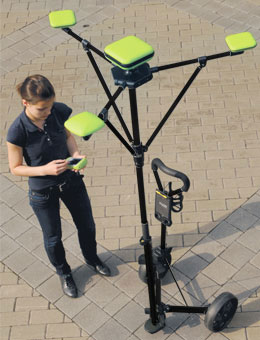
that's a funny looking golf bag!

Andy J, post: 383642, member: 44 wrote: that's a funny looking golf bag!
I was thinking it looked kinda like the spreader bars for a military camo net myself.

Robert Hill, post: 383551, member: 378 wrote:
I want the poster, to hang up in my garage.

Jim Frame, post: 383578, member: 10 wrote: Not the way I use a bipod. Which reminds me: I wish Seco would make a bipod with micro-adjusters like the ones they use on their heavy-duty tripod. The backlash in the thumb-button mechanism makes it annoyingly difficult to fine-tune the setup.
You could drill and tap the ring around the pole for 2 more screws.
Larry Best, post: 383758, member: 763 wrote: You could drill and tap the ring around the pole for 2 more screws.
It's not the prism pole attachment that's subject to movement, it's the leg adjusters themselves. I depress the thumb buttons and get the bubble centered, but when when I release the thumb buttons the leg extension moves a bit taking the bubble out of plumb. On Seco's heavy-duty GPS tripod, the legs have clamps but also a micro-adjusting ring that you turn to gain a fine adjustment of the bubble. (I've not seen these in person, only on the Seco website, so I'm inferring a bit as to their construction and operation.)

Richard, post: 383550, member: 833 wrote: I'll second that Jim.
It boils down to knowing your gear, it's capabilities, weaknesses and being confident in your methodology.
That's something often lacking today.
Where people are given basic training to read the script that is written to prevent idiotic decisions made by those that have little understanding of the 'thing' in their hands /control.With regards to Kent's comment I'd suggest GPS measurement uncertainty would "swamp" pole errors. Unless it was a hopelessly calibrated bubble which surveyors should check frequently.
"people are given basic training to read the script"
Is this what you rely solely upon Richard and expect others to do the same? What happened to relying on your own problem solving capabilities using the tools that you have at hand....my first inclination is to look at at it conceptually, run tests and look at the data...I'm certainly not going to wait until some one hands me the drivers manual and then be grateful to the sob...

Rlshound that didn't read too well at all.
No way.
"Where (best add most/some depending on tasks) are, in today's world of cereal packet qualified experts, given basic training to read the script and only know how to follow the "idiot sheet" before them.
For those not aware, here in Oz people get all sort of qualifications and licences from diving into a breakfast cereal packet and pulling out a little card.
We call them Kellogg or Weetbix Licenses.;)
Thanks for pointing that out. Oops. It conflicts somewhat with the previous sentence!
Richard, post: 384000, member: 833 wrote: Rlshound that didn't read too well at all.
No way.
"Where (best add most/some depending on tasks) are, in today's world of cereal packet qualified experts, given basic training to read the script and only know how to follow the "idiot sheet" before them.
For those not aware, here in Oz people get all sort of qualifications and licences from diving into a breakfast cereal packet and pulling out a little card.
We call them Kellogg or Weetbix Licenses.;)Thanks for pointing that out. Oops. It conflicts somewhat with the previous sentence!
Hello Richard, I apologize, been working to much...I should have thought a lot more before commenting, Paul
Paul absolutely no need for apologies. But thanks.
I reckon I'd have jumped in if I'd read that as it stood, if that makes any sense seeing I wrote it in the first place. 🙁
I was just glad I had the opportunity to correct.

Kent McMillan, post: 383480, member: 3 wrote:
Has anyone ever tested the centering accuracy of their rover pole to derive the standard errors of centering, either DRMS (standard error of radial error) or standard error of the orthogonal components of the total centering error? If so, what values did you determine to apply?
Kent, just found this thread so am late to the party (party over?)
We use a pole for the GNSS rover that always locks out at 2 m so no variable heights for us. I centred the bubble to make the centre of the 5/8 thread at the top straight above the point at where the tip makes a mark on the ground. I did that with an assistant, Allan key, and a total station whilst bracing myself and the pole against a verandah post. It's a pretty quick procedure. I did that probably >6 months ago. Just checked it with a different method recently by putting a Leica spigot adapter on the 5/8 thread and recording the position of the prism in two opposite bubble positions. The result was 0.8 mm apart for the recorded shots which should mean the top of the pole is making a 0.4 mm orbit around vertical. This is about the limit for the poles I keep adjusted. I imagine I would make a point readjust a pole soon if it was >0.5 mm. I only imagine it because the calibrations tend to hold pretty well contrary to what I read from others.