

You are missreading me, I'm defending your position...........
I understood what you meant, and was giving some real world examples of staking a "metes" deed by holding evidence that doesn't agree perfectly with the math.
Since he is answering my comment, I just have to say that I never took his statement to mean what so many here do.
Protecting the Deed isn't something to be thrown out lightly.

Can't help the thin skinned.
Lets look at the real world:
I just finished a survey of two properties that needed to rearrange their common lines, this wasn't to deal with boundary issues, they had different reasons to do it, however, along their exterior lines there are occupations that don't line up the their deeds.
To just move 1/16th and a missing 1/4 to occupations would have been wrong in this case IMO, maybe someone else would differ, but at the end of the day the DEED was staked. Did it match up with occupation? No.
Often surveyors are not going to solve all boundary issues in the field, and the DEED should be staked as written, fences are sometimes just fences even when they are used as division lines. Do I see these landowners going to court over the occupations,,,,,,,,,,,,,,NO, but you never can be sure.
To further complicate things, this property is in a township next to one the BLM is retracing, there is extensive mineral development near, much of the mineral ownership for this survey is fee but not all, so it may well be subject to a BLM retracement in the near future, and I will always consider that when any section, 1/4 or 1/16th is monumented, the BLM WILL NOT accept any of those fences, that I do know.
So saying you will go out and solve occupations here yourself during a survey, really? How as a surveyor would you do that?

For "some people": If a lot of professional land surveyors who study, discuss, and philosophize about this subject misunderstand your statements, maybe there is something lacking in your ability to explain yourself. If you haven't learned anything from posters like "eapls", then I would suggest you are either a better man than me, or you have not listened well.
Perhaps you are, indeed, better than all those that misconstrue your statement, but perhaps you need to exercise a little humility.
(In my opinion) It is best to develop some thicker skin than to argue with people who have done this for years, testified in court, and defended their boundary decisions to their own peers who disagree with them. Keep carrying your righteous sword and fighting the good fight of always being right if you so choose, but that is not the way I would recommend (if I were asked (and I doubt I will be asked)). 😉

"They should have someone with a law degree teaching them rather than an engineering degree."
Actually, they should have someone teaching who has a degree in teaching. A degree in any other discipline does not make one a good teacher. I experienced this over and over again as I worked my way through the academic morasse in the fields of of electrical engineering, aquatic biology and chemistry. Many of my professiors were extremely knowledgable in their field, but had no clue whatsoever how to transmit that information to others.

Nor does a teaching degree make a good teacher if they don't also understand the material they are teaching, to better than the level they expect the students to achieve.
I think that goes without saying - you can't very well teach that which you don't know...

Jim in AZ, post: 346815, member: 249 wrote: I think that goes without saying - you can't very well teach that which you don't know...
Absolutely. When I was teaching I took every opportunity to attend continuing education on teaching/learning methods, etc.. But there's an awful lot going on in higher ed. (lower too I suppose) that works against people (especially in the fields you mention) becoming, being, or staying good teachers. One of the things I tried to do was get students to realize they are in charge of their own learning. One students worst teacher is another students best. Learn just to spite the one you think sucks if that's what it takes. Part of education is learning to deal with difficult people in difficult situations. If you can't do that you're not going to last long in the workforce no matter what your grades were or if you graduate or not. Of course some learn that eventually in the workforce too. But blaming failure on teachers or anyone else is a copout. I for one, am sick of the whole blame someone else thing that seems to be SOP in our society today.
I've been in learning situations/classes where the teacher, although brilliant was a very poor and boring teacher, and have taken classes where the teacher was an amazing educator who knew their subject and how to hold the class's attention. I tried to learn from both of them. But I must say that there are instructors out there that can really teach and get the "light bulb" to come on over a lot more guys heads.
I agree it is not right just to blame the teacher, because the student has to have some drive to learn, but it is a cop-out for a teacher to not try to become a more dynamic educator as well.

I found that my level of effort was commensurate to that of the instructor's. Fortunately, I had the privilege to attend Dave Carlisle's program at White Mountains Community College in Berlin, NH. It was so obvious that Professor Carlisle cared deeply about the subject matter and his students that anything less than 100% effort made me feel ashamed. One of my classmates was a bit of a hellion and went on a two week bender that brought him to Melbourne, Australia and back. When he sobered up and came back to classes he said to me, "Murphy, I could give a **** about my other professors but I really feel like I let Dave down. Do you think he'll still like me?" Letting Dave down was like letting your grandfather down, it just felt wrong. Real respect is always earned.
MightyMoe, post: 346789, member: 700 wrote: Lets look at the real world:
I just finished a survey of two properties that needed to rearrange their common lines, this wasn't to deal with boundary issues, they had different reasons to do it, however, along their exterior lines there are occupations that don't line up the their deeds.
To just move 1/16th and a missing 1/4 to occupations would have been wrong in this case IMO, maybe someone else would differ, but at the end of the day the DEED was staked. Did it match up with occupation? No.
Often surveyors are not going to solve all boundary issues in the field, and the DEED should be staked as written, fences are sometimes just fences even when they are used as division lines. Do I see these landowners going to court over the occupations,,,,,,,,,,,,,,NO, but you never can be sure.To further complicate things, this property is in a township next to one the BLM is retracing, there is extensive mineral development near, much of the mineral ownership for this survey is fee but not all, so it may well be subject to a BLM retracement in the near future, and I will always consider that when any section, 1/4 or 1/16th is monumented, the BLM WILL NOT accept any of those fences, that I do know.
So saying you will go out and solve occupations here yourself during a survey, really? How as a surveyor would you do that?
I would teach the difference between an occupation and something else.

I think that in reducing the question to hold the fences vs hold the measurements & math simplifies the matter way too much and skips some crucial steps in the investigatory and analytical process of a boundary survey.
The surveyor shouldn't accept the fence simply because it's old, or seems like it was probably placed to be on the boundary, or because one or both landowners always thought that it was the boundary, although any of those may be factors to consider and may contribute to a larger body of evidence that leads to concluding that a fence properly marks a boundary.
The surveyor needs to look into the questions of:
1) Who placed the fence?
2) Why did they build the fence?
3) When did they build the fence?
4) What was their basis for placement?
5) If their basis was a belief that they were placing it on the true boundary, what physical evidence did they rely on to foster that belief, and what procedures did they use to reasonably ensure that they were where they needed to be?
6) Regarding the physical evidence the fence builder(s) relied on, who placed it and was it something that the landowners should have had a reasonable right to rely on? (i.e. corners monuments set by a licensed surveyor)
7) What representations have the current or past landowners made to others regarding the existing fence?
More often than not, when I find a fence at variance with other indirect monument evidence and my measurements, it causes me to look for reasons why the true boundaries would be where the fences are, but not to conclude that the true boundary is where the fence is. But I always try to as many of the questions above before making that conclusion. If enough of the answers lead me toward the fence as the boundary, then I accept it as evidence of such.
The answers to these questions can be kind of like the UN Security Council in that several must agree to move my conclusions in that direction, but often one contrary answer can veto the whole idea of the fence as marking the boundary.
If your not going through such an analysis and seeking as many of these answers as you can, then you haven't really sought a solid basis to make the decision of whether or not to accept the fence locations, but your saving grace is that most other surveyors probably won't give much thought beyond the fence location other than Is there an original monument at the fence corner? and Does the fence match my measurements and mathemagical section breakdown?
For many, those seem to be the only two criteria that could justify opining that a fence reasonably marks a boundary and they never consider looking beyond them.

It's not quite so complicated under Utah law. It doesn't matter who built the fence or why, it just matters if the fence has been treated as a boundary for twenty or more years. There doesn't need to be a dispute or uncertainty. The fact that you could show exactly where the section lines or aliquot lines are wouldn't matter. What matters is how the landowners have treated the fence line.
From Bahr v. Imus:
B. Boundary by Acquiescence
å¦ 35 The doctrine of boundary by acquiescence is rooted in policy considerations of "avoiding litigation and promoting stability in landownership." Staker v. Ainsworth, 785 P.2d 417, 423 (Utah 1990). It "derives from [the] realization, ancient in our law, that peace and good order of society [are] best served by leaving at rest possible disputes over long established boundaries." Id. (internal quotation marks omitted). A successful invocation of boundary by acquiescence requires a showing of the following four elements: "(1) occupation up to a visible line marked by monuments, fences, or buildings, (2) mutual acquiescence in the line as a boundary, (3) for a long period of time, (4) by adjoining landowners."[7] Id. at 420 (internal quotation marks omitted).
å¦ 36 The first element may be satisfied where land up to the visible, purported boundary line is farmed, occupied by homes or other structures, improved, irrigated, used to raise livestock, or put to similar use. See id. In evaluating whether this element is satisfied, courts should consider whether a particular "occupation up to a visible line" would place a reasonable party on notice that the given line was being treated as the boundary between the properties.
å¦ 37 The second element is satisfied where neighboring owners "recognize 66*66 and treat an observable line, such as a fence, as the boundary dividing the owner's property from the adjacent landowner's property." Ault v. Holden, 2002 UT 33, å¦ 19, 44 P.3d 781. This element is met where neighbors do not "behave[] in a fashion inconsistent with the belief" that a given line is the boundary between their properties.Staker, 785 P.2d at 420. Failure by the record title owner to "suggest or imply" that the dividing line between the properties is "not in the proper location" suggests acquiescence. Judd Family Ltd. P'ship v. Hutchings, 797 P.2d 1088, 1090 (Utah 1990). Nonacquiescence in a boundary would be signaled where, for example, a landowner notifies the adjoining landowner of her disagreement over the boundary, or takes action inconsistent with recognition of a given line as the boundary, such as tearing "down significant portions of [a] fence and, without objection by [the adjoining landowner], proceed[ing] to plant trees and shrubs, store firewood, and construct a chain link fence in a different location." See Staker, 785 P.2d at 421.
å¦ 38 To satisfy the third element, an unbroken period of no less than twenty years must pass during which each of the other elements is continuously met.[8] See id. at 420; see also Parsons v. Anderson, 690 P.2d 535, 539 (Utah 1984) (explaining that fifteen years of mutual acquiescence was insufficient). To satisfy the fourth element, "the parcels involved" must be "contiguous." Staker, 785 P.2d at 420.
Too many words. Could you cut that down to one sentence please.

Dave Karoly, post: 346944, member: 94 wrote: Too many words. Could you cut that down to one sentence please.
It depends!
I highlighted the important stuff!
The rest is just there to explain it. Of course you could read the case and all the cites and then the cites in the cites. So maybe what's sort of simple to some is not for others.
I'll add, if you can't understand what the courts opinion is saying or you don't want to study enough until you can understand it, land surveying is probably not your calling in life.
It's taken me a while to get it and even longer to gain the confidence to apply it but I'm there. If I find a situation where the facts point to an established boundary I just show it that way.
One sentence Eh? Something trendy like "Landowners Matter." Problem is to understand them two words in this context you need to read volumes.
And sometimes a fence is just a fence to keep cows in pastures, and like the recent famous local case, the long held fence was rejected by the court.
The property owner along the east side of a section line was allowed to move his fence 150' to the west into the landowner to the west.
My point being, be very careful about rejecting deeds.
The deeds are very, very important................
eapls2708, post: 346909, member: 589 wrote: I think that in reducing the question to hold the fences vs hold the measurements & math simplifies the matter way too much and skips some crucial steps in the investigatory and analytical process of a boundary survey.
The surveyor shouldn't accept the fence simply because it's old, or seems like it was probably placed to be on the boundary, or because one or both landowners always thought that it was the boundary, although any of those may be factors to consider and may contribute to a larger body of evidence that leads to concluding that a fence properly marks a boundary.
The surveyor needs to look into the questions of:
1) Who placed the fence?
2) Why did they build the fence?
3) When did they build the fence?
4) What was their basis for placement?
5) If their basis was a belief that they were placing it on the true boundary, what physical evidence did they rely on to foster that belief, and what procedures did they use to reasonably ensure that they were where they needed to be?
6) Regarding the physical evidence the fence builder(s) relied on, who placed it and was it something that the landowners should have had a reasonable right to rely on? (i.e. corners monuments set by a licensed surveyor)
7) What representations have the current or past landowners made to others regarding the existing fence?More often than not, when I find a fence at variance with other indirect monument evidence and my measurements, it causes me to look for reasons why the true boundaries would be where the fences are, but not to conclude that the true boundary is where the fence is. But I always try to as many of the questions above before making that conclusion. If enough of the answers lead me toward the fence as the boundary, then I accept it as evidence of such.
The answers to these questions can be kind of like the UN Security Council in that several must agree to move my conclusions in that direction, but often one contrary answer can veto the whole idea of the fence as marking the boundary.
If your not going through such an analysis and seeking as many of these answers as you can, then you haven't really sought a solid basis to make the decision of whether or not to accept the fence locations, but your saving grace is that most other surveyors probably won't give much thought beyond the fence location other than Is there an original monument at the fence corner? and Does the fence match my measurements and mathemagical section breakdown?
For many, those seem to be the only two criteria that could justify opining that a fence reasonably marks a boundary and they never consider looking beyond them.
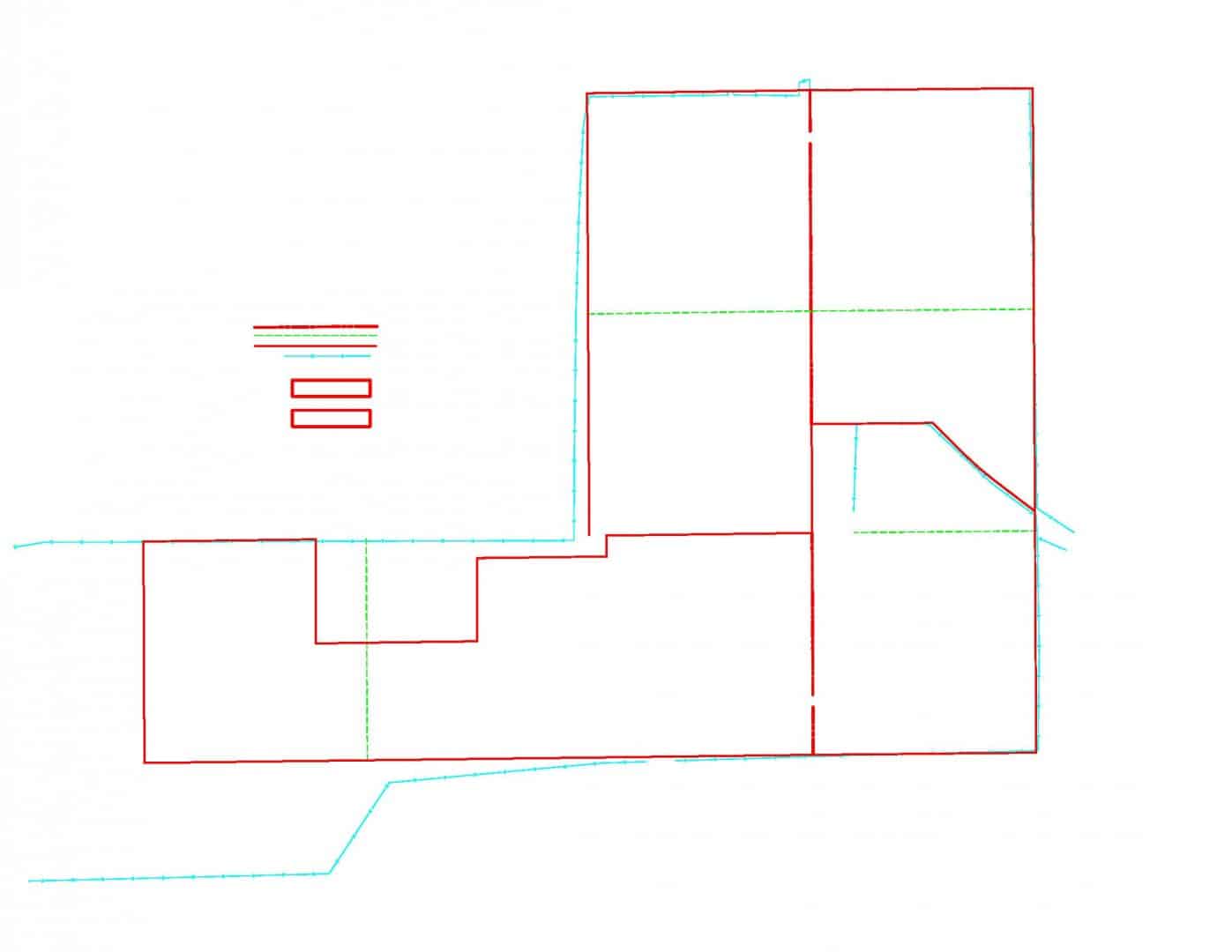
Yes a lot goes into it when looking at fences, the diagram above is an indication of what is going on with these fences.
Not knowing more than just the geometry can direct anyone to some important conclusions about these fences.
I can tell you that the people on both properties that I surveyed are descendants of the patent holders.
These fences are old, not all in their original locations for many reasons, but they have been in place for a long time.
Say you accept the fence corner along the west line which is the SE1/6. It's 120' from the math position, it's there for a reason unrelated to a section breakdown, as you move north it has a strong NE bearing, again unrelated to math, and it angles more than once, do you angle along it, setting at least 5-6 maybe 7 monuments along the 1/16th line? You could do that, not sure how you would justify it.
There's roughly 4 acres between the fence and the deed (math section breakdown), not real valuable surface land, but there is mineral development in this township, lots of it, and a payment of $80,000 an acre for coal for just the right to lease has be made to mineral owners, which both landowners are.
So yes, we talk to the landowners, we see why fences are where they are, we make decisions about section breakdowns, but at the end of the day the DEEDS are very, very important.
The math has never meant much to me. I don't think that way, maybe because sections in my area often will have 1/2 miles record of 2640 but measured of 2460, or 4260 and weird bearings, makes you think differently, but that doesn't mean every situation can be solved by a surveyor, sometimes we can only show landowners issues they have, which is surveyor-in-training's point, and it is a very valid point that should be respected.
MightyMoe, post: 346973, member: 700 wrote: And sometimes a fence is just a fence to keep cows in pastures, and like the recent famous local case, the long held fence was rejected by the court.
The property owner along the east side of a section line was allowed to move his fence 150' to the west into the landowner to the west.
My point being, be very careful about rejecting deeds.
The deeds are very, very important................
I'd like to read the case, what is it?