Reading RPLS is free for the whole profession. Members post, reply, and get the members-only rooms.

Notifications
Clear all

Topic starter
Translate
▼
English
Spanish
French
German
Italian
Portuguese
Russian
Chinese
Japanese
Korean
Arabic
Hindi
Dutch
Polish
Turkish
Vietnamese
Thai
Swedish
Danish
Finnish
Norwegian
Czech
Hungarian
Romanian
Greek
Hebrew
Indonesian
Malay
Ukrainian
Bulgarian
Croatian
Slovak
Slovenian
Serbian
Lithuanian
Latvian
Estonian
Yes, it is true that one can download shapefiles representing the entire highly irregular pattern of original land grants in Texas as made available by the GIS folks of the Texas Railroad Commission, the so-called "Original Texas Land Survey" dataset. Yes, it is free as is a lot of other data available via the Texas Natural Resources Information System. TNRIS is an excellent source for all sorts of stuff, including digital orthophotos and delivers that data efficiently. No complaints about them.

However, please don't be so stupid as to transfer the original land grant boundaries to some supposedly surveyed representation of the real world, i.e. a survey map. I'm looking at one right now in which a surveyor not only lifted the land grant boundaries from the GIS data, but made a calculation using the GIS data from which he concluded that one of the surveys had significant excess and advised his client accordingly. His map presents absolutely no tie to any original corner or other identifiable evidence of the original surveys, but apparently relies upon the GIS data to somehow be a reconstruction of those lines that were run in the period between 1874 and 1928.
Even a casual inspection shows that the GIS representation is not even a faint imitation of what a surveyor could do using the records of the original surveys, other data in the archives of the General Land Office, and USGS 1:24000 topographic maps. It doesn't take much to find obvious errors of 1/4 mile or more in the position of many survey lines as GISed.
If you look in the data catalog that TNRIS provides, it's true that this is how the shapefiles are described:
[INDENT]An interpretation of the Original Texas Land Surveys boundaries and bay tracts. The dataset was derived from the Texas General Land Office (GLO) county maps, the GLO Abstract of Original Land Titles: Volumes and Supplements, and the GLO maps of State-Owned Submerged Lands of the Texas Gulf Coast (bay tracts).
The GLO county maps, showing the boundaries of the original land grants of the State of Texas, were compiled and drawn by GLO draftsmen. This dataset is a digital interpretation of the geographic placement of the original land grants and bay area tracts depicted on these GLO maps and is not a legal survey product.
[/INDENT]
That the shapefiles are "not a legal survey product" has to be the understatement of this century. It would be far more straightforward to make that: "This digital data is provided mainly for entertainment purposes and to lull unsuspecting land surveyors into using it and ultimately looking like idiots, which is the dream of every GIS technician."
Posted : June 28, 2016 8:14 pm

Translate
▼
English
Spanish
French
German
Italian
Portuguese
Russian
Chinese
Japanese
Korean
Arabic
Hindi
Dutch
Polish
Turkish
Vietnamese
Thai
Swedish
Danish
Finnish
Norwegian
Czech
Hungarian
Romanian
Greek
Hebrew
Indonesian
Malay
Ukrainian
Bulgarian
Croatian
Slovak
Slovenian
Serbian
Lithuanian
Latvian
Estonian
If it makes you feel better this is SOP for GIS parcel lines in other parts of the country.
Posted : June 28, 2016 8:44 pm
Topic starter
Translate
▼
English
Spanish
French
German
Italian
Portuguese
Russian
Chinese
Japanese
Korean
Arabic
Hindi
Dutch
Polish
Turkish
Vietnamese
Thai
Swedish
Danish
Finnish
Norwegian
Czech
Hungarian
Romanian
Greek
Hebrew
Indonesian
Malay
Ukrainian
Bulgarian
Croatian
Slovak
Slovenian
Serbian
Lithuanian
Latvian
Estonian
MightyMoe, post: 379371, member: 700 wrote: If it makes you feel better this is SOP for GIS parcel lines in other parts of the country.
It would probably be entertaining to compare the phrasing of the various disclaimers attached to the GIS representations. I'm still chuckling over "this is not a legal survey product", which has to be in the same class as Custer's last words.
Posted : June 28, 2016 8:53 pm
Topic starter
Translate
▼
English
Spanish
French
German
Italian
Portuguese
Russian
Chinese
Japanese
Korean
Arabic
Hindi
Dutch
Polish
Turkish
Vietnamese
Thai
Swedish
Danish
Finnish
Norwegian
Czech
Hungarian
Romanian
Greek
Hebrew
Indonesian
Malay
Ukrainian
Bulgarian
Croatian
Slovak
Slovenian
Serbian
Lithuanian
Latvian
Estonian
These two maps represent my current favorite example of the giant traps awaiting any surveyor who wants to have complete confidence in the compilations of original survey lines represented in the Texas Railroad Commission GIS. The first image below is a detail taken from the official County Map for Dimmit County dated 1976 compiled in the GLO. This is the same map that the Texas RRC GIS was basically traced from.
Note the mysterious white space with a couple of file numbers on it between the Kirchner and Henry Castro surveys and the A.J. Lloyd and Mathias Schmidt surveys, as well as the double-headed arrow indicating that the lines at either end of the two arrows are in fact adjacent and not hundreds of varas apart.
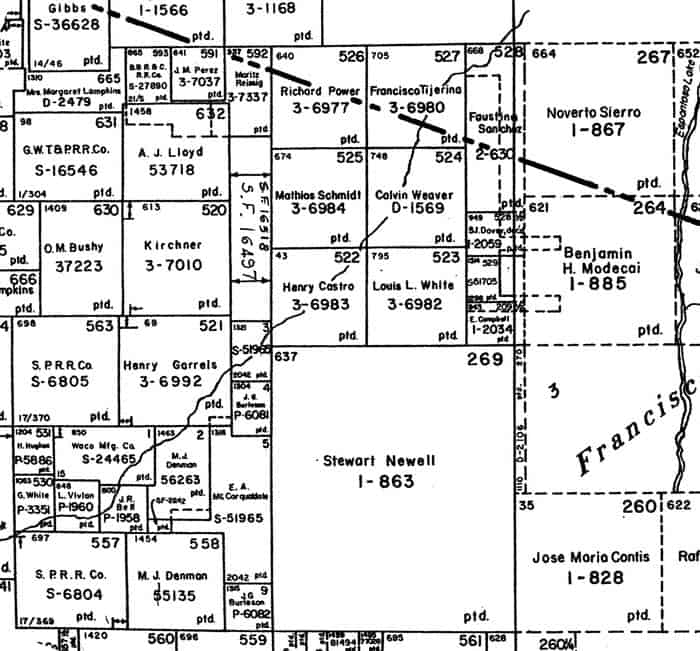
This map was, of course, compiled forty years ago by a GLO draftsman from the field notes of the various surveys shown that are on file in the GLO, as well as from earlier versions of the Official County Map that had done the same.
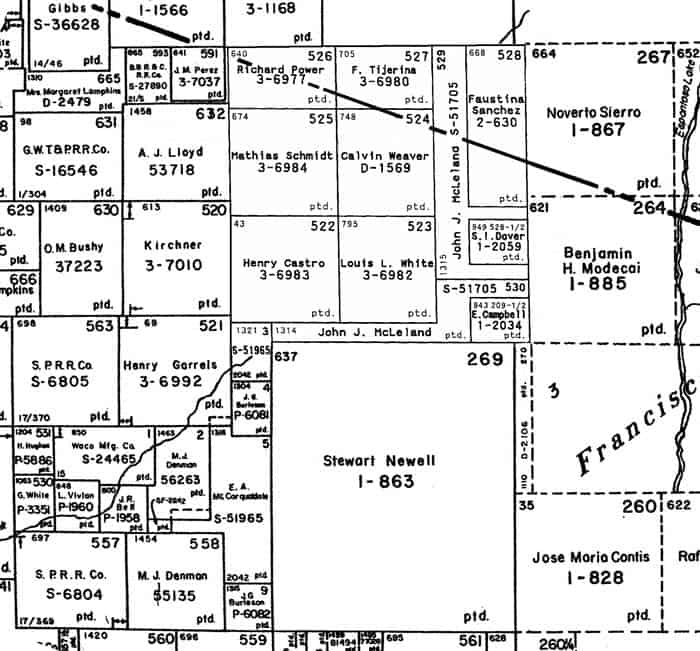
However, what the compiling draftsman neglected to discover was that two entire patented surveys were omitted in the earlier county map. The field notes of those surveys are on file in the GLO as you only discover when you start actually examining the field notes of the various surveys that are shown upon the map.
This is what the Official County Map would really look like if properly drawn. Looks a bit different, eh? Well guess which is reflected by the RR Commission GIS and probably will be for the foreseeable future?
Posted : June 28, 2016 9:39 pm
Translate
▼
English
Spanish
French
German
Italian
Portuguese
Russian
Chinese
Japanese
Korean
Arabic
Hindi
Dutch
Polish
Turkish
Vietnamese
Thai
Swedish
Danish
Finnish
Norwegian
Czech
Hungarian
Romanian
Greek
Hebrew
Indonesian
Malay
Ukrainian
Bulgarian
Croatian
Slovak
Slovenian
Serbian
Lithuanian
Latvian
Estonian
The local assessor had a set of township maps with the ownership lines plotted on them,,,,,,, pre GIS.
If they would have scanned those, taken a couple of corners and aligned them into the GIS, it would have been more accurate than what was done.
Posted : June 29, 2016 7:20 am
Translate
▼
English
Spanish
French
German
Italian
Portuguese
Russian
Chinese
Japanese
Korean
Arabic
Hindi
Dutch
Polish
Turkish
Vietnamese
Thai
Swedish
Danish
Finnish
Norwegian
Czech
Hungarian
Romanian
Greek
Hebrew
Indonesian
Malay
Ukrainian
Bulgarian
Croatian
Slovak
Slovenian
Serbian
Lithuanian
Latvian
Estonian
I find some counties are better than others, and I do not know why. Cherokee County seems to work quite well, for the most part, while Panola County, on the other hand, especially the closer you get to the Sabine River, is wildly different. In fact, now that I think about it, every county where I work near a river, I find the shapefile to be a best guess. I found two vacancies near the Trinity that the shapefile didn't catch, but the GLO county map showed enough to prove both vacancies.
Posted : June 29, 2016 7:23 am
Topic starter
Translate
▼
English
Spanish
French
German
Italian
Portuguese
Russian
Chinese
Japanese
Korean
Arabic
Hindi
Dutch
Polish
Turkish
Vietnamese
Thai
Swedish
Danish
Finnish
Norwegian
Czech
Hungarian
Romanian
Greek
Hebrew
Indonesian
Malay
Ukrainian
Bulgarian
Croatian
Slovak
Slovenian
Serbian
Lithuanian
Latvian
Estonian
Kris Morgan, post: 379410, member: 29 wrote: I find some counties are better than others, and I do not know why.
The method used in compiling the GIS (which I assume amounted to digitizing the county maps and rubbersheeting them to match features that show up on 1:24000 quad sheets) would work better in the counties with large grants surveyed over a relatively short span of time such as the colonial period from 1821 to 1836 and where cultural features like roads and landmark fences follow land grant lines and show up on quad sheets.
Posted : June 29, 2016 7:59 am
Topic starter
Translate
▼
English
Spanish
French
German
Italian
Portuguese
Russian
Chinese
Japanese
Korean
Arabic
Hindi
Dutch
Polish
Turkish
Vietnamese
Thai
Swedish
Danish
Finnish
Norwegian
Czech
Hungarian
Romanian
Greek
Hebrew
Indonesian
Malay
Ukrainian
Bulgarian
Croatian
Slovak
Slovenian
Serbian
Lithuanian
Latvian
Estonian
Kent McMillan, post: 379386, member: 3 wrote: However, what the compiling draftsman neglected to discover was that two entire patented surveys were omitted in the earlier county map. The field notes of those surveys are on file in the GLO as you only discover when you start actually examining the field notes of the various surveys that are shown upon the map.
This is what the Official County Map would really look like if properly drawn.
Actually, to be more correct, I should have pointed out that the GLO County Map does note file no. Bex-S-51705, which is the file that contains the field notes of the two McLeland surveys upon which patents issued. So, in that sense, the surveys aren't missing completely. However, the compiling draftsman failed to plot the field notes of the surveys in an way that resembles what the GLO records disclose as correct; so they are nearly invisible on the County Map and completely so in the GIS product.
Posted : June 29, 2016 8:08 am
Translate
▼
English
Spanish
French
German
Italian
Portuguese
Russian
Chinese
Japanese
Korean
Arabic
Hindi
Dutch
Polish
Turkish
Vietnamese
Thai
Swedish
Danish
Finnish
Norwegian
Czech
Hungarian
Romanian
Greek
Hebrew
Indonesian
Malay
Ukrainian
Bulgarian
Croatian
Slovak
Slovenian
Serbian
Lithuanian
Latvian
Estonian
just had a guy come in wanting to do a boundary line adjustment, he had a map prepared, complicated thing, all the owners, all the parcels hatched with different owners, the highway (interstate) and railroad all plotted.
There was a reason to do this cause the property line (section line) cuts off the land from access.
Anyway, the section line just by visual inspection is about 300' "off" on the drawing, but shifting it where it "should" be there probably would be no reason for the adjustment................
The area was surveyed by the GLO in 1881, a resurvey in 24, then another to the south in the 50's by the BLM. In the 70's the interstate was surveyed, section lines located, deeds written, plans drawn up, all on state plane, West of the interstate the area was surveyed in the very late 70's, tied to state plane and plats filed, to the east a different surveyor did a survey on state plane, filed a plat with state plane at each section corner, in the 90's a new highway survey was done on the same sections and used NAD83/93 and retied these sections and a plat map with coordinates was filed............
Anyhoo........there is no lack of PUBLIC information set on a platter by surveyors to locate probably within a couple of feet any land corner in the area.............but for some reason the "official" (yes I was told that by a GISer) "PLS" file is 150-300' from where all that data shows it......Why? danged if I know, you can lead a horse..................................
Posted : June 29, 2016 10:11 am
Topic starter
Translate
▼
English
Spanish
French
German
Italian
Portuguese
Russian
Chinese
Japanese
Korean
Arabic
Hindi
Dutch
Polish
Turkish
Vietnamese
Thai
Swedish
Danish
Finnish
Norwegian
Czech
Hungarian
Romanian
Greek
Hebrew
Indonesian
Malay
Ukrainian
Bulgarian
Croatian
Slovak
Slovenian
Serbian
Lithuanian
Latvian
Estonian
MightyMoe, post: 379422, member: 700 wrote: there is no lack of PUBLIC information set on a platter by surveyors to locate probably within a couple of feet any land corner in the area.............but for some reason the "official" (yes I was told that by a GISer) "PLS" file is 150-300' from where all that data shows it.
Impressive. Presumably it would create too many "problems" to just correct the GIS.
Posted : June 29, 2016 10:17 am
Translate
▼
English
Spanish
French
German
Italian
Portuguese
Russian
Chinese
Japanese
Korean
Arabic
Hindi
Dutch
Polish
Turkish
Vietnamese
Thai
Swedish
Danish
Finnish
Norwegian
Czech
Hungarian
Romanian
Greek
Hebrew
Indonesian
Malay
Ukrainian
Bulgarian
Croatian
Slovak
Slovenian
Serbian
Lithuanian
Latvian
Estonian
Kent McMillan, post: 379424, member: 3 wrote: Impressive. Presumably it would create too many "problems" to just correct the GIS.
I'm not really sure what GIS means in this case, the new county lines are much better, this looks like something taken from a computer file off the interweb,,,,,,,,,,
Long ago I quit trying to make the GCDB, GIS, GOOGLE, EARTHPOINT or anything else work, it's always much better to use data that I can find in the record and do it myself
Posted : June 29, 2016 10:41 am

Translate
▼
English
Spanish
French
German
Italian
Portuguese
Russian
Chinese
Japanese
Korean
Arabic
Hindi
Dutch
Polish
Turkish
Vietnamese
Thai
Swedish
Danish
Finnish
Norwegian
Czech
Hungarian
Romanian
Greek
Hebrew
Indonesian
Malay
Ukrainian
Bulgarian
Croatian
Slovak
Slovenian
Serbian
Lithuanian
Latvian
Estonian
I think I've had 3 or 4 "problem letters" from the RRC this year informing me that my well location plat was too close to the section line or in the wrong section. I asked them to have the surveyor who prepared their GIS map give me a call and we could discuss which monuments were controlling.
I think they have new staff this year because I had the same problem last year and after a come-to-jesus meeting, the letters stopped. Until this year. I think I have it resolved for now and hopefully they will pass along the institutional knowledge that GIS does not trump a properly surveyed well location.
Posted : June 29, 2016 10:50 am
Translate
▼
English
Spanish
French
German
Italian
Portuguese
Russian
Chinese
Japanese
Korean
Arabic
Hindi
Dutch
Polish
Turkish
Vietnamese
Thai
Swedish
Danish
Finnish
Norwegian
Czech
Hungarian
Romanian
Greek
Hebrew
Indonesian
Malay
Ukrainian
Bulgarian
Croatian
Slovak
Slovenian
Serbian
Lithuanian
Latvian
Estonian
Andy Nold, post: 379430, member: 7 wrote: I think I've had 3 or 4 "problem letters" from the RRC this year informing me that my well location plat was too close to the section line or in the wrong section. I asked them to have the surveyor who prepared their GIS map give me a call and we could discuss which monuments were controlling.
I think they have new staff this year because I had the same problem last year and after a come-to-jesus meeting, the letters stopped. Until this year. I think I have it resolved for now and hopefully they will pass along the institutional knowledge that GIS does not trump a properly surveyed well location.
Hey!!!! you have to use the OFFICAL lines, you know the ones my teacher at college said were right when I took my GIS course.........
Posted : June 29, 2016 2:16 pm
Translate
▼
English
Spanish
French
German
Italian
Portuguese
Russian
Chinese
Japanese
Korean
Arabic
Hindi
Dutch
Polish
Turkish
Vietnamese
Thai
Swedish
Danish
Finnish
Norwegian
Czech
Hungarian
Romanian
Greek
Hebrew
Indonesian
Malay
Ukrainian
Bulgarian
Croatian
Slovak
Slovenian
Serbian
Lithuanian
Latvian
Estonian
Andy Nold, post: 379430, member: 7 wrote: I think I've had 3 or 4 "problem letters" from the RRC this year informing me that my well location plat was too close to the section line or in the wrong section. I asked them to have the surveyor who prepared their GIS map give me a call and we could discuss which monuments were controlling.
I think they have new staff this year because I had the same problem last year and after a come-to-jesus meeting, the letters stopped. Until this year. I think I have it resolved for now and hopefully they will pass along the institutional knowledge that GIS does not trump a properly surveyed well location.
And, they must have a new staff member. I just received another problem letter where my "on-the-ground" surveyed boundary does not match the magical, all-knowing GIS. My tech forwarded the email chain from the last problem letter. Hopefully they will come to the right conclusion without any additional training required.
SMH.
Posted : August 23, 2016 10:04 am

Translate
▼
English
Spanish
French
German
Italian
Portuguese
Russian
Chinese
Japanese
Korean
Arabic
Hindi
Dutch
Polish
Turkish
Vietnamese
Thai
Swedish
Danish
Finnish
Norwegian
Czech
Hungarian
Romanian
Greek
Hebrew
Indonesian
Malay
Ukrainian
Bulgarian
Croatian
Slovak
Slovenian
Serbian
Lithuanian
Latvian
Estonian
Aww, you think that's bad, I work for an LSLS, and we sometimes file corrected field notes, moving the section lines to where they should be (Original corners and ties, all that such) try getting the RRC to understand that. That takes a few phone calls.
Posted : August 23, 2016 1:43 pm
Translate
▼
English
Spanish
French
German
Italian
Portuguese
Russian
Chinese
Japanese
Korean
Arabic
Hindi
Dutch
Polish
Turkish
Vietnamese
Thai
Swedish
Danish
Finnish
Norwegian
Czech
Hungarian
Romanian
Greek
Hebrew
Indonesian
Malay
Ukrainian
Bulgarian
Croatian
Slovak
Slovenian
Serbian
Lithuanian
Latvian
Estonian
4 months ago we were following behind an LSLS who is filing about 6 blocks of corrected field notes and the RRC is asking me to provide updated linework/coordinates. I said that seems to be the purview of the GLO and the filing LSLS.
Posted : August 23, 2016 2:23 pm
Translate
▼
English
Spanish
French
German
Italian
Portuguese
Russian
Chinese
Japanese
Korean
Arabic
Hindi
Dutch
Polish
Turkish
Vietnamese
Thai
Swedish
Danish
Finnish
Norwegian
Czech
Hungarian
Romanian
Greek
Hebrew
Indonesian
Malay
Ukrainian
Bulgarian
Croatian
Slovak
Slovenian
Serbian
Lithuanian
Latvian
Estonian
I agree, the LSLS and GLO should be working to get that figured out. I guess this would be where to insert the joke of the RRC again not knowing where to find the information the quickest way...
Posted : August 23, 2016 3:30 pm

Translate
▼
English
Spanish
French
German
Italian
Portuguese
Russian
Chinese
Japanese
Korean
Arabic
Hindi
Dutch
Polish
Turkish
Vietnamese
Thai
Swedish
Danish
Finnish
Norwegian
Czech
Hungarian
Romanian
Greek
Hebrew
Indonesian
Malay
Ukrainian
Bulgarian
Croatian
Slovak
Slovenian
Serbian
Lithuanian
Latvian
Estonian
I've got the same issue. In my case there were two different constructions of how the PSL blocks were put together at one point. So there were Wells staked on differing constructions. I get problem letters all the time due to this.
Sent from my SAMSUNG-SM-N920A using Tapatalk
Posted : August 23, 2016 7:45 pm
Translate
▼
English
Spanish
French
German
Italian
Portuguese
Russian
Chinese
Japanese
Korean
Arabic
Hindi
Dutch
Polish
Turkish
Vietnamese
Thai
Swedish
Danish
Finnish
Norwegian
Czech
Hungarian
Romanian
Greek
Hebrew
Indonesian
Malay
Ukrainian
Bulgarian
Croatian
Slovak
Slovenian
Serbian
Lithuanian
Latvian
Estonian
I'm fortunate that I can send them a SEP Letter. (Somebody Else's Problem).
Posted : August 23, 2016 7:50 pm