

Dave Karoly, post: 412460, member: 94 wrote: So the method involves finding the lowest qualified bank on either side of the river within a 5 or 6 mile stretch. Do the heights he established above the toe of the bank stay the same or do they keep shifting?
In other words, does a new survey involve reestablishing the mid bank height then staking the gradient or do you use his mid bank height to stake the gradient line?
In theory, the gradient boundary represents the limits of the floodplain of the river at a particular flow,(equivalent to a frequency of flood on the order of the 6 month event), so as long as the conveyance of the river remains pretty much the same over time at a particular cross section, the elevation of the gradient boundary ought to remain unchanged.
In practice, where the river channel changes so much over time, the most defensible practice would be to reexamine the river to find the lowest qualified banks, set new gauges, recompute the heights of the gradient boundary at cross sections along the river, and map the locations of those levels on the ground.
That is so labor intensive that if I were to try to map the gradient boundary along 119 miles of the Red River it would be much more efficient to simply determine the heights of the gradient boundary at wide intervals along the river and then just take aerial orthophotos of the river when it is flowing at a level that is nominally at the stage of the gradient boundary at those intervals.
BTW, one of the more interesting things I've read about the Red River is this paper written by the University of Texas Plant Ecologist, B.C. Tharp, who was one of the witnesses for Texas in 1923. Thirty years later, he went back to revist the Big Bend area that was the focus of the 1923 proceeding and was startled by how very different everything was, even down to the plants growing in the channel. Here's a link to his paper in "The Southwestern Historical Quarterly":
https://texashistory.unt.edu/ark:/67531/metapth101196/m1/441/

Kent McMillan, post: 412464, member: 3 wrote: In theory, the gradient boundary represents the limits of the floodplain of the river at a particular flow,(equivalent to a frequency of flood on the order of the 6 month event), so as long as the conveyance of the river remains pretty much the same over time at a particular cross section, the elevation of the gradient boundary ought to remain unchanged.
In practice, where the river channel changes so much over time, the most defensible practice would be to reexamine the river to find the lowest qualified banks, set new gauges, recompute the heights of the gradient boundary at cross sections along the river, and map the locations of those levels on the ground.
That is so labor intensive that if I were to try to map the gradient boundary along 119 miles of the Red River it would be much more efficient to simply determine the heights of the gradient boundary at wide intervals along the river and then just take aerial orthophotos of the river when it is flowing at a level that is nominally at the stage of the gradient boundary at those intervals.
Except for channel movement or change due to avulsion in which the case waters edge in your photo would not be accurate.
Dave Karoly, post: 412475, member: 94 wrote: Except for channel movement or change due to avulsion in which the case waters edge in your photo would not be accurate.
It would still represent the gradient boundary though, regardless of whether there had been an avulsive change in the channel. Judging by the results of the investigations by Kidder and Stiles, there probably are not that many places along the reach of the Red River in question where the boundary has moved by avulsion after 1923. Those few instances known to have occurred between 1821 and 1923 were fairly well documented by the Commissioners.
That is, the gradient boundary is subject to change by the natural processes at work in the river. In the event of an avulsive change to the channel, the federal boundary would remain fixed at the position of the gradient boundary prior to the avulsion, although the gradient boundary itself would have shifted.
Kent McMillan, post: 412479, member: 3 wrote: It would still represent the gradient boundary though, regardless of whether there had been an avulsive change in the channel. Judging by the results of the investigations by Kidder and Stiles, there probably are not that many places along the reach of the Red River in question where the boundary has moved by avulsion after 1923. Those few instances known to have occurred between 1821 and 1923 were fairly well documented by the Commissioners.
That is, the gradient boundary is subject to change by the natural processes at work in the river. In the event of an avulsive change to the channel, the federal boundary would remain fixed at the position of the gradient boundary prior to the avulsion, although the gradient boundary itself would have shifted.
I'm wondering why the BLM thinks the boundary is so far south? Is it because they think the Red River pushed north because of avulsion or they are retracing Stiles who thought so?
Dave Karoly, post: 412487, member: 94 wrote: I'm wondering why the BLM thinks the boundary is so far south? Is it because they think the Red River pushed north because of avulsion or they are retracing Stiles who thought so?
Good question, but it does seem likely to me that the location of the gradient boundary along the South bank of the Red River is much nearer to the bluff on the Texas side than the Texas-New Mexico boundary as drawn on Thornberry, Tex. Quadrangle (but noted as "Indefinite Boundary" on the quad sheet.) Where there is a cut bank that is washed by water in flood, basically the gradient boundary runs at some specific height along that cut bank.
One thing that Dr. B.C. Tharp noted in his 1953 paper that I linked above was that the valley of the Red River that in 1923 had been a broad sand flat was thirty years later covered in saltcedar, an invasive species that grows in dense stands.
I would suspect that if the saltcedar is still there, that it alone has altered the riverine environment in which deposition of water-borne sediments occurs. I'd expect that the saltcedar actually holds the sand in place and increases sedimentation in the overbank areas. That ought to have the effect of shifting the gradient boundary significantly closer to the low bank along the flowing river, but that's reaally just a guess on my part.

[MEDIA=youtube]bJqr3G9Z67c[/MEDIA]
RADAR, post: 412492, member: 413 wrote: [stuff]
Or, considering the location, maybe James McMurtry's "Choctaw Bingo".
I'm thinking the old hymn...Down by the Riverside applies.
I don't make a practice of posting links to this source, but it does capture the misunderstanding as to what the decision in the 1923 case of Oklahoma v. Texas as to the south bank of the Red River really means to the rural folks in North Texas who own land along the Red River thinking that they really own more than they do. History is hard, apparently even for ambulance-chasing lawyers who say things like this:
The U.S. Supreme court case is clear in that it established the boundary of federal territory at the south bank of the Red River," Henneke said. "Beyond that is my clients' private property and it is outrageous for the government to suggest they should have to buy back what they already own."
Being an amateur hydrologist and semi-professional topographer, I thought that it would be interesting to examine the stream gaging data for the Red River in the area of interest near Burkburnett, Texas.
Basically, what it shows is that the common range of variation of the Red River during the year is just a few feet. There are extraordinary floods that increase water levels well beyond those limits, but a rise of three or four feet is not uncommon. So, I'd expect that the criteria for determining the gradient boundary would fit a stage of the Red River that was less than three or four feet above ordinary stage.
Here's a portion of the record of the gage data for the Red River near Burkburnett, Texas, for example:
There are BLM Dependent Resurveys in the Big Bend area. Some of them don't resurvey the gradient boundary but one on the east side of Stiles Map 1 does. The notes say the same thing as the other one Paden found, Stiles gradient boundary hasn't moved. They found some of Stiles' control monuments on both sides out there.
Dave Karoly, post: 412580, member: 94 wrote: There are BLM Dependent Resurveys in the Big Bend area. Some of them don't resurvey the gradient boundary but one on the east side of Stiles Map 1 does. The notes say the same thing as the other one Paden found, Stiles gradient boundary hasn't moved. They found some of Stiles' control monuments on both sides out there.
Taken at face value, the claim that the gradient boundary hasn't moved in the nearly 100 years that have passed since 1923 is absurd. I'd want to read the report on the examination of the cut banks along that reach of the Red River to see what basis there might be for asserting no change since it defies reason that it might not have changed at all.
Kent McMillan, post: 412582, member: 3 wrote: Taken at face value, the claim that the gradient boundary hasn't moved in the nearly 100 years that have passed since 1923 is absurd. I'd want to read the report on the examination of the cut banks along that reach of the Red River to see what basis there might be for asserting no change since it defies reason that it might not have changed at all.
I'm betting they reestablished it from the record data in report no. 1 using the surviving control they found. The Plat shows some of the witness posts so some of those may have survived.
Field Notes:
https://glorecords.blm.gov/details/fieldnote/page.aspx?viewer=html&viewerWindow=true&viewerWidth=758&viewerHeight=954&imageFile=FNVOKO0243OKO024305750.JP2&dm_id=176845&s_dm_id=176834&fn_idx=0
They found W.P. 51 (see page 12).
Dave Karoly, post: 412585, member: 94 wrote: I'm betting they reestablished it from the record data in report no. 1 using the surviving control they found. The Plat shows some of the witness posts so some of those may have survived
And even better, the GLO plat shows ties to at least a couple of the Kidder/Stiles reference monuments to which their field notes of the meanders of the gradient boundary in 1923 are tied. In the Kidder/Stiles reports, you'll note that they give both the geodetic positions of the reference monuments and courses and distances along the Texas-Oklahoma boundary (which is typically the gradient boundary). So it would have been quite possible to locate a couple of the reference monuments and calculate the 1923 boundary from just those monuments while verifying the calculated positions of witness posts to refine things a bit.
Naturally, where the gradient boundary was found to be in 1923 will be irrelevant if there have been any of the usual processes at work in the river channel rearranging the sediment in the channel and along its banks.
Kent McMillan, post: 412504, member: 3 wrote: I don't make a practice of posting links to this source, but it does capture the misunderstanding as to what the decision in the 1923 case of Oklahoma v. Texas as to the south bank of the Red River really means to the rural folks in North Texas who own land along the Red River thinking that they really own more than they do. History is hard, apparently even for ambulance-chasing lawyers who say things like this:
The U.S. Supreme court case is clear in that it established the boundary of federal territory at the south bank of the Red River," Henneke said. "Beyond that is my clients' private property and it is outrageous for the government to suggest they should have to buy back what they already own."
So I guess what they show is not the riverbank per the gradient method?
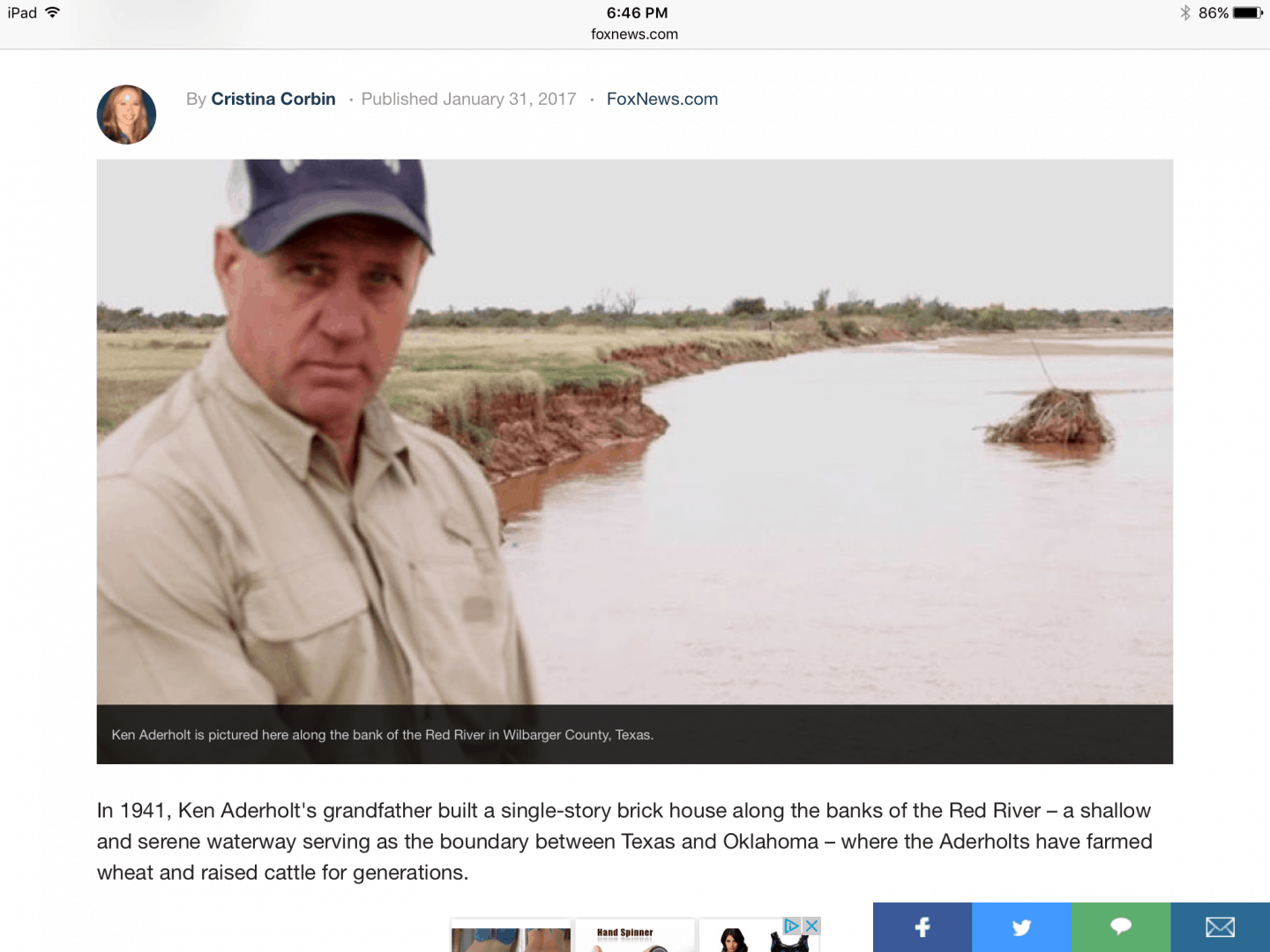
Dave Karoly, post: 412591, member: 94 wrote: So I guess what they show is not the riverbank per the gradient method?
That doesn't look like an accretion bank with a back drain on the side away from the river, so I don't think that it would not be considered one of the key banks from which the gradient boundary height would be determined.
"so I don't think that it would be considered one of the key banks"
Kent McMillan, post: 412210, member: 3 wrote: Here's a link to the actual map that Mssrs. Kidder and Stiles made of the Big Bend of the Red River for submission to the Supreme Court in Oklahoma v. Texas
Okay looking at this map it is evident that in some places the cut flowing water channel with eroded banks is a large distance from the boundary. In other places the cut water channel is at the boundary.