

Dave Karoly, post: 412597, member: 94 wrote: Okay looking at this map it is evident that in some places the cut flowing water channel with eroded banks is a large distance from the boundary. In other places the cut water channel is at the boundary.
Yes, the key to determining the height of the gradient boundary is examining all of the accretion banks with back drains and upland vegetation on them. Under the Kidder-Stiles theory, the accretion bank was formed by frequent inundation in flood and the back drain indicated that the water seldom rose above the bank and the upland vegetation showed it to be seldom subject to inundation.
Once that lowest qualified bank (to use the phrase Stiles adopted for that key accretion bank) is identified, the gradient boundary is basically determined by where the limit of the surface of the flowing river is when the height of the river is midway between the water at ordinary stage and the top of the adopted bank.

Kent McMillan, post: 412598, member: 3 wrote: Yes, the key to determining the height of the gradient boundary is examining all of the accretion banks with back drains and upland vegetation on them. Under the Kidder-Stiles theory, the accretion bank was formed by frequent inundation in flood and the back drain indicated that the water seldom rose above the bank and the upland vegetation showed it to be seldom subject to inundation.
Once that lowest qualified bank (to use the phrase Stiles adopted for that key accretion bank) is identified, the gradient boundary is basically determined by where the limit of the surface of the flowing river is when the height of the river is midway between the water at ordinary stage and the top of the adopted bank.
What he calls the riverbank is based on the change in vegetation and the accretion bank which is different from the lay understanding of the riverbank which is just the eroded bank with riverbottom vegetation on top.
Dave Karoly, post: 412599, member: 94 wrote: What he calls the riverbank is based on the change in vegetation and the accretion bank which is different from the lay understanding of the riverbank which is just the eroded bank with riverbottom vegetation on top.
One thing that evidently goes on along the Red River is that floods scalp parts of the bed of vegetation when then grows back over time. I'll see if I can figure out where that photo that appears above was taken.
I'm going to guess that Ken Aderholt's property is somewhere in the vicinity of this:
https://www.google.com/maps/place/34%C2%B011'23.6%22N+99%C2%B003'07.9%22W/ @34.1929516,-99.0899149,12773m/data=!3m1!1e3!4m5!3m4!1s0x0:0x0!8m2!3d34.189881!4d-99.052203?hl=en'"> https://www.google.com/maps/place/34å¡1 1'23.6"N+99å¡03'07.9"W/@34.1929516,-99.0899149,12773m/data=!3m1!1e3!4m5!3m4!1s0x0:0x0!8m2!3d34.189881!4d-99.052203?hl=en
Check out the view of the Red River from the bridge on US Hwy 183:
@34.2091801,-99.0822424,3a,75y,301.32h,84.01t/data=!3m6!1e1!3m4!1sU1JC2bD_RZSYzYFOgztbmQ!2e0!7i13312!8i6656?hl=en"> https://www.google.com/maps/ @34.2091801,-99.0822424,3a,75y,301.32h,84.01t/data=!3m6!1e1!3m4!1sU1JC2bD_RZSYzYFOgztbmQ!2e0!7i13312!8i6656?hl=en
Part of Mr. Aderholt's confusion may be from the fact that it looks like his land is out of a large agricultural subdivision known as Waggoner Colony that didn't follow the original survey lines and may have taken in land in the bed of the Red River.
Yes, per Willbarger Central Appraisal District, all of the land rendered in the name of Kenneth Aderholt in Wilbarger County is in an agricultural subdivision known as WAGGONER COLONY (Cabinet A Slide 3B Wilbarger County Plat Records) that was laid out in 1905. It would be interesting to overlay the subdivision plat onto the real world to see if the subdivision didn't obviously extend into the bed of the Red River.
Kent McMillan, post: 412609, member: 3 wrote: Yes, per Willbarger Central Appraisal District, all of the land rendered in the name of Kenneth Aderholt in Wilbarger County is in an agricultural subdivision known as WAGGONER COLONY (Cabinet A Slide 3B Wilbarger County Plat Records) that was laid out in 1905. It would be interesting to overlay the subdivision plat onto the real world to see if the subdivision didn't obviously extend into the bed of the Red River.
It looks like the picnic area at 34.186468, -99.089846 is on top of the bluff overlooking the river valley. I'm not sure how far that is from the gradient boundary.
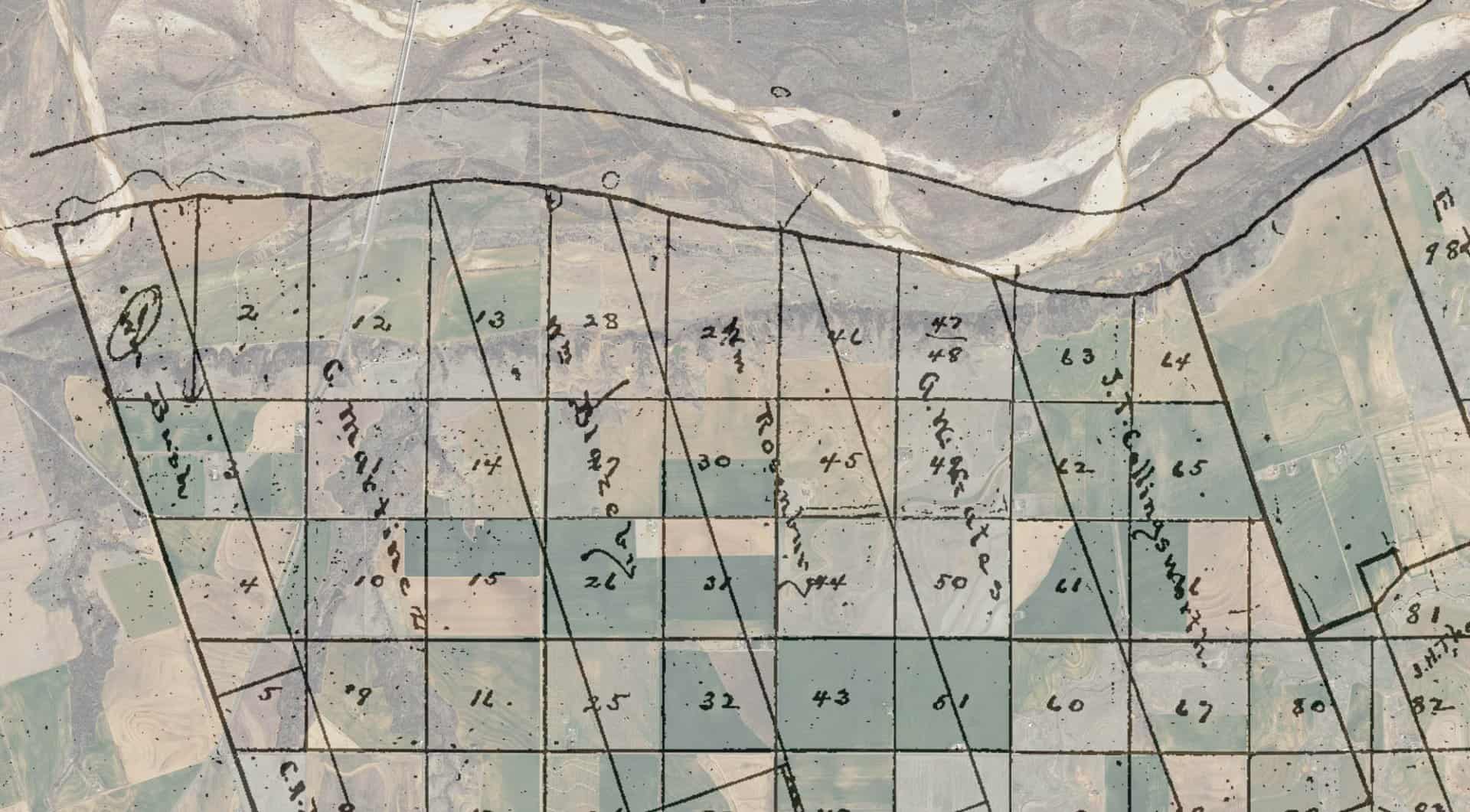
Here is that 1905 map of the agricultural subdivision known as WAGGONER COLONY (a resubdivision of various original land grants) overlaid on a current aerial. Some of the 160 acre "sections" of WAGGONER COLONY as platted do appear to have originally extended well out into the channel of the Red River. There was a Charlie M. Aderholt who in 1942 was conveyed the tract designated as Section 47/48 on the map of WAGGONER COLONY that appears to now have a house on it on the top of the Texas bluff on the Red River that may be the land that Ken Aderholt described as that his grandfather built a house on in the early 1940s.
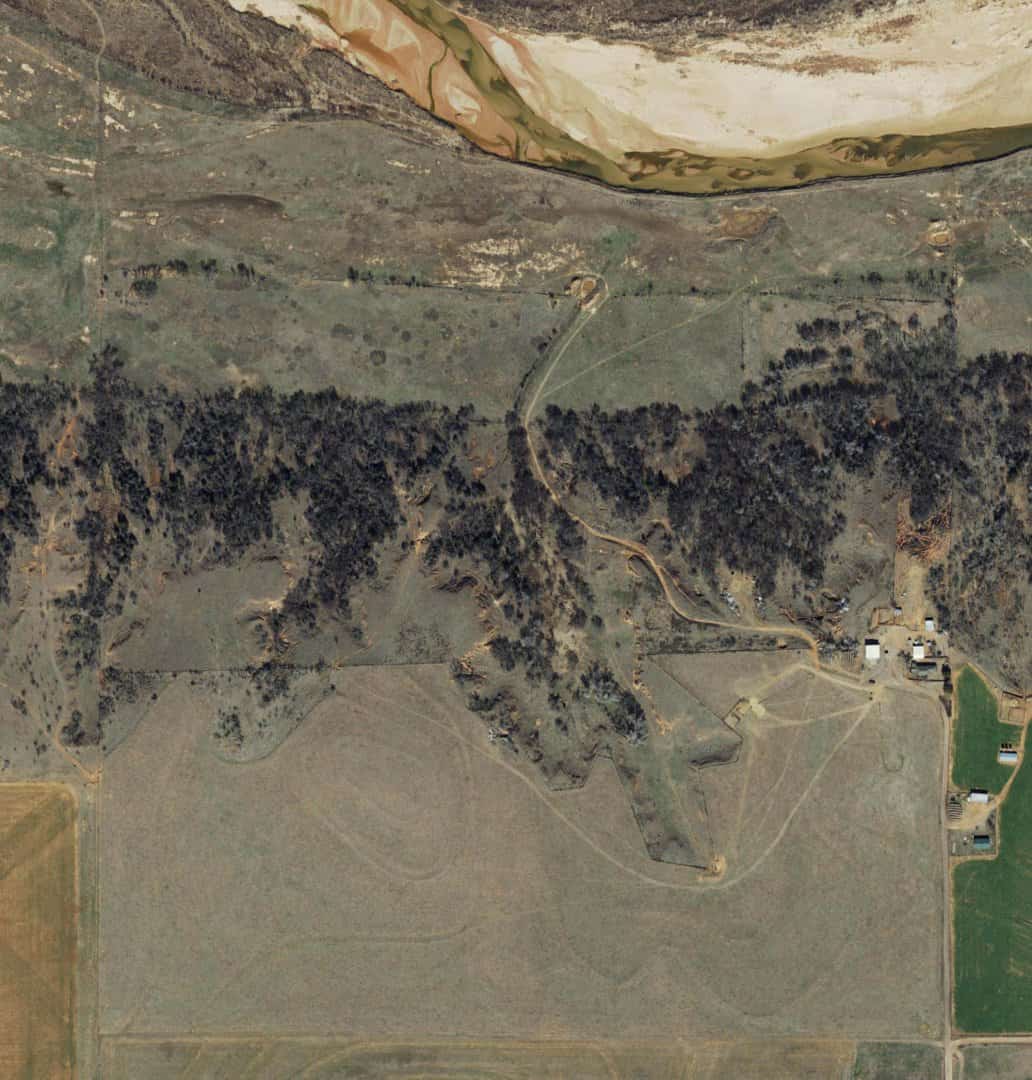
And here's what I think is "Section 47/48" of WAGGONER COLONY that in 1942 was conveyed to Charlie M. Aderholt (and the land lying North of the gradient boundary along the South bank of the Red River):
There aren't any recent Resurveys in GLO Records but A.D. Kidder signed this one which stops at the north meander line:
https://glorecords.blm.gov/details/survey/imaging/plat.aspx?viewer=html&viewerWindow=true&viewerWidth=1910&viewerHeight=1010&imageFile=PLATOK17040S0170WOK170040S0170W00002.SID&dm_id=19240&p_dm_id=33960&cs_idx=-1

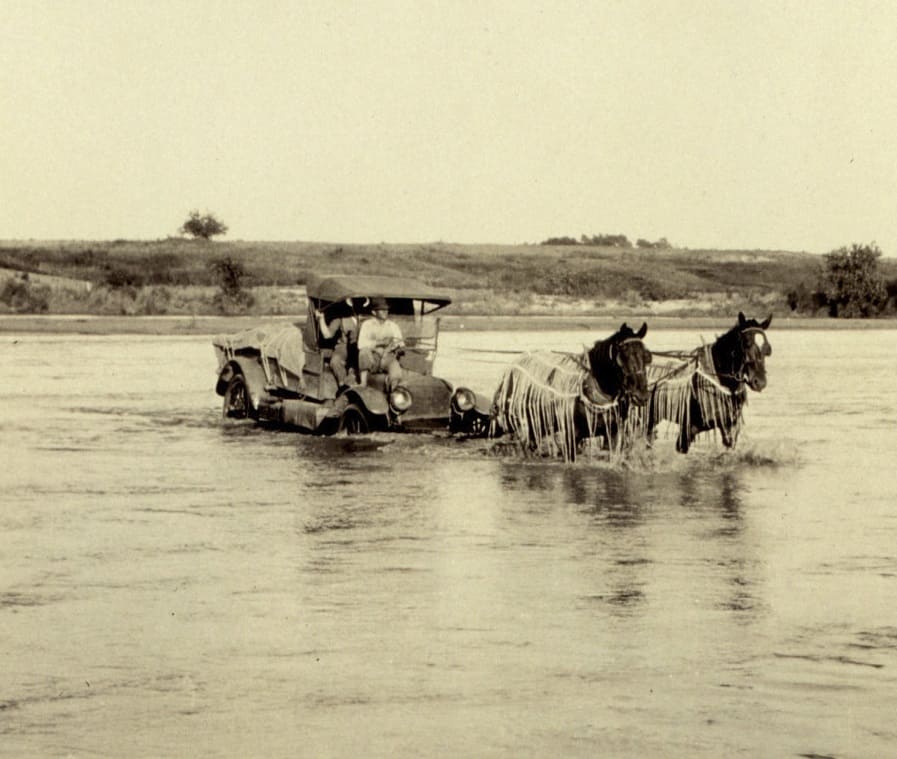
This USC&GS crew must have been looking for the gradient boundary when they crossed the Red River near Granite, OK in 1921? Photo courtesy of the NOAA Historic photo library. http://www.photolib.noaa.gov/htmls/theb0771.htm
Kent McMillan, post: 412630, member: 3 wrote: And here's what I think is "Section 47/48" of WAGGONER COLONY that in 1942 was conveyed to Charlie M. Aderholt (and the land lying North of the gradient boundary along the South bank of the Red River):
Why is the Texas GLO offering to sell copies of the Reports for hundreds of dollars? The PDF is free.
Dave Karoly, post: 412787, member: 94 wrote: Why is the Texas GLO offering to sell copies of the Reports for hundreds of dollars? The PDF is free.
That's just the cost of having lots of pages printed in color at the GLO. You can download the PDF and print it yourself for whatever your costs are. Color copies of legal size documents like field notes and correspondence are $2.00 per page at the GLO.
Kent McMillan, post: 412789, member: 3 wrote: That's just the cost of having lots of pages printed in color at the GLO. You can download the PDF and print it yourself for whatever your costs are. Color copies of legal size documents like field notes and correspondence are $2.00 per page at the GLO.
The last two pages of the third report is interesting. Stiles outlines his conflict with Kidder.
Dave Karoly, post: 412792, member: 94 wrote: The last two pages of the third report is interesting. Stiles outlines his conflict with Kidder.
Thanks for catching that. I had not ever noticed that memorandum by Stiles which detailed the fundamental disagreement that he and Arthur Kidder had about those pretty basic matters. As a point of interest, in my collection I have Christmas cards that Justice Willis Van Devanter later sent to Arthur A. Stiles after Oklahoma v. Texas as concluded.
Here is the memo by Arthur A. Stiles that is appended to the Texas GLO copy of the printed copy of the 3rd report by Kidder and Stiles. This memo is a classic in that it shows the fundamental disagreements that the two boundary commissioners, Stiles and Kidder, had even at that late date in the survey as well as the last minute tinkering that was involved in the survey.
Kent McMillan, post: 412466, member: 3 wrote: BTW, one of the more interesting things I've read about the Red River is this paper written by the University of Texas Plant Ecologist, B.C. Tharp, who was one of the witnesses for Texas in 1923. Thirty years later, he went back to revist the Big Bend area that was the focus of the 1923 proceeding and was startled by how very different everything was, even down to the plants growing in the channel. Here's a link to his paper in "The Southwestern Historical Quarterly":
https://texashistory.unt.edu/ark:/67531/metapth101196/m1/441/
I think this may be the same article found in the GLO archive but the maps are better.
I found a reference to a BLM Report on the Gradient Boundary filed in the NM office but I sure can't find it again. I thought I saw it in the Official Field Notes of one of the recent Resurveys but I can't see it a second time. It says the Report has numerous cites to authorities in it but I can't find the reference again.
Dave Karoly, post: 413454, member: 94 wrote: I think this may be the same article found in the GLO archive but the maps are better.
The maps in B.C. Tharp's paper are either the same ones that were published as exhibits to one of the reports by Kidder and Stiles in 1923 or were revised versions of them, as where a new channel had been cut by 1953 to sever a peninsula from the Texas mainland.
Photos of the Big Bend were taken from a report published by the University of Texas Bureau of Economic Geology in the 1920s that summarized the geologic and botanical investigations that had been made into various alleged changes in the position of the channel of the Red River after 1821. I have a copy of that report, but I don't think it is available on line yet.
Found it near the bottom of Page 4 of the Field Notes:
"On January 14, 2005, the Cadastral Survey Team of the New Mexico State Office prepared a "REPORT ON THE BOUNDARY ISSUES ALONG THE RED RIVER IN RANGES 12 THROUGH 15 WEST, OF THE INDIAN MERIDIAN, IN THE STATE OF OKLAHOMA", which provided numerous Supreme Court cites and outlined the surveying methodology that would be used on that stretch of the Red River."
T4S, R14W, Indian Meridian (Oklahoma)
https://glorecords.blm.gov/details/survey/default.aspx?dm_id=77545&sid=dbedtbr2.0hn
https://glorecords.blm.gov/details/survey/default.aspx?dm_id=77545&sid=dbedtbr2.0hn&apos ;">Dependent Resurvey 2/28/2006 OK Indian 004.0S - 014.0W Subdivisional, Sections Tillman https://glorecords.blm.gov/details/fieldnote/default.aspx?dm_id=106193&s_dm_id=77545&sid=dbedtbr2.0hn&apos ;">00242
Kent McMillan, post: 413458, member: 3 wrote: The maps in B.C. Tharp's paper are either the same ones that were published as exhibits to one of the reports by Kidder and Stiles in 1923 or were revised versions of them, as where a new channel had been cut by 1953 to sever a peninsula from the Texas mainland.
Photos of the Big Bend were taken from a report published by the University of Texas Bureau of Economic Geology in the 1920s that summarized the geologic and botanical investigations that had been made into various alleged changes in the position of the channel of the Red River after 1821. I have a copy of that report, but I don't think it is available on line yet.
I failed to post the link which my post referred to somehow:
http://www.glo.texas.gov/ncu/SCANDOCS/archives_webfiles/arcmaps/webfiles/arcmaps/pdfs/4/9/49546.pdf