

I was wondering if it was normal for these drains in the wall to be flowing so much water all the way to the top of the spillway. 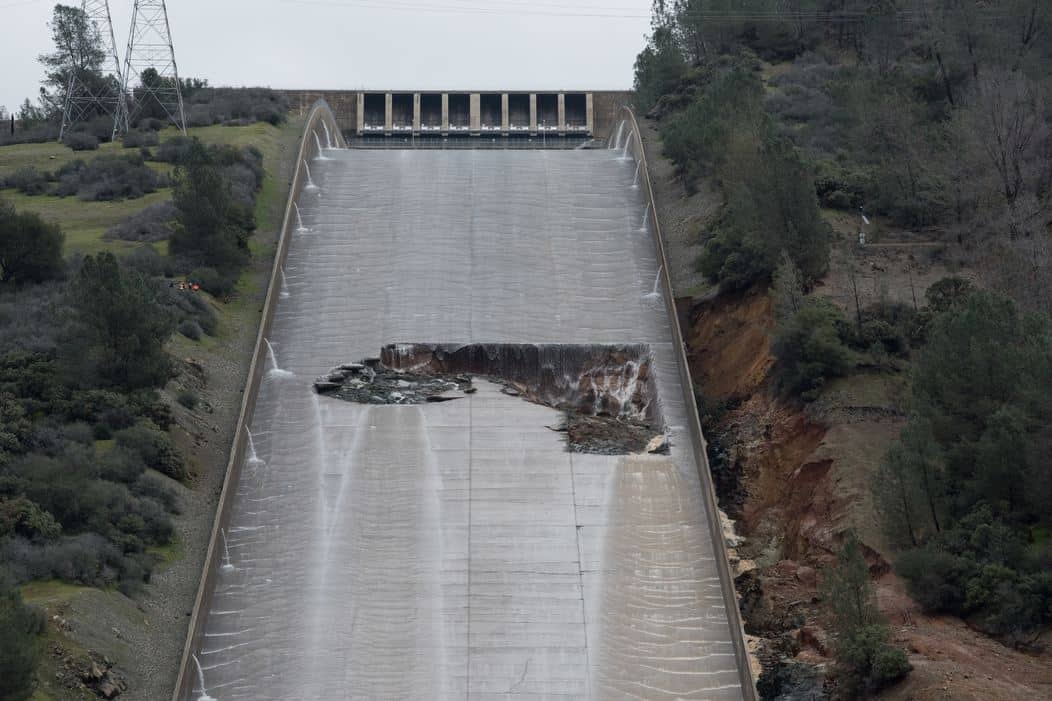

Jim in AZ, post: 415193, member: 249 wrote: Okay ... So the spillway damage was probably caused by cavitation?
I don't know whether it was cavitation. That is when the pressure goes negative and the water starts to turn into a gas. The bubbles explode and can cause quite a bit of damage. I would look for it in a closed pipe or pump but not saying it couldn't happen a in a open channel flow situation (supercritical for sure in this situation).
I'd be more inclined to think the spillway had over run its design life and should have been replaced before now. But there again I don't know what the design life was. Concrete will last a long time if you can keep water out of the cracks and then freezing. Concrete cracks, that's just a fact. What I was taught was that hydraulic structures need to be the toughest as they take more abuse than almost any others. The reinforcement usually doesn't last as long as the concrete. That's one heck of a spillway. Just the temperature expansion and shrinkage would be a difficult design parameter to deal with. It should be obvious now that the design life was exceeded. There are improved methods now like prestressing and such but still, that's one heck of concrete structure to design.
Paul in PA, post: 415225, member: 236 wrote: It appears the Oroville spillway was designed and constructed just prior to information being published on cavitation in spillways. Other spillways have since been upgraded to reduce cavitation. What is being missed by many is that in recent inspections the they avoided actually inspecting the spillway in detail. It is highly probable that cavitation had caused sufficient changing of the spillway surface that cavitation would be increasingly induced in future events. From what I can see in pictures and videos which are slow in being released is that the at least the lower 75% of the spillway will have to be replaced. Everything from the break on down has been compromised by underminng of the supporting soil and rock.
From the Noon press conference yesterday I got the impression that they may require 2 years to fully repair it. Somehow they think they can continue to operate the reservoir without complete repairs.
My personal opinion is that the reservoir should be reduced to 75% below typical use until final solutions are installed. A new lower elevation spillway should be constructed and they have to fully repair the bottom drains to 100% effectiveness not the current 40%. After that it the reservoir should be limited to 90%.
Paul in PA
I'd tend to agree, SOP is to drain a reservoir with major repairs needed, but I've never been involved in one this big. It's a big time roll of the dice to operate a reservoir without the needed capacity to release the water. Many dam failures in history were over topping during construction where the capacity to release water hadn't been built yet. Here it's severely crippled. This is a lose-lose for sure. Drain the water and big time water shortages and economic loss. Get a bigger than probability storm with the crippled capacity to release and kill a lot of people and epic damages.

LRDay, post: 415267, member: 571 wrote: I don't know whether it was cavitation. That is when the pressure goes negative and the water starts to turn into a gas. The bubbles explode and can cause quite a bit of damage. I would look for it in a closed pipe or pump but not saying it couldn't happen a in a open channel flow situation (supercritical for sure in this situation).
I'd be more inclined to think the spillway had over run its design life and should have been replaced before now. But there again I don't know what the design life was. Concrete will last a long time if you can keep water out of the cracks and then freezing. Concrete cracks, that's just a fact. What I was taught was that hydraulic structures need to be the toughest as they take more abuse than almost any others. The reinforcement usually doesn't last as long as the concrete. That's one heck of a spillway. Just the temperature expansion and shrinkage would be a difficult design parameter to deal with. It should be obvious now that the design life was exceeded. There are improved methods now like prestressing and such but still, that's one heck of concrete structure to design.
There will probably be volumes written about what caused the failure. I'm sure age, materials, conditions and water all had their hand in there.
I am not an engineer, but I've seen a jillion square yards of reinforced flatwork, some good and some bad. Concrete usually has moisture migrating underneath also. I'm sure in this case mitigating the subsurface water was as much a part of the design as the flows it was designed to carry. If the water underneath was trying to keep up with what was on top, strange things might have happened.
The size of the spillway falls into the "pretty big" category. Those longitudinal joints are 40' oc. That's a 180' wide spillway at God-knows-how-steep a grade.
I'm amazed after such a lengthy drought that more of that spillway didn't get up and walk off with the pounding it took.

imaudigger, post: 415233, member: 7286 wrote: Paul, are you privy to the dam inspection reports? What makes you think they purposely avoided a detailed inspection of the spillway?
Who is "they"?I am not familiar with dam inspection procedures, but I suspect inspection is done on a specified interval, which is dependent on the condition of the structure.
An earlier report said that in the two most recent inspections no one walked on the spillway surface, only visual inspection from the air.
Paul in PA

Money. It's always about the money and the voters who are losing that money. They want to have their cake and eat it, too.
How does the local economy suffer as the level drops, especially for an extended period? Google Earth shows significant boating activity, for example.
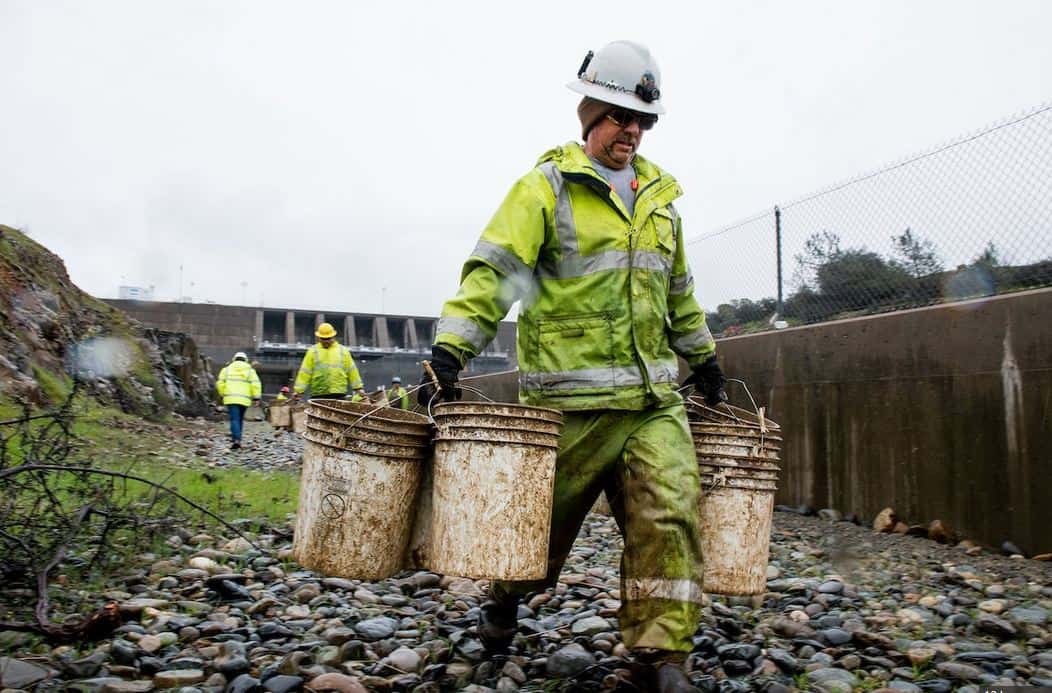
I am wondering what the bucket brigade is all about? Seems like they could be using a more efficient method...It seems like they could use a wide tracked skip loader to at least cut 300 yards off the distance they have to pack buckets! Or how about stringing up a cable? They must be doing some sort of maintenance on the drainage system shown in the photo above?
imaudigger, post: 415335, member: 7286 wrote: I am wondering what the bucket brigade is all about? Seems like they could be using a more efficient method...It seems like they could use a wide tracked skip loader to at least cut 300 yards off the distance they have to pack buckets! Or how about stringing up a cable? They must be doing some sort of maintenance on the drainage system shown in the photo above?
Possibly taking samples for testing? Or maybe some small miniscule repair. Who knows? Looks like the buckets have had grout or concrete in them. Whatever they're doing I would almost bet there's a good explanation. 😉

imaudigger, post: 415335, member: 7286 wrote: I am wondering what the bucket brigade is all about?
I wouldn't call "that" a bucket brigade; those buckets look empty to me and he's probably hauling them off because they're done...
paden cash, post: 415346, member: 20 wrote: Whatever they're doing I would almost bet there's a good explanation. 😉
[SARCASM]That sounds Reasonable to me...[/SARCASM]

There are reasons that they call the overflow system an emergency spillway.
In the event of the possibility of water breaching the dam it allows water to leave the lake along a route to the downstream natural waterway.
The overflow system is not expected to actually prevent any failures to happen downstream, it's purpose is to hope it allows enough water to leave the reservoir and prevent dam failure and loss.
It has been doing that, unfortunately the viaduct is falling apart because water flow began under the concrete.
Too bad the sidewalls did not extend deeper into the side of the dam.

All you engineers out there, what's the difference between concrete spalling vs. cavitation? 😎
paden cash, post: 415346, member: 20 wrote: Possibly taking samples for testing? Or maybe some small miniscule repair. Who knows? Looks like the buckets have had grout or concrete in them. Whatever they're doing I would almost bet there's a good explanation. 😉
I'm sure your right....but it is so fun second guessing...Maybe not quite as efficient as a bucket brigade..
imaudigger, post: 415362, member: 7286 wrote: I'm sure your right....but it is so fun second guessing...Maybe not quite as efficient as a bucket brigade..
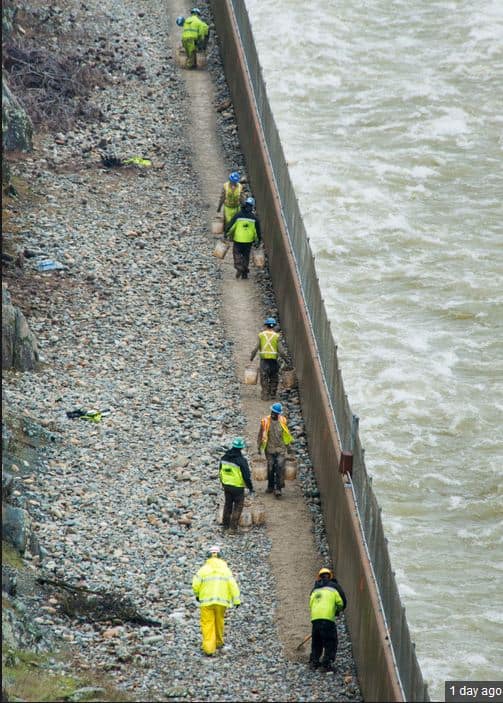
You know, in light of that second picture it almost looks like they're cleaning debris off the parapet footing....by hand. :confounded:
So my guess then would be (a) there is no physical access for equipment or (b) it is a Californiated ecologically sensitive area or (c) the equivalent of some green "Lt." is making sure everybody is doing something....
Those are my "reasonable" assumptions. 🙂
paden cash, post: 415376, member: 20 wrote: You know, in light of that second picture it almost looks like they're cleaning debris off the parapet footing....by hand. :confounded:
So my guess then would be (a) there is no physical access for equipment or (b) it is a Californiated ecologically sensitive area or (c) the equivalent of some green "Lt." is making sure everybody is doing something....
Those are my "reasonable" assumptions. 🙂
I'm thinking they are placing sand/cement slurry or something....
Based on the methods and the blue hard hats, my gut feeling is that it is a http://www.ccc.ca.gov/Pages/default.aspx&apos ;">CCC work crew making a walkway for easier walking over those rocks.
I wish they had a information page outlining the repair efforts, just because I'm interested.

FL/GA PLS., post: 415361, member: 379 wrote: All you engineers out there, what's the difference between concrete spalling vs. cavitation? 😎
I suppose one could say spalling is concrete breaking out due to something expanding inside it, like corroding reinforcement, whereas damage from cavitation is a result of adverse fluid action on the outside face of the concrete. I've heard genuine cavitation once, in a valve/pipeline from a dam and it sounds like rocks rolling down a pipe.
imaudigger, post: 415379, member: 7286 wrote: I'm thinking they are placing sand/cement slurry or something....
Based on the methods and the blue hard hats, my gut feeling is that it is a http://www.ccc.ca.gov/Pages/default.aspx&apos ;">CCC work crew making a walkway for easier walking over those rocks.I wish they had a information page outlining the repair efforts, just because I'm interested.
I agree with imaudigger, they are most likely placing a sand cement mixture to make a safer walkway along the outer wall of the spillway for future repairs or inspection.
Paul in P

They shut down the main spillway to get a look at the damage. Embedding a link to the image didn't work so here's the https://pixel-ca-dwr.photoshelter.com/galleries/C0000OxvlgXg3yfg/G00003YCcmDTx48Y/I0000OcLDDFj7wVI/BB-OROVILE-DAM-1726-02-28-2017-JPG&apos ;">link. There's a bunch of other pictures there (including the guy hauling buckets).
Just from a glance with a "seat of the pants" estimate I'm thinking there's a quarter of a million cubic yards of subgrade missing on the spillway area alone. The backslopes could quadruple that amount. Somebody's gonna burn up a lot of diesel filling up that hole.
They may as well have built a waterfall.
That is such a tall dam to try and carry all that water with a concrete ramp.

imaudigger, post: 415335, member: 7286 wrote: I am wondering what the bucket brigade is all about? Seems like they could be using a more efficient method...It seems like they could use a wide tracked skip loader to at least cut 300 yards off the distance they have to pack buckets! Or how about stringing up a cable? They must be doing some sort of maintenance on the drainage system shown in the photo above?
Union job...?