Reading RPLS is free for the whole profession. Members post, reply, and get the members-only rooms.

Notifications
Clear all
Strictly Surveying
61
Posts
12
Users
0
Reactions
1,896
Views

Topic starter
Translate
▼
English
Spanish
French
German
Italian
Portuguese
Russian
Chinese
Japanese
Korean
Arabic
Hindi
Dutch
Polish
Turkish
Vietnamese
Thai
Swedish
Danish
Finnish
Norwegian
Czech
Hungarian
Romanian
Greek
Hebrew
Indonesian
Malay
Ukrainian
Bulgarian
Croatian
Slovak
Slovenian
Serbian
Lithuanian
Latvian
Estonian
Here is an interesting twist on a gap not of record. While the parcels are three lode mining claims and a mill site, please consider that the solution is not dependent upon a specialized knowledge of mining claims.
In 1882, the Old Lode (MS 1500) was surveyed by U.S. Dep. Mineral Surveyor, Albert E. Chase with a solar transit and 500 ft. steel tape. The plat shows it to be 1500 feet long and 150 feet wide. The plat and field notes show a connection between Cor. No. 1 and a section corner on the south township line to be S14?ø27'W, a distance of 8010.8 ft. All four corners are chiseled stones surrounded with a mound of stone. The patent was issued in 1885 and it does not state any conflicts or exclusions with other claims (acreage of 5.165 acres).
In 1902, the One and Two lode claims and a mill site (MS 15000 A&B) were surveyed by U.S. Dep. Mineral Surveyor, A.J. Ventress with a Gurley Light Mountain transit and 500 ft. steel tape. The true meridian was determined by direct solar observations. The plat shows both lode claims to be 1500 feet by 150 feet and the mill site boundary is coincident with the side lines of the Old, One, and Two lodes. The plat and field notes show connections between Cors. Nos. 1 of the One and Two lodes and Cor. No. 1 of the mill site and a section corner on the south township line (same PLSS corner as MS 1500) to be S9?ø24'W, 8194.3 ft, S17?ø27'W, 8251.6 ft., and S13?ø31'W, 8556.5 ft., respectively.
All 8 lode claim corners and Cors. No. 2 and 3 of the mill site are chiseled stones surrounded by mounds of stone. Cor. No. 1 of the mill site falls on a 8 x 3 ft. boulder, standing 2 ft. above the ground and marked with a chiseled "+". The patent was issued in 1904 and it expressly excepts and excludes from the patent that portion of the Old Lode (MS1500) in conflict with the One and Two lodes (acreage of 9.661). The patent states that the mill site has an acreage of 1.316 acres.
Plat for Sur. No. 15000 A&B showing conflict with Old Lode, Sur. No. 1500.
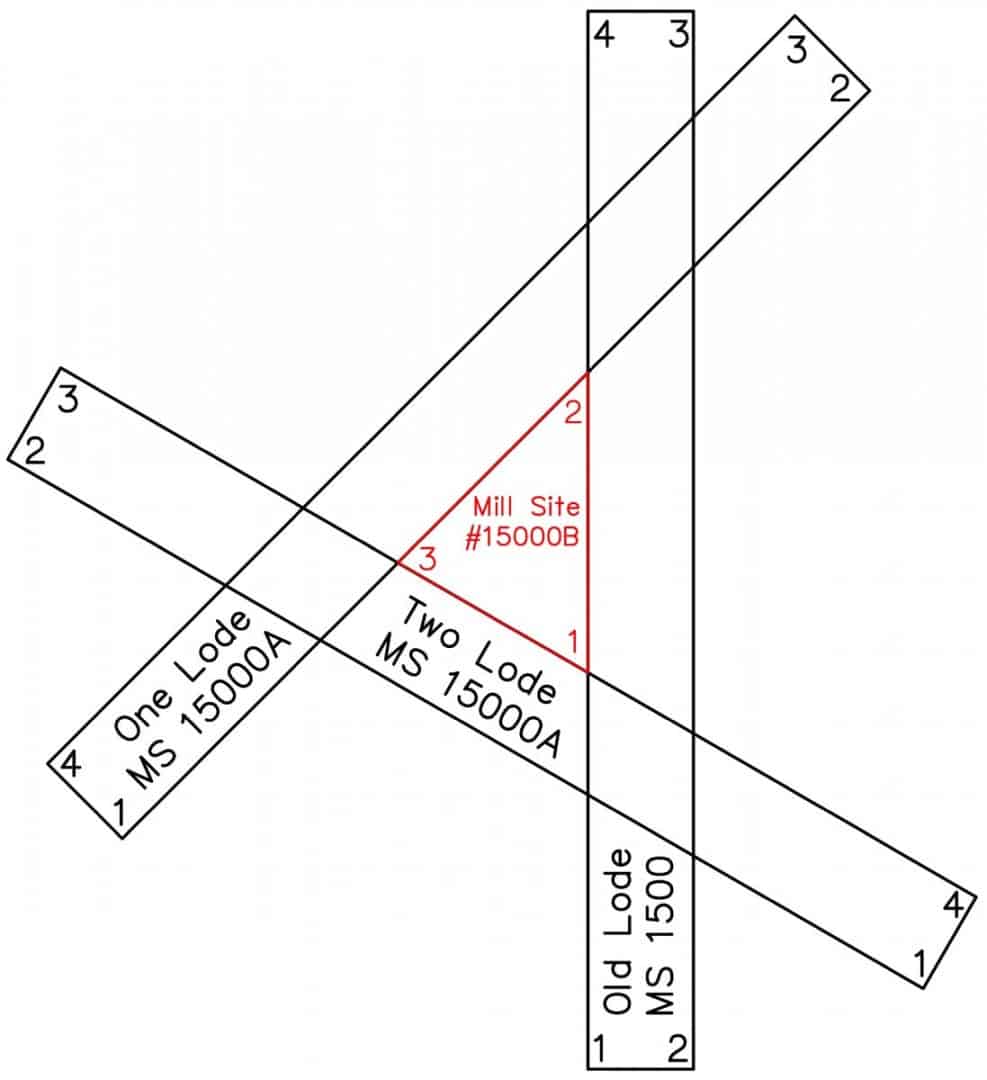
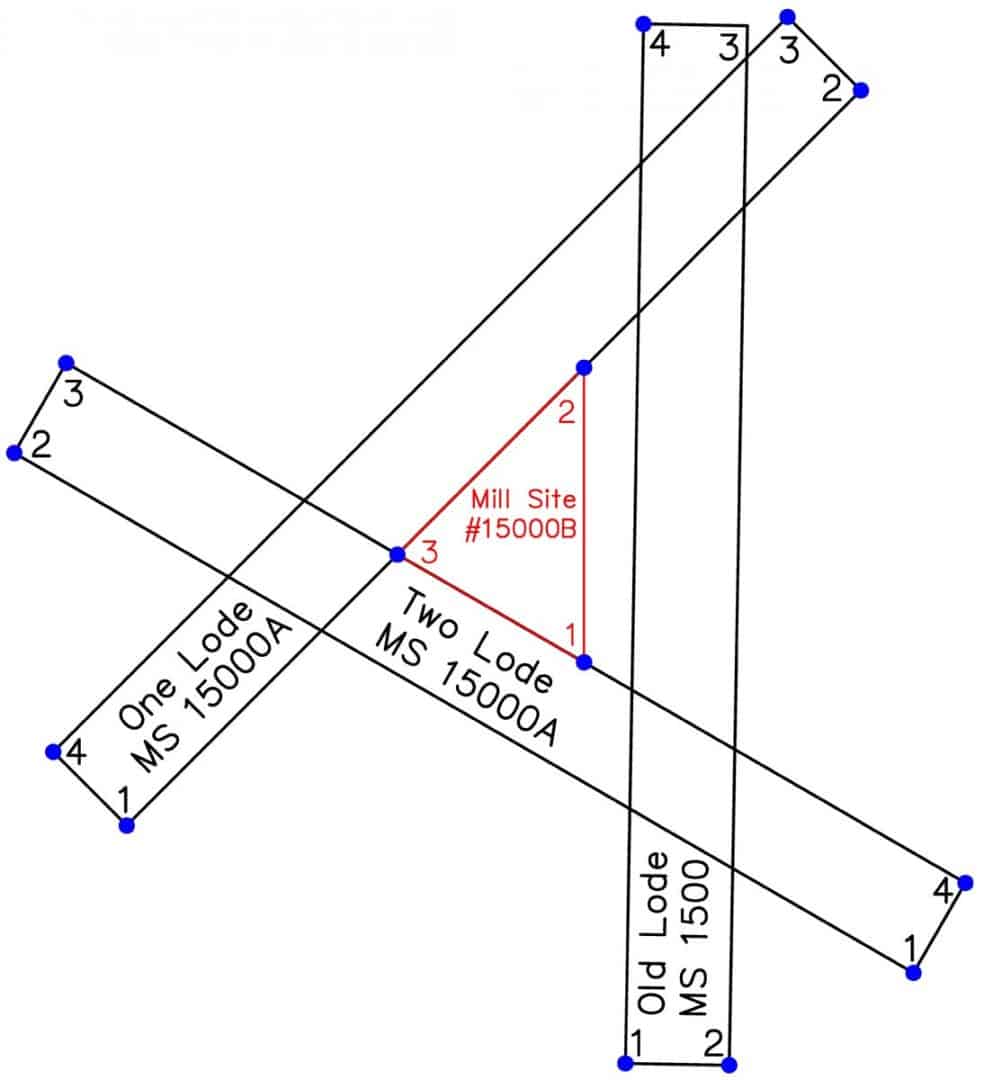
I conducted a field survey and found all of the original corners either firmly set or reestablished from the stone mound or original accessories). The exception is Cor. No. 3 of the Old Lode, which currently falls in a road. The measured courses and distances "reasonably" match the record dimensions for Sur. No. 15000 A&B. The distances of the Old Lode reasonably match the record. Line 1-2 of the mill site matches record of N0?øE, but Line 4-1 of the Old Lode is S1?øW. The mining improvements for the Old Lode fit the found position, not the position shown on Sur. No. 15000 A&B. The area is covered in pine forest and there are no improvements placed on any of the boundary lines (i.e. no fences). My client owns the mill site and wants to build a cabin. There is an existing road that provides access from the north to the Old Lode.
Cors. Nos. 3 and 2 of the mill site create two angle points in Line 1-2 of the One Lode with fallings of 0.4 ft. and 0.6 ft. respectively. Cors. Nos. 3 and 1 of the mill site create two angle points in Line 3-4 of the Two Lode with fallings of 0.3 ft. for both corners. Instead of being coincident, Line 4-1 of the Old Lode is approx. 74 ft. east of Line 1-2 of the mill site.
The field notes for the mill site (MS 15000B) clearly state that Cor. No. 1 is a chiseled "+" in a boulder and was set at the intersection of Line 4-1 of the Old Lode and Line 3-4 of the Two Lode. The field notes continue, "Thence north along Line 4-1 of the Old Lode a distance of 425.2 ft. to Cor. No. 2 at the intersection with Line 1-2 of the One Lode." There is a gap of 0.82 acres.
Preliminary plat showing the found positions of the 3 lode claims and mill site.
These claims are private inholdings within a national forest located somewhere in Colorado. What would you do with the "technical gap" (i.e. it is not of record).
- The monuments are still in their originally established positions. Hold everything and show the gap. The gap is Federal interest land.
- Hold the call to the senior line over the original monuments. They are closing corners. Set new monuments at the true intersections.
- Despite the suspected blunder of Dep. Ventress there is no gross error or fraud and since the other criteria of "mistake" is not defined in Chapter X of the 2009 manual, it is appropriate to bend Line 4-1 of the Old Lode through Cors. Nos. 2 and 1 of the mill site. This is in keeping the general rule that no gap in the record, no gap on the ground. (Sorry, this one is specific to mineral surveys.)
- Call your buddies at the USFS and BLM.
- Other solutions?
Posted : July 17, 2017 6:42 pm

Translate
▼
English
Spanish
French
German
Italian
Portuguese
Russian
Chinese
Japanese
Korean
Arabic
Hindi
Dutch
Polish
Turkish
Vietnamese
Thai
Swedish
Danish
Finnish
Norwegian
Czech
Hungarian
Romanian
Greek
Hebrew
Indonesian
Malay
Ukrainian
Bulgarian
Croatian
Slovak
Slovenian
Serbian
Lithuanian
Latvian
Estonian
2
Posted : July 17, 2017 8:39 pm

Translate
▼
English
Spanish
French
German
Italian
Portuguese
Russian
Chinese
Japanese
Korean
Arabic
Hindi
Dutch
Polish
Turkish
Vietnamese
Thai
Swedish
Danish
Finnish
Norwegian
Czech
Hungarian
Romanian
Greek
Hebrew
Indonesian
Malay
Ukrainian
Bulgarian
Croatian
Slovak
Slovenian
Serbian
Lithuanian
Latvian
Estonian
Gene Kooper, post: 437352, member: 9850 wrote:
- Other solutions?
As you may know, parts of Colorado were once part of Texas. If this were in Texas, the operative principle would be whether the call for adjoiner was made by speculation or mistake or whether the surveyor of the Mill Site actually had knowledge of the location of the West line of the Old Lode. If the call for adjoiner were made purely by speculation, then there is a basis for arguing that it does not control. On the other hand, if the survey did have the means to know where the West line of the Old Lode was, but was merely mistaken in his measurements, then the adjoiner call would most likely control.
In your case, that might boil down to a fact question such as whether the same surveyor who surveyed the Old Lode also surveyed the Mill Site, but merely made a mistake in his calculations. I have Texas in mind, of course and you are in Colordado.
In Colorado, the most important question is probably what the cookbook and various recipes issued in the form of instructions provided at the time that the Mill Site was surveyed and title left the United States.
Posted : July 17, 2017 9:49 pm

Translate
▼
English
Spanish
French
German
Italian
Portuguese
Russian
Chinese
Japanese
Korean
Arabic
Hindi
Dutch
Polish
Turkish
Vietnamese
Thai
Swedish
Danish
Finnish
Norwegian
Czech
Hungarian
Romanian
Greek
Hebrew
Indonesian
Malay
Ukrainian
Bulgarian
Croatian
Slovak
Slovenian
Serbian
Lithuanian
Latvian
Estonian
Kent McMillan, post: 437363, member: 3 wrote: As you may know, parts of Colorado were once part of Texas. If this were in Texas, the operative principle would be whether the call for adjoiner was made by speculation or mistake or whether the surveyor of the Mill Site actually had knowledge of the location of the West line of the Old Lode. If the call for adjoiner were made purely by speculation, then there is a basis for arguing that it does not control. On the other hand, if the survey did have the means to know where the West line of the Old Lode was, but was merely mistaken in his measurements, then the adjoiner call would most likely control.
In your case, that might boil down to a fact question such as whether the same surveyor who surveyed the Old Lode also surveyed the Mill Site, but merely made a mistake in his calculations. I have Texas in mind, of course and you are in Colordado.
In Colorado, the most important question is probably what the cookbook and various recipes issued in the form of instructions provided at the time that the Mill Site was surveyed and title left the United States.
Kent,
The first clue to consider, is the date of Mineral Survey 15000A&B (1902)!
BTW, ALL of Texas was part of Mexico, so what does any of that have to do with US Mineral Surveys?
Loyal
Posted : July 17, 2017 9:59 pm
Translate
▼
English
Spanish
French
German
Italian
Portuguese
Russian
Chinese
Japanese
Korean
Arabic
Hindi
Dutch
Polish
Turkish
Vietnamese
Thai
Swedish
Danish
Finnish
Norwegian
Czech
Hungarian
Romanian
Greek
Hebrew
Indonesian
Malay
Ukrainian
Bulgarian
Croatian
Slovak
Slovenian
Serbian
Lithuanian
Latvian
Estonian
Loyal, post: 437364, member: 228 wrote: ALL of Texas was part of Mexico, so what does any of that have to do with US Mineral Surveys?
Actually, a good bit of New Mexico and Colorado was part of the Republic of Texas before the United States paid a large sum of money to Texas to abandon any claim to either. Since that is the case, I felt it was proper to imagine what might have been had Colorado not fallen to the recipes and cookbooks that determine the solution to Gene's problem. One has to keep a sense of historical perspective, after all.
Posted : July 17, 2017 10:09 pm
Translate
▼
English
Spanish
French
German
Italian
Portuguese
Russian
Chinese
Japanese
Korean
Arabic
Hindi
Dutch
Polish
Turkish
Vietnamese
Thai
Swedish
Danish
Finnish
Norwegian
Czech
Hungarian
Romanian
Greek
Hebrew
Indonesian
Malay
Ukrainian
Bulgarian
Croatian
Slovak
Slovenian
Serbian
Lithuanian
Latvian
Estonian
Cor 1 and 4 of the Old Mill Lode are existent. The surveyor of the Mill Site was supposed to find them and use for establishing corners 1 and 2 of the Mill Site. The Mill Site Plat shows the east line of the Mill Site coincident with the west line of Old Lode, this shows the intention to leave no gap. If there were two versions of the west line of Old Lode then there would be a question of fact which one was referred to on the Plat but that is not in this case. The monuments establish the line.
Granted the BLM may be of the opinion that the Mill Site corners establish the boundaries of the patent although they wouldn't in the case of an overlap.
Posted : July 17, 2017 10:15 pm
Translate
▼
English
Spanish
French
German
Italian
Portuguese
Russian
Chinese
Japanese
Korean
Arabic
Hindi
Dutch
Polish
Turkish
Vietnamese
Thai
Swedish
Danish
Finnish
Norwegian
Czech
Hungarian
Romanian
Greek
Hebrew
Indonesian
Malay
Ukrainian
Bulgarian
Croatian
Slovak
Slovenian
Serbian
Lithuanian
Latvian
Estonian
Kent McMillan, post: 437365, member: 3 wrote: Actually, a good bit of New Mexico and Colorado was part of the Republic of Texas before the United States paid a large sum of money to Texas to abandon any claim to either. Since that is the case, I felt it was proper to imagine what might have been had Colorado not fallen to the recipes and cookbooks that determine the solution to Gene's problem. One has to keep a sense of historical perspective, after all.
You REALLY don't get it do ya?
o_O
Posted : July 17, 2017 10:16 pm
Translate
▼
English
Spanish
French
German
Italian
Portuguese
Russian
Chinese
Japanese
Korean
Arabic
Hindi
Dutch
Polish
Turkish
Vietnamese
Thai
Swedish
Danish
Finnish
Norwegian
Czech
Hungarian
Romanian
Greek
Hebrew
Indonesian
Malay
Ukrainian
Bulgarian
Croatian
Slovak
Slovenian
Serbian
Lithuanian
Latvian
Estonian
Loyal, post: 437367, member: 228 wrote: You REALLY don't get it do ya?
Sure I do. Gene's solution will depend upon some specific instruction (aka "recipe") that was in effect when the Mill Site was surveyed and title left the United States. It's a classic example of cookbooking.
Posted : July 17, 2017 10:19 pm
Topic starter
Translate
▼
English
Spanish
French
German
Italian
Portuguese
Russian
Chinese
Japanese
Korean
Arabic
Hindi
Dutch
Polish
Turkish
Vietnamese
Thai
Swedish
Danish
Finnish
Norwegian
Czech
Hungarian
Romanian
Greek
Hebrew
Indonesian
Malay
Ukrainian
Bulgarian
Croatian
Slovak
Slovenian
Serbian
Lithuanian
Latvian
Estonian
Dave,
I argued in front of a bunch of federal surveyors back in 2011 that No. 2 was the correct choice. I carried my argument beyond where I should have by saying that calls to senior lines were regarded as natural monuments in Skelton's treatise. That was quickly rebutted since my mineral survey example was subject to Federal rules, while Skelton's examples were subject to state rules.
Posted : July 17, 2017 10:22 pm
Translate
▼
English
Spanish
French
German
Italian
Portuguese
Russian
Chinese
Japanese
Korean
Arabic
Hindi
Dutch
Polish
Turkish
Vietnamese
Thai
Swedish
Danish
Finnish
Norwegian
Czech
Hungarian
Romanian
Greek
Hebrew
Indonesian
Malay
Ukrainian
Bulgarian
Croatian
Slovak
Slovenian
Serbian
Lithuanian
Latvian
Estonian
Gene Kooper, post: 437369, member: 9850 wrote: I argued in front of a bunch of federal surveyors back in 2011 that No. 2 was the correct choice. I carried my argument beyond where I should have by saying that calls to senior lines were regarded as natural monuments in Skelton's treatise. That was quickly rebutted since my mineral survey example was subject to Federal rules, while Skelton's examples were subject to state rules.
So, if I understand you, they took issue with your use of the wrong cookbook?
Posted : July 17, 2017 10:37 pm
Topic starter
Translate
▼
English
Spanish
French
German
Italian
Portuguese
Russian
Chinese
Japanese
Korean
Arabic
Hindi
Dutch
Polish
Turkish
Vietnamese
Thai
Swedish
Danish
Finnish
Norwegian
Czech
Hungarian
Romanian
Greek
Hebrew
Indonesian
Malay
Ukrainian
Bulgarian
Croatian
Slovak
Slovenian
Serbian
Lithuanian
Latvian
Estonian
Kent McMillan, post: 437363, member: 3 wrote: As you may know, parts of Colorado were once part of Texas. If this were in Texas, the operative principle would be whether the call for adjoiner was made by speculation or mistake or whether the surveyor of the Mill Site actually had knowledge of the location of the West line of the Old Lode. If the call for adjoiner were made purely by speculation, then there is a basis for arguing that it does not control. On the other hand, if the survey did have the means to know where the West line of the Old Lode was, but was merely mistaken in his measurements, then the adjoiner call would most likely control.
In your case, that might boil down to a fact question such as whether the same surveyor who surveyed the Old Lode also surveyed the Mill Site, but merely made a mistake in his calculations. I have Texas in mind, of course and you are in Colordado.
In Colorado, the most important question is probably what the cookbook and various recipes issued in the form of instructions provided at the time that the Mill Site was surveyed and title left the United States.
I listed who the two mineral surveyors were in the opening post. The Old Lode was surveyed by Albert E. Chase, who conducted mineral surveys from 1880 to 1904. He was one of the more prolific mineral surveyors in Colorado with a total of 376 approved mineral surveys. The One and Two lodes were surveyed by Arthur J. Ventress, who conducted mineral surveys from 1897 to 1905 with a total of 195 approved mineral surveys. Mr. Ventress was also a mining engineer whose career was cut short when he died in an accident at the Argo Tunnel that ran from Idaho Springs to Central City.
Fact: No mistake was made in any calculations.
As for your insistence that the answer must lie in the Cookbook and its various recipes, the answer is no. There was an obscure Departmental letter that the U.S. Surveyor General of Colorado excerpted a couple of paragraphs from to create a circular to his deputies that contributed to the cadastral mayhem, but I'll wait a bit to address its impact.
I know this will just be ignored by you Kent, but various sets of instructions are valuable to today's surveyor for one reason; that being what the original surveyor was supposed to do. The next thing to look at is what did the original surveyor say he did (i.e. what's in the field notes and on his preliminary plat). The most important thing for the retracement surveyor is unsurprisingly what evidence was found for what the original surveyor actually did.
Posted : July 17, 2017 10:49 pm
Translate
▼
English
Spanish
French
German
Italian
Portuguese
Russian
Chinese
Japanese
Korean
Arabic
Hindi
Dutch
Polish
Turkish
Vietnamese
Thai
Swedish
Danish
Finnish
Norwegian
Czech
Hungarian
Romanian
Greek
Hebrew
Indonesian
Malay
Ukrainian
Bulgarian
Croatian
Slovak
Slovenian
Serbian
Lithuanian
Latvian
Estonian
Gene Kooper, post: 437369, member: 9850 wrote: Dave,
I argued in front of a bunch of federal surveyors back in 2011 that No. 2 was the correct choice. I carried my argument beyond where I should have by saying that calls to senior lines were regarded as natural monuments in Skelton's treatise. That was quickly rebutted since my mineral survey example was subject to Federal rules, while Skelton's examples were subject to state rules.
If the senior line is discoverable then it can't be moved.
The case could be made that in the case of a conflict between a call for a monument and a call for a line the patent would be limited by the call for the monument. I think this fails to take into account the superior rule, the intentions of the patent is the paramount consideration, that is to leave no gap.
Posted : July 17, 2017 10:54 pm
Translate
▼
English
Spanish
French
German
Italian
Portuguese
Russian
Chinese
Japanese
Korean
Arabic
Hindi
Dutch
Polish
Turkish
Vietnamese
Thai
Swedish
Danish
Finnish
Norwegian
Czech
Hungarian
Romanian
Greek
Hebrew
Indonesian
Malay
Ukrainian
Bulgarian
Croatian
Slovak
Slovenian
Serbian
Lithuanian
Latvian
Estonian
Gene Kooper, post: 437371, member: 9850 wrote: There was an obscure Departmental letter that the U.S. Surveyor General of Colorado excerpted a couple of paragraphs from to create a circular to his deputies that contributed to the cadastral mayhem, but I'll wait a bit to address its impact.
So what you're saying is that you found a particular recipe that was well understood to be part of the cookbook as used at an earlier date? That is exactly what I suspected.
Posted : July 17, 2017 11:03 pm
Translate
▼
English
Spanish
French
German
Italian
Portuguese
Russian
Chinese
Japanese
Korean
Arabic
Hindi
Dutch
Polish
Turkish
Vietnamese
Thai
Swedish
Danish
Finnish
Norwegian
Czech
Hungarian
Romanian
Greek
Hebrew
Indonesian
Malay
Ukrainian
Bulgarian
Croatian
Slovak
Slovenian
Serbian
Lithuanian
Latvian
Estonian
Kent McMillan, post: 437374, member: 3 wrote: So what you're saying is that you found a particular recipe that was well understood to be part of the cookbook as used at an earlier date? That is exactly what I suspected.
Now you're just trolling LOL. Carry on.
Posted : July 17, 2017 11:05 pm
Topic starter
Translate
▼
English
Spanish
French
German
Italian
Portuguese
Russian
Chinese
Japanese
Korean
Arabic
Hindi
Dutch
Polish
Turkish
Vietnamese
Thai
Swedish
Danish
Finnish
Norwegian
Czech
Hungarian
Romanian
Greek
Hebrew
Indonesian
Malay
Ukrainian
Bulgarian
Croatian
Slovak
Slovenian
Serbian
Lithuanian
Latvian
Estonian
Dave Karoly, post: 437366, member: 94 wrote: Cor 1 and 4 of the Old Mill Lode are existent. The surveyor of the Mill Site was supposed to find them and use for establishing corners 1 and 2 of the Mill Site. The Mill Site Plat shows the east line of the Mill Site coincident with the west line of Old Lode, this shows the intention to leave no gap. If there were two versions of the west line of Old Lode then there would be a question of fact which one was referred to on the Plat but that is not in this case. The monuments establish the line.
One would hope that Mr. Ventress would have done that, although the positions of Cors. Nos. 1 and 2 of the mill site do not seem to bear that out from an analysis of the two surveys.
Posted : July 17, 2017 11:15 pm
Translate
▼
English
Spanish
French
German
Italian
Portuguese
Russian
Chinese
Japanese
Korean
Arabic
Hindi
Dutch
Polish
Turkish
Vietnamese
Thai
Swedish
Danish
Finnish
Norwegian
Czech
Hungarian
Romanian
Greek
Hebrew
Indonesian
Malay
Ukrainian
Bulgarian
Croatian
Slovak
Slovenian
Serbian
Lithuanian
Latvian
Estonian
Dave Karoly, post: 437375, member: 94 wrote: Now you're just trolling LOL. Carry on.
Well, Gene has already suggested that a general discussion of principles of cooking , such as that contained in Skelton was rejected, but a specific and detailed recipe carried the day.
Posted : July 17, 2017 11:17 pm

Translate
▼
English
Spanish
French
German
Italian
Portuguese
Russian
Chinese
Japanese
Korean
Arabic
Hindi
Dutch
Polish
Turkish
Vietnamese
Thai
Swedish
Danish
Finnish
Norwegian
Czech
Hungarian
Romanian
Greek
Hebrew
Indonesian
Malay
Ukrainian
Bulgarian
Croatian
Slovak
Slovenian
Serbian
Lithuanian
Latvian
Estonian
I don't know the answer, but with federal property all around, this feels different than a typical gap between privately held property where there is an original grantor that had no intention of keeping the land. This is the government and they had no intention of neccessarily disposing of all their lands, they've still got land surrounding all of this.
How did these patents work? Was the government selling this land or just giving it away? You mentioned that the patent for the mill site specified a certain amount of acreage and that measurements matched within reason, so I assume that this acreage is about what you are finding monumented today, correct?
Posted : July 17, 2017 11:18 pm
Topic starter
Translate
▼
English
Spanish
French
German
Italian
Portuguese
Russian
Chinese
Japanese
Korean
Arabic
Hindi
Dutch
Polish
Turkish
Vietnamese
Thai
Swedish
Danish
Finnish
Norwegian
Czech
Hungarian
Romanian
Greek
Hebrew
Indonesian
Malay
Ukrainian
Bulgarian
Croatian
Slovak
Slovenian
Serbian
Lithuanian
Latvian
Estonian
Kent McMillan, post: 437370, member: 3 wrote: So, if I understand you, they took issue with your use of the wrong cookbook?
I see that Kent is continuing with his screed on the Cookbook. If that were so, the owner of the Old Lode would love for me to follow the recipe in sections 10-224 and 10-225 of Chapter X of the manual. Bending the senior line (Line 4-1 of the Old Lode) though Cors. Nos. 2 and 1 of the mill site would give them the entire gap, plus extra area in conflict with the One and Two lodes, not to mention a couple of wedges of National Forest land. The owner of the Old Lode would magically gain 1.623 acres. I could tell my client that owns the mill site that, "sorry the original corners hold" and omit showing the Old Lode on the plat. I could then call up the Old Lode owner and tell him I have a super-duper bargain for him compliments of the Cookbook. I'd quote him a fixed price worthy of bending a senior line though junior corners and he'd get some extra land.
[SARCASM]Easy, peasy as I wouldn't need to step foot in the field again unless he wants to pay me extra to set Cor. No. 3 of the Old Lode. [/SARCASM]
Posted : July 17, 2017 11:19 pm
Translate
▼
English
Spanish
French
German
Italian
Portuguese
Russian
Chinese
Japanese
Korean
Arabic
Hindi
Dutch
Polish
Turkish
Vietnamese
Thai
Swedish
Danish
Finnish
Norwegian
Czech
Hungarian
Romanian
Greek
Hebrew
Indonesian
Malay
Ukrainian
Bulgarian
Croatian
Slovak
Slovenian
Serbian
Lithuanian
Latvian
Estonian
Gene Kooper, post: 437379, member: 9850 wrote: I see that Kent is continuing with his screed on the Cookbook.
Well, if ultimately this isn't merely a matter of using the right recipe as recognized at the time of the survey and grant of the Mill Site, I'll be honestly surprised. People do collect cookbooks for a reason, you know.
Posted : July 17, 2017 11:29 pm
Topic starter
Translate
▼
English
Spanish
French
German
Italian
Portuguese
Russian
Chinese
Japanese
Korean
Arabic
Hindi
Dutch
Polish
Turkish
Vietnamese
Thai
Swedish
Danish
Finnish
Norwegian
Czech
Hungarian
Romanian
Greek
Hebrew
Indonesian
Malay
Ukrainian
Bulgarian
Croatian
Slovak
Slovenian
Serbian
Lithuanian
Latvian
Estonian
roger_LS, post: 437378, member: 11550 wrote: I don't know the answer, but with federal property all around, this feels different than a typical gap between privately held property where there is an original grantor that had no intention of keeping the land. This is the government and they had no intention of neccessarily disposing of all their lands, they've still got land surrounding all of this.
How did these patents work? Was the government selling this land or just giving it away? You mentioned that the patent for the mill site specified a certain amount of acreage and that measurements matched within reason, so I assume that this acreage is about what you are finding monumented today, correct?
The mining claims were sold. The price paid by the claimant of Sur. No. 15000 A&B was $50 for the lode claims ($5 per acre; acreage rounded up) and $5 for the mill site ($2.50 per acre; acreage rounded up).
Yes, Roger. The mill site acreage from my field survey is 1.314 acres (patent is for 1.316 acres)
Posted : July 17, 2017 11:30 pm
Page 1 / 4
Next