

Some Lucien Shaw quotes:
Young v. Blakeman, 153 Cal. 477, 480; 95 P. 888 (1908):
When the division line of adjoining owners is designated in their respective deeds as a line beginning at a specified distance from a fixed object, the only method of ascertaining the location of the line on the ground is by measuring the required distance from the object. Experience shows that such measurements, made at different times by different persons with different instruments, will usually vary somewhat. The position of the object or monument at which the course begins may also be changed and the change may not be known to the parties, or there may be no means of ascertaining its *481 original position. If the position of the line always remained to be ascertained by measurement alone, the result would be that it would not be a fixed boundary, but would be subject to change with every new measurement. Such uncertainty and instability in the title to land would be intolerable.
Price v. De Reyes, 161 Cal. 484, 489; 119 P. 893 (1911):
These facts bring the case directly within the rule above stated and the findings and judgment should have been in favor of the defendants. The plaintiffs claim that this rule does not apply where the location of the boundary is merely uncertain but that it must have been absolutely unascertainable. We find no such qualification of the rule stated in any of the authorities. Obviously it could not be thus qualified. It is only where the true location is subsequently ascertained that actions of this kind arise. Consequently, the rule could not apply if the location was unascertainable. According to all the authorities, it is sufficient if the true location is uncertain and the parties fix the boundary because of its uncertainty and afterwards occupy up to it and make improvements thereon. At the time this boundary was fixed Bennett and Reyes were the owners of the respective adjoining lots. The position of the division line had not been marked and was uncertain. Bennett, as the original owner of both tracts, would presumably have knowledge of the location of the lines superior to that of defendants. He pointed them out to Reyes, who desired at that time to know their position. Reyes accepted the location thus fixed. This constituted an agreement as to the location. Reyes acted upon it by building the fence and buildings with the full knowledge and under the observation of Bennett. The succeeding owners took with knowledge of the possession of Reyes up to the fence. Their acquiescence has the same effect as that of Bennett would have had if he had continued to own the lot. It is not necessary for the application of this rule that there should have been a dispute as to the boundary prior to the agreement as to the location. This was expressly decided in Helm v. Wilson, 76 Cal. 585, [18 Pac. 604].

Brian Allen, post: 363890, member: 1333 wrote: Thanks Evan.
That case is a great example of the landowners being failed. First by the title personnel. Using your common sense rational, the dividing landowners used common sense by asking the title company (reasonably believed by the average person to be experts in writing deeds) to write the descriptions and deeds for the sales of the properties. Yes, they should have hired a surveyor, but how many people think that all we do is measure property?
"Heck, it ain't that hard, grab the hunrt foot tape Edith, we're gonna go survey our property and then we'll take them thar measurements down to the title company & ole Joe will prepare some of those quick claim deeds". Hey, it happens all time doesn't it?But where they were really failed was by our profession. How more prudent could the buyer (plaintiff) be? She hired a licensed professional to find the boundaries of the property she bought at auction. Predictably, the "surveyor" grabbed the deeds, and run out and slapped the math on the ground, climbed over fences to set irons in the ground, filed the "plaque" at the courthouse and told the client "Hey, your neighbors are using some of your property!" As I have heard JB say, "he pulled the pin on the hand grenade, handed it to the client, run to town and cashed his $400 check." Yep, money well earned!
Would these landowners have saved (combined) probably near $100,000 and years of battling each other if the "surveyor" would have performed a proper boundary survey? How much more would effort would it take, after finding the ambiguities, to conduct a few interviews and find the true intent of the deeds? Maybe another $200?
What a bargain for the landowners!!! They would saved tens of thousands of dollars and years of heartache!!!
What a bargain for the land surveyor!!! He would have found the true intent, prevented another lawsuit, made a little more money, but more importantly he would have actually performed a professional service that would have elevated our image as a profession, not given us another black eye!!
What a bargain for the lawyers!! Well, maybe not.As for the importance of learning the laws of the states you practice in, compare the basis of the decision in this Oregon case to similar Idaho cases - Reid v Duzet, 94 P.3d 694 (2004) and Campbell v Weisbrod, 245 P.2d 1052 (1952). I believe the Idaho courts properly would have rejected the boundary by agreement argument in favor of "Where the seller and the buyer go upon the land and there agree upon and mark the boundary between the part to be conveyed and the part to be retained by the seller, the line thus fixed controls the courses and distances set out in the deed executed to effectuate the division agreed upon."
Stuff like that happens every day because of all these math wizards. They're not doing the profession any favors.

Tommy Young, post: 363934, member: 703 wrote: Stuff like that happens every day because of all these math wizards. They're not doing the profession any favors.
I like that first line from "The Judicial Function of Surveyors" paper by Cooley;
When a man has had a training in one of the exact sciences, where every problem within its purview is supposed to be susceptible of accurate solution, he is likely to be not of little impatient when he is told that, under some circumstances, he must recognize inaccuracies, and govern his action by facts which lead him away from the results which theoretically he out to reach. Observation warrants us in saying that this remark may frequently be made of surveyors.
It is funny that in this field, it we must gear back our "intelligence" and compulsion for precision, for facts and evidence in the field. It is just counter-intuitive to many who do have a good mind for math, and least squares, and not making measurement error.
Look @ that math major who came on thinking he would be great @ surveying because he has high-level math skills. I'm not putting him down, I think most of us have that mindset when we first start surveying. (and how many of you know engineers who think that we are essentially engineer dropouts who couldn't handle the higher math they do).
I am sure this article has some truth to it, and I know there are surveyors out there that totally rely on the math in the description. They pride themselves in their precision. But I don't think one of them are "scamming" to move property lines, and that is somehow going to get them more money. I would venture to say those guys probably lose money more than they clean up. And I damn well don't think there is a conspiracy with the state boards and engineers to protect our scamming union brothers or whatever they are implying.
Tom Adams, post: 363940, member: 7285 wrote: I like that first line from "The Judicial Function of Surveyors" paper by Cooley;
When a man has had a training in one of the exact sciences, where every problem within its purview is supposed to be susceptible of accurate solution, he is likely to be not of little impatient when he is told that, under some circumstances, he must recognize inaccuracies, and govern his action by facts which lead him away from the results which theoretically he out to reach. Observation warrants us in saying that this remark may frequently be made of surveyors.
It is funny that in this field, it we must gear back our "intelligence" and compulsion for precision, for facts and evidence in the field. It is just counter-intuitive to many who do have a good mind for math, and least squares, and not making measurement error.
Look @ that math major who came on thinking he would be great @ surveying because he has high-level math skills. I'm not putting him down, I think most of us have that mindset when we first start surveying. (and how many of you know engineers who think that we are essentially engineer dropouts who couldn't handle the higher math they do).
I am sure this article has some truth to it, and I know there are surveyors out there that totally rely on the math in the description. They pride themselves in their precision. But I don't think one of them are "scamming" to move property lines, and that is somehow going to get them more money. I would venture to say those guys probably lose money more than they clean up. And I damn well don't think there is a conspiracy with the state boards and engineers to protect our scamming union brothers or whatever they are implying.
I agree that this is not part of some organized scam to separate unknowing clients from their money. Ignorance is the much simpler explanation.

Tom Adams, post: 363940, member: 7285 wrote: I like that first line from "The Judicial Function of Surveyors" paper by Cooley;
When a man has had a training in one of the exact sciences, where every problem within its purview is supposed to be susceptible of accurate solution, he is likely to be not of little impatient when he is told that, under some circumstances, he must recognize inaccuracies, and govern his action by facts which lead him away from the results which theoretically he out to reach. Observation warrants us in saying that this remark may frequently be made of surveyors.
It is funny that in this field, it we must gear back our "intelligence" and compulsion for precision, for facts and evidence in the field. It is just counter-intuitive to many who do have a good mind for math, and least squares, and not making measurement error.
Look @ that math major who came on thinking he would be great @ surveying because he has high-level math skills. I'm not putting him down, I think most of us have that mindset when we first start surveying. (and how many of you know engineers who think that we are essentially engineer dropouts who couldn't handle the higher math they do).
I am sure this article has some truth to it, and I know there are surveyors out there that totally rely on the math in the description. They pride themselves in their precision. But I don't think one of them are "scamming" to move property lines, and that is somehow going to get them more money. I would venture to say those guys probably lose money more than they clean up. And I damn well don't think there is a conspiracy with the state boards and engineers to protect our scamming union brothers or whatever they are implying.
"...we must gear back our "intelligence" and compulsion for precision, for facts and evidence in the field."
I don't "gear back" any of those - I just realize that the written measurements are essentially a "last resort." The evidence in the field should take precedence over all else.
"I would venture to say those guys probably lose money more than they clean up."
I wish that were the case, but I have been competing with "measurement experts" for decades. They don't have a clue about boundary law and they seem to be doing okay financially. Unfortunately they are destroying the profession as they are usually the "lowballers" that bill for their time instead of the value of the service they provide.
Jim in AZ, post: 363952, member: 249 wrote: "...we must gear back our "intelligence" and compulsion for precision, for facts and evidence in the field."
I don't "gear back" any of those - I just realize that the written measurements are essentially a "last resort." The evidence in the field should take precedence over all else.
"I would venture to say those guys probably lose money more than they clean up."
I wish that were the case, but I have been competing with "measurement experts" for decades. They don't have a clue about boundary law and they seem to be doing okay financially. Unfortunately they are destroying the profession as they are usually the "lowballers" that bill for their time instead of the value of the service they provide.
Most of the value is left in the property owner's wallets.
Imagine if neighbor's can spend $200,000 collectively litigating the boundary then $5,000 for the Survey products necessary to settle by agreement seems like a bargain to me.
Jim in AZ, post: 363952, member: 249 wrote: "...we must gear back our "intelligence" and compulsion for precision, for facts and evidence in the field."
I don't "gear back" any of those - I just realize that the written measurements are essentially a "last resort." The evidence in the field should take precedence over all else.
Gear back was a poor choice of words. I had second thoughts about it while I was even typing it.
"I would venture to say those guys probably lose money more than they clean up."
I wish that were the case, but I have been competing with "measurement experts" for decades. They don't have a clue about boundary law and they seem to be doing okay financially. Unfortunately they are destroying the profession as they are usually the "lowballers" that bill for their time instead of the value of the service they provide.
When I started surveying (besides working for my dad in my early years), I worked for a company who did in fact prescribe to precision-math stakeout of properties. They, definitely worked hard, double-chained, took multiple D & R measurements, shot distances both ways, got good ppm readings, checked level with a hand-level just to chain a distance. They took pride in their precision. We strived for 1:500,000 precision traverses.
They also had a philosophy that you accept all section and quarter-section corners, but the Center of section was always @ the intersection of lines, and 1/16th corners were always exactly half-way on line between quarter-section corners. We would put in our property corners and 1/16th corners right next to other's corners. We spread havoc. In that company, they had two "sides" the Engineering side and the Survey side. The engineering surveyors did construction staking. They were fast and good. They made money hand-over-fist for the company. The survey side, where I worked, was notorious for always barely making it or losing money. The founder of the company was notorious for almost failing financially, and it was only when he teamed up with his engineer brother-in-law, that the company became successful. But it was engineering that paid the bills.
(It always confused me that they wouldn't accept other monuments and I never did buy into that philosophy, but I was not a licensed surveyor at that time - btw)
I agree precision should not be sacrificed for interpreting evidence. It just changes your "as-measured" distances between found monuments vs. the "record".
I meant to add, that the company I worked for did have the attitude that we were more precise than most surveyors out there (right or wrong) they trained to not just side-shoot in boundary marks and property pins and that they need to be proven. I think that is part of the attitude that you didn't just take any monument that another surveyor might have just slopped in. In that sense taking someone else's monument who didn't go to the precision-extremes we would have been "gearing down" to accept inferior monuments that did not go through our accuracy standards.
Also, not to mention, guys like Robillard and others were out there on the teaching circuit saying that the "Center of Section" is the intersection of the center-section lines - always. I have talked to other of my surveyor friends, and a lot of them were of the same mindset in the '80s. It was kind of a different philosophy back then among a lot of professionals. Expert surveyor-lawyers were explaining that to us.

Tom, I saw your backtrack on the "Gear back" remark and had a feeling as I read it that there would probably be a clarifying post farther down the page, but I'm going to comment anyway because I'm sure there are many surveyors for whom that "gear back" statement accurately describes the way they view it.
It's not a matter of setting aside intelligence or learning. It's a matter of directing one's intelligence to a cognitive track which is significantly different than what serves for the more engineering related aspects of our practice and employing a different set of learning than many of us were immersed in a college and/or in the earlier portions of our careers.
Perhaps that's part of a natural progression that needs to happen to some extent. A lot of us came into surveying as teenagers. Teenagers are typically lazy, distracted, think they know everything they need to know, and are constantly looking for shortcuts to what they are told they need to do. They need to have the importance of consistently employing good field procedures to produce good quality observations drilled into them over and over. Many teenagers, if given the message that it's more important to properly identify and use the available evidence than it is to make precise measurements would hear that as a mixed message and as tacit permission to be careless in their measurements on boundary surveys. They are still part child and part adult and so need a consistent message and consistent guidance to perform well.
There's also the aspect that math and measurement are easier to teach because they are subject to the natural laws of science and mathematics. If you consistently apply the same methods with the same equipment, you can expect the same level of results within reasonable allowances. If you don't achieve those results, you can be reasonably certain a mistake occurred, determine the most likely observation(s) where the mistake(s) occurred, and remake those observations. If you consistently apply the same mathematical procedures to the observations, you will have consistently predictable results. Things are right or wrong. Results are consistent as long as the quality of input is consistently good. The process enforces, or reinforces the procedures. It takes intelligence to learn the procedures and why they are employed, but there are no exceptions to the rules. GIGO - Garbage In, Garbage Out or Good data In, Good results Out.
Once a field hand has the importance of employing good field procedures ingrained into their work habits, then they're ready to start learning when and where other facts are more important. When they've developed a bit more maturity, they are ready to start learning the aspects of practice where, instead of consistent rules that work the same every time, it is guided by principles where practically every rule has at least one notable exception and most have several exceptions. Instead of hard and fast rules, there are presumptions based on long societal experience.
The importance of non-measurement evidence does not diminish the importance of making good measurements, it's simply another level of knowledge and another skill set needed by the surveyor. It's kind of like teaching a new shooter how to safely handle a firearm before you are able to teach them to consistently hit the target.
eapls2708, post: 363994, member: 589 wrote: Tom, I saw your backtrack on the "Gear back" remark and had a feeling as I read it that there would probably be a clarifying post farther down the page, but I'm going to comment anyway because I'm sure there are many surveyors for whom that "gear back" statement accurately describes the way they view it.
Evan, You are right. There is an element to the term "gear back" that applies, in that it's not about being less accurate, but it's about being more accepting of other surveyor's work even if they don't employ the same precision tactics as you. That is to say, we find a 1/16th corner that we view as off, and say "hey we do better work than that clown" and don't accept his corner. (Or like some guys "found monument 0.1 S X 0.2 W of the true corner.) We accept the corner.
There is a certain amount of irritation that comes with trying to apply accurate standards and get as precise as you possibly can, and finding monuments set by some guys that would go out and wing out some angles, set some hubs with one angle and distance, don't close their traverse work and slap in a corner monument. It is a bit of a hard pill to swallow to accept their work based on the principle that the public and the adjoining properties have "accepted" this half-a$$ed monument, but you feel it has become a legal boundary division. (or how about the guy that rtk-ed the corner in.....should we get Kent started?)
If that makes sense. Regardless of my poor wording, I would never advocate sloppy survey work.

A quote from one of my old mentors:
"You boys are getting better and better at measuring between two points...but worse and worse at finding them two points..."
A.J. Robinson, Arkansas #192
Back in 1976...when I thought my measurements had all the answers...
DDSM
Tom Adams, post: 363997, member: 7285 wrote: It is a bit of a hard pill to swallow to accept their work based on the principle that the public and the adjoining properties have "accepted" this half-a$$ed monument, but you feel it has become a legal boundary division.
Fellows,
We have discussed Û÷following in the footstepsÛª, retracement surveying, and locating the Û÷establishedÛª boundary. What do we advise a young surveyor to do when they run into a previous surveyorÛªs blunder?
Not a question of tools or technology, but of following in the footsteps Û÷without stepping on toesÛª.
The clip of a recorded plat is dated 2007 (information redacted to protect the Û÷oldÛª surveyor). The clip of ÛÏsketchÛ is datedÛ?errrÛ?yesterday and was presented to the Û÷oldÛª surveyor for comment.
Do you HOLD or FOLD?
DDSM:-S
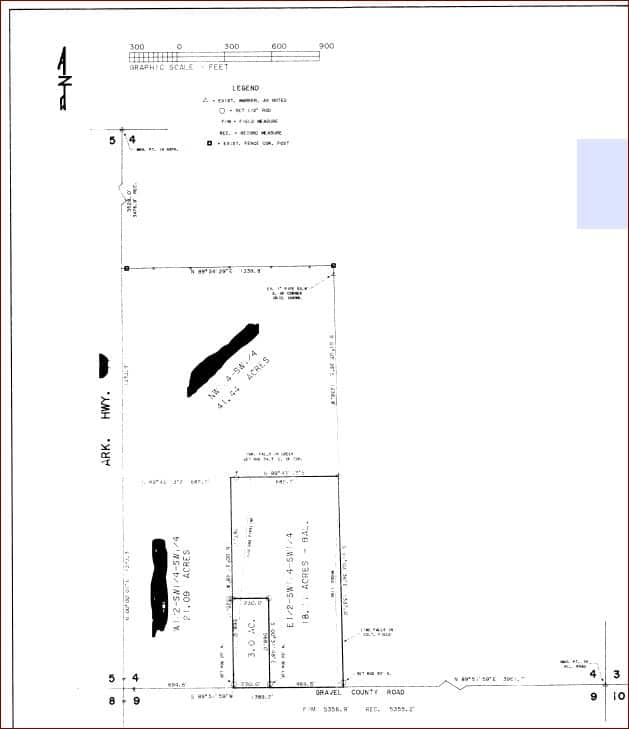
2007 Plat
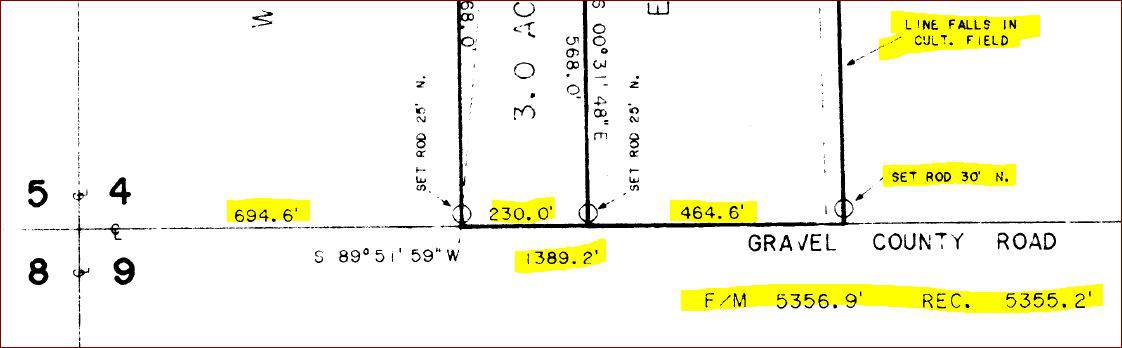
Close up...note the dimensions...do you see the 50 foot blunder?
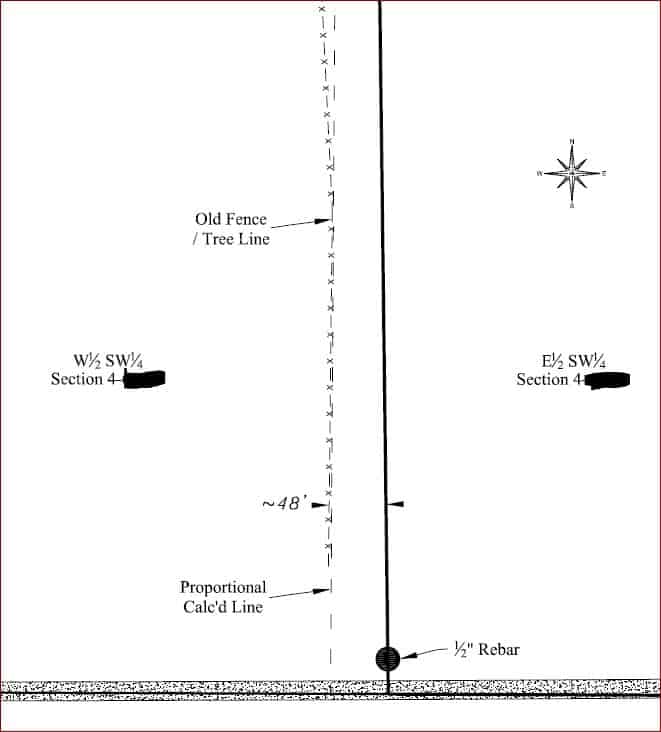
2016 Retracement sketch
Dan B. Robison, post: 364004, member: 34 wrote: Fellows,
We have discussed Û÷following in the footstepsÛª, retracement surveying, and locating the Û÷establishedÛª boundary. What do we advise a young surveyor to do when they run into a previous surveyorÛªs blunder?Not a question of tools or technology, but of following in the footsteps Û÷without stepping on toesÛª.
The clip of a recorded plat is dated 2007 (information redacted to protect the Û÷oldÛª surveyor). The clip of ÛÏsketchÛ is datedÛ?errrÛ?yesterday and was presented to the Û÷oldÛª surveyor for comment.
Do you HOLD or FOLD?
DDSM:-S
2007 Plat
Close up...note the dimensions...do you see the 50 foot blunder?
2016 Retracement sketch
Can't divide by 4?
Dan B. Robison, post: 364004, member: 34 wrote: Fellows,
We have discussed Û÷following in the footstepsÛª, retracement surveying, and locating the Û÷establishedÛª boundary. What do we advise a young surveyor to do when they run into a previous surveyorÛªs blunder?Not a question of tools or technology, but of following in the footsteps Û÷without stepping on toesÛª.
The clip of a recorded plat is dated 2007 (information redacted to protect the Û÷oldÛª surveyor). The clip of ÛÏsketchÛ is datedÛ?errrÛ?yesterday and was presented to the Û÷oldÛª surveyor for comment.
Do you HOLD or FOLD?
DDSM:-S
That's a good one. If I understand it correctly, even the older survey shows a fence substantially in the correct proportioned location?
Tom Adams, post: 364007, member: 7285 wrote: That's a good one. If I understand it correctly, even the older survey shows a fence substantially in the correct proportioned location?
The 2007 plat notes a "woods line" (for the thin line to the west) and "line falls in CULT. FIELD" (for the heavy property line). There is no mention of any fence along the "woods line".
The 2016 retracement surveyor, questioning his next move, called the old surveyor and "went back out there after we talked and found an old fence mostly on the ground running northward through the woods".
DDSM
(See the last few posts at https://surveyorconnect.com/threads/gps-on-benchmarks.325906/page-2&apos ;">GPS ON BENCHMARKS to see how well Arkansas Surveyors communicate...LOL)
[USER=94]@Dave Karoly[/USER]: A BRAND NEW FENCE WAS BUILT ALONG THE 2007 SURVEY LINE.
What would you advise the young retracement surveyor to do??? HOLD or FOLD??
Dan B. Robison, post: 364013, member: 34 wrote: The 2007 plat notes a "woods line" (for the thin line to the west) and "line falls in CULT. FIELD" (for the heavy property line). There is no mention of any fence along the "woods line".
The 2016 retracement surveyor, questioning his next move, called the old surveyor and "went back out there after we talked and found an old fence mostly on the ground running northward through the woods".
DDSM
(See the last few posts at https://surveyorconnect.com/threads/gps-on-benchmarks.325906/page-2&apos ;">GPS ON BENCHMARKS to see how well Arkansas Surveyors communicate...LOL)
[USER=94]@Dave Karoly[/USER]: A BRAND NEW FENCE WAS BUILT ALONG THE 2007 SURVEY LINE.
What would you advise the young retracement surveyor to do??? HOLD or FOLD??
The 2007 Surveyor messed up. If the owners agreed to settle their uncertainty in 2007 and accepted the messed up line by building the fence then it may be too late to fix it.

Dave Karoly, post: 364047, member: 94 wrote: The 2007 Surveyor messed up. If the owners agreed to settle their uncertainty in 2007 and accepted the messed up line by building the fence then it may be too late to fix it.
Yes, and if so, the 2007 surveyor may ultimately end up "buying" the ground lost by the adjoiner. Sure hope he has insurance...............

These are all great comments, lets keep this thread going. Anyone have more words of wisdom or war stories?
I thought of another place we don't mix surveys and their monuments. When we have two subdivisions adjacent to each other and we are retracing a lot boundary in one of them.
I was always told or read to stay within the subdivision your survey is in. Or, you shouldn't cross the subdivision line and use irons from the adjacent subdivision to establish a location in the subd you are working in. If you need to set a monument on the dividing line between the two subdivisions it is okay to survey up to the line from the adjacent subdivision to establish that line. But don't cross it.
I've seen a surveyor apportion cross a subdivision lines. I also seen were a surveyor did a single proportion in a east and west direction across a range line.
The buffalo picture on my post I took about 15 years ago. I always hoped that the big one wasn't a bull.
DELETED USER, post: 364077, member: 8983 wrote:
I thought of another place we don't mix surveys and their monuments. When we have two subdivisions adjacent to each other and we are retracing a lot boundary in one of them.
I was always told or read to stay within the subdivision your survey is in. Or, you shouldn't cross the subdivision line and use irons from the adjacent subdivision to establish a location in the subd you are working in. If you need to set a monument on the dividing line between the two subdivisions it is okay to survey up to the line from the adjacent subdivision to establish that line. But don't cross it.
I've seen a surveyor apportion cross a subdivision lines. I also seen were a surveyor did a single proportion in a east and west direction across a range line.
The buffalo picture on my post I took about 15 years ago. I always hoped that the big one wasn't a bull.
I would suggest that we need to expand our research and sources of professional advice far beyond the "I was always told", or "I heard/read somewhere" or "I heard at a seminar once", or "the way it is done 'round here", or my favorite "the way I was taught". How about we find authoritative sources of the "rules" we tend to throw around. One thing is for sure in boundary surveying, it depends.
"When it comes to boundary law and procedures, anyone having a set of black and white rules is a foolish and dangerous surveyor." D. Mouland
As for the buffalo - ummm, It appears to be feeding its calf - so ya, I would hope it isn't a bull..............
DELETED USER, post: 364077, member: 8983 wrote: These are all great comments, lets keep this thread going
Brian Allen, post: 364083, member: 1333 wrote: How about we find authoritative sources of the "rules" we tend to throw around.
Dave Karoly, post: 364047, member: 94 wrote: The 2007 Surveyor messed up. If the owners agreed to settle their uncertainty in 2007 and accepted the messed up line by building the fence then it may be too late to fix it.
Brian Allen, post: 364051, member: 1333 wrote: Yes, and if so, the 2007 surveyor may ultimately end up "buying" the ground lost by the adjoiner. Sure hope he has insurance...............
Arkansas Code Annotated å¤ 16-56-112 (2011) ....must commence any legal action based upon any defect in this survey within five years after you first discover such defect. In no event may any action based upon any defect in this survey be commenced more than five years from the date of the certification shown hereon....
When adjoining owners employ a surveyor to run the boundary between them not because they have had a dispute about it, but merely because they are ignorant of its exact location, such survey is not conclusive on the parties, even though they acquiesce in it believing it to be correct. Pickett v. Nelson, 79 Wis. 9, 47 N.W. 936
The owners of adjoining lands are not bound by an erroneous survey made at their request, without knowledge of the error. Wesley v. Sargent, 38 Maine 315.
Where adjoining owners, whose division line is susceptible of exact location, have a survey made, which is afterwards discovered to be erroneous, the fact that both parties, having no previous opinion as to the location of the line, express themselves as satisfied with the survey, and acquiesce therein for five years, does not estop either of them from insisting on the true boundary. Sanford v. McDonald, 53 Hun. 263, 6 N. Y. S. 613, 25 N. Y. St. 721.
Whether he was a professional or official surveyor, or represented himself as such, his undertaking was that he should bring to the work the necessary knowledge and skill to perform the same properly and correctly; and if he failed so to do, and the employer sustained damages in consequence of such failure, the plaintiff will be entitled to recover. Highway Coms. V. Beebe, 55 Mich. 137, 20 N.W. 826.
Yet a person undertaking to make a survey does not insure the correctness of his work, nor is absolute correctness the test of the amount of skill the law requires. Reasonable care, honesty and a reasonable amount of skill are all he is bound to bring to the discharge of his duties. 4 Ruling Case Law 77; Taft v. Rugherford, 66 Wash. 256, 119 Pac. 740.
[sarcasm]I figure it will be easier to have the survey crew move a half mile of fence...[/sarcasm]
DDSM:beer: