Reading RPLS is free for the whole profession. Members post, reply, and get the members-only rooms.

Notifications
Clear all
Strictly Surveying
4
Posts
1
Users
0
Reactions
1,083
Views

Topic starter
Translate
▼
English
Spanish
French
German
Italian
Portuguese
Russian
Chinese
Japanese
Korean
Arabic
Hindi
Dutch
Polish
Turkish
Vietnamese
Thai
Swedish
Danish
Finnish
Norwegian
Czech
Hungarian
Romanian
Greek
Hebrew
Indonesian
Malay
Ukrainian
Bulgarian
Croatian
Slovak
Slovenian
Serbian
Lithuanian
Latvian
Estonian
For those who may benefit from the demonstration, here's an example of some control points positioned in an area about 2100 ft. x 1300 ft. in extent. The points all fall along urban streets with plenty of traffic and obstructions. The monuments themselves are punchmarks on spikes set with stamped aluminum washers in drillholes in concrete curbs and pavements.
This is what the uncertainties of the positions look like by GPS only:
So, just looking at the uncertainties of the individual GPS-derived positions, one might think that would be as good as things could get without adding more GPS vectors. However, running conventional measurements between them and adjusting both GPS vectors and conventional measurements in Star*Net makes a significant improvement.
The "magic" that reduces the uncertainties by roughly 50% from the GPS-only solution is from several GPS-derived positions being connected by ties with sufficiently small uncertainties in direction and distance.
Posted : December 2, 2015 11:29 pm
Topic starter
Translate
▼
English
Spanish
French
German
Italian
Portuguese
Russian
Chinese
Japanese
Korean
Arabic
Hindi
Dutch
Polish
Turkish
Vietnamese
Thai
Swedish
Danish
Finnish
Norwegian
Czech
Hungarian
Romanian
Greek
Hebrew
Indonesian
Malay
Ukrainian
Bulgarian
Croatian
Slovak
Slovenian
Serbian
Lithuanian
Latvian
Estonian
For those who may benefit from the demonstration, here's an example of some control points positioned in an area about 2100 ft. x 1300 ft. in extent. The points all fall along urban streets with plenty of traffic and obstructions. The monuments themselves are punchmarks on spikes set with stamped aluminum washers in drillholes in concrete curbs and pavements.
This is what the uncertainties of the positions look like by GPS only:
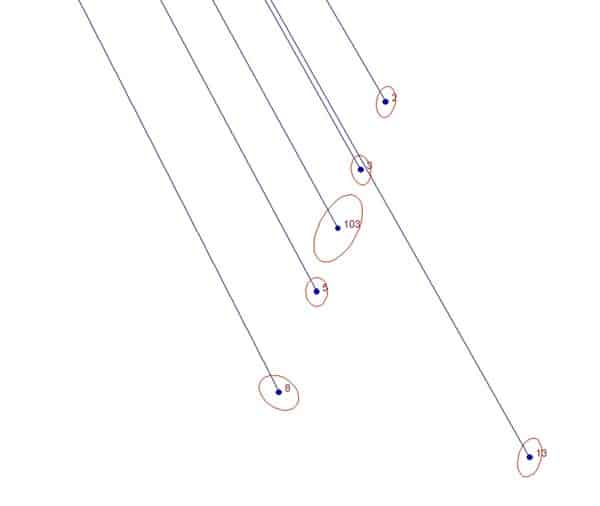
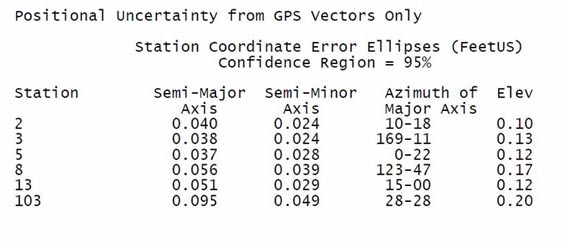
So, just looking at the uncertainties of the individual GPS-derived positions, one might think that would be as good as things could get without adding more GPS vectors. However, running conventional measurements between them and adjusting both GPS vectors and conventional measurements in LSA program like Star*Net makes a significant improvement.
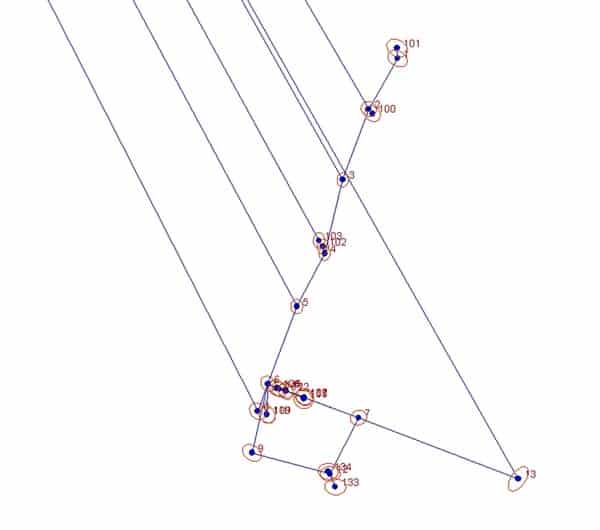
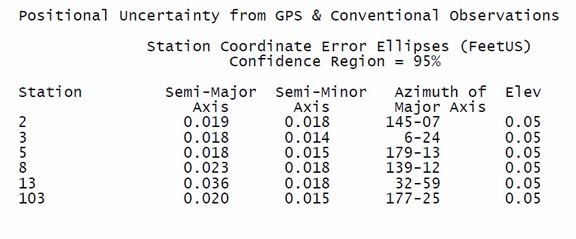
The "magic" that reduces the uncertainties by roughly 50% from the GPS-only solution is from several GPS-derived positions being connected by ties with sufficiently small uncertainties in direction and distance.
Posted : December 2, 2015 11:49 pm
Topic starter
Translate
▼
English
Spanish
French
German
Italian
Portuguese
Russian
Chinese
Japanese
Korean
Arabic
Hindi
Dutch
Polish
Turkish
Vietnamese
Thai
Swedish
Danish
Finnish
Norwegian
Czech
Hungarian
Romanian
Greek
Hebrew
Indonesian
Malay
Ukrainian
Bulgarian
Croatian
Slovak
Slovenian
Serbian
Lithuanian
Latvian
Estonian
Sorry, trying to get the formatting of text for the output listing to work took so long that the edit screen timed out. See below for what should have been the initial post.
Posted : December 2, 2015 11:59 pm
Topic starter
Translate
▼
English
Spanish
French
German
Italian
Portuguese
Russian
Chinese
Japanese
Korean
Arabic
Hindi
Dutch
Polish
Turkish
Vietnamese
Thai
Swedish
Danish
Finnish
Norwegian
Czech
Hungarian
Romanian
Greek
Hebrew
Indonesian
Malay
Ukrainian
Bulgarian
Croatian
Slovak
Slovenian
Serbian
Lithuanian
Latvian
Estonian
Sorry, fiddling with formatting the text from the output listing took too long and the edit screen timed out. See below for what the intial post should have been.
Posted : December 3, 2015 12:01 am