

Kent McMillan, post: 340199, member: 3 wrote: I suppose that if land surveyors can't write good metes and bounds descriptions, a map or plat would be a fairly good work-around. The GIS folks probably like it quite a bit. :>
We don't get that fancy up here...but we all know what kind of purgatory you consider lands north of the Red.
I would imagine a call such as "Thence S88å¡44'21"W along the North Line of the W.S. Allen Survey No. 947, wearing a red tartan plaid flannel shirt received last Christmas from my Grandson, while riding in a 1996 Toyota Truck, VIN No. 4T1BG12K2TU949406, a distance of 936.53 varas..." wouldn't be out of the ordinary down there. No wonder it's 12 pages...;-)

Well, when the patent field notes give a call in varas, why would a surveyor not express his or her resurvey measurement in varas, too? It's just too easy to convert a modern resurvey measurement in feet to varas for comparison with the original measurements that were reported to the nearest vara or one-half vara.
Otherwise, you'd risk converting, say, 23-1/2 varas to 65.28 ft. and implying a precision that wasn't present in the record measurement.
No wonder it's 12 pages...
Well, the things that bulk out the description are pretty much necessary and useful information.
For example, there is a complete list of the geodetic coordinates of every point connected to the description. That means that Mr. or Ms. Future Surveyor can easily digitize the whole survey and generate coordinates at the full accuracy that I had them in my office.
The general purpose of much of the incidental calls is to make it clear what the rationale behind the boundary determination was and to provide future surveyors with a convincing demonstration of the basis in evidence. For example, compare a naked call for a land grant line with the actual ties to the corners of the land grant that define the line and the evidence in place that supports the conclusion as to the locations of those corners. One is professional quality, the other just nudism.
The other general purpose is to describe the setting which is likely to be different at some time in the not-so-distant future. Does it matter for purposes of location that a rod and cap monument is set about 0.4 ft. away from a pipe fence post if the pipe fence post is not called for in any prior conveyance of record? Probably not. However, in the future if there is some question as to whether or not the rod and cap monument has been disturbed and the pipe fence post has been replaced by something else, that's a pretty useful clue as to what probably disturbed the rod and cap.
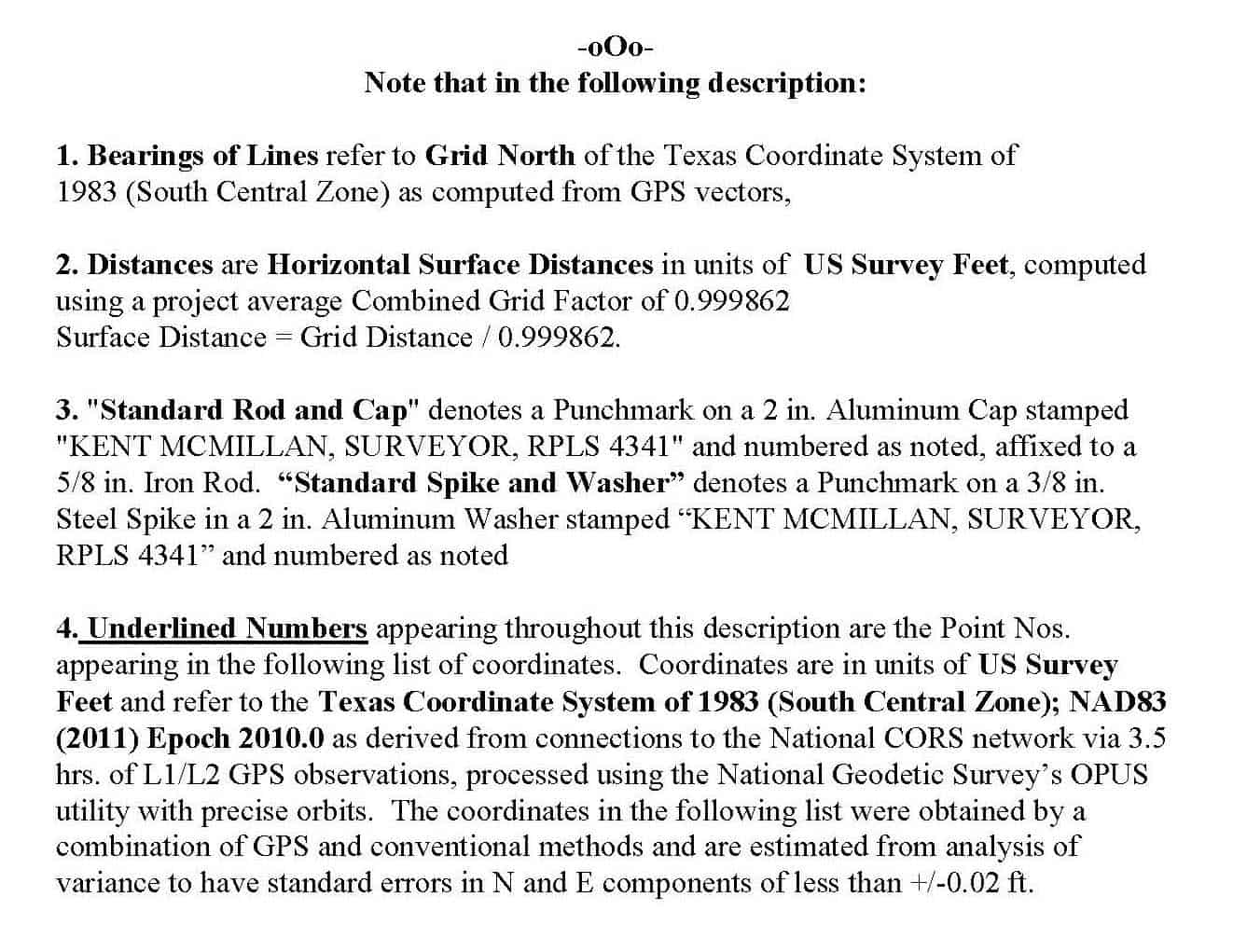
For example, there are some standard notes that take up some space. In a long description the definition of shorthand monument descriptions is compact. In an ideal world, it shouldn't be necessary to give a sample calculation of surface distance to show how the average Project Scale Factor was applied. In this world, it seems like a useful thing to do.
Should a surveyor mention the estimated uncertainties of marks positioned by the survey? Yeah, I'd think so.

Kent McMillan, post: 340199, member: 3 wrote: I suppose that if land surveyors can't write good metes and bounds descriptions, a map or plat would be a fairly good work-around. The GIS folks probably like it quite a bit. :>
Well, it looks like you do a better job then most in writing legal descriptions. I know tradition down there speaks against it, but I think all the information in most legal descriptions can be put in a one or two page plat much more elegantly. Additionaly, most non-surveyors are much better equipped to get usfull information from a plat than a legal description.
I would feel much less strongly about this if all legal descriptions were written as thouroughly as yours.
I know tradition down there speaks against it, but I think all the information in most legal descriptions can be put in a one or two page plat much more elegantly.
In the case of that 4.080 acre tract that took 12 pages to describe, the basic mapping problem is that you have to prepare one map demonstrating the boundary of one 160 acre land grant and it would be loaded with insets to convey the same information that the written description does. Either that or you'd end up writing long corner descriptions that include the ties to acccessories. I drew that map and it all pretty much filled a 24 x 36 sheet once you included the line annotations and the table of corner descriptions.
Then it would take another 24 x 36 map to show the 4.08 acres, also with either lots of insets or mashing the ties into the corner descriptions.
In my opinion, the value of a written description is that if it is constructed logically, it shows the rationale of the survey at the same time as it describes the shape and location of some tract of land.
Twelve pages of the deed records, particularly if a coordinate list is included, would be my preference over several pages of maps littered with insets and tables.

So, the highway ROW was also in varas or you converted from feet to be consistent with the patent note? I assume the client didn't care about the units. Just curious. While I do frequently deal with varas, feet would normally be at least an alternate unit for the convenience of the client.
Kent McMillan, post: 340234, member: 3 wrote: For example, there are some standard notes that take up some space...
I am truly in awe of the amount of time and information you get in your descriptions, Kent. And I don't disagree every bit of information you have included is good lean informational 'meat'. Anyone following your surveys should have no trouble at all, even in years to come.
One of the surveyors with which I share office space has a similar format for his descriptions. He does, almost exclusively, work for a couple of tribal nations and most of his work has to get past the local BLM/BIA office. His descriptions are full of passing calls, bounds called by monument or book and page and corner monument descriptions. Although I don't put that much chrome and metal flake on my descriptions, I always enjoy reading his more 'ornate' descriptions.
But what generally happens, more often than not, is a clerk at a title company (or an attorney's clerk) takes his description, strips it to the basic "thence bearing and distance" , and makes it fit on one or two pages. He gets enraged...and I would be too. This has gone on for years and I have heard to him growl at anybody that will listen for all those years; no change. Although his surveys and descriptions are filed at the courthouse, a lot of incidental conveyances and paperwork winds up with the abbreviated description.
I don't think I could tolerate what I've seen transpire. Kudos to those that take the time to be explicit in their notes.
So, the highway ROW was also in varas or you converted from feet to be consistent with the patent note? I assume the client didn't care about the units. Just curious.
No, if you look at that description, I think you'll see in those examples I gave that the calls are in feet, but in ___ ft. = ___ varas in cases where an original measurement in varas is to be compared for demonstrative purposes, as in the case of distance calls from the patent field notes.
The coordinates are in units of US Survey Feet expressed relative to the Texas Coordinate System of 1983, but the description serves two purposes, only one of which is to exactly define the shape and location of the tract as determined.
The equally important purpose of the description and the narrative that is embedded in it is to allow the next surveyor to easily verify that the reconstruction is quite reasonably consistent with the evidence.
The original patent calls in varas contain information about the survey itself. The original surveyor of the W.S. Allen Survey, for example rounded all of his passing calls to the nearest 10 varas, which comparing in varas helps to expose in a way that converting 550 varas to 1527.8 ft. would obscure.
I am truly in awe of the amount of time and information you get in your descriptions, Kent. And I don't disagree every bit of information you have included is good lean informational 'meat'. Anyone following your surveys should have no trouble at all, even in years to come.
The best instruction that I've had on the preparation of useful metes and bounds descriptions has been looking at descriptions that were written more than fifty years ago and recognizing what made them particularly useful or not. There was one surveyor in practice in Austin, who was consistently diligent about giving additional details that made all the difference in following his work. He was both describing the shape and location of the tract as well as answering some questions about how he had arrived at it when things were not perfectly straight forward. Contrasted with the "iron pin" this and "iron pin" that descriptions that were also being churned out, you'd always want the more informative record.
But what generally happens, more often than not, is a clerk at a title company (or an attorney's clerk) takes his description, strips it to the basic "thence bearing and distance" , and makes it fit on one or two pages.
Fortunately, the common practice in the parts of Texas familiar to me is to just incorporate the actual written description furnished by the surveyor and bearing his or her seal and signature. I have had calls from lenders wanting to get an electronic version of the description so that they can try to shoehorn it into the body of their conveyance rather than simply attaching it as an attachment, but they are idiots who apparently were failing to actually attach Exhibit "A" often enough that they decided that the description couldn't be a separate exhibit. I have every confidence that since the basic problem was idiocy, the transcribed descriptions will be seduced in novel, unforeseen ways.
paden cash, post: 340258, member: 20 wrote: I am truly in awe of the amount of time and information you get in your descriptions, Kent. And I don't disagree every bit of information you have included is good lean informational 'meat'. Anyone following your surveys should have no trouble at all, even in years to come.
One of the surveyors with which I share office space has a similar format for his descriptions. He does, almost exclusively, work for a couple of tribal nations and most of his work has to get past the local BLM/BIA office. His descriptions are full of passing calls, bounds called by monument or book and page and corner monument descriptions. Although I don't put that much
But what generally happens, more often than not, is a clerk at a title company (or an attorney's clerk) takes his description, strips it to the basic "thence bearing and distance" , and makes it fit on one or two pages. He gets enraged...and I would be too. This has gone on for years and I have heard to him growl at anybody that will listen for all those years; no change. Although his surveys and descriptions are filed at the courthouse, a lot of incidental conveyances and paperwork winds up with the abbreviated description.
I don't think I could tolerate what I've seen transpire. Kudos to those that take the time to be explicit in their notes.
Can an unlicensed title clerk alter your descriptions? In Alaska only a licensed land surveyor can monkey with a legal description that was based on a survey. I know many other states have similar provisions.
aliquot, post: 340344, member: 2486 wrote: Can an unlicensed title clerk alter your descriptions?....
Oh, HELL YEAH. This is Oklahoma, altering descriptions that are too lengthy (or confusing for their little pea-brains) is standard procedure. I finally finished an ALTA a few weeks ago where I kept waiting for a description and a title commitment. The idiot at the title company told me they were waiting for the survey , because they always use the survey to write the description.
Title research? They don't need no stinkin' research....
Probably the only State in the Union that a convicted felon can be freed from prison on one day and be a Notary Public the next. And I think the particularly heinous and morally irreprehensible criminals seek out the title industry here. The "real estate" industry has a thick lobbyist presence down at the Capitol. Not only CAN a title clerk change anything they want, I've had them call me up and want to argue about things they know absolutely nothing about. They will stick anything on a document that pleases them.

Kent McMillan, post: 340142, member: 3 wrote: Sure, of course I check my own work. There's a step-by-step procedure that I use, proofing the whole description several times using different criteria on each pass to catch things that require revision or correction. I don't use an automated description writer, so the proofing even includes running a closure check on the courses and distances from the description.
Providing the geodetic coordinates of all points connected by the description, identified by point number that is also given in the description has simplified/eliminated quite a few sources of error.
Writing metes and bounds descriptions in outline style also makes them quite a bit easier to proof.
Do you have an example of the outline style description and how you show the coordinates and point numbers in the plat and description? That sounds like a fantastic idea!
Here's a pdf of a metes and bounds description of a 9.752 acre tract that I prepared recently. It's in the public records.
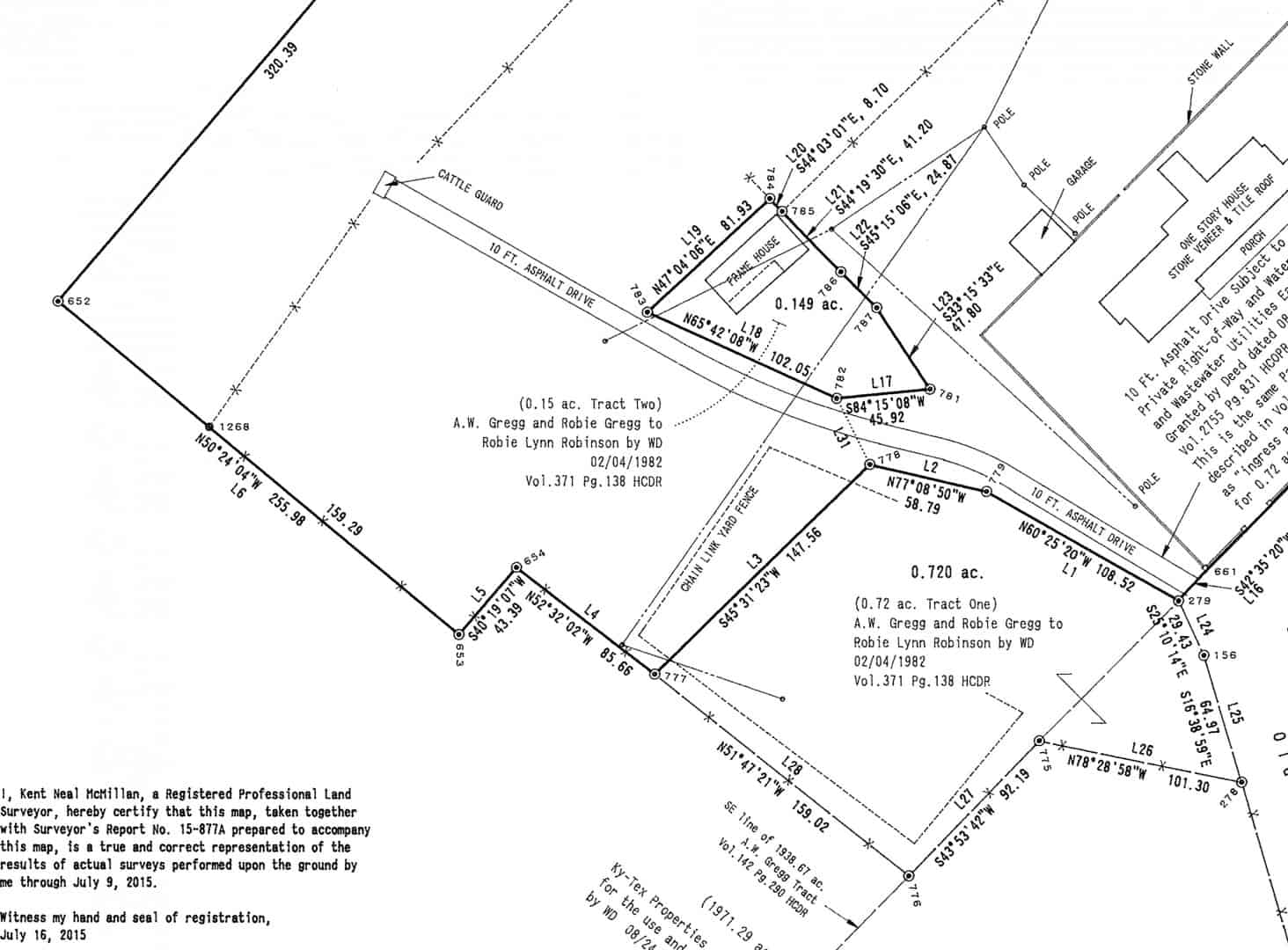
Here's a portion of the map that accompanied that description that shows how the point nos. used in the description and on the coordinate list are also annotated on the map.
The line annotations, "L(no.)" refer to a line data table that also lists the record data for the same line from various sources.
Wow. I've actually never seen a description written that way. My descriptions seem pretty bare in comparison. I'm going to give this style a whirl on my next project. Thanks Kent 😀
arctan(x), post: 340384, member: 6795 wrote: ...I'm going to give this style a whirl on my next project. Thanks Kent 😀
Oh gawd, Kent has started spawning....no doubt years from now this format will be know as the McMillan Method...:pinch:

I have had a few smarty pants lawyers and legal aids that have revamped my descriptions and even going so far as to writing descriptions by putting info from more than one drawing together into a new description on certain properties.
When they are not on the same bearing basis, it gets my phone ringing.
Then the title company or another lawyer will contact me for a drawing of the description they have. Send me a copy. After getting a copy I reply "THAT IS NOT MY DESCRIPTION, CAN'T HELP YOU"
It takes a few days or weeks until they get the message that I did actually survey the property and somebody else thru some words on paper.
Notified them all that when they change a single word of my property description that it is not my piece of work any more and I am not liable for it, the new author is.
None of them liked that very much at all.......
:gammon:

I've had an attorney pare down my descriptions, eliminating calls to senior abutters w/ their deed recording info., because the description was too "verbose".
"Bearings & distances, man, that's all I need....."
Well, if you want to make it difficult to read, you can always write "N45å¡34'52"W" as "North 45Degrees 34Minutes 52Seconds West".