Reading RPLS is free for the whole profession. Members post, reply, and get the members-only rooms.


Notifications
Clear all
Software, CAD & Mapping
15
Posts
9
Users
0
Reactions
1,046
Views

Topic starter
Translate
▼
English
Spanish
French
German
Italian
Portuguese
Russian
Chinese
Japanese
Korean
Arabic
Hindi
Dutch
Polish
Turkish
Vietnamese
Thai
Swedish
Danish
Finnish
Norwegian
Czech
Hungarian
Romanian
Greek
Hebrew
Indonesian
Malay
Ukrainian
Bulgarian
Croatian
Slovak
Slovenian
Serbian
Lithuanian
Latvian
Estonian
Well, another Friday, the day I usually reserve for deep contemplation on all things theoretical...
This time it's another question about Star*net:
Say you adjust a network, with a lot of redundancy, and come up with a list of adjusted coordinates.
Then you take those coordinates, do a bunch of inverses between all the points and re-enter those into a new data file. I think they'd be all distances, but I guess you could input the angles based on the azimuths between points as well. Then ran the analysis again.
Would it come out "perfectly"? Similar to a Compass Rule adjustment that makes a traverse close perfectly? Or would you still see error ellipses that match exactly your standard errors? For that matter, what would you use for standard errors for the re-adjustment? Wouldn't there be NO "random errors" in this data?
I guess I'm asking the question: does a Star*net adjustment get any "better" if you "wash and rinse" the data multiple times? Obviously I haven't taken the time to try it, but may, unless the Sages here all say it's a worthless endeavor with nothing to be learned by trying it.
Posted : October 30, 2015 6:48 am

Translate
▼
English
Spanish
French
German
Italian
Portuguese
Russian
Chinese
Japanese
Korean
Arabic
Hindi
Dutch
Polish
Turkish
Vietnamese
Thai
Swedish
Danish
Finnish
Norwegian
Czech
Hungarian
Romanian
Greek
Hebrew
Indonesian
Malay
Ukrainian
Bulgarian
Croatian
Slovak
Slovenian
Serbian
Lithuanian
Latvian
Estonian
Try it and see what you get.
Posted : October 30, 2015 6:55 am

Translate
▼
English
Spanish
French
German
Italian
Portuguese
Russian
Chinese
Japanese
Korean
Arabic
Hindi
Dutch
Polish
Turkish
Vietnamese
Thai
Swedish
Danish
Finnish
Norwegian
Czech
Hungarian
Romanian
Greek
Hebrew
Indonesian
Malay
Ukrainian
Bulgarian
Croatian
Slovak
Slovenian
Serbian
Lithuanian
Latvian
Estonian
I don't use StarNet, but in SurvNet or TBC the inverse information would be mathematically perfect.
Kind of a pointless exercise. Or should I say "observation-less".
You would still see error ellipses, but it should be solely computed from the equipment standard error information you entered in.
Posted : October 30, 2015 7:03 am

Translate
▼
English
Spanish
French
German
Italian
Portuguese
Russian
Chinese
Japanese
Korean
Arabic
Hindi
Dutch
Polish
Turkish
Vietnamese
Thai
Swedish
Danish
Finnish
Norwegian
Czech
Hungarian
Romanian
Greek
Hebrew
Indonesian
Malay
Ukrainian
Bulgarian
Croatian
Slovak
Slovenian
Serbian
Lithuanian
Latvian
Estonian
rfc, post: 342373, member: 8882 wrote: Well, another Friday, the day I usually reserve for deep contemplation on all things theoretical...
This time it's another question about Star*net:Say you adjust a network, with a lot of redundancy, and come up with a list of adjusted coordinates.
Then you take those coordinates, do a bunch of inverses between all the points and re-enter those into a new data file. I think they'd be all distances, but I guess you could input the angles based on the azimuths between points as well. Then ran the analysis again.Would it come out "perfectly"? Similar to a Compass Rule adjustment that makes a traverse close perfectly? Or would you still see error ellipses that match exactly your standard errors? For that matter, what would you use for standard errors for the re-adjustment? Wouldn't there be NO "random errors" in this data?
I guess I'm asking the question: does a Star*net adjustment get any "better" if you "wash and rinse" the data multiple times? Obviously I haven't taken the time to try it, but may, unless the Sages here all say it's a worthless endeavor with nothing to be learned by trying it.
YOU ADJUST OBSERVATIONS. Once you adjust observations, unless you do additional observations there is nothing to adjust.
But it is your time, go ahead.
Paul in PA
Posted : October 30, 2015 7:33 am
Topic starter
Translate
▼
English
Spanish
French
German
Italian
Portuguese
Russian
Chinese
Japanese
Korean
Arabic
Hindi
Dutch
Polish
Turkish
Vietnamese
Thai
Swedish
Danish
Finnish
Norwegian
Czech
Hungarian
Romanian
Greek
Hebrew
Indonesian
Malay
Ukrainian
Bulgarian
Croatian
Slovak
Slovenian
Serbian
Lithuanian
Latvian
Estonian
Thanks for the input. I certainly have bigger fish to fry.:stakeout:
Posted : October 30, 2015 7:38 am

Translate
▼
English
Spanish
French
German
Italian
Portuguese
Russian
Chinese
Japanese
Korean
Arabic
Hindi
Dutch
Polish
Turkish
Vietnamese
Thai
Swedish
Danish
Finnish
Norwegian
Czech
Hungarian
Romanian
Greek
Hebrew
Indonesian
Malay
Ukrainian
Bulgarian
Croatian
Slovak
Slovenian
Serbian
Lithuanian
Latvian
Estonian
There actually is a use for inverses in an adjustment. I deal with very old control networks occasionally, where none of the data is available (or even still exists). So, the only option is to go out and observe a few points, and then try to "adjust" the network to fit.
I am talking about triangulation networks that were adjusted by hand, and all that remains are coordinates and a map showing the connections between points. I have dealt with several situations like this, on networks from the 20's and 30's, even one from 1890's. The alternative is to just compute a coordinate transformation (using least squares) using the recently observed stations, and then applying the transformation parameters to all of the old coordinates. I usually do the transformation route, but I have messed around with using inverses as observations.
Here is a portion of a network from 1891, the map is dated 1940, but I don't know when the topo was done (by planetable). Note the labels on the lines between control stations (for example VAULT and STORE on opposite sides of the river). They are the inversed azimuth and distance. I am not sure if they taped between stations on the same side of the river, but I doubt it as the notes on the map say it was a triangulation net. In any case, none of the field books with observations have been found, so we don't have the raw angles.
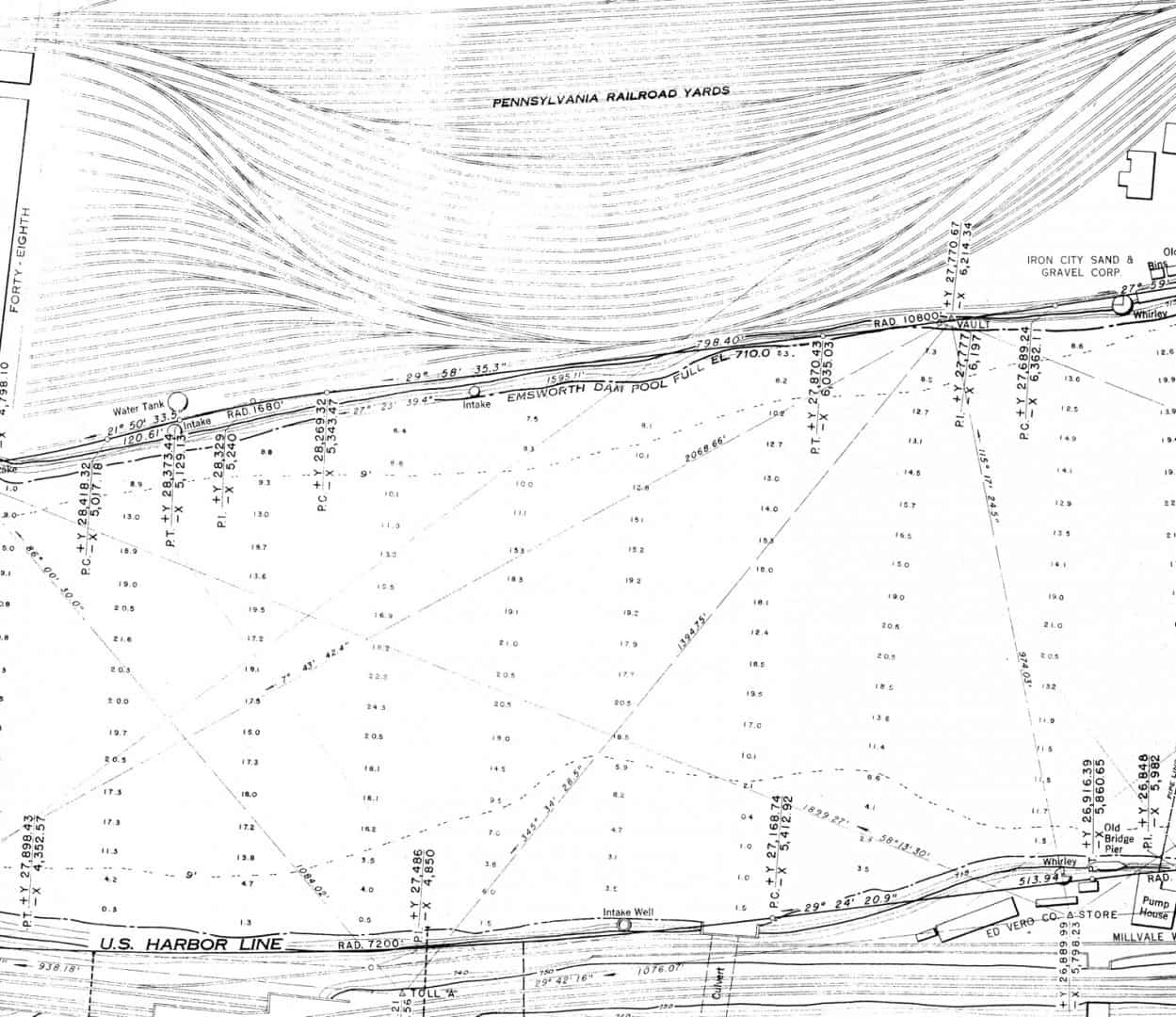
I did recover the ORIGIN of the coordinate system, indirectly. It is gone (wall fell into the river). But I found City survey notes from the 1920's where they tied in the brass plate. I found the nearby City monuments that they used, GPS'd them, and then computed a coordinate for ORIGIN. We have tied quite a few of the old brass plates marking the 1891 network along all three rivers. Needless to say the fit is not very good. I think they probably used a 1' transit for the angles, taped some distances, and never had any other coordinates upriver to adjust to. So it was open-ended triangulation, maybe some length control along the way. As far as I know they only observed polaris at the origin. But, the network is important because it was used to define the harbor lines (tangents and curves) that many property deeds along the river reference. The Harbor Lines were never marked or monumented, but the maps (100's) show the geometry. If one can find a couple of the old monuments in the area, then the HL can be laid out on the ground. The HL system in this area was abrogated 50+ years ago, but still many of the deeds go to it. All of the PT's, PI's, and PC's have coordinates in the HL system
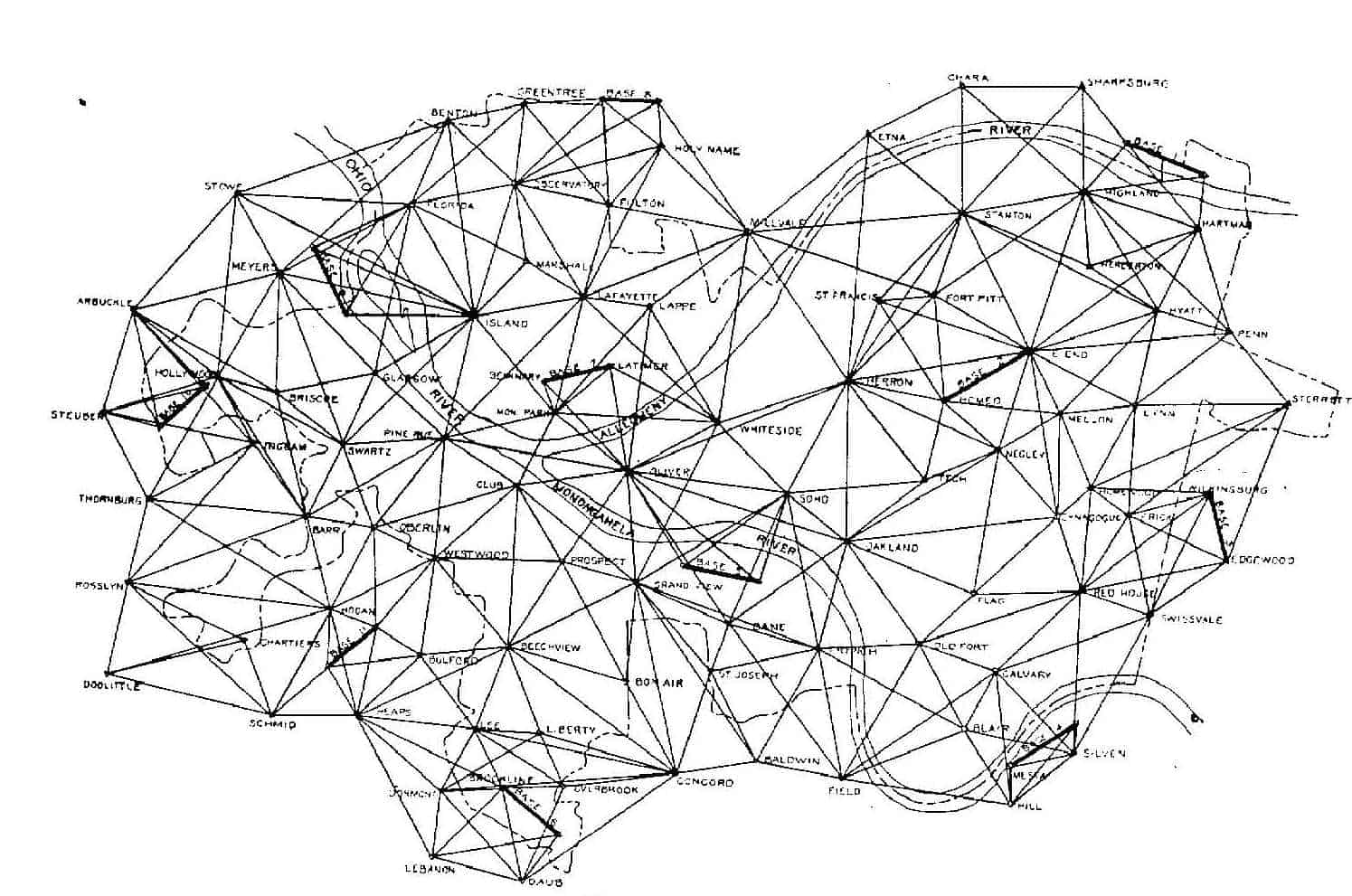
Here is another network (1920's) where none of the observations still exist (field books thrown out in the 60's). Only adjusted coordinates still exist. Note the 10 baselines.
Posted : October 30, 2015 8:35 am

Translate
▼
English
Spanish
French
German
Italian
Portuguese
Russian
Chinese
Japanese
Korean
Arabic
Hindi
Dutch
Polish
Turkish
Vietnamese
Thai
Swedish
Danish
Finnish
Norwegian
Czech
Hungarian
Romanian
Greek
Hebrew
Indonesian
Malay
Ukrainian
Bulgarian
Croatian
Slovak
Slovenian
Serbian
Lithuanian
Latvian
Estonian
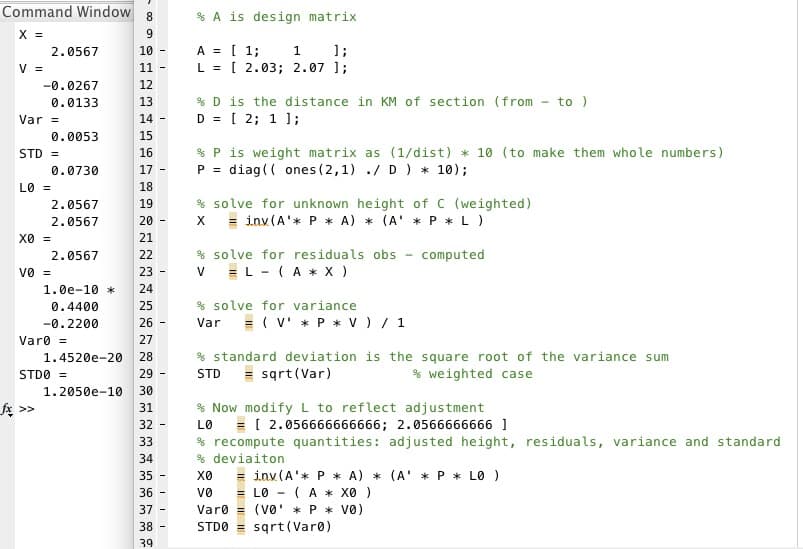
I understood your question to be what happens to an adjustment when one replaces the actual observations with adjusted values. Using the simplest example, leveling to determine one unknown from two knowns, I ran some made up values using Matlab. Unfortunately my computed height was a repeating decimal. I also did not make my updated observations equal.
As can be seen in this simplest case, replacing the observed values with adjusted yields zero (here not quite) residuals. As the residuals are used for the computation of standard deviations no error ellipses can be formed.
I do not use StarNet but the adjustment shown is pretty standard. Improving an adjustment requires new observations, removal of outliers according to rigorous criteria, insuring there are no singularities, recomputing observations (e.g. to account for better models), improving weighting, etc. In Mr. Hamilton's case, he is trying to fit some otherwise unavailable information into the mix. The problem is realistic weighting.
In the image file below, the results are shown on the left, the script file to the right. I forgot to label "L" it is the observation matrix. To over explain, if I ru levels from point A to the unknown and point B to the unknown, I can merely add the height differences to the known heights to calculate two starting values for the unknown. What is the optimal value for the unknown? I added the distances from each known to the unknown (in KM) which I used to provide weights. While I could have done this more efficiently, I hope this is clear.
Hope this contributes,
DMM
Posted : October 30, 2015 10:28 am
Topic starter
Translate
▼
English
Spanish
French
German
Italian
Portuguese
Russian
Chinese
Japanese
Korean
Arabic
Hindi
Dutch
Polish
Turkish
Vietnamese
Thai
Swedish
Danish
Finnish
Norwegian
Czech
Hungarian
Romanian
Greek
Hebrew
Indonesian
Malay
Ukrainian
Bulgarian
Croatian
Slovak
Slovenian
Serbian
Lithuanian
Latvian
Estonian
That's very cool.
Posted : October 30, 2015 1:32 pm

Translate
▼
English
Spanish
French
German
Italian
Portuguese
Russian
Chinese
Japanese
Korean
Arabic
Hindi
Dutch
Polish
Turkish
Vietnamese
Thai
Swedish
Danish
Finnish
Norwegian
Czech
Hungarian
Romanian
Greek
Hebrew
Indonesian
Malay
Ukrainian
Bulgarian
Croatian
Slovak
Slovenian
Serbian
Lithuanian
Latvian
Estonian
John:
You might try a program like this to fit the new to the old.
http://www.primacode.com/transform.htm
T.W.
Posted : November 9, 2015 9:13 am

Translate
▼
English
Spanish
French
German
Italian
Portuguese
Russian
Chinese
Japanese
Korean
Arabic
Hindi
Dutch
Polish
Turkish
Vietnamese
Thai
Swedish
Danish
Finnish
Norwegian
Czech
Hungarian
Romanian
Greek
Hebrew
Indonesian
Malay
Ukrainian
Bulgarian
Croatian
Slovak
Slovenian
Serbian
Lithuanian
Latvian
Estonian
Tom Wilson, post: 343558, member: 247 wrote: John:
You might try a program like this to fit the new to the old.
http://www.primacode.com/transform.htm
T.W.
TRANSFORM is the most valuable software we own - nothing else compares...
Posted : November 9, 2015 1:50 pm
Translate
▼
English
Spanish
French
German
Italian
Portuguese
Russian
Chinese
Japanese
Korean
Arabic
Hindi
Dutch
Polish
Turkish
Vietnamese
Thai
Swedish
Danish
Finnish
Norwegian
Czech
Hungarian
Romanian
Greek
Hebrew
Indonesian
Malay
Ukrainian
Bulgarian
Croatian
Slovak
Slovenian
Serbian
Lithuanian
Latvian
Estonian
I do have some transformation programs (very basic, but they do it as least squares). I will have to demo this program. Seems a little pricey for "just" a transformation program, maybe it is more than that.
Posted : November 9, 2015 1:56 pm
Translate
▼
English
Spanish
French
German
Italian
Portuguese
Russian
Chinese
Japanese
Korean
Arabic
Hindi
Dutch
Polish
Turkish
Vietnamese
Thai
Swedish
Danish
Finnish
Norwegian
Czech
Hungarian
Romanian
Greek
Hebrew
Indonesian
Malay
Ukrainian
Bulgarian
Croatian
Slovak
Slovenian
Serbian
Lithuanian
Latvian
Estonian
It may be pricey but it is really slick and works great for it's intended purposes. It is easy to make a comparison between old work such as tape and or compass surveys and a modern survey with more precise measurements.
T.W.
Posted : November 9, 2015 3:03 pm
Translate
▼
English
Spanish
French
German
Italian
Portuguese
Russian
Chinese
Japanese
Korean
Arabic
Hindi
Dutch
Polish
Turkish
Vietnamese
Thai
Swedish
Danish
Finnish
Norwegian
Czech
Hungarian
Romanian
Greek
Hebrew
Indonesian
Malay
Ukrainian
Bulgarian
Croatian
Slovak
Slovenian
Serbian
Lithuanian
Latvian
Estonian
Thanks. I will certainly look at it.
Posted : November 9, 2015 3:04 pm
Topic starter
Translate
▼
English
Spanish
French
German
Italian
Portuguese
Russian
Chinese
Japanese
Korean
Arabic
Hindi
Dutch
Polish
Turkish
Vietnamese
Thai
Swedish
Danish
Finnish
Norwegian
Czech
Hungarian
Romanian
Greek
Hebrew
Indonesian
Malay
Ukrainian
Bulgarian
Croatian
Slovak
Slovenian
Serbian
Lithuanian
Latvian
Estonian
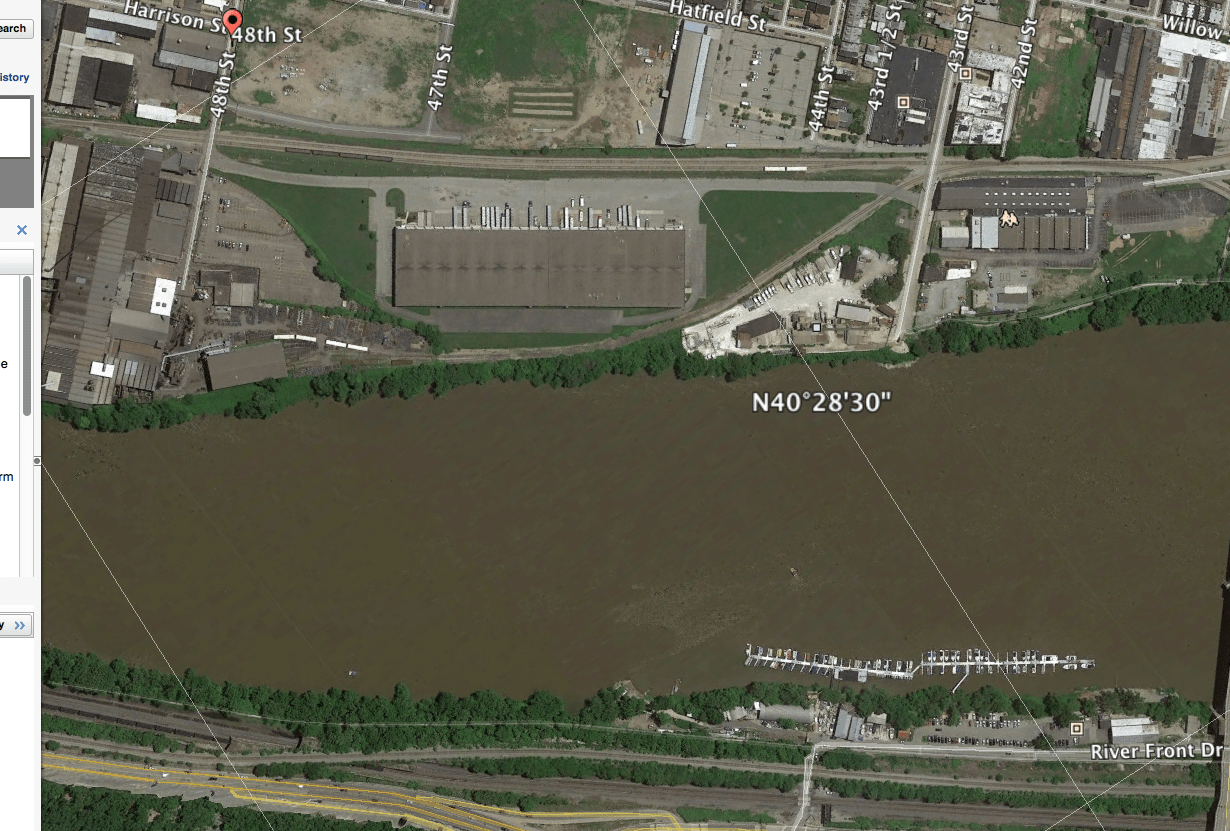 I think I found the spot (of the first drawing)...in Pittsburg. How one even finds such old monuments in an urban area after decades of change is pretty amazing.
Posted : November 9, 2015 3:39 pm

Translate
▼
English
Spanish
French
German
Italian
Portuguese
Russian
Chinese
Japanese
Korean
Arabic
Hindi
Dutch
Polish
Turkish
Vietnamese
Thai
Swedish
Danish
Finnish
Norwegian
Czech
Hungarian
Romanian
Greek
Hebrew
Indonesian
Malay
Ukrainian
Bulgarian
Croatian
Slovak
Slovenian
Serbian
Lithuanian
Latvian
Estonian
I concur that repeated analysis of data is an exercise in futility. There is some good value in finding techniques to add properly weighted record positions and measurements to new networks.
I am not in the camp that thinks things magically get better than the measurements themselves. Statistical testing with least squares will help you isolate errors, validate weighting strategies and a lot more.
The best part is I can push it around, ask it to do stupid stuff and force it wildly off the beaten path. I applaud RFC for thinking out loud. That's how you figure stuff out..
Posted : November 9, 2015 4:30 pm