

I've brought a small piece of a control network into Star*net (6 stations, 2 of which are fixed; 22 observations, of which 14 redundant). I've got multiple instances of some stations, each with different coordinates. These were provided (calculated) either by the DC or my software. I've attached no standard errors to the free stations, ("* *") which are therefore completely free to move.
I've "data off'd" the whole lot of C data lines (except the two fixed points), and it seems to make no difference to the analysis.
Of what value are these "redundant" calculated positions? Under what circumstances should one use standard errors in the "C" data line? Don't the apriori assumptions for standard errors for the observations "drive the boat" here?

rfc, post: 340226, member: 8882 wrote: Under what circumstances should one use standard errors in the "C" data line? Don't the apriori assumptions for standard errors for the observations "drive the boat" here?
Specify standard errors when you have them. For example, if you have coordinates from a previous adjustment, you can use the standard errors reported in that adjustment.
The a priori errors for coordinates without explicitly stated errors is essentially infinite, i.e. they're free to move as much as they have to. But in some cases the adjustment engine needs some starting values to push against, and that's where free station coordinates are useful.

This is unlikely to be rfc's problem, but it's worth pointing out that the weighting of coordinates by standard errors works best when those uncertainties are not strongly correlated. In practice that means that the points whose coordinates are used as conditions are separated by about four or five connecting measurements to assure their functional independence.

rfc, post: 340226, member: 8882 wrote: I've brought a small piece of a control network into Star*net (6 stations, 2 of which are fixed; 22 observations, of which 14 redundant).
I do not understand why you adjust only a portion of a network?
Paul in PA
That one's easy. I am using the demo version of Star*net 8. Limitation is 10 stations. That said, though, I should have worded it slightly differently: Right now the 6 points are the ENTIRE network. I've tossed just about everything I've previously done, and started over again. The future network will be expanded from these points. Once adjusted, I will use at least two of these (an OP and a BS) to move forward.
In that event, Jim Frame's comment about using coordinates' standard errors may well come into play at that time.
I think Kent's answer may be closer to getting at the question than Jim's. None of the points have been previously adjusted. They're right out of the raw data.
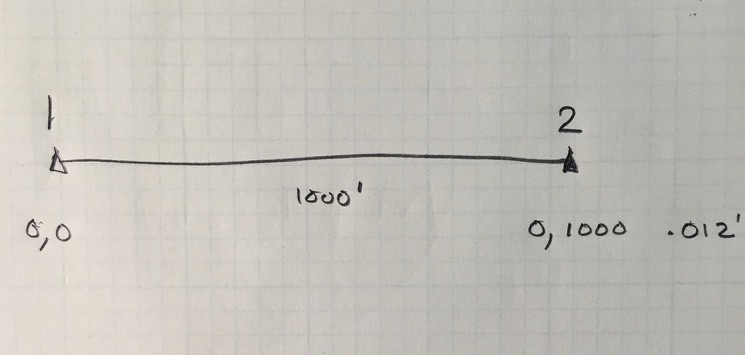
In the simple example shown...a single distance observed with an instrument whose distance constant is, say .009', and whose PPM is 3.0 would result in a standard error for the observation of .012' (I hope I got that right). The question is, if Star*net is going to use that for the observation, why include the coordinates the DC or software came up with at all, in a data lines that would read:
C 1 0.0 0.0 ! !
C 2 0.0 1000.0 * *
either with or without the standard error for the observation added. Isn't it the same thing?

RFC,
with respect to your continued interest in measurement theory and computations, I am recommending http://www.wiley.com/WileyCDA/WileyTitle/productCd-0470464917.html&apos ;">this book for your use in the future. It has a data format similar (but a little more difficult to use), but once you bought the book with CD and LSA programs, you will not be limited to the demo mode of star net and its maximum of ten stations. looks like walmart's book store has it for as little as $145
Thanks for the link. I'm familiar with that book. (I'm using Ghilani and Wolf as my "go to" text). But I've been drawn back to Star*net, primarily because of the support from the very knowledgeable folks here who know that program. It also seems to be the most straight forward, and easy to grasp program for the job.
Finally, I remember a lengthy thread many moons ago about the fact that Ghilani's method of Least Squares was somehow fundamentally different than that used in Star*net. Not that the minutiae of how it's different would be of any consequence to me and my learning, necessarily, but when I read the discussion, it seemed that many were saying that Star*net was simply superior.

That was a discussion I initiated. The gist of the answer was that Star*Net believes your standard errors when computing the error ellipses and posteriori statistics but W&G do their own estimate.
W&G estimate a scale factor for the standard errors from the overall goodness of fit and amount of redundancy, and only use your standard errors to proportion out the error when computing the error ellipses and other statistics. Using the fit to re-estimate the scale factor results in less certainty so they get larger error ellipses, especially when there is low redundancy.
rfc, post: 340506, member: 8882 wrote: Thanks for the link. I'm familiar with that book. (I'm using Ghilani and Wolf as my "go to" text). But I've been drawn back to Star*net, primarily because of the support from the very knowledgeable folks here who know that program. It also seems to be the most straight forward, and easy to grasp program for the job.
Finally, I remember a lengthy thread many moons ago about the fact that Ghilani's method of Least Squares was somehow fundamentally different than that used in Star*net. Not that the minutiae of how it's different would be of any consequence to me and my learning, necessarily, but when I read the discussion, it seemed that many were saying that Star*net was simply superior.
While a student I had done side by side comparisons with Star-Net, albeit an earlier version and Wolf and Ghilani's Adjust and saw minimal differences in results or in data input difficulty. I saw no fundamental differences.
Paul in PA

See Chapter 10, section 2 of the StarNet Manual. There it states how StarNet's approach will break down if you are running an adjustment that is very large in extent. As in larger than your grid zone. As in as big as a whole state.
Interesting. I think that may be what Kent was referencing when he mentioned using coordinates as conditions separated by 4 or 5 connecting measurements. It's not really applicable to my situation. The maximum extent of this network, once complete, will be less than 2000' end to end.
Since starting this thread, I've continued to experiment with the data lines that include the coordinates of the points (with or without the standard error for each), and it's really not making a difference to the adjustment. So, I think for now, I'll just use the observations and "global" errors set in the Project Options dialog, to keep things simple.
Besides, my biggest problem lately seems to be with the verticals; not the horizontals, but that's a subject for another thread all together.:-S