Reading RPLS is free for the whole profession. Members post, reply, and get the members-only rooms.


Notifications
Clear all

Topic starter
Translate
▼
English
Spanish
French
German
Italian
Portuguese
Russian
Chinese
Japanese
Korean
Arabic
Hindi
Dutch
Polish
Turkish
Vietnamese
Thai
Swedish
Danish
Finnish
Norwegian
Czech
Hungarian
Romanian
Greek
Hebrew
Indonesian
Malay
Ukrainian
Bulgarian
Croatian
Slovak
Slovenian
Serbian
Lithuanian
Latvian
Estonian
Troubleshooting some very simple triangle/quadrangle traverses for a control network. Star*net is reporting the error "Geometric Weakness found".
The manual contributes this:
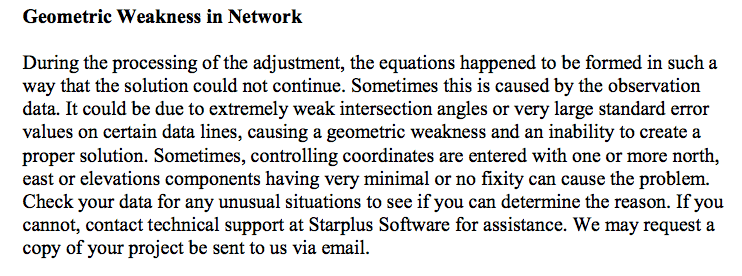
Huh? Not much of a clue there. The part I like is: "Check your data for any unusual situations..." Ya, like that describes just about everything I attempt to do lately, it seems like.
Ideas?
Posted : October 10, 2015 7:01 pm

Translate
▼
English
Spanish
French
German
Italian
Portuguese
Russian
Chinese
Japanese
Korean
Arabic
Hindi
Dutch
Polish
Turkish
Vietnamese
Thai
Swedish
Danish
Finnish
Norwegian
Czech
Hungarian
Romanian
Greek
Hebrew
Indonesian
Malay
Ukrainian
Bulgarian
Croatian
Slovak
Slovenian
Serbian
Lithuanian
Latvian
Estonian
Try supplying more provisional coordinates. That is, coordinates for control points which are approximate, but not held.
Posted : October 10, 2015 8:48 pm

Translate
▼
English
Spanish
French
German
Italian
Portuguese
Russian
Chinese
Japanese
Korean
Arabic
Hindi
Dutch
Polish
Turkish
Vietnamese
Thai
Swedish
Danish
Finnish
Norwegian
Czech
Hungarian
Romanian
Greek
Hebrew
Indonesian
Malay
Ukrainian
Bulgarian
Croatian
Slovak
Slovenian
Serbian
Lithuanian
Latvian
Estonian
rfc, post: 340022, member: 8882 wrote: Star*net is reporting the error "Geometric Weakness found".
I get this error a lot, and in my case it usually means that I forgot to fix, in the Star*Net DAT file, the distance from the initial occupied point to the initial backsite point, and/or forgot to fix a bearing somewhere.
I often start a control net in the field by assigning an arbitrary coordinate (often 15000,15000,100) to Point 1, and another arbitrary coordinate to Point 2 (often 15500,15000,100). My first setup is then gun at Point 1 backsighting Point 2, and everything proceeds from there. Once back in the office, if I don't put in D and B records like these:
D 1-2 500 !
B 1-2 N0.0000E !
fixing the bearing and distance between 1 and 2, I'll get the "geometric weakness" error. (The bearing can also be established by other means, like fixing the bearing between some located monuments, or with sufficient constrained coordinates as Norman said.) But the omission of these two records is by far the most common source of the "geometric weakness" message for me.
Posted : October 10, 2015 10:16 pm
Topic starter
Translate
▼
English
Spanish
French
German
Italian
Portuguese
Russian
Chinese
Japanese
Korean
Arabic
Hindi
Dutch
Polish
Turkish
Vietnamese
Thai
Swedish
Danish
Finnish
Norwegian
Czech
Hungarian
Romanian
Greek
Hebrew
Indonesian
Malay
Ukrainian
Bulgarian
Croatian
Slovak
Slovenian
Serbian
Lithuanian
Latvian
Estonian
I think you've got it. I had "plugged" an arbitrary back sight. Once I put a real fixed location for both the POB and backsight, the network solved. I may not have had enough redundancies on some of the angles, as well
On my way. Thanks very much.
Posted : October 11, 2015 3:42 pm
Translate
▼
English
Spanish
French
German
Italian
Portuguese
Russian
Chinese
Japanese
Korean
Arabic
Hindi
Dutch
Polish
Turkish
Vietnamese
Thai
Swedish
Danish
Finnish
Norwegian
Czech
Hungarian
Romanian
Greek
Hebrew
Indonesian
Malay
Ukrainian
Bulgarian
Croatian
Slovak
Slovenian
Serbian
Lithuanian
Latvian
Estonian
Glad you're up and running again.
In rereading my initial reply, I see that I wasn't very clear about the logic behind my field approach. My initial backsight (Point 2 in the above description) might be an actual point in the ground, but more often than not it's a virtual point -- an arbitrary coordinate value established only to give the data collector something from which to compute coordinates using measured angles and distances.
When using an instrument operator, Point 2 is usually a natural sight, like a tower or a road sign. When running robotic, it's usually online with a real point, i.e. the gun points at a prism centered over an actual point, but the measured distance and the calculated distance will be different.
Posted : October 11, 2015 4:03 pm