Reading RPLS is free for the whole profession. Members post, reply, and get the members-only rooms.


Notifications
Clear all
GNSS & Geodesy
22
Posts
10
Users
0
Reactions
1,000
Views

Topic starter
Translate
▼
English
Spanish
French
German
Italian
Portuguese
Russian
Chinese
Japanese
Korean
Arabic
Hindi
Dutch
Polish
Turkish
Vietnamese
Thai
Swedish
Danish
Finnish
Norwegian
Czech
Hungarian
Romanian
Greek
Hebrew
Indonesian
Malay
Ukrainian
Bulgarian
Croatian
Slovak
Slovenian
Serbian
Lithuanian
Latvian
Estonian
I started out, asking alot of questions, some 12 or so yrs ago. When I first joined the RTK game. I was already in the L1 GPS game.
I wanted answers from USERS, not VENDORS.
I asked the Trimble people, and was told "GPS don't work in the woods".
I asked the Topcon People, and was told, "We have users who use them in the woods"
I asked the Other vendors, and users, and at that time, was told that Topcon was the best unit to use in the woods. (at that time, Topcon was a Javad, painted yellow, and sold by Topcon.)
I went, and ran with another surveyor, who had Topcon Gear. He had Hiper GGD. What I learned was that it worked fairly well, but in bad spots, it would occasionally give a bad shot. Especially when the Satellite configuration was poor.
Then, I went and talked with another user of Topcon gear, and he told me that for woods work, the Legacy E was the most robust, but the wires were a pain. So, I found a Legacy E unit, from an engineering firm, in Kansas, who was restructuring. They had paid some 42k for it.
I took it home.
And, with it, I learned many things. Set it in the woods, and there are 2 kinds of errors it makes.
1.) Bad Init. This typically results in a shot that is up to 7 or 8 feet off. Rarely more. This is the "big one" The is the one that can bite you.
2.) Poor shot. This is one, that is just sloppy. Up to 1/2 foot off. Usually is within 0.3'
So, I determined that these are my errors to watch.
The way to catch these, is to REPEAT the observation. With a time frame between shots. I sat under a big oak, and shot a point for 3-1/2-4 hrs, in me early days, and watched it accumulate coords, within a 0.7 error ellipse. I had a good survey on it, so I pretty well knew what was the correct coord, but I wanted to learn. I had 2 shots that were around 5' out. What I learned with this, is that the unit will be right more often than it is wrong. And, the worse the environment, the more often it is wrong, and the more time it is going to take, to quality check it.
So, I continued experimenting. (nobody was really talking about HOW to do this, so I was sort of on my own) Those who were talking, were brief, just said shoot, it again, and again, over time.
I kept at it.
I developed a habit of shooting 3 shots, and using the one closest to the middle of the group. If it was in any way critical, it always got 15-30 minutes, so I could OBSERVE the shot spread. I learned to raise and lower the rod. (This works to modify the Multi path environment) If it is in an area with lots of HORIZONTAL branches, ie, oaks, big horizontal, limbs, UP and DOWN changes the environment. If it is in an area with lots of VERTICAL trees, (tree trunks and such) up and down does NOT check it so well. The only way to check these is to MOVE it horizontally. And, compass and tape to the prev shot. If they agree within 0.15' we are probably good. Usually this is done, within 5-8 foot of move. This can save some time. Get 2 shots 8' apart, that agree, and you know it is not "the big one". Must loose init between shots. Must understand and use compass.
Think in terms of an inverted tripod. 3 open holes to the sky, and you can get it. It may take a while, but you can do it. Confirmed points is the ONLY way to go, with rtk in harsh environments. This is an absolute, for woods work. Multiple shots, over a period of time.
I am FINDING errors in the 3 foot magnitude, by others, using GPS in the woods, without adequate QUALITY CHECKING.
I know where these errors come from. Somebody got in a hurry, and did not check their work. Usually 2 points that are supposed to be 60' apart, are found 56.5'. Etc.
Well, I am a cheap skate. Don't like to spend my money. Don't have alot of it anyway.
But, I knew from experience, that IF it was a JAVAD product, it would be a leader of the pack. I called Shawn Billings, down in TX, and he offered to come and demo for me. I tried to get some other surveyors to come and see, but only one was interested.
What I saw, made me smile.
Here is what I saw.
The Javad LS does several things.
It runs with an "Open Squelch". Picks up the faintest signals. In the woods.
1.) It gains a fix, and throws it out. Does this OVER and OVER. Until it develops an statistical "pile of coordinates" to say it has the right group. That is what all the clicking sounds are.
Then, it ASSUMES it has the right group. A group is typically a pile of coords, within a radius of 0.15'. It can make up to 10 groups.
2.) Then, it tries to narrow it down within this group. So, it will run for some 2 minutes, collecting all fixes, that fall within this radius.
Then, it goes back to Phase 1 above, and double checks that a certain percentage of the shots are within this 0.15'. If statistically it determines that it has the right group, then it allows you to store it.
Now, you have a shot, that most of the time, (I really push it in the deep dark forest) is within 0.10'
If it matters much, you repeat this 3x, and then it uses a weighted average, and makes an average of these 3 shots, and stores it.
Now, you have achieved near total station accuracy.
Now, I have a few confessions to make. It will puff up your ego, and make you swell with pride. It will make the hair on your neck, and arm stand up, when in 2 hrs, you have done what used to take all day, with a total station, and crew. It can give you a "god complex" It did this to me. I thought we were near the end of the total station or robot days. No, it is NOT that good. Especially if you need elevations, on some sewer work, with little slope, to make it flow. We still need out total stations, and levels, But, not as often.
When the GPS satellite configurations are poor, it runs slow. Usually there are 2-3 times in the day that go real good.
I like it. It will require you to really get up to speed on State Plane Coords, and scale factors. It uses Lat Lon internally. And, can project to essentially any plane. Or, plane with scale factor. It is good. I have yet to see any money from them, for my reviews. But, it is the fastest chariot in the bunch.
I am glad to hear that other companies are "moving on up", but the error trapping that the Javad does is unique. No other system will give you this much confidence, in the crazy environments I go.
You can circumvent the error trapping, and store points, but they will be wrong. I was on a point the other day, for 56 minutes. I set it up, and left to go hunt for corners. When I got back... nothing. At my sons suggestion, I raised the rod, to 10 ft or so, and BOOM, got confirmed shot, in 17 minutes, and another in 6.33 minutes. So, I have 3 shots, and the first 2 are 0.06' apart, (Static shot, to first RTK shot) and and then Second shot to 3rd shot are 0.14', but all 3 are in a semi straight line. After averaging these, I will probably have this point tied to 0.05'. I also have all that data to Post Process. So, I can check it too with DPOS, (that's Javad's more automated OPUS). So, I can also look at the Static shots on all 3.
Later, that point turned out to be the WRONG point, but I did not know it! (it was not the corner I thought it was). So, it really does not matter.
Life goes on. We owe the public the very best product we can generate. The Javad LS is a team partner in providing this service to the public.
So, that's my little story. I have had several curious about "how I got this way", and one wondered what book to buy. To my knowledge, there is no book on how to ABUSE GPS, and win. If you already have the moral character NOT to get in a hurry, you can do good work, with the LS, or with any GPS, IF you take the time to check yourself. It's just easier and more confidence, with the LS.
If you are using GPS in the woods, WITHOUT the above mechanism, of QUALITY CHECKING your data, you are putting your livelihood at risk, by performing work, that is substandard. And, you are doing a disservice to the public, by leaving a mess, to be solved by others.
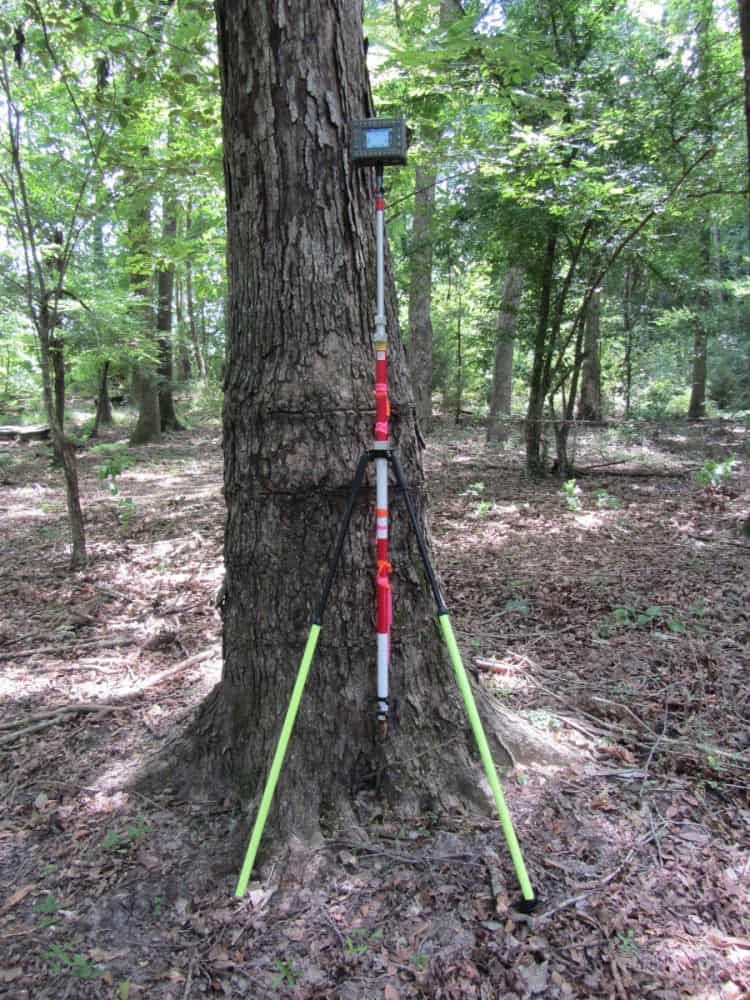 This pic, was taken of the LS sitting on a rebar. It is about 14" from that big oak. It ran up 10 groups, (Shawn calls them Buckets of coords) and threw the shot out 3 times, before it finally stored it. Took some 34 mins on this point. It was not a critical shot, and I was still trying to get oriented on this job. So, I thought I'd try this. I also have a 34 minute static shot here too, so I compared them. (These are run simultaneously, so total time is 34 mins. Differences are: N +0.012' E -.026' Elev +.037. All those differences are holding the Static shot, and comparing to RTK.
Some patience is in order, if you go as I have done, "off in the bad stuff".
I'd probably double check this if I were going on any plats. But, I'd also say that if it were off more than a tenth, it would surprise me. I'm sure it is within 0.16'.
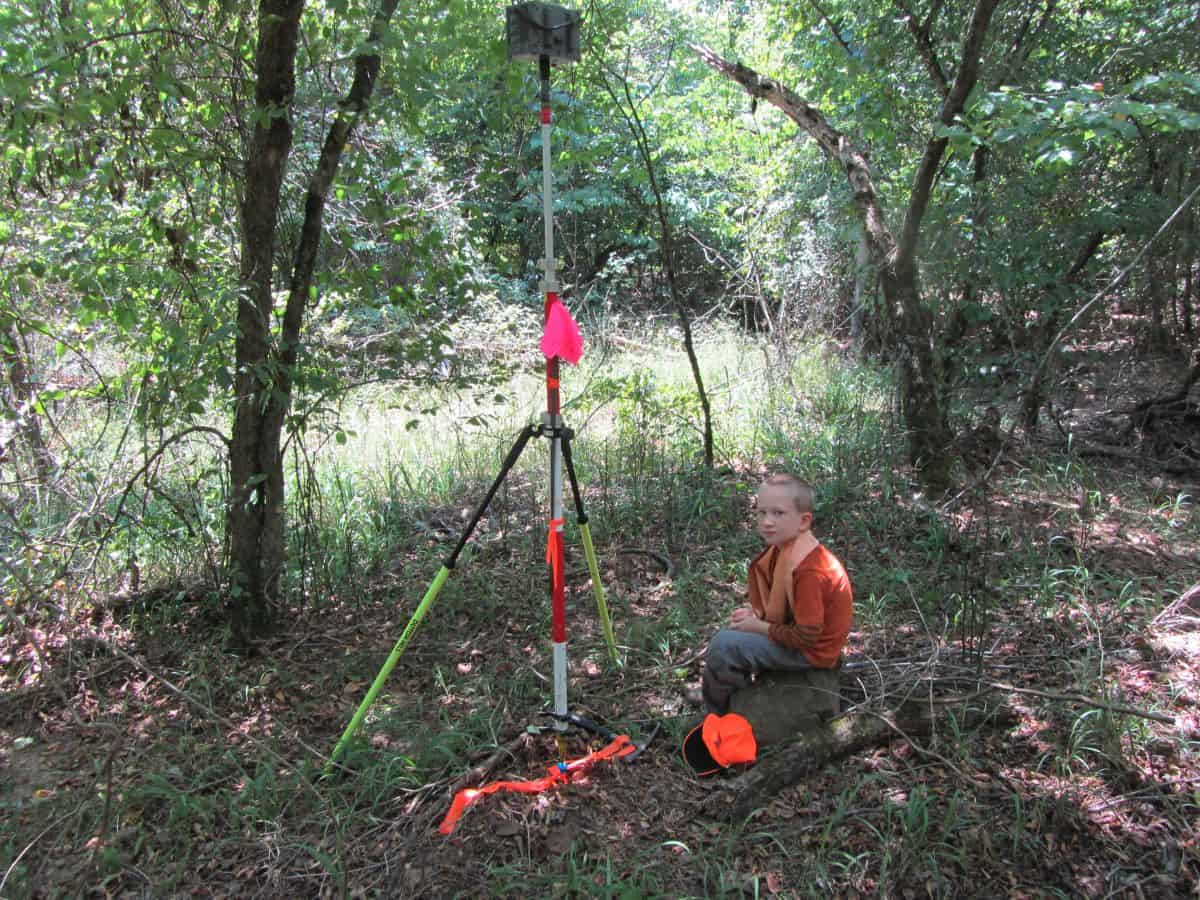 Now, on this shot, I have my 5 yr old with me. He is a blast to work with . I had a few corners to set, and he wanted to go. I often set a rock pile around my corners. I had walked to the local creek, and got a large semi square stone, and while waiting on the GPS, Set it beside the point, to be moved to beside the corner, before I left. I set it down, and 5 yr old said "Thanks dad, now I have a seat". It made my day. Like as though I had gone to the creek bed, and hauled that 50-60 Lb rock over there, so he could have a seat!!
Now, I hope everyone has a good day. And, I hope my story helps some who don't understand what I'm doing, to understand.
And, don't get a God Complex, like I did. (You'll have to fight it, if you get a Javad!)
And, as Paul Harvey used to say:
Good Day!
Nate
Posted : July 21, 2016 5:29 pm

Translate
▼
English
Spanish
French
German
Italian
Portuguese
Russian
Chinese
Japanese
Korean
Arabic
Hindi
Dutch
Polish
Turkish
Vietnamese
Thai
Swedish
Danish
Finnish
Norwegian
Czech
Hungarian
Romanian
Greek
Hebrew
Indonesian
Malay
Ukrainian
Bulgarian
Croatian
Slovak
Slovenian
Serbian
Lithuanian
Latvian
Estonian
So, that's my little story. I have had several curious about "how I got this way", and one wondered what book to buy. To myknowledge, there is no book on how to ABUSE GPS, and win.
Here's a new book of text that a few centuries old It is a English-German edition. So you could learn some German too and be a real ÌÏber Surveyor. If you want to buy it, I'll send it to you.
Posted : July 21, 2016 6:05 pm
Topic starter
Translate
▼
English
Spanish
French
German
Italian
Portuguese
Russian
Chinese
Japanese
Korean
Arabic
Hindi
Dutch
Polish
Turkish
Vietnamese
Thai
Swedish
Danish
Finnish
Norwegian
Czech
Hungarian
Romanian
Greek
Hebrew
Indonesian
Malay
Ukrainian
Bulgarian
Croatian
Slovak
Slovenian
Serbian
Lithuanian
Latvian
Estonian
Well, How much do you want for it? And, have you read it?
Least Squares is interesting.
N
Posted : July 21, 2016 6:21 pm
Translate
▼
English
Spanish
French
German
Italian
Portuguese
Russian
Chinese
Japanese
Korean
Arabic
Hindi
Dutch
Polish
Turkish
Vietnamese
Thai
Swedish
Danish
Finnish
Norwegian
Czech
Hungarian
Romanian
Greek
Hebrew
Indonesian
Malay
Ukrainian
Bulgarian
Croatian
Slovak
Slovenian
Serbian
Lithuanian
Latvian
Estonian
Nate The Surveyor, post: 382008, member: 291 wrote: Well, How much do you want for it? And, have you read it?
Least Squares is interesting.
N
I was thinking Gauss and German was stuck in my head.
This is the Latin-English edition.
I guess he wrote in Latin
Posted : July 21, 2016 6:51 pm
Topic starter
Translate
▼
English
Spanish
French
German
Italian
Portuguese
Russian
Chinese
Japanese
Korean
Arabic
Hindi
Dutch
Polish
Turkish
Vietnamese
Thai
Swedish
Danish
Finnish
Norwegian
Czech
Hungarian
Romanian
Greek
Hebrew
Indonesian
Malay
Ukrainian
Bulgarian
Croatian
Slovak
Slovenian
Serbian
Lithuanian
Latvian
Estonian
OK, I read a LITTLE Latin (et al) but not enough to try to comprehend a technical work, at any productive rate....
And, I know a little Greek. He owns a restaurant in Chicago.... 🙂
And, a Jewish guy... owns a clothing store!
N
Posted : July 21, 2016 6:57 pm
Translate
▼
English
Spanish
French
German
Italian
Portuguese
Russian
Chinese
Japanese
Korean
Arabic
Hindi
Dutch
Polish
Turkish
Vietnamese
Thai
Swedish
Danish
Finnish
Norwegian
Czech
Hungarian
Romanian
Greek
Hebrew
Indonesian
Malay
Ukrainian
Bulgarian
Croatian
Slovak
Slovenian
Serbian
Lithuanian
Latvian
Estonian
Nate The Surveyor, post: 382010, member: 291 wrote: OK, I read a LITTLE Latin (et al) but not enough to try to comprehend a technical work, at any productive rate....
And, I know a little Greek. He owns a restaurant in Chicago.... 🙂
And, a Jewish guy... owns a clothing store!
N
It's in English and Latin
It's still used as a text for Applied Mathematics since it is the inception of least squares in 1656.
Posted : July 21, 2016 7:13 pm
Topic starter
Translate
▼
English
Spanish
French
German
Italian
Portuguese
Russian
Chinese
Japanese
Korean
Arabic
Hindi
Dutch
Polish
Turkish
Vietnamese
Thai
Swedish
Danish
Finnish
Norwegian
Czech
Hungarian
Romanian
Greek
Hebrew
Indonesian
Malay
Ukrainian
Bulgarian
Croatian
Slovak
Slovenian
Serbian
Lithuanian
Latvian
Estonian
It may be that I need a less rigorous book to start with.... I found one of those on Amazon for 25.00 I have played with expanding error ellipses, and traverses, with maximum errors, and average error potential. It was kind of like deliberately building a cabinet sloppy, and then playing with the slop, or looseness of the joints. That is one thing I like about GPS. Error from one base station does not propagate, in the same fashion that it does with a multiple leg Total Station Traverse. Have you read it? How easy to comprehend is it?
N
Posted : July 21, 2016 7:28 pm

Translate
▼
English
Spanish
French
German
Italian
Portuguese
Russian
Chinese
Japanese
Korean
Arabic
Hindi
Dutch
Polish
Turkish
Vietnamese
Thai
Swedish
Danish
Finnish
Norwegian
Czech
Hungarian
Romanian
Greek
Hebrew
Indonesian
Malay
Ukrainian
Bulgarian
Croatian
Slovak
Slovenian
Serbian
Lithuanian
Latvian
Estonian
You raised it to 10ft. and stored a shot? How? I am curious because this was a major concern of mine considering the combined receiver/data collector. Thanks!
Posted : July 22, 2016 8:00 am
Translate
▼
English
Spanish
French
German
Italian
Portuguese
Russian
Chinese
Japanese
Korean
Arabic
Hindi
Dutch
Polish
Turkish
Vietnamese
Thai
Swedish
Danish
Finnish
Norwegian
Czech
Hungarian
Romanian
Greek
Hebrew
Indonesian
Malay
Ukrainian
Bulgarian
Croatian
Slovak
Slovenian
Serbian
Lithuanian
Latvian
Estonian
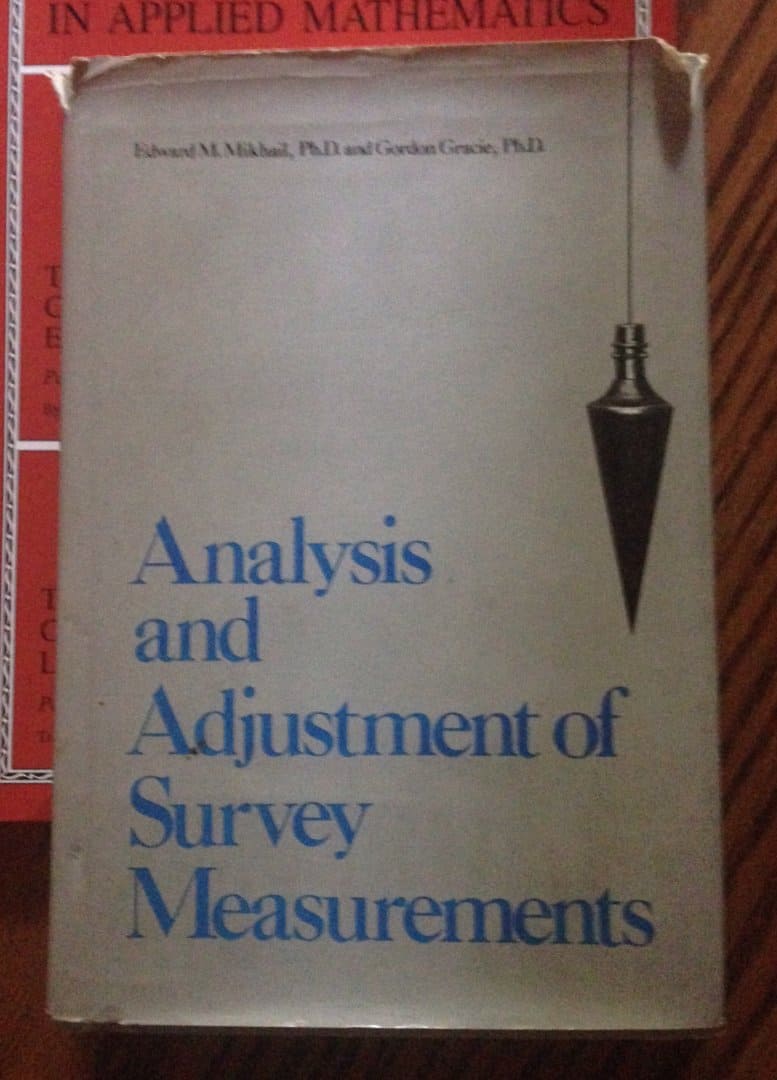
Nate The Surveyor, post: 382015, member: 291 wrote: It may be that I need a less rigorous book to start with.... I found one of those on Amazon for 25.00 I have played with expanding error ellipses, and traverses, with maximum errors, and average error potential. It was kind of like deliberately building a cabinet sloppy, and then playing with the slop, or looseness of the joints. That is one thing I like about GPS. Error from one base station does not propagate, in the same fashion that it does with a multiple leg Total Station Traverse. Have you read it? How easy to comprehend is it?
N
You might want to take a gander of this book or a later edition. This is the
3rd.
Posted : July 22, 2016 8:13 am

Translate
▼
English
Spanish
French
German
Italian
Portuguese
Russian
Chinese
Japanese
Korean
Arabic
Hindi
Dutch
Polish
Turkish
Vietnamese
Thai
Swedish
Danish
Finnish
Norwegian
Czech
Hungarian
Romanian
Greek
Hebrew
Indonesian
Malay
Ukrainian
Bulgarian
Croatian
Slovak
Slovenian
Serbian
Lithuanian
Latvian
Estonian
You may want to check out some of the work of Dr. Gilbert Strang as well.
Posted : July 22, 2016 10:13 am

Translate
▼
English
Spanish
French
German
Italian
Portuguese
Russian
Chinese
Japanese
Korean
Arabic
Hindi
Dutch
Polish
Turkish
Vietnamese
Thai
Swedish
Danish
Finnish
Norwegian
Czech
Hungarian
Romanian
Greek
Hebrew
Indonesian
Malay
Ukrainian
Bulgarian
Croatian
Slovak
Slovenian
Serbian
Lithuanian
Latvian
Estonian
(Javad glory waves on this board happen periodically, looks like this is about time for the new one, i was actually missing one :))
Besides the above joke this is my recommendation: https://www.amazon.com/Algorithms-Global-Positioning-Gilbert-Strang/dp/0980232732&apos ;">Algorithms for Global Positioning
Posted : July 22, 2016 12:41 pm
Topic starter
Translate
▼
English
Spanish
French
German
Italian
Portuguese
Russian
Chinese
Japanese
Korean
Arabic
Hindi
Dutch
Polish
Turkish
Vietnamese
Thai
Swedish
Danish
Finnish
Norwegian
Czech
Hungarian
Romanian
Greek
Hebrew
Indonesian
Malay
Ukrainian
Bulgarian
Croatian
Slovak
Slovenian
Serbian
Lithuanian
Latvian
Estonian
Jason Graves, post: 382074, member: 9531 wrote: You raised it to 10ft. and stored a shot? How? I am curious because this was a major concern of mine considering the combined receiver/data collector. Thanks!
Well, there are several ways to do this.
My common way is to set the settings to "Boundary", and then press START. Then, elevate it. If it manages to grab a click or two, before it gets up there, it is ok. It will abandon those point groups, because they won't fit the accuracy pattern.
Then, it has a light on the bottom. This light flashes, with every Epoch. Then, it has a pattern it goes into after it gets the shot. So, you can strictly do it visually.
Another way, is to turn on the MIFI on the cell phone, and completely control it from your Android based device, or I-phone. The down side of this, is it does drain the batteries in the cell phone a bit faster. I have a backup power source for the cell phone. Another minor down side, is there is a little delay between the two.
Another way, is to put a time delay in it, of 10", or so.
One word here, is versatility. There are usually 2 or 4 ways to accomplish a given task.
Another way to do it, is with a WIRE and an external antenna. This would be a good way to go, with a Side by Side UTV. Mount the external antenna, on the UTV, with a wire, and a small cradle for the LS.
Versatility is a BIG part of the LS.
Why do I like it? It does things that NO OTHER device can do. I have run MILES and MILES of traverse, with Transit, and tape. And, with Thedodolite, and EDM. And, with Total Station. I held a funeral service, for my fine traversing skills, the other day! There is a ROMANCE with doing GOOD Total station work.
I was concerned about that item too, when I bought it.
I'd prefer a VERY light GPS antenna, that bluetooths the signal to the Data collector, and processor.
But, I don't think that can be done... yet!
N
Posted : July 22, 2016 8:54 pm

Translate
▼
English
Spanish
French
German
Italian
Portuguese
Russian
Chinese
Japanese
Korean
Arabic
Hindi
Dutch
Polish
Turkish
Vietnamese
Thai
Swedish
Danish
Finnish
Norwegian
Czech
Hungarian
Romanian
Greek
Hebrew
Indonesian
Malay
Ukrainian
Bulgarian
Croatian
Slovak
Slovenian
Serbian
Lithuanian
Latvian
Estonian
I'd like to join in on this discussion. I'm a student studying Geomatics and I have worked with the equipment in a pretty wide range of environments. I've never had the opportunity to thoroughly test the equipment in some of the more austere conditions, and I am presently fortunate to have robotic total stations available when I need them. Addressing your curiosity about different textbooks, there are two books that I would seriosly recommend purchasing to learn about least-squares, and another that I believe thoroughly addresses the use of least-squares algorithms in GPS. The last book is not one that I've personally read, but the author is a Professor that I've read other works from who has a very conversational tone in textbooks. I've placed hyperlinks to the text titles. If you click on them, they will (hopefully) take you to the correct sources.
https://www.amazon.com/Introduction-Linear-Algebra-Fourth-Gilbert/dp/0980232716/ref=sr_1_1?s=books&ie=UTF8&qid=1469311232&sr=1-1&keywords=introduction+to+linear+algebra&apos ;">Introduction to Linear Algebra, Fourth Edition
Author: Gilbert Strang
Gilbert Strang is a professor at MIT who I think teaches Linear Algebra better than almost anyone else in the world. An added benefit to purchasing his textbook is that MIT offers an open courseware series on the subject, taught by him and based on this textbook. His writing is very conversational, and he does not typically write a lot of proofs for the concepts he is discussing. I suspect that most other books on the subject would require exposure to mathematical proofs and some advanced calculus, and those texts would be much more concise in their descriptions of the subject matter. This guy writes and lectures as though he is teaching a freshman level course, which eliminates the need for a more thorough background in advanced mathematics. Since his lectures at MIT are broken into roughly 50 minute blocks of time, which I can appreciate as being a rare commodity, I would also recommend looking at the Linear Algebra channel on Khan Academy, which has several shorter videos that address the same subject. Khan Academy was created by an MIT graduate, and I think he provides content that is similarly easy to understand. The links are below, but in either case I do not believe that the textbook is a must-have for learning the basics of linear algebra. The first 2 chapters of this textbook are the only ones that are imperative for learning how to actually use the mathematics. After that, any book will begin talking about advanced topics that are either theoretical or extraneous to understanding the process of applying linear algebra to least-squares.
http://ocw.mit.edu/courses/mathematics/18-06-linear-algebra-spring-2010/&apos ;">MIT Linear Algebra Video Lectures
https://www.khanacademy.org/&apos ;">Khan Academy
https://www.amazon.com/s/ref=nb_sb_ss_c_2_23?url=search-alias%3Dstripbooks&field-keywords=adjustment+computations&sprefix=adjustment+computations%2Caps%2C165&apos ;">Adjustment Computations
Author: Charles Ghilani
Ghilani is one of my favorite authors. In his Elementary Surveying text, I sometimes found that his derivations were a little too concise, but so far Adjustment Computations is a fantastic piece of work. This book is completely dedicated to the study of least-squares in Surveying and GIS applications, and is probably the best bang for your buck if you only consider purchasing one text on the subject. The others will give better context either to the mathematics, or to the application in GPS measurements, but adjustment computations would also give you insights in applying the adjustments to all of your work. The link I provided for this book was only the search criteria on amazon. I'm reading out of an early edition of the book right now, but I might recommend one of the later editions if you're okay with spending the extra money to purchase it. The edition I've borrowed included a floppy disc with software that is probably accessible from a CD or other piece of media with the later editions. The most modern copy would most likely come with a product key to access the material in a college classroom, but that would not be of much use unless you were enrolled in a course at a university that used the book. Because of that, I would emphasize that you should purchase newer editions of the text used.
https://www.amazon.com/Linear-Algebra-Geodesy-Gilbert-Strang/dp/0961408863/ref=sr_1_25?s=books&ie=UTF8&qid=1469312353&sr=1-25&keywords=gilbert+strang&apos ;">Linear Algebra, Geodesy, and GPS
Authors: Gilbert Strang and Kae Borre
I have not yet purchased this book, and I don't think I'll be seeing it any time soon. However, that is not for a lack of interest in doing so. The only thing about this text that would be worrisome is that looking at the product reviews, the top rated comment comes from Dr. Mike Bevis, who is a professor in the Department of Geodetic Science at The Ohio State University. That suggests to me that the book may be used in graduate level studies, and that any reader may need a pretty significant background in each subject listed in the title. I don't doubt that it is a good read, but I believe that it would require greater exposure to all three topics than whatever introduction they will give in the text.
I would also suggest looking into a computations software package if you work any of the examples in the books shown. Due to the volume of computations performed when doing anything related to Linear Algebra, those packages are very helpful. Microsoft Excel offers tools for doing matrix computations, but I don't think the software handles them very efficiently. Gilbert Strang offers a lot of sample code in his books for use in MATLAB, which I understand carries a hefty pricetag for a software license. An alternative to MATLAB is something called SCILAB, which is an opensource program that parallels MATLAB pretty well. SCILAB even offers a converter that will adapt a MATLAB program into its SCILAB equivalent. Lastly, if you use a software to perform the computations, I would first recommend trying some of them by hand just to better understand what's going on in the software. I think that's important just to move past the phase of being a proverbial button-pusher. SCILAB can be found at
I hope this is helpful! And thank you for sharing your findings on when GPS is good. Sometimes we use it in unideal conditions, and I always dread doing it.
Posted : July 23, 2016 4:36 pm
Translate
▼
English
Spanish
French
German
Italian
Portuguese
Russian
Chinese
Japanese
Korean
Arabic
Hindi
Dutch
Polish
Turkish
Vietnamese
Thai
Swedish
Danish
Finnish
Norwegian
Czech
Hungarian
Romanian
Greek
Hebrew
Indonesian
Malay
Ukrainian
Bulgarian
Croatian
Slovak
Slovenian
Serbian
Lithuanian
Latvian
Estonian
Excellent post Daniel!
Posted : July 23, 2016 6:33 pm

Translate
▼
English
Spanish
French
German
Italian
Portuguese
Russian
Chinese
Japanese
Korean
Arabic
Hindi
Dutch
Polish
Turkish
Vietnamese
Thai
Swedish
Danish
Finnish
Norwegian
Czech
Hungarian
Romanian
Greek
Hebrew
Indonesian
Malay
Ukrainian
Bulgarian
Croatian
Slovak
Slovenian
Serbian
Lithuanian
Latvian
Estonian
Every optical survey instrument and GPS receiver should come from the factory with a quote from the introduction to Ghilani's book engraved on it: "All measurements have error."
Posted : July 23, 2016 6:48 pm

Translate
▼
English
Spanish
French
German
Italian
Portuguese
Russian
Chinese
Japanese
Korean
Arabic
Hindi
Dutch
Polish
Turkish
Vietnamese
Thai
Swedish
Danish
Finnish
Norwegian
Czech
Hungarian
Romanian
Greek
Hebrew
Indonesian
Malay
Ukrainian
Bulgarian
Croatian
Slovak
Slovenian
Serbian
Lithuanian
Latvian
Estonian
Could I use a topcon hiper v base with a triumph LS rover?
Sent from my SAMSUNG-SM-N920A using Tapatalk
Posted : July 23, 2016 10:35 pm

Translate
▼
English
Spanish
French
German
Italian
Portuguese
Russian
Chinese
Japanese
Korean
Arabic
Hindi
Dutch
Polish
Turkish
Vietnamese
Thai
Swedish
Danish
Finnish
Norwegian
Czech
Hungarian
Romanian
Greek
Hebrew
Indonesian
Malay
Ukrainian
Bulgarian
Croatian
Slovak
Slovenian
Serbian
Lithuanian
Latvian
Estonian
arctan(x), post: 382332, member: 6795 wrote: Could I use a topcon hiper v base with a triumph LS rover?
Sent from my SAMSUNG-SM-N920A using Tapatalk
Even if you could I would not recommend it. There are so many features that use both base and rover, particular the 5.0 Hz Beast Mode.
Licensed Land Surveyor
Finger Lakes Region, Upstate New York
Posted : July 24, 2016 5:26 am
Translate
▼
English
Spanish
French
German
Italian
Portuguese
Russian
Chinese
Japanese
Korean
Arabic
Hindi
Dutch
Polish
Turkish
Vietnamese
Thai
Swedish
Danish
Finnish
Norwegian
Czech
Hungarian
Romanian
Greek
Hebrew
Indonesian
Malay
Ukrainian
Bulgarian
Croatian
Slovak
Slovenian
Serbian
Lithuanian
Latvian
Estonian
My hiper v has a 5 Hz option. Is that the same thing? What other features are there? Is anyone going to bring their LS to the Texas state convention in October?
Sent from my SAMSUNG-SM-N920A using Tapatalk
Posted : July 24, 2016 10:02 am

Translate
▼
English
Spanish
French
German
Italian
Portuguese
Russian
Chinese
Japanese
Korean
Arabic
Hindi
Dutch
Polish
Turkish
Vietnamese
Thai
Swedish
Danish
Finnish
Norwegian
Czech
Hungarian
Romanian
Greek
Hebrew
Indonesian
Malay
Ukrainian
Bulgarian
Croatian
Slovak
Slovenian
Serbian
Lithuanian
Latvian
Estonian
arctan(x), post: 382361, member: 6795 wrote: My hiper v has a 5 Hz option. Is that the same thing? What other features are there? Is anyone going to bring their LS to the Texas state convention in October?
Sent from my SAMSUNG-SM-N920A using Tapatalk
I plan to be there. We could try it out sooner if you aren't too far away.
Posted : July 24, 2016 1:56 pm
Translate
▼
English
Spanish
French
German
Italian
Portuguese
Russian
Chinese
Japanese
Korean
Arabic
Hindi
Dutch
Polish
Turkish
Vietnamese
Thai
Swedish
Danish
Finnish
Norwegian
Czech
Hungarian
Romanian
Greek
Hebrew
Indonesian
Malay
Ukrainian
Bulgarian
Croatian
Slovak
Slovenian
Serbian
Lithuanian
Latvian
Estonian
Shawn Billings, post: 382380, member: 6521 wrote: I plan to be there. We could try it out sooner if you aren't too far away.
Thanks Shawn! My office is in Denton. Where are you out of?
Sent from my SAMSUNG-SM-N920A using Tapatalk
Posted : July 24, 2016 1:58 pm
Page 1 / 2
Next