Reading RPLS is free for the whole profession. Members post, reply, and get the members-only rooms.


Notifications
Clear all
GNSS & Geodesy
9
Posts
4
Users
0
Reactions
3,978
Views

Topic starter
Translate
▼
English
Spanish
French
German
Italian
Portuguese
Russian
Chinese
Japanese
Korean
Arabic
Hindi
Dutch
Polish
Turkish
Vietnamese
Thai
Swedish
Danish
Finnish
Norwegian
Czech
Hungarian
Romanian
Greek
Hebrew
Indonesian
Malay
Ukrainian
Bulgarian
Croatian
Slovak
Slovenian
Serbian
Lithuanian
Latvian
Estonian
Some Indiana SPC questions for which I can't seem to find answers:
1. At what elevation (or approx. elevation if it varies) and relative to what datum are the Indiana SPC grids?
2. How are horizontal coordinates projected to the grid? Perpendicular to the grid? Perpendicular to the ellipsoid? Perpendicular to the geoid? From ground to center of ellipsoid?
Scott
Posted : July 6, 2015 6:53 am

Translate
▼
English
Spanish
French
German
Italian
Portuguese
Russian
Chinese
Japanese
Korean
Arabic
Hindi
Dutch
Polish
Turkish
Vietnamese
Thai
Swedish
Danish
Finnish
Norwegian
Czech
Hungarian
Romanian
Greek
Hebrew
Indonesian
Malay
Ukrainian
Bulgarian
Croatian
Slovak
Slovenian
Serbian
Lithuanian
Latvian
Estonian
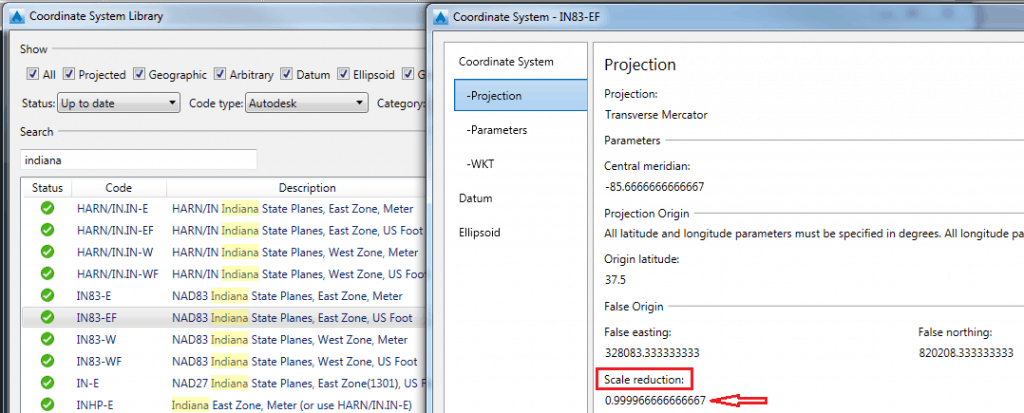
The grid does not really have an elevation per se. The grid "touches" the surface of the ellipsoid at two line of longitude. This is controlled by establishing a scale factor on the central meridian. In both Indiana zones the SF on the CM is set at 1:30,000.
Distances should be reduced to the GRS80 ellipsoid (elevation factor, depends on ellipsoidal elevation or orthometric height plus geoid separation) and then to the grid surface (grid factor, depends on location, mainly longitude).
Horizontal coordinates are on the grid, so I am not sure I understand your second question
Good reference material: http://www.ngs.noaa.gov/PUBS_LIB/ManualNOSNGS5.pdf&apos ;">NOAA MANUAL NOS NGS 5
Also, "The Indiana State Plane Coordinate System" by Kenneth S Curtis (was a professor at Purdue). This was written in 1974, so it does not discuss NAD83, or GPS, etc.
I found this link for the latter reference:
http://biblio.co.uk/book/indiana-state-plane-coordinate-system-curtis/d/226742453&apos ;">The Indiana State Plane Coordinate System
Posted : July 6, 2015 7:25 am

Translate
▼
English
Spanish
French
German
Italian
Portuguese
Russian
Chinese
Japanese
Korean
Arabic
Hindi
Dutch
Polish
Turkish
Vietnamese
Thai
Swedish
Danish
Finnish
Norwegian
Czech
Hungarian
Romanian
Greek
Hebrew
Indonesian
Malay
Ukrainian
Bulgarian
Croatian
Slovak
Slovenian
Serbian
Lithuanian
Latvian
Estonian
Scott,
"How are horizontal coordinates projected to the grid? Perpendicular to the grid?"
Yes. Projections are Cartesian.

scale factor = (R + h) / R
R=Radius of Ellipsoid (Approximately 20,906,000 ft)
h=Ellipsoid Height(NOT Orthometric)
So, along the Central Meridian, the State Plane Projection is roughly 697' below the Ellipsoid.
Dave
Posted : July 6, 2015 8:35 am
Topic starter
Translate
▼
English
Spanish
French
German
Italian
Portuguese
Russian
Chinese
Japanese
Korean
Arabic
Hindi
Dutch
Polish
Turkish
Vietnamese
Thai
Swedish
Danish
Finnish
Norwegian
Czech
Hungarian
Romanian
Greek
Hebrew
Indonesian
Malay
Ukrainian
Bulgarian
Croatian
Slovak
Slovenian
Serbian
Lithuanian
Latvian
Estonian
Dave, do you mean:
...So, along the Central Meridian, the State Plane Projection is roughly 697' below the Ellipsoid HEIGHT (AKA GROUND) ...
The state plane grid is more or less ON the ellipsoid, right?
Posted : July 6, 2015 9:02 am
Translate
▼
English
Spanish
French
German
Italian
Portuguese
Russian
Chinese
Japanese
Korean
Arabic
Hindi
Dutch
Polish
Turkish
Vietnamese
Thai
Swedish
Danish
Finnish
Norwegian
Czech
Hungarian
Romanian
Greek
Hebrew
Indonesian
Malay
Ukrainian
Bulgarian
Croatian
Slovak
Slovenian
Serbian
Lithuanian
Latvian
Estonian
Scott,
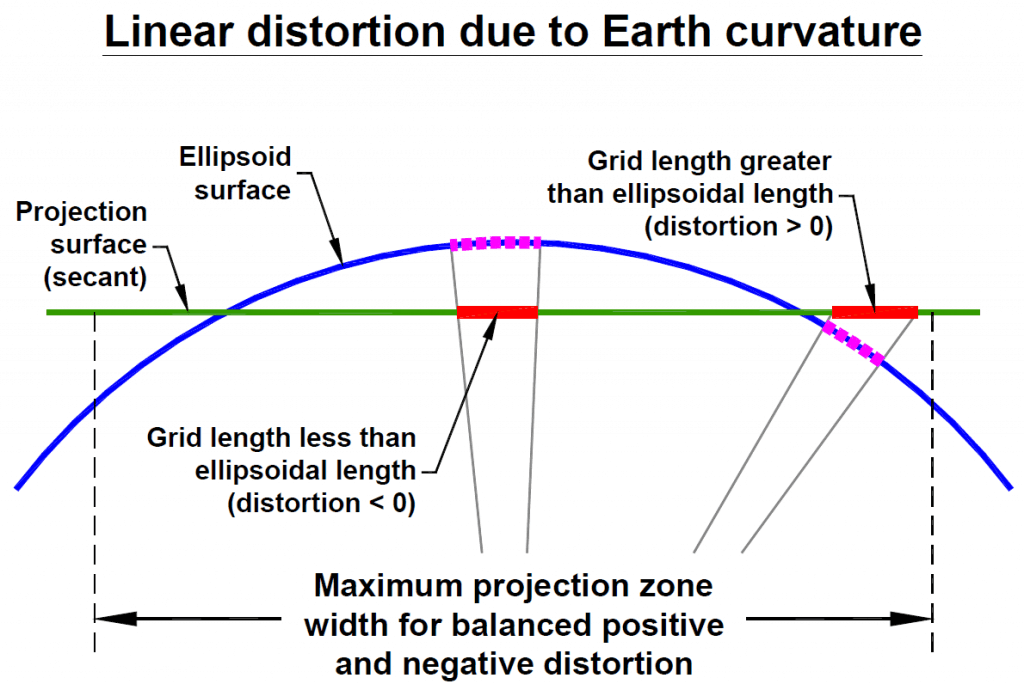
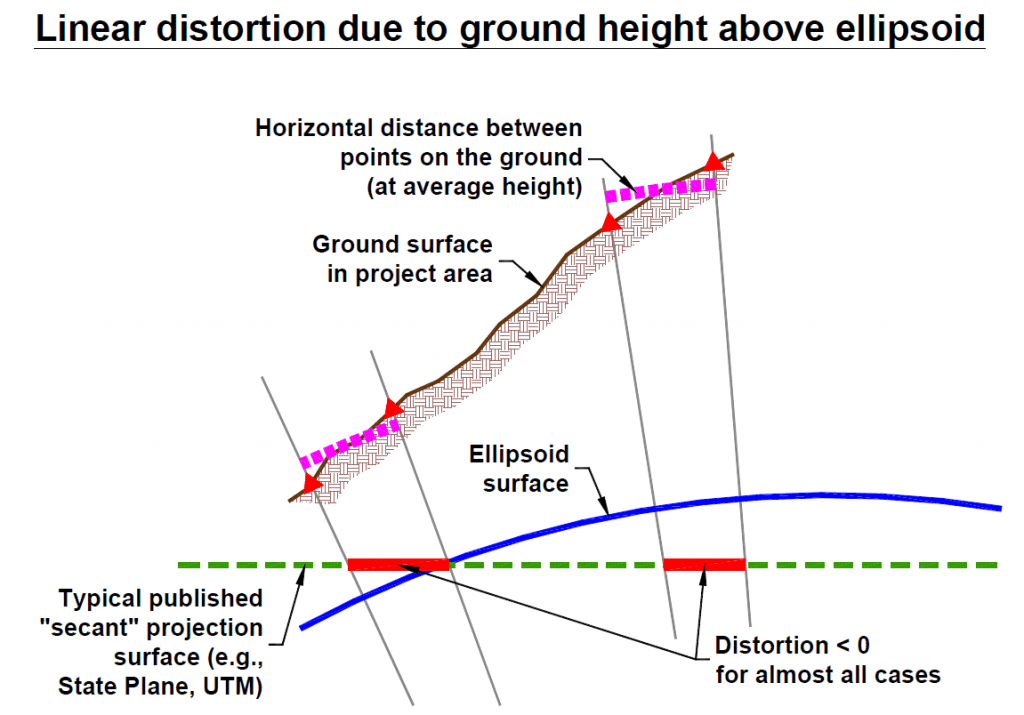
Can I retract what I said? I was wrong. Grid coordinates are projected perpendicular to the Ellipsoid.
Here's a couple of good graphics lifted from http://www.oregon.gov/ODOT/HWY/GEOMETRONICS/docs/ldp_workshop/2_low_distortion_projections_ground_truth_v9-michael_dennis.pdf&apos ;">Michael Dennis's excellent white paper:
http://www.oregon.gov/ODOT/HWY/GEOMETRONICS/docs/ldp_workshop/2_low_distortion_projections_ground_truth_v9-michael_dennis.pdf
Dave
Posted : July 6, 2015 10:43 am
Topic starter
Translate
▼
English
Spanish
French
German
Italian
Portuguese
Russian
Chinese
Japanese
Korean
Arabic
Hindi
Dutch
Polish
Turkish
Vietnamese
Thai
Swedish
Danish
Finnish
Norwegian
Czech
Hungarian
Romanian
Greek
Hebrew
Indonesian
Malay
Ukrainian
Bulgarian
Croatian
Slovak
Slovenian
Serbian
Lithuanian
Latvian
Estonian
Thanks, Dave. I now know that I am not crazy (sort of).
Using your reference to Michael Dennis's pdf, this is what I am trying to develop in each Indiana zone:
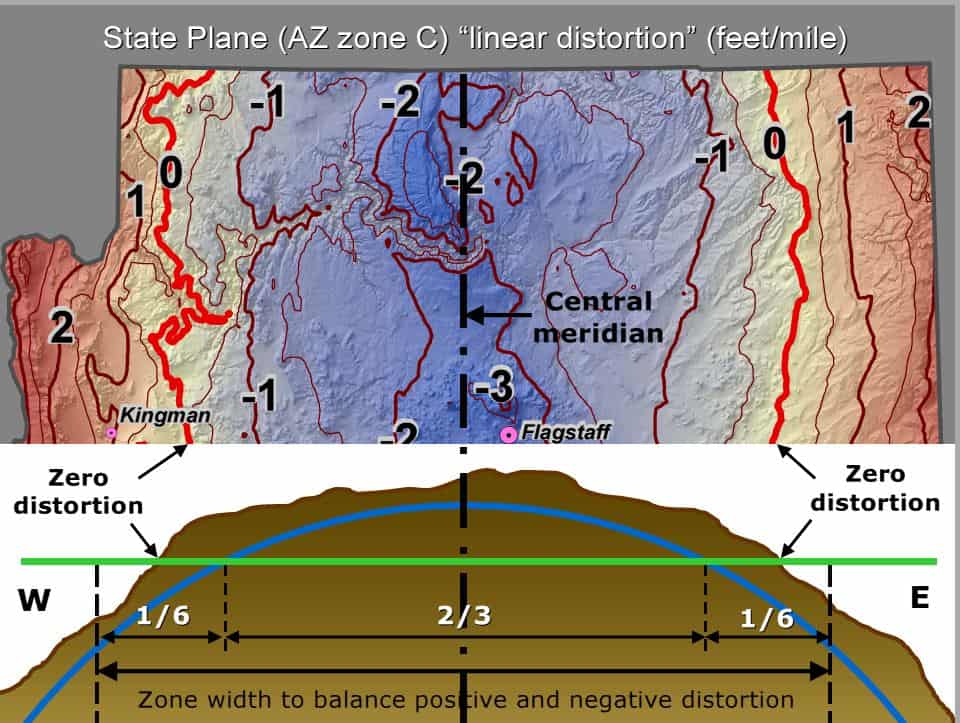
The only difference is that I want it to be in equation that uses ellipsoidal height, latitude and longitude within a given zone.
Scott
Posted : July 6, 2015 12:06 pm
Translate
▼
English
Spanish
French
German
Italian
Portuguese
Russian
Chinese
Japanese
Korean
Arabic
Hindi
Dutch
Polish
Turkish
Vietnamese
Thai
Swedish
Danish
Finnish
Norwegian
Czech
Hungarian
Romanian
Greek
Hebrew
Indonesian
Malay
Ukrainian
Bulgarian
Croatian
Slovak
Slovenian
Serbian
Lithuanian
Latvian
Estonian
Scott,
Michael Dennis has a wonderful site to investigate projections. You get one free day's play:
https://geo.ldpdesign.com/support/getting-started
Dave
Posted : July 6, 2015 1:46 pm

Translate
▼
English
Spanish
French
German
Italian
Portuguese
Russian
Chinese
Japanese
Korean
Arabic
Hindi
Dutch
Polish
Turkish
Vietnamese
Thai
Swedish
Danish
Finnish
Norwegian
Czech
Hungarian
Romanian
Greek
Hebrew
Indonesian
Malay
Ukrainian
Bulgarian
Croatian
Slovak
Slovenian
Serbian
Lithuanian
Latvian
Estonian
Dave is spot on with using Michael Dennis' website. Also, download the Oregon and Iowa LDP manuals; they offer a lot of valuable information.
As to the distortion in feet per mile, a general formula is: Distortion = 5280( 1- EF * SF) = 5280( 1 - CF) where EF, SF, and CF are the elevation factor, the scale factor, and the combined factor, respectively, for the point in question. Now, calculating the scale factor from latitude and longitude for a Transverse Mercator point is complicated. In fact, I've never done one, but pages 32 - 35 in the NGS Manual 5 that John Hamilton noted will show you how. A good approach might be to use NGS data sheets to compute some distortions for an area in order to get an idea of the distortion in that area.
Incidentally, for what it's worth, I like to look at distortion as the error committed by substituting a grid distance in the place of a ground distance. That keeps in perspective the notion that both are correct, they just represent different things.
On the question of perpendicularity of projections from the ellipsoid to the plane, I don't know the answer for a Transverse Mercator projection. However, for a Lambert Conformal system, the projection is perpendicular neither to the ellipsoid nor the plane. Instead, it's perpendicular to the semi-minor axis. The mathematics that demonstrates this counterintuitive idea is found on page 28 of the NGS Manual 5.
Posted : July 6, 2015 2:19 pm
Translate
▼
English
Spanish
French
German
Italian
Portuguese
Russian
Chinese
Japanese
Korean
Arabic
Hindi
Dutch
Polish
Turkish
Vietnamese
Thai
Swedish
Danish
Finnish
Norwegian
Czech
Hungarian
Romanian
Greek
Hebrew
Indonesian
Malay
Ukrainian
Bulgarian
Croatian
Slovak
Slovenian
Serbian
Lithuanian
Latvian
Estonian
Now, that Lambert perpendicularity statement above is just plain wrong. My apologies to anyone who read it. Undoubtedly, no one was misled, but I am embarrassed.
David is absolutely correct; a point on a state plane lies on the normal to the corresponding point on the ellipsoid.
Here's a diagram and some math that verifies David's post. The diagram shows a point on a Lambert plane and on the ellipsoid. The math derives the NGS Manual 5 formula for the scale factor, which is called k on page 28. Hopefully, my printing is legible enough.

Posted : July 7, 2015 9:13 am