Reading RPLS is free for the whole profession. Members post, reply, and get the members-only rooms.

Notifications
Clear all

Topic starter
Translate
▼
English
Spanish
French
German
Italian
Portuguese
Russian
Chinese
Japanese
Korean
Arabic
Hindi
Dutch
Polish
Turkish
Vietnamese
Thai
Swedish
Danish
Finnish
Norwegian
Czech
Hungarian
Romanian
Greek
Hebrew
Indonesian
Malay
Ukrainian
Bulgarian
Croatian
Slovak
Slovenian
Serbian
Lithuanian
Latvian
Estonian
I am trying to figure out how to calculate an overhead rate for a small surveying business. Can someone give me a list of categories that would contain typical direct costs and typical overhead costs? Also, if you are the owner/surveyor of a small surveying business, are you an overhead cost, direct cost or both? And if both, how do you separate that out?
Also, where can I find resources on this topic? I have heard that Dan Beardslee's book covers it, but I have not been able to find one.
Thanks
Posted : November 10, 2015 6:44 am

Translate
▼
English
Spanish
French
German
Italian
Portuguese
Russian
Chinese
Japanese
Korean
Arabic
Hindi
Dutch
Polish
Turkish
Vietnamese
Thai
Swedish
Danish
Finnish
Norwegian
Czech
Hungarian
Romanian
Greek
Hebrew
Indonesian
Malay
Ukrainian
Bulgarian
Croatian
Slovak
Slovenian
Serbian
Lithuanian
Latvian
Estonian
According to the cost accounting class in college, overhead is defined as anything that is consumable and small. Hammers wouldn't fit into it, but laths and iron rods and caps would. That being said, assigning a rate can be done in a myriad of ways.
One would need to track those items long term before simply adding it in as "overhead". Tracking the materials are a pain to say the least. Different manufacturing does it differently, but all seem to be based on some "average" use and then that cost per batch assigned to the cost center.
Then, once you do it, you need to look at other costs such as the theoretical, budgeted, and actual costs, with respect to overhead. This is a nightmare but is the only way, that I see, that you can begin to build a good feel for the jobs. This is no different than determining specs for an instrument. Once they are done, you can then easily attach an overhead cost to the man hours to track the costs. It won't be exact, but at $0.25/lath or $1/rod, it's close enough.
I'd buy the standard cost accounting book for college that is being taught now. It's dry, like sahara desert dry, but I got the most mileage out of that class over any other accounting class in college. It dovetails very nicely with the management classes.
Also, expect to see ZERO reference to service industries in that book. Nearly 100% of my business degrees focused on manufacturing rather than service because of the fluidity of the service industry. I had to pull it out of my professors as how to apply the lessons to service rather than manufacturing or retail.
Posted : November 10, 2015 9:27 am

Translate
▼
English
Spanish
French
German
Italian
Portuguese
Russian
Chinese
Japanese
Korean
Arabic
Hindi
Dutch
Polish
Turkish
Vietnamese
Thai
Swedish
Danish
Finnish
Norwegian
Czech
Hungarian
Romanian
Greek
Hebrew
Indonesian
Malay
Ukrainian
Bulgarian
Croatian
Slovak
Slovenian
Serbian
Lithuanian
Latvian
Estonian
First you figure out what the market will bear price-wise. Then you total up your day to day expenses. Subtract number two from number one and divide by the number of days you prefer to count.
Posted : November 10, 2015 9:49 am

Translate
▼
English
Spanish
French
German
Italian
Portuguese
Russian
Chinese
Japanese
Korean
Arabic
Hindi
Dutch
Polish
Turkish
Vietnamese
Thai
Swedish
Danish
Finnish
Norwegian
Czech
Hungarian
Romanian
Greek
Hebrew
Indonesian
Malay
Ukrainian
Bulgarian
Croatian
Slovak
Slovenian
Serbian
Lithuanian
Latvian
Estonian
"Overhead" is what it costs to operate your business other than labor. So your total outgo minus labor equals overhead. To get overhead rate you divide by the number of billable hours to get a $/hr figure.
Just as with least squares, accounting is a business where you can make numbers mean just about anything you want them to if you work at it. No one number tells you anything. Even if you aren't paying yourself a salary you should probably do a shadow calculation with a reasonable figure substituted to get a better idea of where you stand.
Posted : November 10, 2015 9:49 am
Topic starter
Translate
▼
English
Spanish
French
German
Italian
Portuguese
Russian
Chinese
Japanese
Korean
Arabic
Hindi
Dutch
Polish
Turkish
Vietnamese
Thai
Swedish
Danish
Finnish
Norwegian
Czech
Hungarian
Romanian
Greek
Hebrew
Indonesian
Malay
Ukrainian
Bulgarian
Croatian
Slovak
Slovenian
Serbian
Lithuanian
Latvian
Estonian
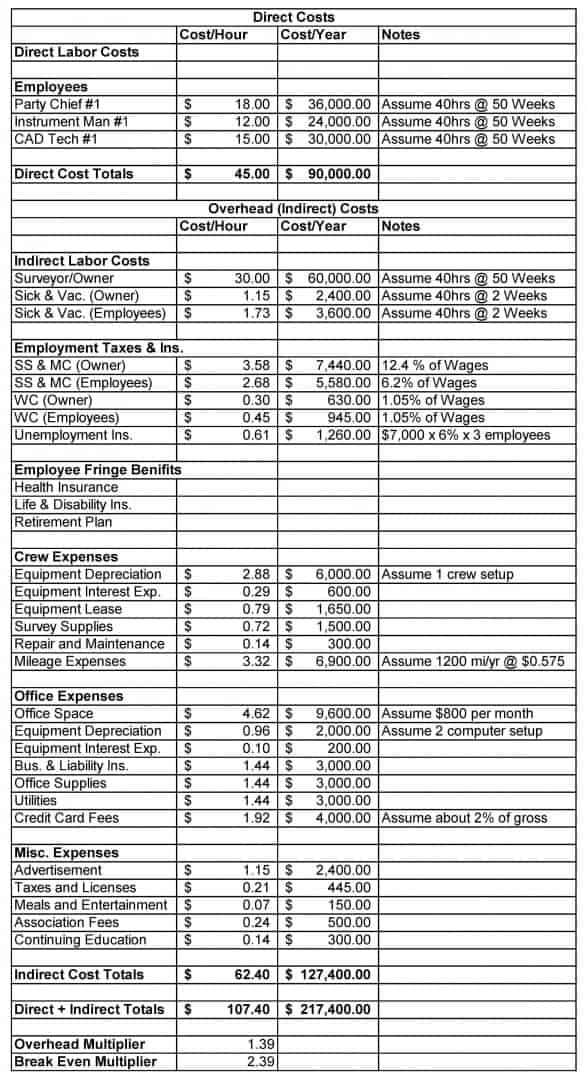
OK, here is my first stab at modeling a typical small survey office with one 2-man crew and one CAD tech in my area. I did the best with making my numbers as realistic as possible based on my own numbers as a solo surveyor and the current going crew and tech rates around here. Some things I took a guess at though. In this scenario, I have the surveyor/owner as 100% overhead. So what do you think? Am I missing any expense categories? Are any of my numbers totally out to lunch?
Posted : November 10, 2015 11:11 am

Translate
▼
English
Spanish
French
German
Italian
Portuguese
Russian
Chinese
Japanese
Korean
Arabic
Hindi
Dutch
Polish
Turkish
Vietnamese
Thai
Swedish
Danish
Finnish
Norwegian
Czech
Hungarian
Romanian
Greek
Hebrew
Indonesian
Malay
Ukrainian
Bulgarian
Croatian
Slovak
Slovenian
Serbian
Lithuanian
Latvian
Estonian
I am not sure that you should count all your (owner) time as an overhead expense if you expect to have charged hours that would be direct labor. Also, any overhead time (non-chargeable) should be counted as an indirect expense as well. Vacation time, sick time, holidays, payroll that is not chargeable to a client
Posted : November 10, 2015 12:14 pm

Translate
▼
English
Spanish
French
German
Italian
Portuguese
Russian
Chinese
Japanese
Korean
Arabic
Hindi
Dutch
Polish
Turkish
Vietnamese
Thai
Swedish
Danish
Finnish
Norwegian
Czech
Hungarian
Romanian
Greek
Hebrew
Indonesian
Malay
Ukrainian
Bulgarian
Croatian
Slovak
Slovenian
Serbian
Lithuanian
Latvian
Estonian
Are you really only paying your party chief 36k ?
NZ isn't known for high wages, but they are worth around twice that here.
Posted : November 10, 2015 12:27 pm
Topic starter
Translate
▼
English
Spanish
French
German
Italian
Portuguese
Russian
Chinese
Japanese
Korean
Arabic
Hindi
Dutch
Polish
Turkish
Vietnamese
Thai
Swedish
Danish
Finnish
Norwegian
Czech
Hungarian
Romanian
Greek
Hebrew
Indonesian
Malay
Ukrainian
Bulgarian
Croatian
Slovak
Slovenian
Serbian
Lithuanian
Latvian
Estonian
Well... I'm not, but that is the going rate around here plus or minus $2-$3 per hour with sketchy benefits. Yeah, I know it should be better, but those are the realities.
Posted : November 10, 2015 12:31 pm

Translate
▼
English
Spanish
French
German
Italian
Portuguese
Russian
Chinese
Japanese
Korean
Arabic
Hindi
Dutch
Polish
Turkish
Vietnamese
Thai
Swedish
Danish
Finnish
Norwegian
Czech
Hungarian
Romanian
Greek
Hebrew
Indonesian
Malay
Ukrainian
Bulgarian
Croatian
Slovak
Slovenian
Serbian
Lithuanian
Latvian
Estonian
Where are you finding lath for $0.25
Posted : November 10, 2015 12:41 pm
Translate
▼
English
Spanish
French
German
Italian
Portuguese
Russian
Chinese
Japanese
Korean
Arabic
Hindi
Dutch
Polish
Turkish
Vietnamese
Thai
Swedish
Danish
Finnish
Norwegian
Czech
Hungarian
Romanian
Greek
Hebrew
Indonesian
Malay
Ukrainian
Bulgarian
Croatian
Slovak
Slovenian
Serbian
Lithuanian
Latvian
Estonian
It was just a number I threw out.
Posted : November 10, 2015 1:40 pm
Translate
▼
English
Spanish
French
German
Italian
Portuguese
Russian
Chinese
Japanese
Korean
Arabic
Hindi
Dutch
Polish
Turkish
Vietnamese
Thai
Swedish
Danish
Finnish
Norwegian
Czech
Hungarian
Romanian
Greek
Hebrew
Indonesian
Malay
Ukrainian
Bulgarian
Croatian
Slovak
Slovenian
Serbian
Lithuanian
Latvian
Estonian
No. Your definition of overhead is wrong. With respect, there are many other things, such as fixed costs, variable costs, et cetera, that do not fall into the "overhead" category.
Posted : November 10, 2015 1:41 pm

Translate
▼
English
Spanish
French
German
Italian
Portuguese
Russian
Chinese
Japanese
Korean
Arabic
Hindi
Dutch
Polish
Turkish
Vietnamese
Thai
Swedish
Danish
Finnish
Norwegian
Czech
Hungarian
Romanian
Greek
Hebrew
Indonesian
Malay
Ukrainian
Bulgarian
Croatian
Slovak
Slovenian
Serbian
Lithuanian
Latvian
Estonian
Looks pretty good to me, especially for a first stab at it.
Posted : November 10, 2015 5:55 pm
Topic starter
Translate
▼
English
Spanish
French
German
Italian
Portuguese
Russian
Chinese
Japanese
Korean
Arabic
Hindi
Dutch
Polish
Turkish
Vietnamese
Thai
Swedish
Danish
Finnish
Norwegian
Czech
Hungarian
Romanian
Greek
Hebrew
Indonesian
Malay
Ukrainian
Bulgarian
Croatian
Slovak
Slovenian
Serbian
Lithuanian
Latvian
Estonian
I forgot holiday pay. Typically how many paid holidays do you have? I probably need to factor in payroll services as well. Does anyone know how much that costs? Also, the owner/surveyor should be somewhat billable, but how much (maybe 20%)?
Posted : November 10, 2015 6:55 pm

Translate
▼
English
Spanish
French
German
Italian
Portuguese
Russian
Chinese
Japanese
Korean
Arabic
Hindi
Dutch
Polish
Turkish
Vietnamese
Thai
Swedish
Danish
Finnish
Norwegian
Czech
Hungarian
Romanian
Greek
Hebrew
Indonesian
Malay
Ukrainian
Bulgarian
Croatian
Slovak
Slovenian
Serbian
Lithuanian
Latvian
Estonian
Your numbers are about right, a 2.5 multiplier but you do need to make your self billable. I would use 30% for a working number and try to be 50% or more billable and offload the book keeping and stuff to an outside service. That will give you more time to work on surveys and business development. I think there area 11 government holidays. Use that for your calculations and consider dropping one or two of them.
Posted : November 10, 2015 7:37 pm
Translate
▼
English
Spanish
French
German
Italian
Portuguese
Russian
Chinese
Japanese
Korean
Arabic
Hindi
Dutch
Polish
Turkish
Vietnamese
Thai
Swedish
Danish
Finnish
Norwegian
Czech
Hungarian
Romanian
Greek
Hebrew
Indonesian
Malay
Ukrainian
Bulgarian
Croatian
Slovak
Slovenian
Serbian
Lithuanian
Latvian
Estonian
I managed a company many years ago that the owner insisted upon keeping the multiplier at or below 1.7 and it really bothered me at the year end evaluations.
His business model kept everything in the stone age with no overhead to acquire better equipment, expect helpers to want to learn more and locked wages so low that it was impossible for any of us to get out of debt.
Making the leap from there to solo was not a hard choice.
After learning of what others make in our industry, 2.5 is not out of the question and that can leave money on the table.
Bottom line is that everyone had a different number because they have different models they want to work under.
Posted : November 10, 2015 10:09 pm
Translate
▼
English
Spanish
French
German
Italian
Portuguese
Russian
Chinese
Japanese
Korean
Arabic
Hindi
Dutch
Polish
Turkish
Vietnamese
Thai
Swedish
Danish
Finnish
Norwegian
Czech
Hungarian
Romanian
Greek
Hebrew
Indonesian
Malay
Ukrainian
Bulgarian
Croatian
Slovak
Slovenian
Serbian
Lithuanian
Latvian
Estonian
A quick rough check you can do on the result you get - the yearly salary divided by 1000 gives the minimum hourly chargeout rate for a person. If your figure works out under that then you are probably missing something. I'd always account for site expendables as an additional cost on the individual job, since they can vary so much.
Hours worked in a year - base it on 1600, unless you have a full time permanent contract: holidays, bad weather, sicknesses, pointless meetings and general application of Sods Law get rid of the other 400 hours. Same applies to instruments.
Posted : November 11, 2015 8:09 am

Translate
▼
English
Spanish
French
German
Italian
Portuguese
Russian
Chinese
Japanese
Korean
Arabic
Hindi
Dutch
Polish
Turkish
Vietnamese
Thai
Swedish
Danish
Finnish
Norwegian
Czech
Hungarian
Romanian
Greek
Hebrew
Indonesian
Malay
Ukrainian
Bulgarian
Croatian
Slovak
Slovenian
Serbian
Lithuanian
Latvian
Estonian
jim.cox, post: 343753, member: 93 wrote: Are you really only paying your party chief 36k ?
NZ isn't known for high wages, but they are worth around twice that here.
There are parts of the United States that they are worth about twice that also.
Posted : November 11, 2015 1:47 pm

Translate
▼
English
Spanish
French
German
Italian
Portuguese
Russian
Chinese
Japanese
Korean
Arabic
Hindi
Dutch
Polish
Turkish
Vietnamese
Thai
Swedish
Danish
Finnish
Norwegian
Czech
Hungarian
Romanian
Greek
Hebrew
Indonesian
Malay
Ukrainian
Bulgarian
Croatian
Slovak
Slovenian
Serbian
Lithuanian
Latvian
Estonian
I'm not going to comment on the completeness of your worksheet but...
When you are considering what goes into your overhead cost - consider the vision of what you want your business to be.
Do you want to:
- provide your staff with regular technical and professional training (this will improve productivity and reduce problems - fewer headaches for you)?
survey conferences
equipment training
software training
professional development
- provide your staff with safety training?
annual first aid
OSHA
others per your work type.
** I want our staff to go home every day - healthier and richer - no injuries.
- have well set up survey rigs stocked with all of the tools to do the job right?
custom equipment boxes
newer and good operating -
metal detectors
hand held distance meters
first aid kits
safety lights
plenty of tripods
good mirror sets
straight rods
turtles
hammer drills
digital cameras for all staff
etc.
Remember your survey rig is highly customized with safety lighting, additional interior lighting, equipment boxes, fire extinguishers, towing setup, etc. the $0.575/mile figure is for a small sedan... maybe a Ford Focus - not a fully customized large vehicle - a well equipped shop on wheels.
- onboard new technology (which helps you attract and retain good staff and clients)?
current robots
scanner
fathometers
drones
** all of these take time and money to adopt and implement
- have well documented processes
equipment checklists
procedure manuals
tailgate meeting worksheets
** I like our staff to develop, edit, and update these - it's more effective than just having them read them - but it costs money to do that.
- have current and appropriate productivity software w/maintenance contracts
AutoCAD C3D
MS Office
ArcGIS
[REDACTED] Geographics - [REDACTED]
Trimble/Leica/Topcon office software
Scanning software (Leica/Riegel/whatever)
Adobe Acrobat
Adobe Creative Suite - you need this to develop proposals and marketing materials
Quickbooks
custom job tracking software
and much, much more
** software acquisition/maintenance/training is a huge cost that is easy to underestimate
- have a near zero downtime IT infrastructure
you can't make money if your system is down and it really sucks if you can't meet deadlines because of IT downtime
As technology dependency goes up so does the overhead rate - not just because of the increased cost of the technology but also because of the reduced cost of labor (not hourly but overall labor cost) - it's significant.
We bill survey equipment separately so it's not factored into the overhead rate but all of the r&d/onboarding/training is overhead.
Don't limit your business' potential by lowballing your overhead rate - get that rate up to what it costs to create the most professional business that you can. A well equipped/operated business attracts qualified staff - that leads to fewer problems and all of that attracts good clients which leads to profit - woohoo!
Best of luck to you.
Posted : November 11, 2015 5:47 pm