
AI Assistant
Notifications
Clear all

Use of a rod

42 Posts
21 Users
0 Reactions
5,095 Views
Thad
 Thad
(@thad)
Posts: 396
Member
Translate
English
Spanish
French
German
Italian
Portuguese
Russian
Chinese
Japanese
Korean
Arabic
Hindi
Dutch
Polish
Turkish
Vietnamese
Thai
Swedish
Danish
Finnish
Norwegian
Czech
Hungarian
Romanian
Greek
Hebrew
Indonesian
Malay
Ukrainian
Bulgarian
Croatian
Slovak
Slovenian
Serbian
Lithuanian
Latvian
Estonian
 

I calibrated my left foot to International and my right to US!


 
Posted : April 4, 2013 7:57 am
Tom Adams
(@tom-adams)
Posts: 3453
Member
Translate
English
Spanish
French
German
Italian
Portuguese
Russian
Chinese
Japanese
Korean
Arabic
Hindi
Dutch
Polish
Turkish
Vietnamese
Thai
Swedish
Danish
Finnish
Norwegian
Czech
Hungarian
Romanian
Greek
Hebrew
Indonesian
Malay
Ukrainian
Bulgarian
Croatian
Slovak
Slovenian
Serbian
Lithuanian
Latvian
Estonian
 

Hey check out this article by Alan Chace from 2002 POB Magazine. (Alan used to post a lot I think. I don't remember if he came over to beerleg).

POB


Posted : April 4, 2013 8:31 am
big-al
(@big-al)
Posts: 831
Member
Topic starter
Translate
English
Spanish
French
German
Italian
Portuguese
Russian
Chinese
Japanese
Korean
Arabic
Hindi
Dutch
Polish
Turkish
Vietnamese
Thai
Swedish
Danish
Finnish
Norwegian
Czech
Hungarian
Romanian
Greek
Hebrew
Indonesian
Malay
Ukrainian
Bulgarian
Croatian
Slovak
Slovenian
Serbian
Lithuanian
Latvian
Estonian
 

Tom,

That's a good article. Thanks for posting it.

What I gather from this entire thread is that the rod was indeed a physical object and used to measure distances in the very early days, maybe pre 1700 (undocumented). But, gradually, the more efficient characteristics of the Gunter's Chain, together with its increasing availability, made it the tool of choice for measuring land.

Perhaps by the 1700s and up to the end of the 1800s, more or less, i.e. most of the early colonial period in the eastern states, that deeds which read in chains, rods, and links were measured with a chain, and that deeds which express distance only in rods may also have been measured using a chain, holding the ancient measure of rod as familiar. I suppose it MIGHT also be the case that these early descriptions were based upon literally laying a rod on the ground, but that this would be less common in general.

When did the use of a chain generally end? Upon the manufacture of the steel tape? When was that?

Thanks for all the great posts. Keep em comin'!

Al


 
Posted : April 4, 2013 9:10 am
charles-l-dowdell
(@charles-l-dowdell)
Posts: 817
Member
Translate
English
Spanish
French
German
Italian
Portuguese
Russian
Chinese
Japanese
Korean
Arabic
Hindi
Dutch
Polish
Turkish
Vietnamese
Thai
Swedish
Danish
Finnish
Norwegian
Czech
Hungarian
Romanian
Greek
Hebrew
Indonesian
Malay
Ukrainian
Bulgarian
Croatian
Slovak
Slovenian
Serbian
Lithuanian
Latvian
Estonian
 

Hey, that's good. Your now ready to meet whichever situation that you encounter.


Posted : April 4, 2013 10:12 am
Tom Adams
(@tom-adams)
Posts: 3453
Member
Translate
English
Spanish
French
German
Italian
Portuguese
Russian
Chinese
Japanese
Korean
Arabic
Hindi
Dutch
Polish
Turkish
Vietnamese
Thai
Swedish
Danish
Finnish
Norwegian
Czech
Hungarian
Romanian
Greek
Hebrew
Indonesian
Malay
Ukrainian
Bulgarian
Croatian
Slovak
Slovenian
Serbian
Lithuanian
Latvian
Estonian
 

I'm curious as well when they stopped using chains in the field. I imagine that when they started manufacturing steel tapes there were still a lot of old codgers that said that they ain't giving up their chains for a number of years. 😉

My Gunter chain was manufactured by W&LE GURLEY, TROY N.Y. if that dates it. I don't know when they began and ended.


 
Posted : April 4, 2013 11:34 am

rich-leu
(@rich-leu)
Posts: 850
Member
Translate
English
Spanish
French
German
Italian
Portuguese
Russian
Chinese
Japanese
Korean
Arabic
Hindi
Dutch
Polish
Turkish
Vietnamese
Thai
Swedish
Danish
Finnish
Norwegian
Czech
Hungarian
Romanian
Greek
Hebrew
Indonesian
Malay
Ukrainian
Bulgarian
Croatian
Slovak
Slovenian
Serbian
Lithuanian
Latvian
Estonian
 

From Milton Denny’s book Surveying the Land, Vol. 1: Distance Measuring Tools & Their Accuracy, 1620-1920:

The W. & L.E. Gurley company was founded in 1845 as Phelps Gurley to manufacture survey instruments. In 1852, William and Lewis purchased Jonas Phelps’ interest in the firm and changed the name to W. & L.E. Gurley. The brothers most likely imported Chesterman chains and added their own handles and maybe tallies. They were a major supplier of chains used in the public land surveys and all types of survey supplies for field and office. They provided chains through the 1920s with some left in stock until the 1950s.


Posted : April 4, 2013 12:19 pm
rich-leu
(@rich-leu)
Posts: 850
Member
Translate
English
Spanish
French
German
Italian
Portuguese
Russian
Chinese
Japanese
Korean
Arabic
Hindi
Dutch
Polish
Turkish
Vietnamese
Thai
Swedish
Danish
Finnish
Norwegian
Czech
Hungarian
Romanian
Greek
Hebrew
Indonesian
Malay
Ukrainian
Bulgarian
Croatian
Slovak
Slovenian
Serbian
Lithuanian
Latvian
Estonian
 

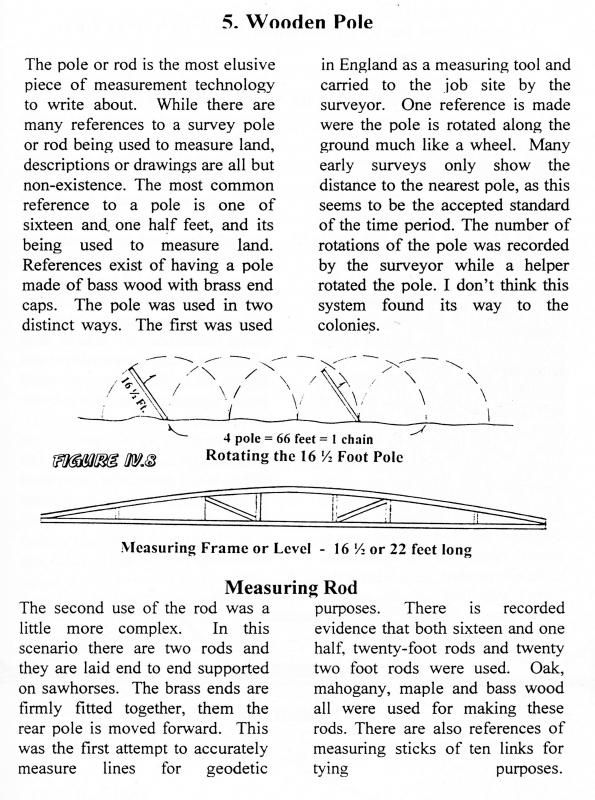
The most definitive source I have found on this subject is Surveying the Land, Vol. 1: Distance Measuring Tools & Their Accuracy, 1620-1920 by Milton Denny.

The book can be purchased from Surveyors Historical Society.

Milton offers the following on the use of the pole or rod as a measuring tool:

 
Posted : April 4, 2013 12:22 pm
Jon Payne
(@jon-payne)
Posts: 1633
Member
Translate
English
Spanish
French
German
Italian
Portuguese
Russian
Chinese
Japanese
Korean
Arabic
Hindi
Dutch
Polish
Turkish
Vietnamese
Thai
Swedish
Danish
Finnish
Norwegian
Czech
Hungarian
Romanian
Greek
Hebrew
Indonesian
Malay
Ukrainian
Bulgarian
Croatian
Slovak
Slovenian
Serbian
Lithuanian
Latvian
Estonian
 

Great post. Thanks. I just sent in my info for ordering a copy.


 
Posted : April 4, 2013 1:15 pm
Dave Ingram
(@dave-ingram)
Posts: 2140
Member
Translate
English
Spanish
French
German
Italian
Portuguese
Russian
Chinese
Japanese
Korean
Arabic
Hindi
Dutch
Polish
Turkish
Vietnamese
Thai
Swedish
Danish
Finnish
Norwegian
Czech
Hungarian
Romanian
Greek
Hebrew
Indonesian
Malay
Ukrainian
Bulgarian
Croatian
Slovak
Slovenian
Serbian
Lithuanian
Latvian
Estonian
 

ROOD is area measure, ROD is linear measure

While frequently confused and often misused, ROOD and ROD are not the same. As noted many times here a ROD is 1/4 chain or 16.5 feet - at least most of the time in America, England can be different depending on the type of land. And that may be true in some of the New England areas.

A ROOD is 1/4 acre. Not widely used, but that what it be.


Posted : April 4, 2013 1:25 pm
Dave Ingram
(@dave-ingram)
Posts: 2140
Member
Translate
English
Spanish
French
German
Italian
Portuguese
Russian
Chinese
Japanese
Korean
Arabic
Hindi
Dutch
Polish
Turkish
Vietnamese
Thai
Swedish
Danish
Finnish
Norwegian
Czech
Hungarian
Romanian
Greek
Hebrew
Indonesian
Malay
Ukrainian
Bulgarian
Croatian
Slovak
Slovenian
Serbian
Lithuanian
Latvian
Estonian
 

The general rule of chaining ....

was to measure as level as possible within the length of the chain. So if the slope is less than the height of the chainmen, then it would be chained close to level. If the slope exceeded the height of the chainmen then the measure would be somewhere between horizontal and ground measure.


 
Posted : April 4, 2013 1:29 pm

jud
 jud
(@jud)
Posts: 1918
Member
Translate
English
Spanish
French
German
Italian
Portuguese
Russian
Chinese
Japanese
Korean
Arabic
Hindi
Dutch
Polish
Turkish
Vietnamese
Thai
Swedish
Danish
Finnish
Norwegian
Czech
Hungarian
Romanian
Greek
Hebrew
Indonesian
Malay
Ukrainian
Bulgarian
Croatian
Slovak
Slovenian
Serbian
Lithuanian
Latvian
Estonian
 

The general rule of chaining ....

Half Chains were often used.
jud


Posted : April 4, 2013 1:33 pm
Dave Ingram
(@dave-ingram)
Posts: 2140
Member
Translate
English
Spanish
French
German
Italian
Portuguese
Russian
Chinese
Japanese
Korean
Arabic
Hindi
Dutch
Polish
Turkish
Vietnamese
Thai
Swedish
Danish
Finnish
Norwegian
Czech
Hungarian
Romanian
Greek
Hebrew
Indonesian
Malay
Ukrainian
Bulgarian
Croatian
Slovak
Slovenian
Serbian
Lithuanian
Latvian
Estonian
 

The general rule of chaining ....

Actually half-chains were probably used more than whole chains. But same idea applies.


 
Posted : April 4, 2013 1:39 pm
foggyidea
(@foggyidea)
Posts: 3462
Member
Translate
English
Spanish
French
German
Italian
Portuguese
Russian
Chinese
Japanese
Korean
Arabic
Hindi
Dutch
Polish
Turkish
Vietnamese
Thai
Swedish
Danish
Finnish
Norwegian
Czech
Hungarian
Romanian
Greek
Hebrew
Indonesian
Malay
Ukrainian
Bulgarian
Croatian
Slovak
Slovenian
Serbian
Lithuanian
Latvian
Estonian
 

Use of a rod = fishing


Posted : April 4, 2013 2:33 pm
Tom Adams
(@tom-adams)
Posts: 3453
Member
Translate
English
Spanish
French
German
Italian
Portuguese
Russian
Chinese
Japanese
Korean
Arabic
Hindi
Dutch
Polish
Turkish
Vietnamese
Thai
Swedish
Danish
Finnish
Norwegian
Czech
Hungarian
Romanian
Greek
Hebrew
Indonesian
Malay
Ukrainian
Bulgarian
Croatian
Slovak
Slovenian
Serbian
Lithuanian
Latvian
Estonian
 

Thank you Mr. Leu. (Has anyone told you you look a lot like Mr. Natural?


 
Posted : April 4, 2013 4:04 pm
B.L. HINDMAN
(@bl-hindman)
Posts: 102
Member
Translate
English
Spanish
French
German
Italian
Portuguese
Russian
Chinese
Japanese
Korean
Arabic
Hindi
Dutch
Polish
Turkish
Vietnamese
Thai
Swedish
Danish
Finnish
Norwegian
Czech
Hungarian
Romanian
Greek
Hebrew
Indonesian
Malay
Ukrainian
Bulgarian
Croatian
Slovak
Slovenian
Serbian
Lithuanian
Latvian
Estonian


Posted : April 4, 2013 6:59 pm

B.L. HINDMAN
(@bl-hindman)
Posts: 102
Member
Translate
English
Spanish
French
German
Italian
Portuguese
Russian
Chinese
Japanese
Korean
Arabic
Hindi
Dutch
Polish
Turkish
Vietnamese
Thai
Swedish
Danish
Finnish
Norwegian
Czech
Hungarian
Romanian
Greek
Hebrew
Indonesian
Malay
Ukrainian
Bulgarian
Croatian
Slovak
Slovenian
Serbian
Lithuanian
Latvian
Estonian


Posted : April 4, 2013 7:01 pm
big-al
(@big-al)
Posts: 831
Member
Topic starter
Translate
English
Spanish
French
German
Italian
Portuguese
Russian
Chinese
Japanese
Korean
Arabic
Hindi
Dutch
Polish
Turkish
Vietnamese
Thai
Swedish
Danish
Finnish
Norwegian
Czech
Hungarian
Romanian
Greek
Hebrew
Indonesian
Malay
Ukrainian
Bulgarian
Croatian
Slovak
Slovenian
Serbian
Lithuanian
Latvian
Estonian
 

ROOD is area measure, ROD is linear measure

From Wikipedia

"Rood is an Old English unit of area, equal to one quarter of an acre (i.e., 0.1 hectares) or 10890 sq ft (1011 sq m, or about 10.1 ares). A rectangular area with edges of one furlong (i.e. 10 chains, or 40 rods) and one rod respectively is one rood, as is an area consisting of 40 perches (square rods). The rood was an important measure in surveying on account of its easy conversion to acres. When referring to areas, rod is often found in old documents and has exactly the same meaning as rood.[1]"


Posted : April 4, 2013 7:43 pm
Tom Adams
(@tom-adams)
Posts: 3453
Member
Translate
English
Spanish
French
German
Italian
Portuguese
Russian
Chinese
Japanese
Korean
Arabic
Hindi
Dutch
Polish
Turkish
Vietnamese
Thai
Swedish
Danish
Finnish
Norwegian
Czech
Hungarian
Romanian
Greek
Hebrew
Indonesian
Malay
Ukrainian
Bulgarian
Croatian
Slovak
Slovenian
Serbian
Lithuanian
Latvian
Estonian
 

Big Al,
If you have a question like that, I am sure you would enjoy reading "Measuring America" by Andro Linklater. I see it on Amazon used for less than $10. (I see that Rich L referenced it, but just thought I would mention/recommend it.)


Posted : April 5, 2013 12:52 pm
big-al
(@big-al)
Posts: 831
Member
Topic starter
Translate
English
Spanish
French
German
Italian
Portuguese
Russian
Chinese
Japanese
Korean
Arabic
Hindi
Dutch
Polish
Turkish
Vietnamese
Thai
Swedish
Danish
Finnish
Norwegian
Czech
Hungarian
Romanian
Greek
Hebrew
Indonesian
Malay
Ukrainian
Bulgarian
Croatian
Slovak
Slovenian
Serbian
Lithuanian
Latvian
Estonian
 

Thanks Tom. I'll order a copy. You're not the first person to recommend the book to me, a client once told me I'd like it. Thanks for the suggestion.


Posted : April 5, 2013 6:05 pm
big-al
(@big-al)
Posts: 831
Member
Topic starter
Translate
English
Spanish
French
German
Italian
Portuguese
Russian
Chinese
Japanese
Korean
Arabic
Hindi
Dutch
Polish
Turkish
Vietnamese
Thai
Swedish
Danish
Finnish
Norwegian
Czech
Hungarian
Romanian
Greek
Hebrew
Indonesian
Malay
Ukrainian
Bulgarian
Croatian
Slovak
Slovenian
Serbian
Lithuanian
Latvian
Estonian
 

Linklater appears to have two books entitled "Measuring America" with different subtitles. Are they different, or just different editions of essentially the same book?


Posted : April 5, 2013 6:11 pm

Page 2 / 3