Reading RPLS is free for the whole profession. Members post, reply, and get the members-only rooms.

Notifications
Clear all
Strictly Surveying
22
Posts
9
Users
0
Reactions
579
Views

Topic starter
Translate
▼
English
Spanish
French
German
Italian
Portuguese
Russian
Chinese
Japanese
Korean
Arabic
Hindi
Dutch
Polish
Turkish
Vietnamese
Thai
Swedish
Danish
Finnish
Norwegian
Czech
Hungarian
Romanian
Greek
Hebrew
Indonesian
Malay
Ukrainian
Bulgarian
Croatian
Slovak
Slovenian
Serbian
Lithuanian
Latvian
Estonian
Accumulated results from several astro outings....
10 April: 175-26-13.0
15 April: 175-26-08.3
24 April: 175-26-01.2
NGS Published Az between AA8189 and AA8188: 175-25-56.7
The round this morning (all 8 direct, 8 reverse) surprised me. Wanted to minimize out scintillation. It was 25 F when I started. Note to self: Don't try to engage in activity that demands bare finger dexterity (iPhone UTC timer), when it's below freezing. A later round from another setup nearby was disasterous because of it. My fingers were locking up. I'm finding that it works best if a smooth repeatable rhythm of setting the crosshair perhaps 10-15 seconds ahead of the trailing limb is achieved. I found it harder and harder to do the colder my fingers got.
I'll be pleased though if I can continue to achieve the results I'm coming into.
Posted : April 24, 2016 4:34 pm

Translate
▼
English
Spanish
French
German
Italian
Portuguese
Russian
Chinese
Japanese
Korean
Arabic
Hindi
Dutch
Polish
Turkish
Vietnamese
Thai
Swedish
Danish
Finnish
Norwegian
Czech
Hungarian
Romanian
Greek
Hebrew
Indonesian
Malay
Ukrainian
Bulgarian
Croatian
Slovak
Slovenian
Serbian
Lithuanian
Latvian
Estonian
I'm persuaded pure curiosity drives a lot of surveyors. Then they figure out a way to make it pay the bills. Then they want to buy new equipment. Then they figure out a way to make it pay the bills. Then they want to buy new equipment.
Posted : April 24, 2016 4:50 pm

Translate
▼
English
Spanish
French
German
Italian
Portuguese
Russian
Chinese
Japanese
Korean
Arabic
Hindi
Dutch
Polish
Turkish
Vietnamese
Thai
Swedish
Danish
Finnish
Norwegian
Czech
Hungarian
Romanian
Greek
Hebrew
Indonesian
Malay
Ukrainian
Bulgarian
Croatian
Slovak
Slovenian
Serbian
Lithuanian
Latvian
Estonian
Some of the people here are thrilled when the temp gets above -25F. I'm not one of them, fortunately. I wouldn't even attempt to fire up the survey chariot if it was that cold.
BTW, it was 81 yesterday and fairly close to that today.
Posted : April 24, 2016 5:36 pm

Translate
▼
English
Spanish
French
German
Italian
Portuguese
Russian
Chinese
Japanese
Korean
Arabic
Hindi
Dutch
Polish
Turkish
Vietnamese
Thai
Swedish
Danish
Finnish
Norwegian
Czech
Hungarian
Romanian
Greek
Hebrew
Indonesian
Malay
Ukrainian
Bulgarian
Croatian
Slovak
Slovenian
Serbian
Lithuanian
Latvian
Estonian
Cool dense air has its upside.
Astro, even if avocational, has a lot of spin off educational benefits. It's persuit of understanding by doing.
Posted : April 24, 2016 8:00 pm

Translate
▼
English
Spanish
French
German
Italian
Portuguese
Russian
Chinese
Japanese
Korean
Arabic
Hindi
Dutch
Polish
Turkish
Vietnamese
Thai
Swedish
Danish
Finnish
Norwegian
Czech
Hungarian
Romanian
Greek
Hebrew
Indonesian
Malay
Ukrainian
Bulgarian
Croatian
Slovak
Slovenian
Serbian
Lithuanian
Latvian
Estonian
In the middle of traverse, we quickly sighted ahead of the sun and made "mark" when the sun reached the crosshair, recorded the time and angle and repeat 5 more times and then turn to check the backsight and record any change. This usually took less than a minute from start to end. Much faster than trying to use a magnetic needle on a TS.
Posted : April 24, 2016 8:04 pm

Translate
▼
English
Spanish
French
German
Italian
Portuguese
Russian
Chinese
Japanese
Korean
Arabic
Hindi
Dutch
Polish
Turkish
Vietnamese
Thai
Swedish
Danish
Finnish
Norwegian
Czech
Hungarian
Romanian
Greek
Hebrew
Indonesian
Malay
Ukrainian
Bulgarian
Croatian
Slovak
Slovenian
Serbian
Lithuanian
Latvian
Estonian
You mentioned an IPhone UTC Timer. Have you compared it to the radio time broadcast? I have the Navy Clock app on my phone and I get close to a full second difference in it and the radio broadcast. I think it is the digital delay in the cell system but that's just a guess.
James
Posted : April 24, 2016 8:55 pm
Translate
▼
English
Spanish
French
German
Italian
Portuguese
Russian
Chinese
Japanese
Korean
Arabic
Hindi
Dutch
Polish
Turkish
Vietnamese
Thai
Swedish
Danish
Finnish
Norwegian
Czech
Hungarian
Romanian
Greek
Hebrew
Indonesian
Malay
Ukrainian
Bulgarian
Croatian
Slovak
Slovenian
Serbian
Lithuanian
Latvian
Estonian
The time app he used is by Sequoia: Time Stamp. NTP, feedback loop. One-up-same as GPS, WWV. However, only 0.1" resolution. And at low altitude the sun's rate of change in az isn't bad. About 12 arc-seconds per second.
Sequoia's time apps are highly tested and regarded as true NTP. And NTP is millisecond.
Emerald Time by Emerald Sequoia LLC
https://appsto.re/us/3NUtr.i
Emerald Timestamp by Emerald Sequoia LLC
https://appsto.re/us/cH0kw.i
Posted : April 24, 2016 9:09 pm
Topic starter
Translate
▼
English
Spanish
French
German
Italian
Portuguese
Russian
Chinese
Japanese
Korean
Arabic
Hindi
Dutch
Polish
Turkish
Vietnamese
Thai
Swedish
Danish
Finnish
Norwegian
Czech
Hungarian
Romanian
Greek
Hebrew
Indonesian
Malay
Ukrainian
Bulgarian
Croatian
Slovak
Slovenian
Serbian
Lithuanian
Latvian
Estonian
Larry Scott, post: 369201, member: 8766 wrote: The time app he used is by Sequoia: Time Stamp. NTP, feedback loop. One-up-same as GPS, WWV. However, only 0.1" resolution. And at low altitude the sun's rate of change in az isn't bad. About 12 arc-seconds per second.
Sequoia's time apps are highly tested and regarded as true NTP. And NTP is millisecond.
Emerald Time by Emerald Sequoia LLC
https://appsto.re/us/3NUtr.iEmerald Timestamp by Emerald Sequoia LLC
https://appsto.re/us/cH0kw.i
I usually check the "Time" app first, which polls as many as 5 different time servers; It usually reports errors in the .025" region. Then, in the field, I use the Timestamp app, which (as Larry reports), is only "good" to .1" resolution, but for my purposes, it's probably below the threshold of some of the other errors I'm dealing with.
I do need to invest in some kind of stopwatch; ideally one that can log the times. More than once already, I've gone back to Timestamp to find errors in booking the times in the field. Other "requirements" would be: 1. Dead simple (no degree in nuclear physics needed to set or program), 2. Big, easy to read numbers--even in the dark (remember, it's astro), and 3. Foolproof button arrangement so I can't accidentally wipe it's memory with a wrong press. Any suggestions welcome.
Posted : April 25, 2016 4:29 am
Translate
▼
English
Spanish
French
German
Italian
Portuguese
Russian
Chinese
Japanese
Korean
Arabic
Hindi
Dutch
Polish
Turkish
Vietnamese
Thai
Swedish
Danish
Finnish
Norwegian
Czech
Hungarian
Romanian
Greek
Hebrew
Indonesian
Malay
Ukrainian
Bulgarian
Croatian
Slovak
Slovenian
Serbian
Lithuanian
Latvian
Estonian
A twenty buck watch isn't a commitment til a much better (more $) timing tool is found.
HP41 has a great feature, and was a staple for Astro from the 80s til even now. The 41's buttons can be assigned to grab its system time. At its clock can adjusted by 0.01", so it can be aligned to UT1 very well to short wave radio or GPS.
I used to call 1-800-410-time. That was NIST's WWV by telephone. That was cool, back in the day.
The HP41 still is the best Stop Clock, and easy to hold. But drop prone.
Posted : April 25, 2016 7:47 am
Topic starter
Translate
▼
English
Spanish
French
German
Italian
Portuguese
Russian
Chinese
Japanese
Korean
Arabic
Hindi
Dutch
Polish
Turkish
Vietnamese
Thai
Swedish
Danish
Finnish
Norwegian
Czech
Hungarian
Romanian
Greek
Hebrew
Indonesian
Malay
Ukrainian
Bulgarian
Croatian
Slovak
Slovenian
Serbian
Lithuanian
Latvian
Estonian
Larry Scott, post: 369238, member: 8766 wrote: A twenty buck watch isn't a commitment til a much better (more $) timing tool is found.
HP41 has a great feature, and was a staple for Astro from the 80s til even now. The 41's buttons can be assigned to grab its system time. At its clock can adjusted by 0.01", so it can be aligned to UT1 very well to short wave radio or GPS.
I used to call 1-800-410-time. That was NIST's WWV by telephone. That was cool, back in the day.
The HP41 still is the best Stop Clock, and easy to hold. But drop prone.
If I'm going to get anything, it'll be a lanyard-ed, back-lit hand held unit.
Dumb question: Never run, swam or participated in any timed sports (fortunately). For the purposes of Astro, do I use a "Split" time? I looked it up, but am not sure that split times are just recording the running clock,
like:
01:23:43.01
01:23:54.23
01:24:02.15....
Are those "split" times?
Posted : April 25, 2016 7:58 am

Translate
▼
English
Spanish
French
German
Italian
Portuguese
Russian
Chinese
Japanese
Korean
Arabic
Hindi
Dutch
Polish
Turkish
Vietnamese
Thai
Swedish
Danish
Finnish
Norwegian
Czech
Hungarian
Romanian
Greek
Hebrew
Indonesian
Malay
Ukrainian
Bulgarian
Croatian
Slovak
Slovenian
Serbian
Lithuanian
Latvian
Estonian
I always used the hp41 when I did sunshots. I always got relatively good results. I check and adjust the time before I go out, and after I get back. Sometimes I would proportion in the difference in time (as I recall).
As to cold fingers, I looked @ it this way; if I am consistently (as example) 0.2 seconds late hitting the button when it beeps, I am probably also the same 0.2 seconds behind the crosshair "hit" when I am observing. Since I set my time by my button hit, the 0.2 second delay compensates itself out if the delays are equal. It might be good to set your watch in the same temp environment as when you are doing the solar. (also maybe a land line because of possible cell-delay? I don't know anything about that.) Maybe I am wrong about this, but my solars that were checked against North-star observations seemed to be very close.
Posted : April 25, 2016 8:02 am
Translate
▼
English
Spanish
French
German
Italian
Portuguese
Russian
Chinese
Japanese
Korean
Arabic
Hindi
Dutch
Polish
Turkish
Vietnamese
Thai
Swedish
Danish
Finnish
Norwegian
Czech
Hungarian
Romanian
Greek
Hebrew
Indonesian
Malay
Ukrainian
Bulgarian
Croatian
Slovak
Slovenian
Serbian
Lithuanian
Latvian
Estonian
Lap times, I think. My SW is labeled standard and section. All the watches have both. And I think can switch without data loss. But it's vocabulary thing.
Start the SW and it's a free running clock, starting at 0.00. Then a Lap time is time since 0.00. When a time is taken, the display is stopped for recording. When released, not start/stop, the display returns to the running clock, time since 0.00.
Start 0.00
Lap 0:01:30.34
Continue, returns to running time eg 0:02:....
Lap 0;03:01.57
Continue, 0:03:.....
Lap 0:04:58.79
Continue.... Cumulative time since start.
Splits are stop/reset/run in one button.
Split 0:01:30.45
Split 0:01:15.45
Split ....
Not cumulative, segmented
(I might have the terms swapped, but the two modes are typical to all SWs)
That's the beauty of Stamp. A stop clock. Not common. But stamp is the right concept, iPhone not the right form factor.
Backlit is not common. Too much power consumption. I've never missed it.
_______________
I'm sure a telephone time was retarded. Shortwave times have an add for distance to Boulder, CO, too. Not a lot. The timing beeps are hard to really nail. GPS is good. A Garmin handheld has some flakey delay for screen update. iPhone NTP feedback loop screen display is plenty good. And hand-eye delay should be a personal constant. So as I time a running display, I should be delayed a similar amount for the crossing of a star, and similar to the 0 of any one minute on the iPhone display. I've tested it every which way. With sun nailing tangent is a learned skill, and personal, timing delay, constant. Stars are better in that way.
I have an old textbook that describes time transfer by telegraph and spark transmitter radio. That was hard. We have it easy.
Posted : April 25, 2016 9:08 am
Translate
▼
English
Spanish
French
German
Italian
Portuguese
Russian
Chinese
Japanese
Korean
Arabic
Hindi
Dutch
Polish
Turkish
Vietnamese
Thai
Swedish
Danish
Finnish
Norwegian
Czech
Hungarian
Romanian
Greek
Hebrew
Indonesian
Malay
Ukrainian
Bulgarian
Croatian
Slovak
Slovenian
Serbian
Lithuanian
Latvian
Estonian
I think a $40 SW will do exactly the same thing for you as a $140 SW. These days we have timing well below 0.1". When I compare a dozen time syncs, with SW to iPhone display and shortwave, the std dev is generally 0.02". Hand-eye delay? Probably. But that would be the same mental time lapse of a star crossing.
Posted : April 25, 2016 9:39 am

Translate
▼
English
Spanish
French
German
Italian
Portuguese
Russian
Chinese
Japanese
Korean
Arabic
Hindi
Dutch
Polish
Turkish
Vietnamese
Thai
Swedish
Danish
Finnish
Norwegian
Czech
Hungarian
Romanian
Greek
Hebrew
Indonesian
Malay
Ukrainian
Bulgarian
Croatian
Slovak
Slovenian
Serbian
Lithuanian
Latvian
Estonian
Larry Scott, post: 369265, member: 8766 wrote: the same mental time lapse of a star crossing.
Wouldn't those errors add?
But when you check the watch against a time source, that response delay would be about the same as the delay in hitting the button upon seeing the object hit the crosshair so THOSE would mostly cancel.
Posted : April 25, 2016 10:37 am
Translate
▼
English
Spanish
French
German
Italian
Portuguese
Russian
Chinese
Japanese
Korean
Arabic
Hindi
Dutch
Polish
Turkish
Vietnamese
Thai
Swedish
Danish
Finnish
Norwegian
Czech
Hungarian
Romanian
Greek
Hebrew
Indonesian
Malay
Ukrainian
Bulgarian
Croatian
Slovak
Slovenian
Serbian
Lithuanian
Latvian
Estonian
JaRo, post: 369198, member: 292 wrote: You mentioned an IPhone UTC Timer. Have you compared it to the radio time broadcast? I have the Navy Clock app on my phone and I get close to a full second difference in it and the radio broadcast. I think it is the digital delay in the cell system but that's just a guess.
James
Navy Clock will work differently on different phones.
It would show around 43å± seconds different on my droidX phone just like the time lag that shows up on my Garmin handhelds.
Samsung S5 will sync with Navy Clock and is spot on with http://www.time.gov/&apos ;">time.gov
and with my Westclox Atomic Clock model #70026
Some day I hope to be able to check it with a time cube or other proven source.
The HP41 had a smart clock routine that would keep better time after each correction. It would keep track of the corrections and would eventually keep real time for weeks. Dead batteries or taking the batteries out would erase all that info.
Posted : April 25, 2016 12:21 pm
Translate
▼
English
Spanish
French
German
Italian
Portuguese
Russian
Chinese
Japanese
Korean
Arabic
Hindi
Dutch
Polish
Turkish
Vietnamese
Thai
Swedish
Danish
Finnish
Norwegian
Czech
Hungarian
Romanian
Greek
Hebrew
Indonesian
Malay
Ukrainian
Bulgarian
Croatian
Slovak
Slovenian
Serbian
Lithuanian
Latvian
Estonian
When investigating a time app the key is NTP, network time protocol. Emerald Time is high science, (and a free app).
That's millisecond grade. Feed back loop to measure transmission delay and corrects to an estimated error of about 0.05-0.10". But comparing to everything else, time.gov, shortwave, GPS, I've never seen it that far off. I was skeptical at first, so I made a lot of checks. Time err too small to observe with hand-eye coordination.
Posted : April 25, 2016 3:28 pm
Topic starter
Translate
▼
English
Spanish
French
German
Italian
Portuguese
Russian
Chinese
Japanese
Korean
Arabic
Hindi
Dutch
Polish
Turkish
Vietnamese
Thai
Swedish
Danish
Finnish
Norwegian
Czech
Hungarian
Romanian
Greek
Hebrew
Indonesian
Malay
Ukrainian
Bulgarian
Croatian
Slovak
Slovenian
Serbian
Lithuanian
Latvian
Estonian
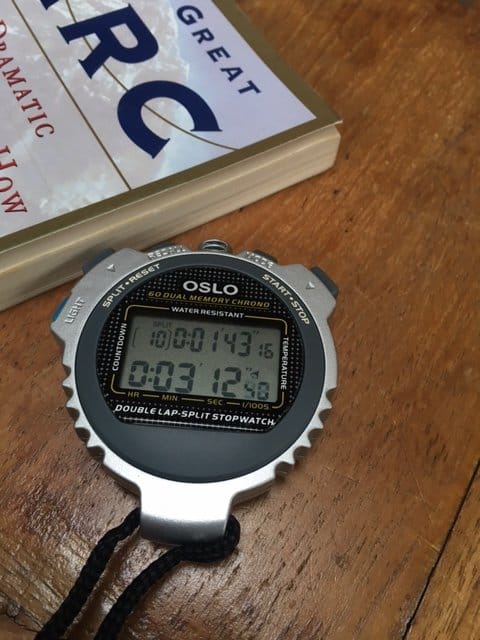
Kiss the frozen fingers goodbye. Got a "proper" stopwatch, with 60 split time memory, and nighttime illumination.
Waterproof too. Good thing; we got an inch of wet snow today.:excruciating:
Posted : April 26, 2016 4:46 pm
Translate
▼
English
Spanish
French
German
Italian
Portuguese
Russian
Chinese
Japanese
Korean
Arabic
Hindi
Dutch
Polish
Turkish
Vietnamese
Thai
Swedish
Danish
Finnish
Norwegian
Czech
Hungarian
Romanian
Greek
Hebrew
Indonesian
Malay
Ukrainian
Bulgarian
Croatian
Slovak
Slovenian
Serbian
Lithuanian
Latvian
Estonian
rfc, post: 369184, member: 8882 wrote: Accumulated results from several astro outings....
10 April: 175-26-13.0
15 April: 175-26-08.3
24 April: 175-26-01.2NGS Published Az between AA8189 and AA8188: 175-25-56.7
The round this morning (all 8 direct, 8 reverse) surprised me. Wanted to minimize out scintillation. It was 25 F when I started. Note to self: Don't try to engage in activity that demands bare finger dexterity (iPhone UTC timer), when it's below freezing. A later round from another setup nearby was disasterous because of it. My fingers were locking up. I'm finding that it works best if a smooth repeatable rhythm of setting the crosshair perhaps 10-15 seconds ahead of the trailing limb is achieved. I found it harder and harder to do the colder my fingers got.
I'll be pleased though if I can continue to achieve the results I'm coming into.
BTW
His 24-Apr solar azimuth, after review (corrected DUT value err), calcs out to be:
175-25-59.5
(175-25-56.7 inverse)
Posted : May 1, 2016 7:34 am

Translate
▼
English
Spanish
French
German
Italian
Portuguese
Russian
Chinese
Japanese
Korean
Arabic
Hindi
Dutch
Polish
Turkish
Vietnamese
Thai
Swedish
Danish
Finnish
Norwegian
Czech
Hungarian
Romanian
Greek
Hebrew
Indonesian
Malay
Ukrainian
Bulgarian
Croatian
Slovak
Slovenian
Serbian
Lithuanian
Latvian
Estonian
Patti Williams tells the story of a crew that was getting horrible results from astronomic observations. They went over and over their procedures until she finally asked them about their timepiece. What time piece? Turns out they were calling the radio station in Mineola, KMOO, to get the current time.
Posted : May 2, 2016 11:19 am
Topic starter
Translate
▼
English
Spanish
French
German
Italian
Portuguese
Russian
Chinese
Japanese
Korean
Arabic
Hindi
Dutch
Polish
Turkish
Vietnamese
Thai
Swedish
Danish
Finnish
Norwegian
Czech
Hungarian
Romanian
Greek
Hebrew
Indonesian
Malay
Ukrainian
Bulgarian
Croatian
Slovak
Slovenian
Serbian
Lithuanian
Latvian
Estonian
Andy Nold, post: 370284, member: 7 wrote: Patti Williams tells the story of a crew that was getting horrible results from astronomic observations. They went over and over their procedures until she finally asked them about their timepiece. What time piece? Turns out they were calling the radio station in Mineola, KMOO, to get the current time.
Now I'm *really* not feeling bad about my observations. Larry Scott has determined that my stopwatch may be losing about 1/100th of a second per hour, and incorporated it into the calcs. It's a cheapie model. Phew. I knew something was amiss.:excruciating:
Posted : May 2, 2016 11:42 am
Page 1 / 2
Next