Reading RPLS is free for the whole profession. Members post, reply, and get the members-only rooms.

Notifications
Clear all

Topic starter
Translate
▼
English
Spanish
French
German
Italian
Portuguese
Russian
Chinese
Japanese
Korean
Arabic
Hindi
Dutch
Polish
Turkish
Vietnamese
Thai
Swedish
Danish
Finnish
Norwegian
Czech
Hungarian
Romanian
Greek
Hebrew
Indonesian
Malay
Ukrainian
Bulgarian
Croatian
Slovak
Slovenian
Serbian
Lithuanian
Latvian
Estonian
In Texas, vast areas of the State, particularly in West and North Texas, were surveyed off in blocks of land grants made by virtue of land scrip issued to various entities, most of which were railroad companies, but which included a motley crew of contractors clearing river channels for navigation, irrigation and iron works companies, and others.
What this meant in practice is that great piles of paper were issued that entitled the bearer/owner of each certificate to have a specific quantity of land, typically in 640 acre squares, surveyed out of the unappropriated public domain of the State of Texas, subject to various conditions.
Many if not most of the companies to which the land scrip was issued immediately sold it for cash. Otherwise, they would have had to pay a District or County Surveyor (or one of his deputies) in some farflung part of the State to make the necessary surveys according to law to locate the land to which the owner of the scrips was entitled and to make a claim to some specific part of the public domain
After the survey, the fun began as field notes were filed in the County or District records and returned to the General Land Office for examination and patent. Once the examiner had determined that the maps reflected that the survey was not in conflict with some other prior appropriation or claim to the public land, patent could issue upon payment of fees. There were instances where the scrip that had been issued to a railroad company was later held to be invalid and all surveys made by virtue of it rendered void. So selling the scrip for cash was not an obviously bad choice and there was some anxiety about obtaining the patents because of that. Some railroad companies, such as the International & Great Northern and the Texas & Pacific did elect to have their scrip located for themselves and then wait for some actual settlers to arrive who might want to buy the land. Either way, the location by survey of great piles of paper, took a special organization to accomplish.
This created a substantial business opportunity for what were known as Land Agents, men who bought and sold land scrip and arranged to have scrips located with the object of obtaining land of the best value possible for the least outlay of money.
The Dallas firm of Powell & Gage consisting of a partnership of Ernest M. Powell and Edward L. Gage were one example of Texas Land Agents They were responsible for the location of great piles of land scrip, first in North Texas in the late 1870s and later, as the unappropriated public domain was surveyed up, in the West Texas counties of Pecos, Brewster, and Presidio. In the course of researching another matter, I've discovered a few things about Mssrs. Powell and Gage that are fairly interesting.
Edward L. Gage was born in 1846 in New Hampshire. He studied at Dartmouth College and took post-graduate courses in the college's Thayer School of Civil Engineering, evidently finishing his studies in 1875 and working at Resident Engineer for a couple of railroad companies in Ohio, the Cincinnati Southern and the Miami Valley Railroads, before his work in Texas.
Gage evidently moved from Ohio to Texas in the late 1870s since The Dallas City Directory published for 1878-1879 by Morrison & Co. lists the firm of Powell & Gage consisting of E. M. Powell and E. L. Gage, in business as "Real Estate agents and Surveyors" at 507 Main.
In 1879, E.L. Gage married Anna Elizabeth Durrell of Hamilton County, Ohio (b.27 Feb 1854 - d. 1919) and in 1880 the Federal Census reported the couple living on McKinney Avenue in Dallas, E.L. Gage giving his occupation as "real estate agent". Gage formed a partnership with Earnest M. Powell (born October 5, 1847 in Illinois) who became his brother-in-law in 1882 when Powell married Mary Almyra Durrell (born July 8, 1858 in Ohio).
If the name Durrell is familiar to West Texas surveyors, it's because one of the Durrell sisters' brothers was Louis Wood Durrell, better known as Pecos County Deputy Surveyor L.W. Durrell (b. February 5, 1860 in Cincinnati, Ohio; d. January 25, 1944 in San Antonio, Texas) who located quite a number of blocks of railroad scrip surveys in Pecos County in the early 1880s.
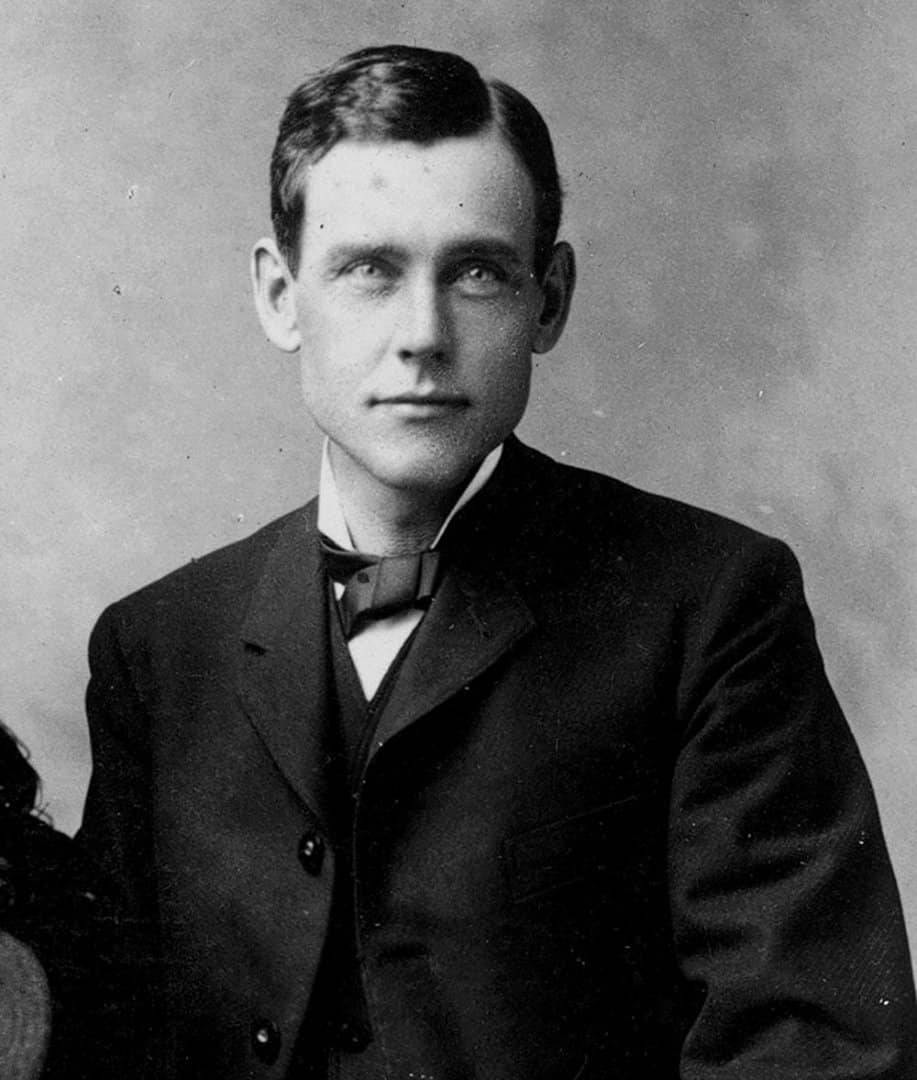
I haven't yet determined what Ernest M. Powell's formal training was or any of the details of his life before Dallas, but here is a photo of him taken in 1882 at age 36:
One of the features of Powell & Gage's work in West Texas is that they were functioning as a sort of preliminary Land Office, hiring surveyors to qualify as Deputy Surveyors of the County or Land District in which scrip was to be located and, in many cases, even drafting the field notes of the surveys that the deputy was to sign for recordation. The other important element to many land agents' work is that they prepared maps showing how the locations of the great piles of scrip were actually arranged in relation to each other, or at least were thought to be by them.
Those maps were then sent to the deputy or county surveyor to be certified as a true and accurate depiction of how the lands were arranged and were then forwarded to the General Land Office to speed up examination of the field notes that had been or were being filed.
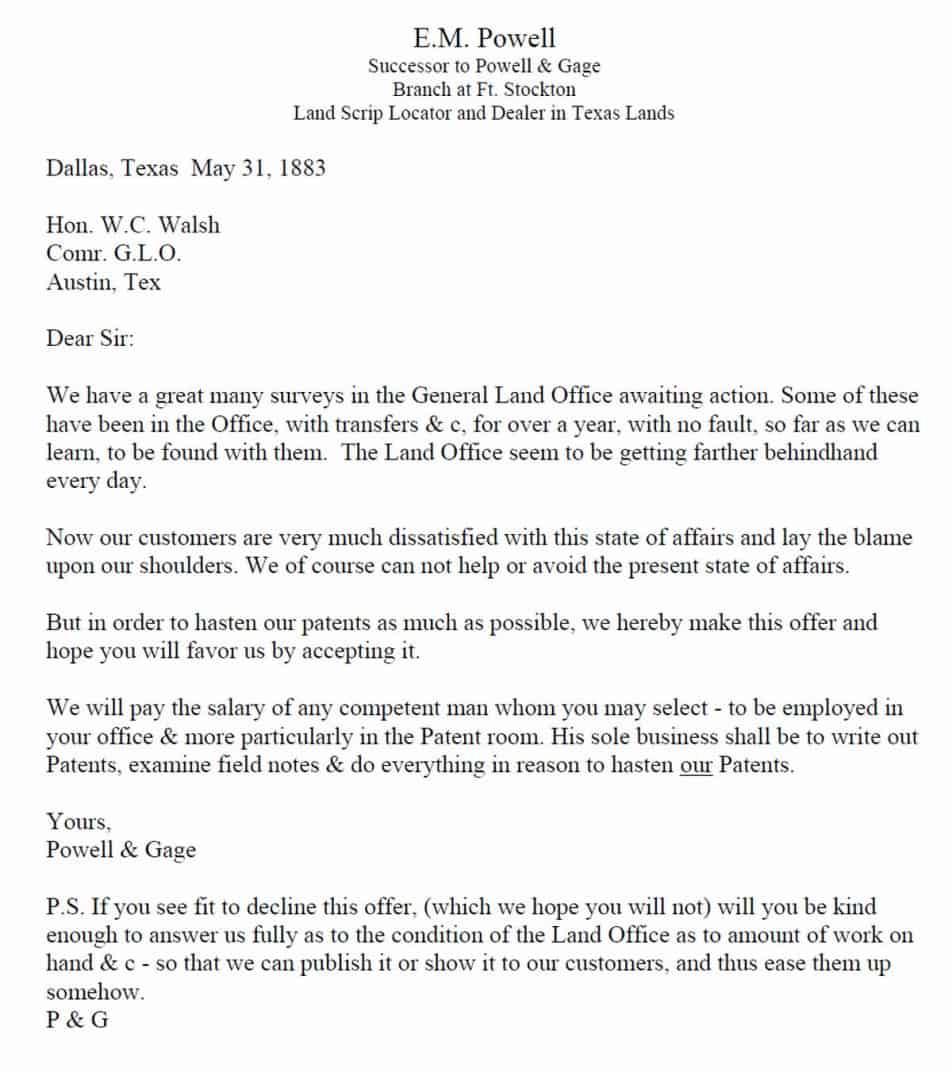
Even greasing the machinery in this manner, the wheels turned very slowly at the GLO. Here is the opening salvo in an exchange of letters that passed between Ernest M. Powell and William C. Walsh, Land Commissioner, in 1883.
Posted : January 29, 2017 2:52 pm
Topic starter
Translate
▼
English
Spanish
French
German
Italian
Portuguese
Russian
Chinese
Japanese
Korean
Arabic
Hindi
Dutch
Polish
Turkish
Vietnamese
Thai
Swedish
Danish
Finnish
Norwegian
Czech
Hungarian
Romanian
Greek
Hebrew
Indonesian
Malay
Ukrainian
Bulgarian
Croatian
Slovak
Slovenian
Serbian
Lithuanian
Latvian
Estonian
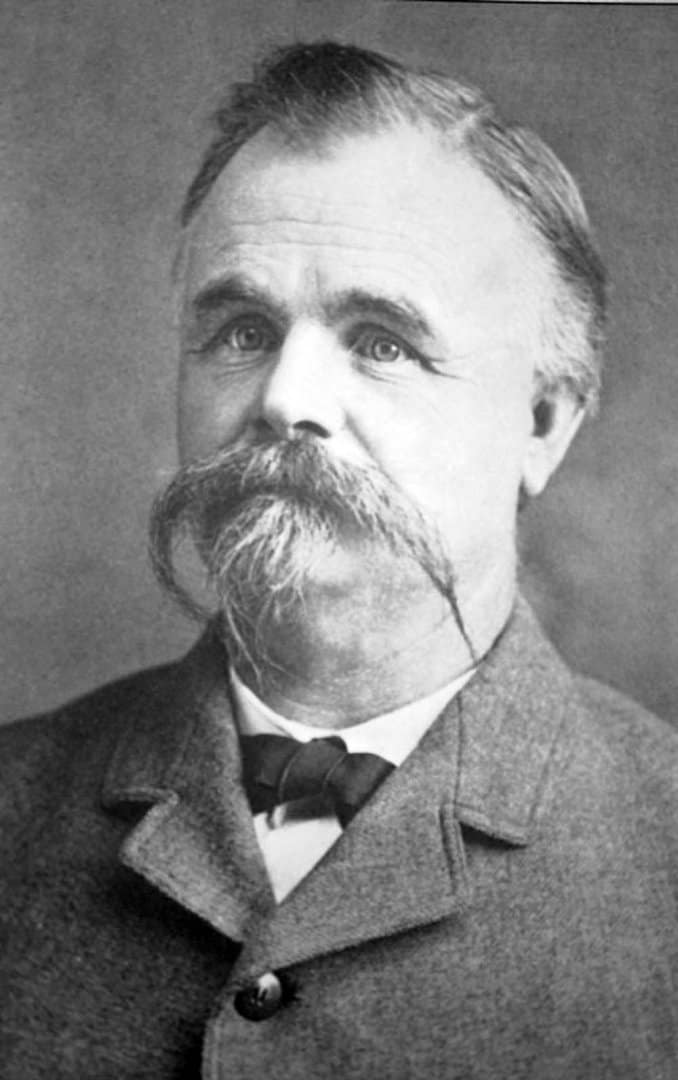
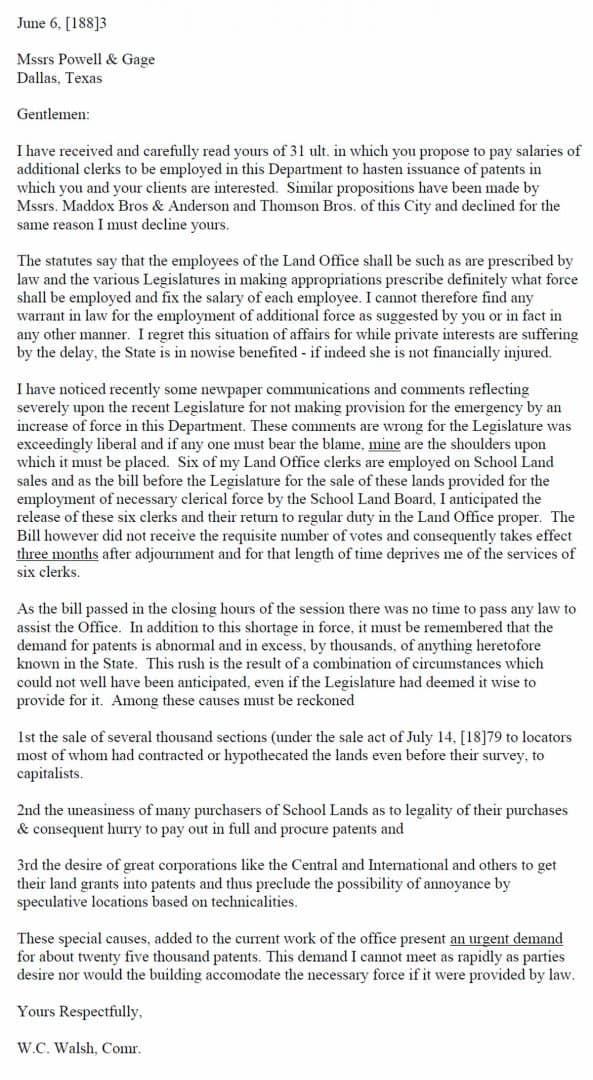
And Commissioner W.C. Walsh (1836ÛÒ1924 ; seen above in the nearly contemporaneous portrait) gave an assessment of the state of the GLO at the time in reply to Powell's query:
Posted : January 29, 2017 8:17 pm
Topic starter
Translate
▼
English
Spanish
French
German
Italian
Portuguese
Russian
Chinese
Japanese
Korean
Arabic
Hindi
Dutch
Polish
Turkish
Vietnamese
Thai
Swedish
Danish
Finnish
Norwegian
Czech
Hungarian
Romanian
Greek
Hebrew
Indonesian
Malay
Ukrainian
Bulgarian
Croatian
Slovak
Slovenian
Serbian
Lithuanian
Latvian
Estonian
Posted : January 29, 2017 8:35 pm
Topic starter
Translate
▼
English
Spanish
French
German
Italian
Portuguese
Russian
Chinese
Japanese
Korean
Arabic
Hindi
Dutch
Polish
Turkish
Vietnamese
Thai
Swedish
Danish
Finnish
Norwegian
Czech
Hungarian
Romanian
Greek
Hebrew
Indonesian
Malay
Ukrainian
Bulgarian
Croatian
Slovak
Slovenian
Serbian
Lithuanian
Latvian
Estonian
One of the more interesting aspects of the active role that some of the Land Agents like Powell & Gage played in the surveying of lands is shown by the caption on a map that was filed in the General Land Office as Pecos County Rolled Sketch 16.
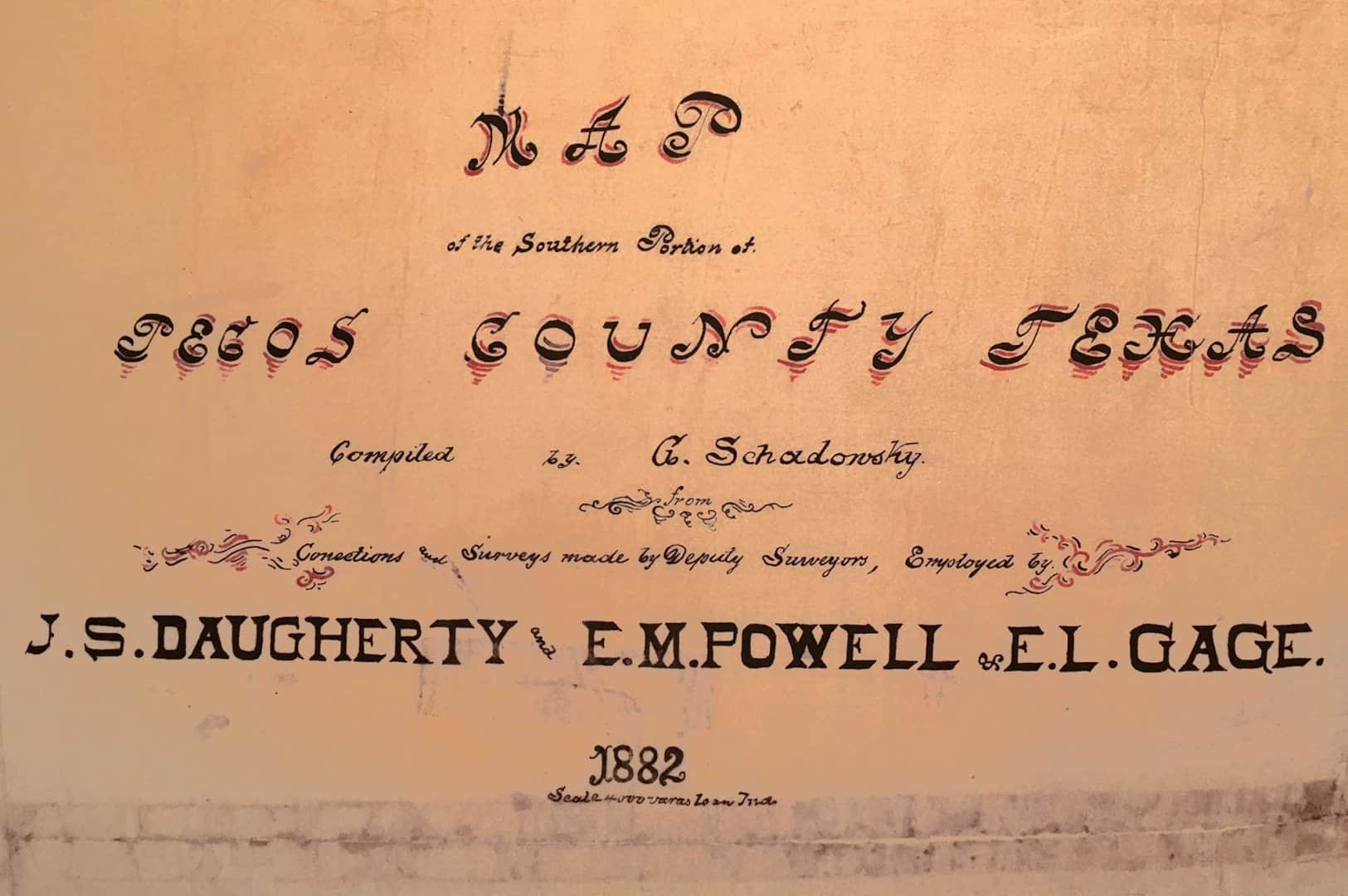
The map is the size of a horse blanket and shows literally thousands of sections of land within the boundaries of Pecos County as they existed prior to the creation of Terrell County out of part of Pecos. Note that the map was compiled by one G. Schadowsky, a fellow who was nearly certainly Gustave Schadowsky who according to a 1884-1885 Dallas City Directory was employed as a draftsman in the office of J.S. Daugherty and who also signed field notes for at least a couple of blocks of surveys between 1882 and 1884 in the capacity of Pecos County Deputy Surveyor.
From the caption alone, one would conclude that it was compiled "from conections [Schadowsky's native language was German] and Surveys made by Deputy Surveyors, Employed by" two firms, that of J.S. Daugherty and Powell & Gage. Incidentally, those Deputy Surveyors of Pecos County included Charles Archer of Dallas and none other that Powell & Gage's mutual brother-in-law LW. Durrell.
Upon its face, the map filed in the GLO was an attempt to show the relationships of the various blocks of surveys as located by the various Deputy Surveyors working as employees of the land agents, and the obvious purpose of filing it in the GLO was to facilitate the examination of those surveys by GLO staff by demonstrating the relationships of the various blocks to each other according to what the Deputy Surveyors were supposed to have done.
Posted : January 29, 2017 9:41 pm
Topic starter
Translate
▼
English
Spanish
French
German
Italian
Portuguese
Russian
Chinese
Japanese
Korean
Arabic
Hindi
Dutch
Polish
Turkish
Vietnamese
Thai
Swedish
Danish
Finnish
Norwegian
Czech
Hungarian
Romanian
Greek
Hebrew
Indonesian
Malay
Ukrainian
Bulgarian
Croatian
Slovak
Slovenian
Serbian
Lithuanian
Latvian
Estonian
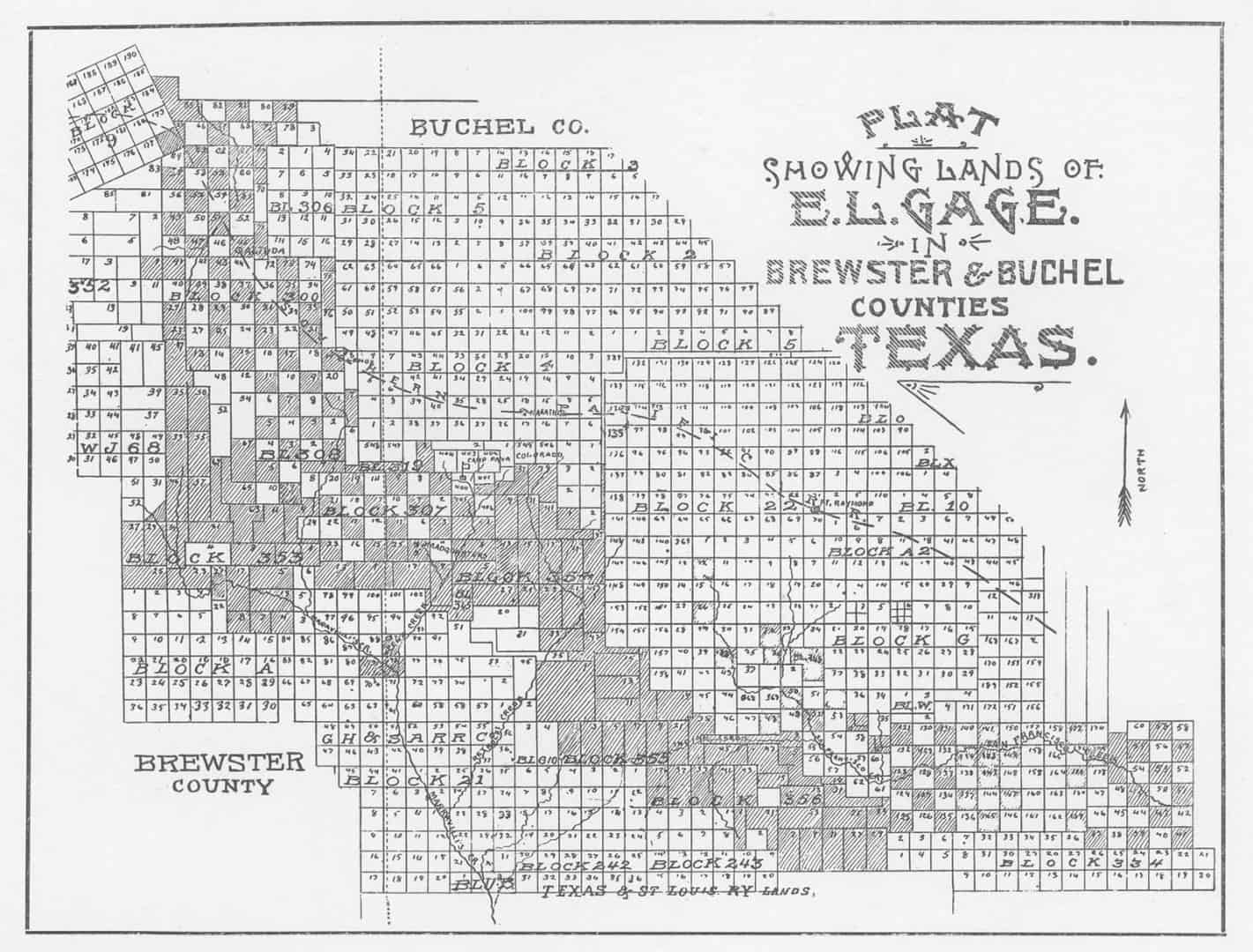
So once the public lands had been taken up by the land agents and their locating operations, leaving mostly scraps that would not sustain their enterprises, what became of Mssrs. Powell & Gage? In the case of E.L. Gage, he moved to Alpine in Brewster County and went into the ranching business on the lands he had accumulated as shown on the map below. Buchel County is one of the phantom counties of West Texas, a county that was created out of Brewster, but that never was organized and so later remerged into Brewster.
Posted : January 30, 2017 7:32 am
Topic starter
Translate
▼
English
Spanish
French
German
Italian
Portuguese
Russian
Chinese
Japanese
Korean
Arabic
Hindi
Dutch
Polish
Turkish
Vietnamese
Thai
Swedish
Danish
Finnish
Norwegian
Czech
Hungarian
Romanian
Greek
Hebrew
Indonesian
Malay
Ukrainian
Bulgarian
Croatian
Slovak
Slovenian
Serbian
Lithuanian
Latvian
Estonian
And ranching in West Texas at the scale of E.L. Gage's land holdings was both capital intensive and unpredictable given the marginal nature of the range, drought cycles, and the variability of markets. E.L. Gage died in Chicago in 1892. While the decision of the court rendered in a lawsuit (Durrell v Farrell, linked below) that was fallout from a foreclosure on the Gage lands doesn't mention this, his death was reportedly a suicide.
These cycles of boom and bust are a recurring theme in the history of Texas lands.
Posted : January 30, 2017 7:39 am

Translate
▼
English
Spanish
French
German
Italian
Portuguese
Russian
Chinese
Japanese
Korean
Arabic
Hindi
Dutch
Polish
Turkish
Vietnamese
Thai
Swedish
Danish
Finnish
Norwegian
Czech
Hungarian
Romanian
Greek
Hebrew
Indonesian
Malay
Ukrainian
Bulgarian
Croatian
Slovak
Slovenian
Serbian
Lithuanian
Latvian
Estonian
Very informative. Thanks for sharing, and for other items as of late.
Posted : January 30, 2017 8:25 am
Topic starter
Translate
▼
English
Spanish
French
German
Italian
Portuguese
Russian
Chinese
Japanese
Korean
Arabic
Hindi
Dutch
Polish
Turkish
Vietnamese
Thai
Swedish
Danish
Finnish
Norwegian
Czech
Hungarian
Romanian
Greek
Hebrew
Indonesian
Malay
Ukrainian
Bulgarian
Croatian
Slovak
Slovenian
Serbian
Lithuanian
Latvian
Estonian
Monte, post: 411504, member: 11913 wrote: Very informative. Thanks for sharing, and for other items as of late.
One of the striking features of the operations of the land agents is how many people were involved in the production of the field notes and maps that passed into the GLO behind the signature of the Deputy Surveyors who actually signed the work. The so-called "D Blocks" that extended across the South end of present day Terrell County into Brewster, located in 1881 under the control of J.S. Daugherty are interesting because even though Charles Archer (later Dallas County Surveyor) signed the field notes filed in the GLO, several different hands were involved in their actual production. It probably would be possible to compile a catalogue of the various handwriting that appears in some of the similarly large scale locating/surveying machines to identify the cast of characters.
Posted : January 30, 2017 8:47 am

Translate
▼
English
Spanish
French
German
Italian
Portuguese
Russian
Chinese
Japanese
Korean
Arabic
Hindi
Dutch
Polish
Turkish
Vietnamese
Thai
Swedish
Danish
Finnish
Norwegian
Czech
Hungarian
Romanian
Greek
Hebrew
Indonesian
Malay
Ukrainian
Bulgarian
Croatian
Slovak
Slovenian
Serbian
Lithuanian
Latvian
Estonian
Kent McMillan, post: 411494, member: 3 wrote: Buchel County is one of the phantom counties of West Texas, a county that was created out of Brewster, but that never was organized and so later remerged into Brewster.
Along with Foley and Brewster Counties, created by division of Presidio County and then later absorbed by Brewster County.
Posted : January 30, 2017 9:45 am
Topic starter
Translate
▼
English
Spanish
French
German
Italian
Portuguese
Russian
Chinese
Japanese
Korean
Arabic
Hindi
Dutch
Polish
Turkish
Vietnamese
Thai
Swedish
Danish
Finnish
Norwegian
Czech
Hungarian
Romanian
Greek
Hebrew
Indonesian
Malay
Ukrainian
Bulgarian
Croatian
Slovak
Slovenian
Serbian
Lithuanian
Latvian
Estonian
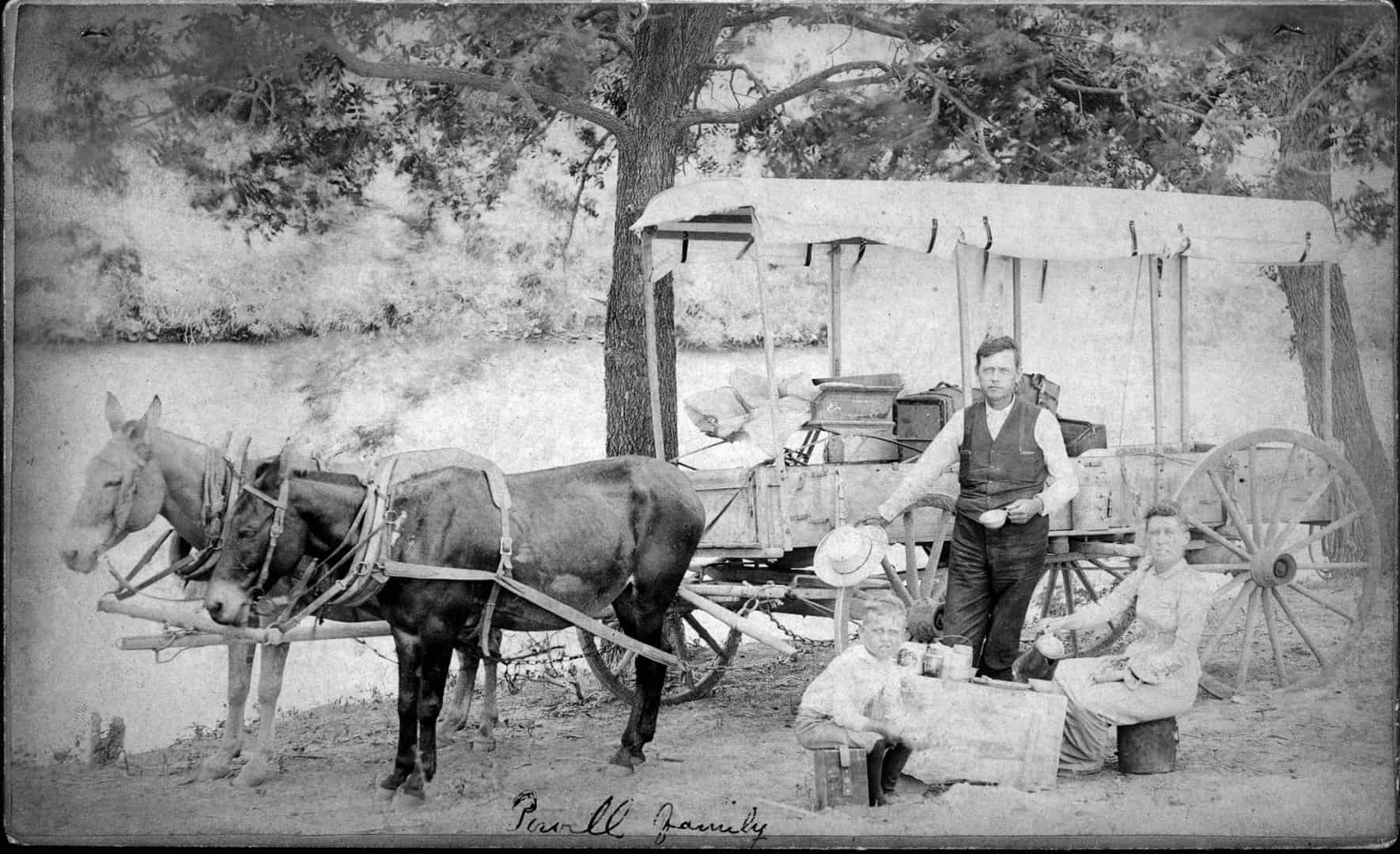
Here's a photo of E.M. Powell and his family taken in about 1889 (considering that his son, Durrell Powell, was born in 1883) at some unidentified location that doesn't look much like any place I've seen in West Texas.
Posted : January 30, 2017 11:18 am

Translate
▼
English
Spanish
French
German
Italian
Portuguese
Russian
Chinese
Japanese
Korean
Arabic
Hindi
Dutch
Polish
Turkish
Vietnamese
Thai
Swedish
Danish
Finnish
Norwegian
Czech
Hungarian
Romanian
Greek
Hebrew
Indonesian
Malay
Ukrainian
Bulgarian
Croatian
Slovak
Slovenian
Serbian
Lithuanian
Latvian
Estonian
Very interesting. Thanks for posting.
Posted : January 30, 2017 11:28 am

Translate
▼
English
Spanish
French
German
Italian
Portuguese
Russian
Chinese
Japanese
Korean
Arabic
Hindi
Dutch
Polish
Turkish
Vietnamese
Thai
Swedish
Danish
Finnish
Norwegian
Czech
Hungarian
Romanian
Greek
Hebrew
Indonesian
Malay
Ukrainian
Bulgarian
Croatian
Slovak
Slovenian
Serbian
Lithuanian
Latvian
Estonian
Kent McMillan, post: 411545, member: 3 wrote: Here's a photo of E.M. Powell and his family taken in about 1889 (considering that his son, Durrell Powell, was born in 1883) at some unidentified location that doesn't look much like any place I've seen in West Texas.
yeah, at which longitude do the pecans stop growing?
i can't help but consider all this in the context of blood meridian, given the time and area. totally re-waxes the whole "things you do as surveyors..." idea (fighting off indians AND deranged indian hunters, for example).
Posted : January 30, 2017 11:36 am

Translate
▼
English
Spanish
French
German
Italian
Portuguese
Russian
Chinese
Japanese
Korean
Arabic
Hindi
Dutch
Polish
Turkish
Vietnamese
Thai
Swedish
Danish
Finnish
Norwegian
Czech
Hungarian
Romanian
Greek
Hebrew
Indonesian
Malay
Ukrainian
Bulgarian
Croatian
Slovak
Slovenian
Serbian
Lithuanian
Latvian
Estonian
Kent McMillan, post: 411545, member: 3 wrote: Here's a photo of E.M. Powell and his family taken in about 1889 (considering that his son, Durrell Powell, was born in 1883) at some unidentified location that doesn't look much like any place I've seen in West Texas.
Does anybody else see what the boy in the photo is sitting upon?
Posted : January 30, 2017 11:43 am
Topic starter
Translate
▼
English
Spanish
French
German
Italian
Portuguese
Russian
Chinese
Japanese
Korean
Arabic
Hindi
Dutch
Polish
Turkish
Vietnamese
Thai
Swedish
Danish
Finnish
Norwegian
Czech
Hungarian
Romanian
Greek
Hebrew
Indonesian
Malay
Ukrainian
Bulgarian
Croatian
Slovak
Slovenian
Serbian
Lithuanian
Latvian
Estonian
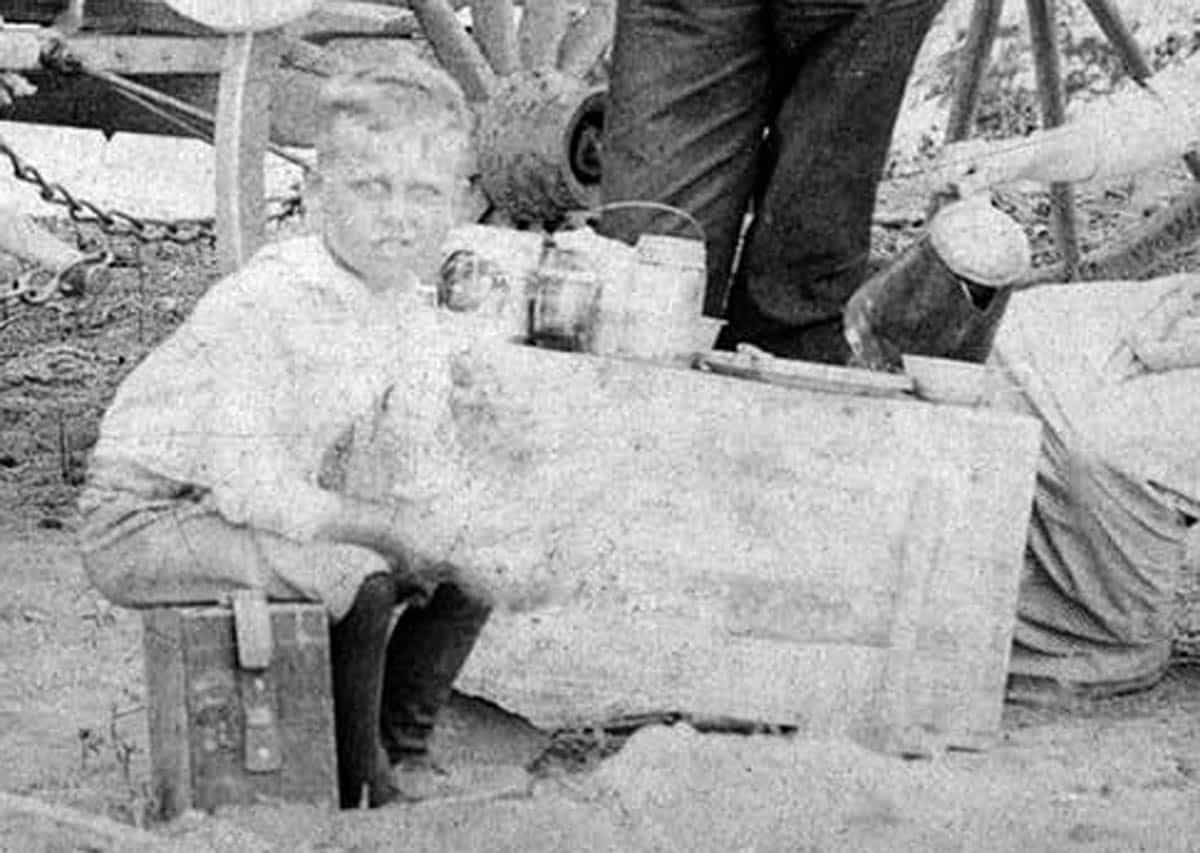
paden cash, post: 411548, member: 20 wrote: Does anybody else see what the boy in the photo is sitting upon?
Good eyes. That does look like the box to what was called a plain transit. I have a Gurley transit from the late 1870s with a nearly identical box.
Posted : January 30, 2017 11:55 am

Translate
▼
English
Spanish
French
German
Italian
Portuguese
Russian
Chinese
Japanese
Korean
Arabic
Hindi
Dutch
Polish
Turkish
Vietnamese
Thai
Swedish
Danish
Finnish
Norwegian
Czech
Hungarian
Romanian
Greek
Hebrew
Indonesian
Malay
Ukrainian
Bulgarian
Croatian
Slovak
Slovenian
Serbian
Lithuanian
Latvian
Estonian
Mrs. Powell is sitting on a box too.
Posted : January 30, 2017 1:34 pm
Topic starter
Translate
▼
English
Spanish
French
German
Italian
Portuguese
Russian
Chinese
Japanese
Korean
Arabic
Hindi
Dutch
Polish
Turkish
Vietnamese
Thai
Swedish
Danish
Finnish
Norwegian
Czech
Hungarian
Romanian
Greek
Hebrew
Indonesian
Malay
Ukrainian
Bulgarian
Croatian
Slovak
Slovenian
Serbian
Lithuanian
Latvian
Estonian
Dave Karoly, post: 411572, member: 94 wrote: Mrs. Powell is sitting on a box too.
The thing she's sitting on appears to be approximately cylindrical, more like a stump or a bucket of some sort.
Posted : January 30, 2017 1:47 pm

Translate
▼
English
Spanish
French
German
Italian
Portuguese
Russian
Chinese
Japanese
Korean
Arabic
Hindi
Dutch
Polish
Turkish
Vietnamese
Thai
Swedish
Danish
Finnish
Norwegian
Czech
Hungarian
Romanian
Greek
Hebrew
Indonesian
Malay
Ukrainian
Bulgarian
Croatian
Slovak
Slovenian
Serbian
Lithuanian
Latvian
Estonian
Thanks Kent! Very interesting! Jp
Posted : January 30, 2017 2:02 pm

Translate
▼
English
Spanish
French
German
Italian
Portuguese
Russian
Chinese
Japanese
Korean
Arabic
Hindi
Dutch
Polish
Turkish
Vietnamese
Thai
Swedish
Danish
Finnish
Norwegian
Czech
Hungarian
Romanian
Greek
Hebrew
Indonesian
Malay
Ukrainian
Bulgarian
Croatian
Slovak
Slovenian
Serbian
Lithuanian
Latvian
Estonian
Thank you Kent for posting this. I cannot imagine a letter like the one written by Mr. Walsh being penned today. Who for cripes sakes accepts responsibility?
Posted : January 30, 2017 2:20 pm
Topic starter
Translate
▼
English
Spanish
French
German
Italian
Portuguese
Russian
Chinese
Japanese
Korean
Arabic
Hindi
Dutch
Polish
Turkish
Vietnamese
Thai
Swedish
Danish
Finnish
Norwegian
Czech
Hungarian
Romanian
Greek
Hebrew
Indonesian
Malay
Ukrainian
Bulgarian
Croatian
Slovak
Slovenian
Serbian
Lithuanian
Latvian
Estonian
Daniel Ralph, post: 411577, member: 8817 wrote: Thank you Kent for posting this. I cannot imagine a letter like the one written by Mr. Walsh being penned today. Who for cripes sakes accepts responsibility?
One of the additional aspects of Commissioner Walsh's responsibilities was that at the time he wrote there was no mechanism for correcting patents that erroneously issued from the GLO, as would be the case where large parts of surveys or surveys in their entirety conflicted with the prior valid rights of others. So the GLO staff were having to both work as quickly as possible to prepare patents and to make no mistakes when the surveys upon which those patents were to be issued were examined.
One of the letters that E.M. Powell wrote to Commissioner Walsh in 1884 dealt with the question of whether a patent had been wrongly issued on for a certain section of land in Denton County that covered land to which someone other than the patentee had the superior claim. Walsh's reply summarizes how few remedies he had at his disposal:

Posted : January 30, 2017 2:43 pm

Translate
▼
English
Spanish
French
German
Italian
Portuguese
Russian
Chinese
Japanese
Korean
Arabic
Hindi
Dutch
Polish
Turkish
Vietnamese
Thai
Swedish
Danish
Finnish
Norwegian
Czech
Hungarian
Romanian
Greek
Hebrew
Indonesian
Malay
Ukrainian
Bulgarian
Croatian
Slovak
Slovenian
Serbian
Lithuanian
Latvian
Estonian
Kent-
Thank you for your historical research piece.
If today's surveyors/lawyers did not know about how the land was divided (or those before you did not know) how do you reconcile the original division fabric that you have determined by your historical research and the long standing 'occupation' boundaries when you find a recognized difference ?
Or, is there much of that ?:)
Cheers,
Derek
PS-
In a jocular manner.......... we have snow that covers up a lot here !
Posted : January 30, 2017 3:43 pm
Page 1 / 2
Next