Reading RPLS is free for the whole profession. Members post, reply, and get the members-only rooms.

Notifications
Clear all
Strictly Surveying
10
Posts
5
Users
0
Reactions
658
Views

Topic starter
Translate
▼
English
Spanish
French
German
Italian
Portuguese
Russian
Chinese
Japanese
Korean
Arabic
Hindi
Dutch
Polish
Turkish
Vietnamese
Thai
Swedish
Danish
Finnish
Norwegian
Czech
Hungarian
Romanian
Greek
Hebrew
Indonesian
Malay
Ukrainian
Bulgarian
Croatian
Slovak
Slovenian
Serbian
Lithuanian
Latvian
Estonian
Hi guys
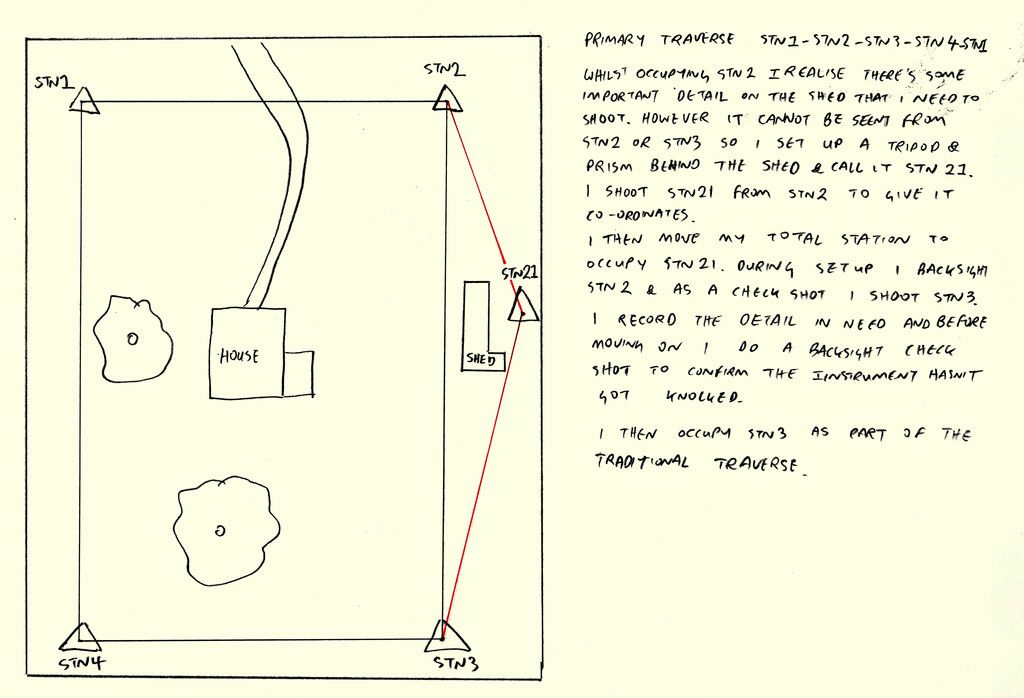
I'm relatively new to surveying so I thought I'd pick your brains about shooting detail that isn't accessible from primary traverse stations. I've been doing a lot surveys for developers/architects which typically involves a plot of land with a house in it. I normally end up traversing close to the perimeter and this picks up most of the detail needed. However there's nearly always some awkward spots that need recording which are obscured by the primary traverse stations.
The diagram below should explain what I mean. Is what I'm doing okay or should I be doing it differently? My traverse accuracy is normally greater that 1 in 70,000. The detail on my surveys needs to be accurate to within 25mm.
If the big diagram is too small click on the one below it and it will open up full screen size.
Kind regards, Andrew
?ÿ
Posted : September 6, 2018 2:26 am

Translate
▼
English
Spanish
French
German
Italian
Portuguese
Russian
Chinese
Japanese
Korean
Arabic
Hindi
Dutch
Polish
Turkish
Vietnamese
Thai
Swedish
Danish
Finnish
Norwegian
Czech
Hungarian
Romanian
Greek
Hebrew
Indonesian
Malay
Ukrainian
Bulgarian
Croatian
Slovak
Slovenian
Serbian
Lithuanian
Latvian
Estonian
I am guessing you can??t see the house or trees in your sketch from your traverse points around the boundary? Sorry, can??t make out the handwritten notes on my phone.
There are probably as many ways to accomplish this as there are contributors to this forum. The answer will be what works best for you given your project parameters. ?ÿI??ll give you two possible solutions and let others chime in.?ÿ
1. Traverse through the middle of the site, survey all of the required featurs, and tie back into your boundary loop.?ÿ
2. If you can find a spot where you can see three of your control loop points and your required features, resection in that point and survey your interior features.?ÿ
As stated above, there are many possible solutions. Either or neither of these may work for you.?ÿ
Posted : September 6, 2018 3:27 am

Translate
▼
English
Spanish
French
German
Italian
Portuguese
Russian
Chinese
Japanese
Korean
Arabic
Hindi
Dutch
Polish
Turkish
Vietnamese
Thai
Swedish
Danish
Finnish
Norwegian
Czech
Hungarian
Romanian
Greek
Hebrew
Indonesian
Malay
Ukrainian
Bulgarian
Croatian
Slovak
Slovenian
Serbian
Lithuanian
Latvian
Estonian
Add traverse points as required. ?ÿNothing is perfect, but, one or two points in the best spots ?ÿon the tract will get you almost everything that is critical.
Posted : September 6, 2018 7:10 am

Translate
▼
English
Spanish
French
German
Italian
Portuguese
Russian
Chinese
Japanese
Korean
Arabic
Hindi
Dutch
Polish
Turkish
Vietnamese
Thai
Swedish
Danish
Finnish
Norwegian
Czech
Hungarian
Romanian
Greek
Hebrew
Indonesian
Malay
Ukrainian
Bulgarian
Croatian
Slovak
Slovenian
Serbian
Lithuanian
Latvian
Estonian
What you show looks reasonable to me.?ÿ If you have least squares fitting capability, you aren't limited to simple traverses.?ÿ You can set up another point anywhere you can see some of your other points and continue to add redundancy as it is available. Cross-connecting across the figure adds a lot to the accuracy. If you give the LS algorithm reasonable standard error estimates for your angle and distance measurement accuracy, the LS solution will then be the best estimate of all your points. As a bonus, it will give you estimates of the accuracy at each point, taking into account the shape of the figure.
Posted : September 6, 2018 7:14 am
Topic starter
Translate
▼
English
Spanish
French
German
Italian
Portuguese
Russian
Chinese
Japanese
Korean
Arabic
Hindi
Dutch
Polish
Turkish
Vietnamese
Thai
Swedish
Danish
Finnish
Norwegian
Czech
Hungarian
Romanian
Greek
Hebrew
Indonesian
Malay
Ukrainian
Bulgarian
Croatian
Slovak
Slovenian
Serbian
Lithuanian
Latvian
Estonian
thanks for your reply Bill.
I'm sure I will use least square some time. For now when I'm setting up over my new intermediate station I backsight one of my primary traverse stations and that do a check shot to another primary traverse station. As my Trimble data collector tells that these stations are within 3mm (1/8 inch) of where its expects them to be I'm happy.
?ÿ
Posted : September 6, 2018 8:55 am

Translate
▼
English
Spanish
French
German
Italian
Portuguese
Russian
Chinese
Japanese
Korean
Arabic
Hindi
Dutch
Polish
Turkish
Vietnamese
Thai
Swedish
Danish
Finnish
Norwegian
Czech
Hungarian
Romanian
Greek
Hebrew
Indonesian
Malay
Ukrainian
Bulgarian
Croatian
Slovak
Slovenian
Serbian
Lithuanian
Latvian
Estonian
What you are doing is common practice. Maybe even a little more than what a lot of people do.?ÿ ?ÿ
Posted : September 6, 2018 9:21 am
Topic starter
Translate
▼
English
Spanish
French
German
Italian
Portuguese
Russian
Chinese
Japanese
Korean
Arabic
Hindi
Dutch
Polish
Turkish
Vietnamese
Thai
Swedish
Danish
Finnish
Norwegian
Czech
Hungarian
Romanian
Greek
Hebrew
Indonesian
Malay
Ukrainian
Bulgarian
Croatian
Slovak
Slovenian
Serbian
Lithuanian
Latvian
Estonian
Norman - what do other people do?
Posted : September 6, 2018 10:03 am
Translate
▼
English
Spanish
French
German
Italian
Portuguese
Russian
Chinese
Japanese
Korean
Arabic
Hindi
Dutch
Polish
Turkish
Vietnamese
Thai
Swedish
Danish
Finnish
Norwegian
Czech
Hungarian
Romanian
Greek
Hebrew
Indonesian
Malay
Ukrainian
Bulgarian
Croatian
Slovak
Slovenian
Serbian
Lithuanian
Latvian
Estonian
Now that I am in the office and can read the hand written notes on your sketch....
I would have just shot two corners of the shed closest to the property line, measured up the shed with a cloth tape, recorded dimensions on a sketch in my field book. That is, unless the shed was a bone of contention for encroachment or if it the survey was for plans to expand the shed. Then I would have traversed around it as you did to pick up more detail.
Posted : September 6, 2018 10:04 am
Topic starter
Translate
▼
English
Spanish
French
German
Italian
Portuguese
Russian
Chinese
Japanese
Korean
Arabic
Hindi
Dutch
Polish
Turkish
Vietnamese
Thai
Swedish
Danish
Finnish
Norwegian
Czech
Hungarian
Romanian
Greek
Hebrew
Indonesian
Malay
Ukrainian
Bulgarian
Croatian
Slovak
Slovenian
Serbian
Lithuanian
Latvian
Estonian
Thanks for the reply Jim. What I'm doing though is not strictly traversing round the shed as I'm not turning the angle STN21-SNT3-STN4 when I occupy STN3.
?ÿ
Posted : September 6, 2018 10:17 am
Translate
▼
English
Spanish
French
German
Italian
Portuguese
Russian
Chinese
Japanese
Korean
Arabic
Hindi
Dutch
Polish
Turkish
Vietnamese
Thai
Swedish
Danish
Finnish
Norwegian
Czech
Hungarian
Romanian
Greek
Hebrew
Indonesian
Malay
Ukrainian
Bulgarian
Croatian
Slovak
Slovenian
Serbian
Lithuanian
Latvian
Estonian
Norman - what do other people do?
There is what Jim described, for example. Which is fine for tying a shed. Then there is just putting out a fly tie point to set up on and not checking to the point in back. Not good practice, but it happens a lot. Given a choice in the circumstances I'd prefer Jim's method over that.?ÿ?ÿ
Personally, I would expect that check point to be tied.?ÿ A fly tie point with a 3rd point check to trap a blunder is quite suitable. Not everything needs to be part of a closed figure. A long time ago it was drilled into me that detecting and eliminating blunders was always the number 1 priority and high precision came somewhere further down the list.?ÿ ?ÿ
Posted : September 6, 2018 10:22 am