Reading RPLS is free for the whole profession. Members post, reply, and get the members-only rooms.

Notifications
Clear all
Strictly Surveying
49
Posts
13
Users
0
Reactions
1,119
Views

Topic starter
Translate
▼
English
Spanish
French
German
Italian
Portuguese
Russian
Chinese
Japanese
Korean
Arabic
Hindi
Dutch
Polish
Turkish
Vietnamese
Thai
Swedish
Danish
Finnish
Norwegian
Czech
Hungarian
Romanian
Greek
Hebrew
Indonesian
Malay
Ukrainian
Bulgarian
Croatian
Slovak
Slovenian
Serbian
Lithuanian
Latvian
Estonian
I've spent the last couple of days working on a problem that involves reconstructing a series of metes and bounds land grants based upon surveys made between 1838 and 1914. In short, the typical Central Texas Hill Country problem.
One particular file contained one of the more unusual sets of field notes I've seen to date, namely this:
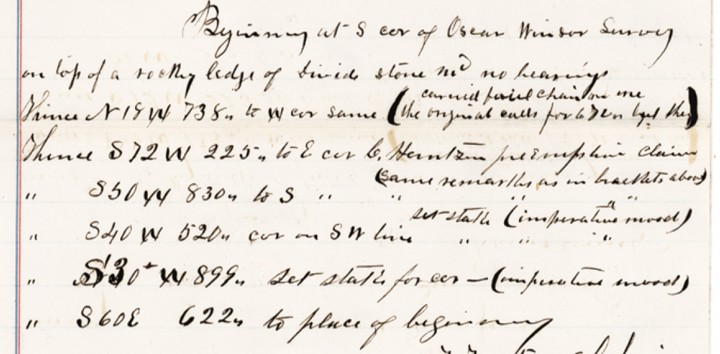
They were filed by the Travis County Surveyor in 1878 to correct the field notes from his original survey made in 1877, a survey for which no fewer than four different sets of Corrected Field Notes were filed between January, 1877 and Janury, 1880 when finally the GLO staff approved the notes for patent.
I'd transcribe the above field notes as follows:
Beginning at S cor of Oscar Winsor Survey
on top of a rocky ledge of divide stone md no bearings
Thence N 18 W 738 vs to W cor same (the original calls for 672 vs but they carried [illegible] chain on me)
Thence S 72 W 225 vs to E cor C Huntzen Preemption claim
Thence S 50 W 830 vs. to S corner C Huntzen Preemption claim (same remarks as in brackets above)
Thence S 40 W 520 vs cor on SW line of C Huntzen Preemption Claim set stake (imperative mood)
Thence S 30 W 899 vs. set stake for cor - (imperative mood)
Thence S 60 E 622 vs. to place of beginning.
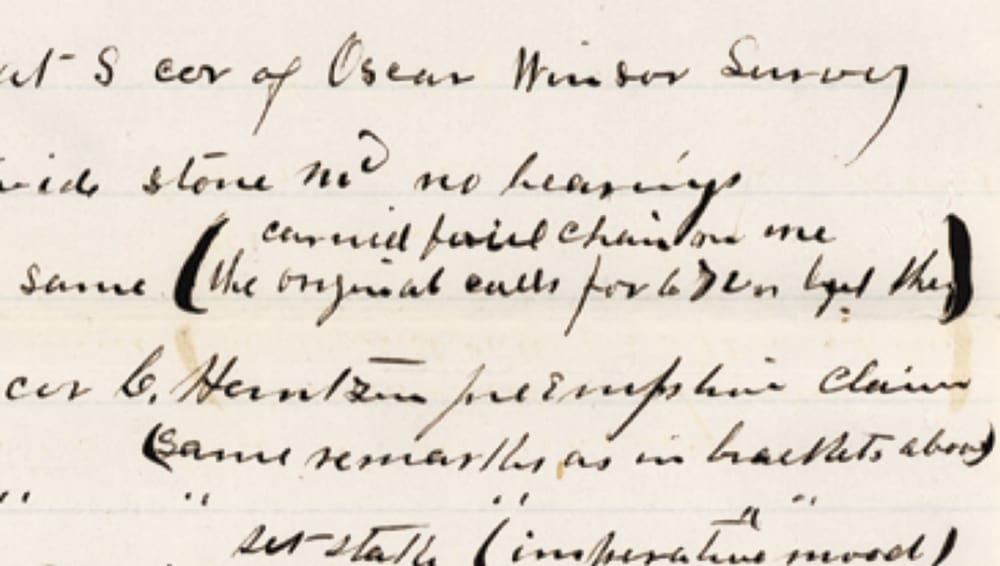
I'm not sure what the missing word in "they carried ___ chain on me" is, but the occasion for the remark was as an explanation for why the Surveyor was reporting a distance of 738 varas between the corners of the Oscar Winsor Survey that he originally reported to the GLO in 1874 as having been 672 varas in his field notes for the Winsor Survey.
You're welcome to take a stab at the missing word. "Fake" and "false" fit the context, but not the handwriting. The "imperative mood" grammatical notation is unique and may well be the only example that exists in the extensive holdings of the Texas GLO.
Posted : July 23, 2017 12:27 pm
Topic starter
Translate
▼
English
Spanish
French
German
Italian
Portuguese
Russian
Chinese
Japanese
Korean
Arabic
Hindi
Dutch
Polish
Turkish
Vietnamese
Thai
Swedish
Danish
Finnish
Norwegian
Czech
Hungarian
Romanian
Greek
Hebrew
Indonesian
Malay
Ukrainian
Bulgarian
Croatian
Slovak
Slovenian
Serbian
Lithuanian
Latvian
Estonian
And here's a better image of the phrase with the mystery word:
Posted : July 23, 2017 1:05 pm

Translate
▼
English
Spanish
French
German
Italian
Portuguese
Russian
Chinese
Japanese
Korean
Arabic
Hindi
Dutch
Polish
Turkish
Vietnamese
Thai
Swedish
Danish
Finnish
Norwegian
Czech
Hungarian
Romanian
Greek
Hebrew
Indonesian
Malay
Ukrainian
Bulgarian
Croatian
Slovak
Slovenian
Serbian
Lithuanian
Latvian
Estonian
What I read is "fixed" with the "d" being more open than shown in other words. He also shows a noticeable offset for dotting his "i"s.
I'm comforted to hear that old Texas surveyors were well versed in Latin grammar and annotated their field notes with the verb mood.
It is too complex for me to figure out how a repaired Texas "chain" created a 66 vara error in a 672 vara distance.
Posted : July 23, 2017 1:33 pm

Translate
▼
English
Spanish
French
German
Italian
Portuguese
Russian
Chinese
Japanese
Korean
Arabic
Hindi
Dutch
Polish
Turkish
Vietnamese
Thai
Swedish
Danish
Finnish
Norwegian
Czech
Hungarian
Romanian
Greek
Hebrew
Indonesian
Malay
Ukrainian
Bulgarian
Croatian
Slovak
Slovenian
Serbian
Lithuanian
Latvian
Estonian
I think it begins with a "b", and could be "biased".
Posted : July 23, 2017 2:32 pm

Translate
▼
English
Spanish
French
German
Italian
Portuguese
Russian
Chinese
Japanese
Korean
Arabic
Hindi
Dutch
Polish
Turkish
Vietnamese
Thai
Swedish
Danish
Finnish
Norwegian
Czech
Hungarian
Romanian
Greek
Hebrew
Indonesian
Malay
Ukrainian
Bulgarian
Croatian
Slovak
Slovenian
Serbian
Lithuanian
Latvian
Estonian
impenetrive (impenetrable) wood
Posted : July 23, 2017 3:08 pm

Translate
▼
English
Spanish
French
German
Italian
Portuguese
Russian
Chinese
Japanese
Korean
Arabic
Hindi
Dutch
Polish
Turkish
Vietnamese
Thai
Swedish
Danish
Finnish
Norwegian
Czech
Hungarian
Romanian
Greek
Hebrew
Indonesian
Malay
Ukrainian
Bulgarian
Croatian
Slovak
Slovenian
Serbian
Lithuanian
Latvian
Estonian
I think it was a former English teacher who thought they could make more money as a surveyor.
Posted : July 23, 2017 3:17 pm

Translate
▼
English
Spanish
French
German
Italian
Portuguese
Russian
Chinese
Japanese
Korean
Arabic
Hindi
Dutch
Polish
Turkish
Vietnamese
Thai
Swedish
Danish
Finnish
Norwegian
Czech
Hungarian
Romanian
Greek
Hebrew
Indonesian
Malay
Ukrainian
Bulgarian
Croatian
Slovak
Slovenian
Serbian
Lithuanian
Latvian
Estonian
In Holy Cows case wouldn't that be spelled "steak" ?
Posted : July 23, 2017 3:18 pm
Translate
▼
English
Spanish
French
German
Italian
Portuguese
Russian
Chinese
Japanese
Korean
Arabic
Hindi
Dutch
Polish
Turkish
Vietnamese
Thai
Swedish
Danish
Finnish
Norwegian
Czech
Hungarian
Romanian
Greek
Hebrew
Indonesian
Malay
Ukrainian
Bulgarian
Croatian
Slovak
Slovenian
Serbian
Lithuanian
Latvian
Estonian
I'm fairly certain that Kent has a few more examples of the Travis County Surveyor's field notes to assist in deciphering the "missing word". It may be that the county surveyor's crew previously used a 10 vara chain that was the same as Jacob Kuechler's 10 vara chain; that being it was 30 feet long instead of the standard 10-vara chain being 27.78 feet (vara defined as 33-1/3 inches). Kent mentioned all of this in his replies to the Texican vara measuring tape thread in 2015. That may be what happened here since there was a Jacob Keuchler who was the Texas GLO Commissioner circa 1870-1874. A distance of 672 varas measured with a 10-vara chain that nominally measures 30 feet would give a distance of 726 varas. A little sloppy, but maybe it was a well worn chain.
An aside: Anyone have any photos of an old 10-vara chain. I found a couple of references that state it was composed of 50 links
Posted : July 23, 2017 3:57 pm

Translate
▼
English
Spanish
French
German
Italian
Portuguese
Russian
Chinese
Japanese
Korean
Arabic
Hindi
Dutch
Polish
Turkish
Vietnamese
Thai
Swedish
Danish
Finnish
Norwegian
Czech
Hungarian
Romanian
Greek
Hebrew
Indonesian
Malay
Ukrainian
Bulgarian
Croatian
Slovak
Slovenian
Serbian
Lithuanian
Latvian
Estonian
I'm gonna' guess 'foul chain' if there's a right or wrong answer, and we win something for being correct.
Posted : July 23, 2017 4:01 pm
Topic starter
Translate
▼
English
Spanish
French
German
Italian
Portuguese
Russian
Chinese
Japanese
Korean
Arabic
Hindi
Dutch
Polish
Turkish
Vietnamese
Thai
Swedish
Danish
Finnish
Norwegian
Czech
Hungarian
Romanian
Greek
Hebrew
Indonesian
Malay
Ukrainian
Bulgarian
Croatian
Slovak
Slovenian
Serbian
Lithuanian
Latvian
Estonian
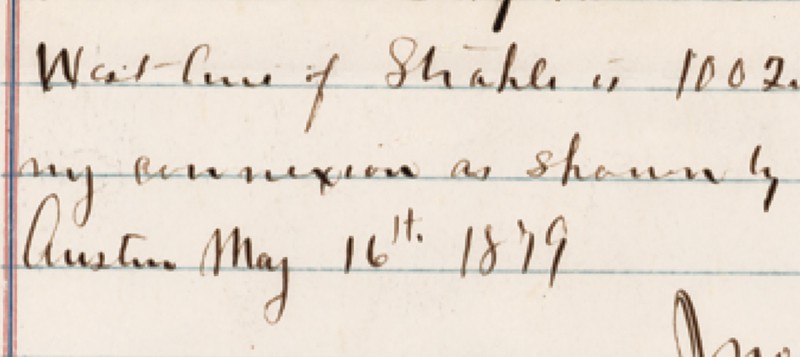
Gene Kooper, post: 438284, member: 9850 wrote: What I read is "fixed" with the "d" being more open than shown in other words. He also shows a noticeable offset for dotting his "i"s.
That is an unlikely candidate for "fixed". Here is a specimen of the same surveyor's handwriting showing the word "connexion"
Posted : July 23, 2017 6:06 pm
Topic starter
Translate
▼
English
Spanish
French
German
Italian
Portuguese
Russian
Chinese
Japanese
Korean
Arabic
Hindi
Dutch
Polish
Turkish
Vietnamese
Thai
Swedish
Danish
Finnish
Norwegian
Czech
Hungarian
Romanian
Greek
Hebrew
Indonesian
Malay
Ukrainian
Bulgarian
Croatian
Slovak
Slovenian
Serbian
Lithuanian
Latvian
Estonian
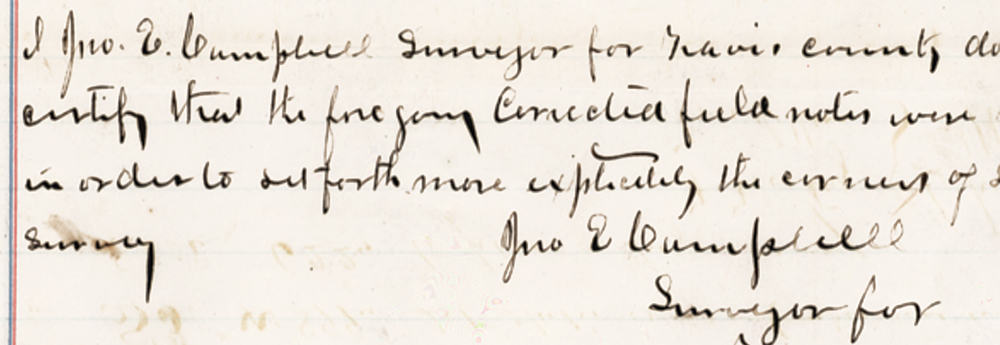
And here's another example with lots of examples of the letter "f":
Posted : July 23, 2017 6:22 pm
Topic starter
Translate
▼
English
Spanish
French
German
Italian
Portuguese
Russian
Chinese
Japanese
Korean
Arabic
Hindi
Dutch
Polish
Turkish
Vietnamese
Thai
Swedish
Danish
Finnish
Norwegian
Czech
Hungarian
Romanian
Greek
Hebrew
Indonesian
Malay
Ukrainian
Bulgarian
Croatian
Slovak
Slovenian
Serbian
Lithuanian
Latvian
Estonian
Robert Hill, post: 438297, member: 378 wrote: I think it was a former English teacher who thought they could make more money as a surveyor.
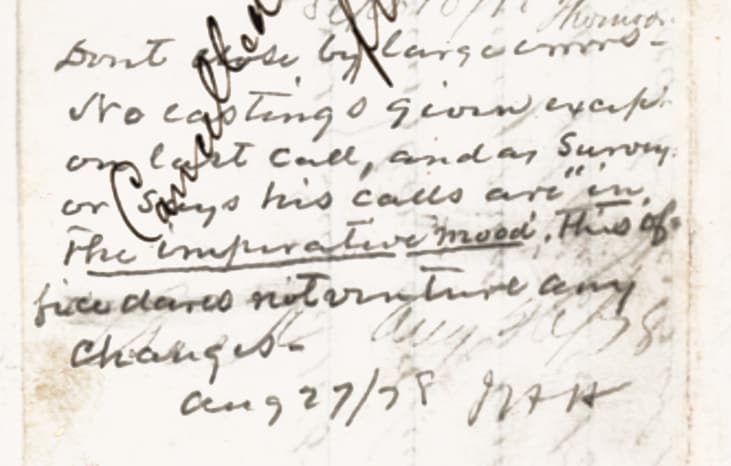
Actually, the County Surveyor, Jno E. Campbell was a fairly diligent surveyor whose work I seldom find to present tremendous difficulties. On the subject of Mr. Campbell's note as to the "imperative mood" in his calls for having set stakes to mark two of the corners, here is how that was understood in the drafting room at the Texas GLO when the field notes were examined (possibly knowing that Mr. Campbell's office was less than a block away).
Posted : July 23, 2017 6:34 pm

Translate
▼
English
Spanish
French
German
Italian
Portuguese
Russian
Chinese
Japanese
Korean
Arabic
Hindi
Dutch
Polish
Turkish
Vietnamese
Thai
Swedish
Danish
Finnish
Norwegian
Czech
Hungarian
Romanian
Greek
Hebrew
Indonesian
Malay
Ukrainian
Bulgarian
Croatian
Slovak
Slovenian
Serbian
Lithuanian
Latvian
Estonian
Wow, those old Texas surveyors couldn't figure out where NORTH was, Chain a decent distance, or WRITE with much better than 3rd grade penmanship either!
No wonder things are so frick'in complicated down there.
:zzz:
Posted : July 23, 2017 6:39 pm

Translate
▼
English
Spanish
French
German
Italian
Portuguese
Russian
Chinese
Japanese
Korean
Arabic
Hindi
Dutch
Polish
Turkish
Vietnamese
Thai
Swedish
Danish
Finnish
Norwegian
Czech
Hungarian
Romanian
Greek
Hebrew
Indonesian
Malay
Ukrainian
Bulgarian
Croatian
Slovak
Slovenian
Serbian
Lithuanian
Latvian
Estonian
my guess is the word ends in "d". Almost looks like "period", but I have no idea how that would make any more sense.
Posted : July 23, 2017 7:22 pm
Topic starter
Translate
▼
English
Spanish
French
German
Italian
Portuguese
Russian
Chinese
Japanese
Korean
Arabic
Hindi
Dutch
Polish
Turkish
Vietnamese
Thai
Swedish
Danish
Finnish
Norwegian
Czech
Hungarian
Romanian
Greek
Hebrew
Indonesian
Malay
Ukrainian
Bulgarian
Croatian
Slovak
Slovenian
Serbian
Lithuanian
Latvian
Estonian
Loyal, post: 438315, member: 228 wrote: Wow, those old Texas surveyors couldn't figure out where NORTH was, Chain a decent distance, or WRITE with much better than 3rd grade penmanship either!
No wonder things are so frick'in complicated down there.
Considering that all of the "field notes" that survive in PLSSia are probably neat copies made in the office by a clerk or draftsman, we do have a more honest record in Texas that typically was by the hand of the responsible surveyor (with multiple exceptions in the railroad survey blocks of West Texas). One of the obvious simplifications of PLSSia was to just start with a blank piece of paper. Within the system of metes and bounds grants followed in Texas, of course, that was not possible since surveys had to be made in relation to the existing fabric of prior appropriations and they were where they were.
What that meant in particular is that when the GLO of the Republic of Texas opened for business, there were plenty of valid existing titles that had issued under Spanish and Mexican sovereignty that were vested rights that under the laws of the Republic were valid and to be respected. So, in the case of, say, Travis County, the variation of 10?ø30'E that had been standardly used to adjust compasses in the district during the Mexican colonial period remained in use to facilitate the retracement of existing land grant lines.
Obviously, this would not be a factor in PSSia when everything was created new at the same time, but it is in the more complex system with junior and senior rights between the owners of land grants. So a bearing of, say N18?øE, recited in 1877 actually refers to a North direction that was established in 1835 and used in filling in the complicated pattern made by prior land grants.
The County Surveyor's records reflect changes in the variation at which surveys were subsequently made in the county during different periods of time, but these changes reflect what you would probably best understand as a "custom projection", a one parameter transformation to fit older work as well as might be done.
Posted : July 23, 2017 7:30 pm
Topic starter
Translate
▼
English
Spanish
French
German
Italian
Portuguese
Russian
Chinese
Japanese
Korean
Arabic
Hindi
Dutch
Polish
Turkish
Vietnamese
Thai
Swedish
Danish
Finnish
Norwegian
Czech
Hungarian
Romanian
Greek
Hebrew
Indonesian
Malay
Ukrainian
Bulgarian
Croatian
Slovak
Slovenian
Serbian
Lithuanian
Latvian
Estonian
R.J. Schneider, post: 438304, member: 409 wrote: I'm gonna' guess 'foul chain' if there's a right or wrong answer, and we win something for being correct.
I think that "they carried foul chain on me" is the most likely possibility yet. The County Surveyor was dependent upon his chainmen, who nearly invariably were local residents induced to work on the survey. Using locals as chainmen was simple for the surveyor, of course, but it also served the purpose of acquainting adjoining landowners with where lines had been run and corners marked.
Posted : July 23, 2017 7:39 pm
Translate
▼
English
Spanish
French
German
Italian
Portuguese
Russian
Chinese
Japanese
Korean
Arabic
Hindi
Dutch
Polish
Turkish
Vietnamese
Thai
Swedish
Danish
Finnish
Norwegian
Czech
Hungarian
Romanian
Greek
Hebrew
Indonesian
Malay
Ukrainian
Bulgarian
Croatian
Slovak
Slovenian
Serbian
Lithuanian
Latvian
Estonian
Kent McMillan, post: 438319, member: 3 wrote: Considering that all of the "field notes" that survive in PLSSia are probably neat copies made in the office by a clerk or draftsman,....
Here's a typical example of some the "neat notes" in PLSSia concerning bearing determination, no doubt made by clerks...
Posted : July 23, 2017 7:48 pm
Topic starter
Translate
▼
English
Spanish
French
German
Italian
Portuguese
Russian
Chinese
Japanese
Korean
Arabic
Hindi
Dutch
Polish
Turkish
Vietnamese
Thai
Swedish
Danish
Finnish
Norwegian
Czech
Hungarian
Romanian
Greek
Hebrew
Indonesian
Malay
Ukrainian
Bulgarian
Croatian
Slovak
Slovenian
Serbian
Lithuanian
Latvian
Estonian
paden cash, post: 438323, member: 20 wrote: Here's a typical example of some the "neat notes" in PLSSia concerning bearing determination, no doubt made by clerks...
Yes, that does look like a good example of a copied field book since it is in ink and evidently written at leisure at some office desk. The downside, of course, is that any transcription errors won't be readily identified if the original field books were destroyed, but the simplication is that you don't have to worry about what the field version of the field notes actually presented unless you have drawn one of the rare instances when the actual field notes survived.
Personally, I'd prefer to have the orginal surveyor's account always instead of relying upon some clerk who may have transcribed it all.
Posted : July 23, 2017 7:54 pm
Translate
▼
English
Spanish
French
German
Italian
Portuguese
Russian
Chinese
Japanese
Korean
Arabic
Hindi
Dutch
Polish
Turkish
Vietnamese
Thai
Swedish
Danish
Finnish
Norwegian
Czech
Hungarian
Romanian
Greek
Hebrew
Indonesian
Malay
Ukrainian
Bulgarian
Croatian
Slovak
Slovenian
Serbian
Lithuanian
Latvian
Estonian
Kent McMillan, post: 438326, member: 3 wrote: Yes, that does look like a good example of a copied field book since it is in ink and evidently written at leisure at some office desk. The downside, of course, is that any transcription errors won't be readily identified if the original field books were destroyed, but the simplication is that you don't have to worry about what the field version of the field notes actually presented unless you have drawn one of the rare instances when the actual field notes survived.
Personally, I'd prefer to have the orginal surveyor's account always instead of relying upon some clerk who may have transcribed it all.
So...am I to believe... that YOU really believe the page(s) of "notes" that you posted above are actually "field" notes, and not a transcription derived from the ACTUAL FIELD books?
I have seen a lot of ACTUAL (Original) Field Notes, and NONE of then indicate distances greater in magnitude of the "chain" used (maybe "they" had REALLY long chains/tapes in Texas). Where are the ACTUAL chained distances w/ vertical angles, reductions, summations, instrument "moves" etc.? Ya know, the REAL FIELD notes!
Enquiring minds want to know.
:rolleyes:
Loyal
Posted : July 23, 2017 8:31 pm
Translate
▼
English
Spanish
French
German
Italian
Portuguese
Russian
Chinese
Japanese
Korean
Arabic
Hindi
Dutch
Polish
Turkish
Vietnamese
Thai
Swedish
Danish
Finnish
Norwegian
Czech
Hungarian
Romanian
Greek
Hebrew
Indonesian
Malay
Ukrainian
Bulgarian
Croatian
Slovak
Slovenian
Serbian
Lithuanian
Latvian
Estonian
OR, maybe he had one of those Texas sized Stadia Rods, and the ground was REALLY flat, or maybe he had an EARLY EDMI that burped out the "true" Horizontal Distance for him, OR was it EARLY RTK shots? Probably DBH (Distance By Hollering) using a stop watch (or Sun Dial).
😉
Posted : July 23, 2017 8:50 pm
Page 1 / 3
Next