

Kent McMillan, post: 438965, member: 3 wrote: I don't see any way that "calls" could be read as "oath", either in the context or the actual handwriting.
Okay, 'calls' then. It looked like 'oath' to me.

I don't have a word suggestion, but is there a chance that he is referring to slope chaining?

ARS Mine Surveyor, post: 439124, member: 12913 wrote: I don't have a word suggestion, but is there a chance that he is referring to slope chaining?
I don't think so, and for the reason that had the chain carriers been chaining along the slope, their reported measurement would have been longer than a horizontal measurements, rather than shorter as the County Surveyor reported.
BTW, for those interested in putting faces and biographical facts to the early Texas surveyors, here is a photo of the messianic figure of John Eaton Campbell taken in about 1900, when he would have been 73., surrounded by his son-in-law and grandsons.
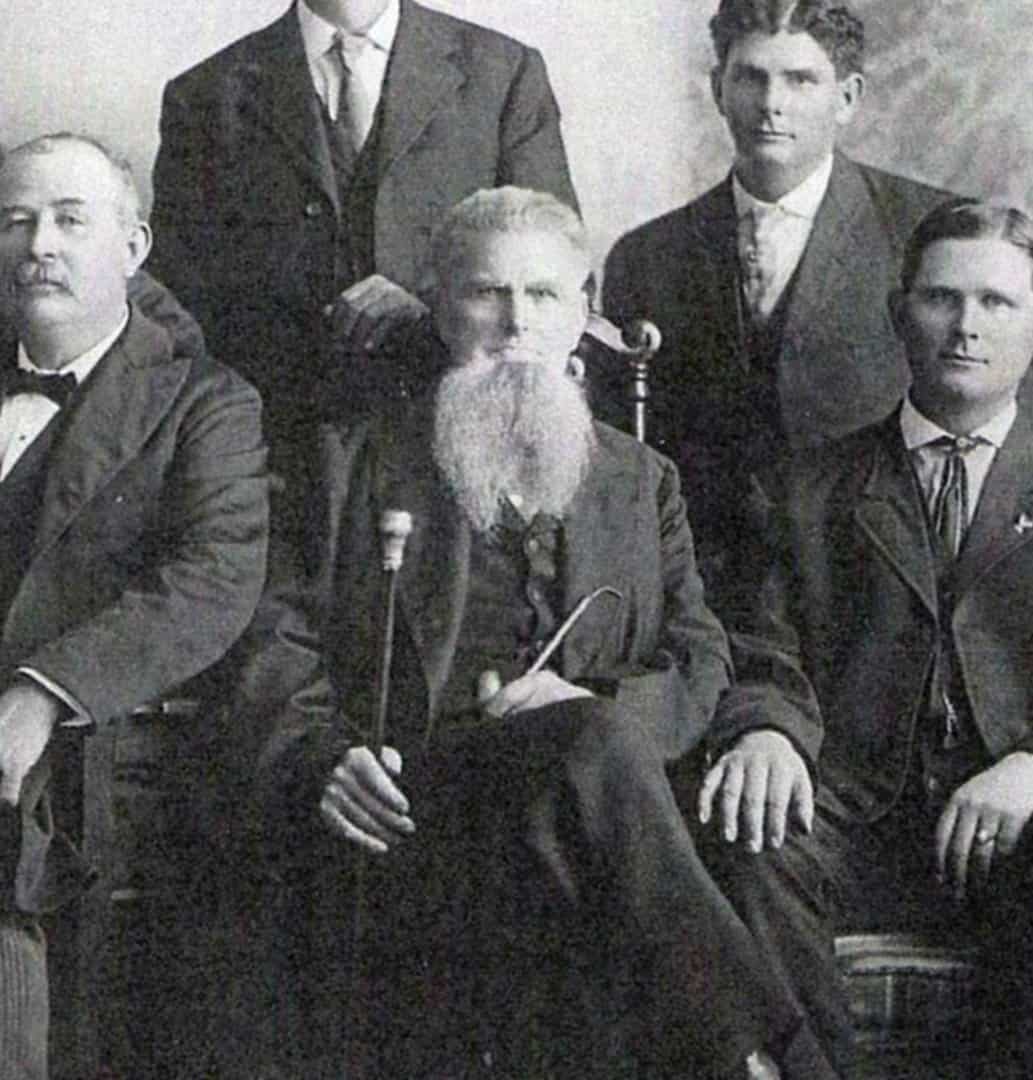
Campbell's biographical sketch reflects that he was born in born in Campbell??s Station, Tennessee on March 28, 1827 and traveled to Texas in 1851 with his brother, Robert Kimbrough Campbell (1829-1853), arriving in Galveston/Houston and travelling overland to Austin with five hundred dollars to assist them in beginning teaching careers. The pupils market was apparently a bit slim in Austin in 1851 and Robert Campbell returned to Tennessee where he died of typhoid fever shortly thereafter. John remained in Texas, John, marrying Lavinia Davidson
(b.ca. 1834-1857) in 1853.
He purchased land (on Williamson Creek, it appears) in Oak Hill, Texas and worked as a surveyor in Travis County. John E. Campbell died on December 11, 1909. His diary is among the collections of the Briscoe Center for American Studies at the University of Texas at Austin.
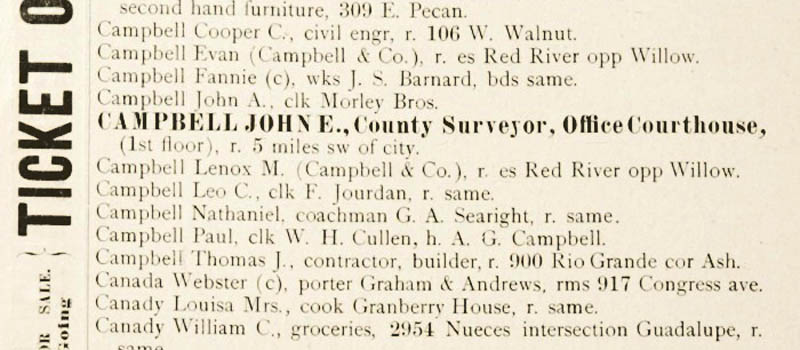
In Austin in 1885-1886, evidently Mr. Campell resided in Oak Hill, about 5 miles SW of Austin and maintained an office in the Travis County Courthouse, right down the street from the Texas GLO.
Gene Kooper, post: 438303, member: 9850 wrote: An aside: Anyone have any photos of an old 10-vara chain. I found a couple of references that state it was composed of 50 links
I don't know or remember whether it was a ten or twenty vara chain on display

R.J. Schneider, post: 439157, member: 409 wrote: I don't know or remember whether it was a ten or twenty vara chain on display
'"> http://i24.photobucket.com/albums/c49/rsjr101/Washington On The Brazos/SurveyExhibit2.jpg
I count 50 tempered steel links in that chain, so it's a 10-vara chain. The links are brazed closed and the handles are brass, of course.
Kent McMillan, post: 439162, member: 3 wrote: I count 50 tempered steel links in that chain, so it's a 10-vara chain. The links are brazed closed and the handles are brass, of course.
Wow! the photo on the second link zooms in pretty close. I had no idea, looking at the upper right brass handle, that the chains had a threaded spindle with an adjusting nut. Learned something new. 🙂
R.J. Schneider, post: 439165, member: 409 wrote: Wow! the photo on the second link zooms in pretty close. I had no idea, looking at the upper right brass handle, that the chains had a threaded spindle with an adjusting nut. Learned something new. 🙂
The advantage to the brazed, tempered steel links was that they were lighter than the heavier untempered wire chains and more resistant to shortening by the links kinking.