Reading RPLS is free for the whole profession. Members post, reply, and get the members-only rooms.

Notifications
Clear all

Topic starter
Translate
▼
English
Spanish
French
German
Italian
Portuguese
Russian
Chinese
Japanese
Korean
Arabic
Hindi
Dutch
Polish
Turkish
Vietnamese
Thai
Swedish
Danish
Finnish
Norwegian
Czech
Hungarian
Romanian
Greek
Hebrew
Indonesian
Malay
Ukrainian
Bulgarian
Croatian
Slovak
Slovenian
Serbian
Lithuanian
Latvian
Estonian
A friend of mine asked if I'd help him get his 41' Tartan (which he entered in the Newport, RI to Bermuda race), back from Bermuda. After pondering the idea (for about 5 seconds), I agreed to do it. What a ride. Sweet weather, following winds most of the way. Spent a lot of time under the A2 Asymmetric Spinnaker.
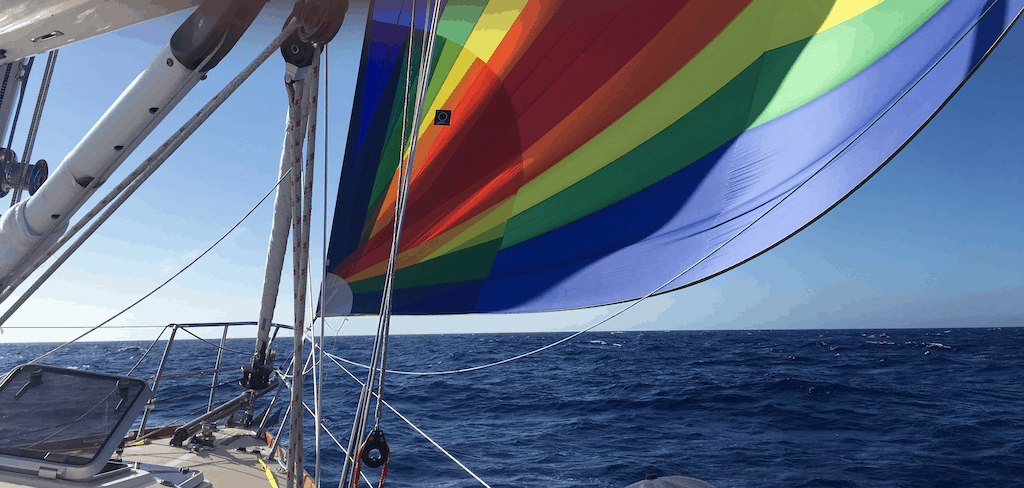
.png "Bermuda (5).png")
For bonus giggles, i got to play with a pretty much state of the art GPS navigation system. Not sure how many or which satellite networks this Raymarine rig uses, but it sure seemed to locate us within a meter or better (not that it mattered)! External antenna was on the aft rail (about 2 meters above water level). .png "Bermuda (1).png")
I can see why all the old school ways (Celestial Navigation, measuring water temps and observing water color to detect the Gulf Stream, Looking at cloud formations) have gone by the wayside.
.png "Bermuda (2).png")
.png "Bermuda (3).png") Using the system, you had real time data on course, bearing to mark (Montauk Light), Speed through the water, Speed over the ground, current set speed and direction. Combine all that with an autopilot linked to the nav system, just as in aviation, you could set the system to maintain a track to the mark, or sail a course relative to the wind, and sit back, enjoy a cold one and watch many of the fabulous sunsets.
Using the system, you had real time data on course, bearing to mark (Montauk Light), Speed through the water, Speed over the ground, current set speed and direction. Combine all that with an autopilot linked to the nav system, just as in aviation, you could set the system to maintain a track to the mark, or sail a course relative to the wind, and sit back, enjoy a cold one and watch many of the fabulous sunsets. .png "Bermuda (4).png")
Or sunrises. This was day 3, but they were all just about as sweet. You can see the GPS antenna next to the Sirius Entertainment system Antenna.
Oh well, back to working on my Terrestrial Astro skills.:unamused:
Posted : July 3, 2016 6:50 am

Translate
▼
English
Spanish
French
German
Italian
Portuguese
Russian
Chinese
Japanese
Korean
Arabic
Hindi
Dutch
Polish
Turkish
Vietnamese
Thai
Swedish
Danish
Finnish
Norwegian
Czech
Hungarian
Romanian
Greek
Hebrew
Indonesian
Malay
Ukrainian
Bulgarian
Croatian
Slovak
Slovenian
Serbian
Lithuanian
Latvian
Estonian
I'm jealous!
Sent from my SAMSUNG-SM-N920A using Tapatalk
Posted : July 3, 2016 7:01 am

Translate
▼
English
Spanish
French
German
Italian
Portuguese
Russian
Chinese
Japanese
Korean
Arabic
Hindi
Dutch
Polish
Turkish
Vietnamese
Thai
Swedish
Danish
Finnish
Norwegian
Czech
Hungarian
Romanian
Greek
Hebrew
Indonesian
Malay
Ukrainian
Bulgarian
Croatian
Slovak
Slovenian
Serbian
Lithuanian
Latvian
Estonian
THIS is what summer is for! Out of curiosity, how many days did it take, and how'd your friend do in the race?
Posted : July 3, 2016 9:44 am

Translate
▼
English
Spanish
French
German
Italian
Portuguese
Russian
Chinese
Japanese
Korean
Arabic
Hindi
Dutch
Polish
Turkish
Vietnamese
Thai
Swedish
Danish
Finnish
Norwegian
Czech
Hungarian
Romanian
Greek
Hebrew
Indonesian
Malay
Ukrainian
Bulgarian
Croatian
Slovak
Slovenian
Serbian
Lithuanian
Latvian
Estonian
You must not have ever watched the movie, The Perfect Storm.
Posted : July 3, 2016 12:27 pm
Topic starter
Translate
▼
English
Spanish
French
German
Italian
Portuguese
Russian
Chinese
Japanese
Korean
Arabic
Hindi
Dutch
Polish
Turkish
Vietnamese
Thai
Swedish
Danish
Finnish
Norwegian
Czech
Hungarian
Romanian
Greek
Hebrew
Indonesian
Malay
Ukrainian
Bulgarian
Croatian
Slovak
Slovenian
Serbian
Lithuanian
Latvian
Estonian
Patrick Yglesias, post: 379858, member: 337 wrote: THIS is what summer is for! Out of curiosity, how many days did it take, and how'd your friend do in the race?
4 days, 15 hours. In the race, he came in first in his division (they're based on size and a ton of other stuff) and 11th overall out of about 135 vessels.
Not too shabby. We probably could have bettered our time coming back had they not blown out all the other, bigger asymmetric spinnakers.
Posted : July 3, 2016 4:22 pm

Translate
▼
English
Spanish
French
German
Italian
Portuguese
Russian
Chinese
Japanese
Korean
Arabic
Hindi
Dutch
Polish
Turkish
Vietnamese
Thai
Swedish
Danish
Finnish
Norwegian
Czech
Hungarian
Romanian
Greek
Hebrew
Indonesian
Malay
Ukrainian
Bulgarian
Croatian
Slovak
Slovenian
Serbian
Lithuanian
Latvian
Estonian
Great pics rfc! They are from 'the field' in a way, as the Vikings used to call the open ocean the blue meadow.
Posted : July 4, 2016 5:45 am

Translate
▼
English
Spanish
French
German
Italian
Portuguese
Russian
Chinese
Japanese
Korean
Arabic
Hindi
Dutch
Polish
Turkish
Vietnamese
Thai
Swedish
Danish
Finnish
Norwegian
Czech
Hungarian
Romanian
Greek
Hebrew
Indonesian
Malay
Ukrainian
Bulgarian
Croatian
Slovak
Slovenian
Serbian
Lithuanian
Latvian
Estonian
maximum what I was getting back was somebody's truck 😉
Posted : July 5, 2016 12:01 pm

Translate
▼
English
Spanish
French
German
Italian
Portuguese
Russian
Chinese
Japanese
Korean
Arabic
Hindi
Dutch
Polish
Turkish
Vietnamese
Thai
Swedish
Danish
Finnish
Norwegian
Czech
Hungarian
Romanian
Greek
Hebrew
Indonesian
Malay
Ukrainian
Bulgarian
Croatian
Slovak
Slovenian
Serbian
Lithuanian
Latvian
Estonian
rfc, post: 379845, member: 8882 wrote: A friend of mine asked if I'd help him get his 41' Tartan (which he entered in the Newport, RI to Bermuda race), back from Bermuda. After pondering the idea (for about 5 seconds), I agreed to do it. What a ride. Sweet weather, following winds most of the way. Spent a lot of time under the A2 Asymmetric Spinnaker.
For bonus giggles, i got to play with a pretty much state of the art GPS navigation system. Not sure how many or which satellite networks this Raymarine rig uses, but it sure seemed to locate us within a meter or better (not that it mattered)! External antenna was on the aft rail (about 2 meters above water level).I can see why all the old school ways (Celestial Navigation, measuring water temps and observing water color to detect the Gulf Stream, Looking at cloud formations) have gone by the wayside.
Or sunrises. This was day 3, but they were all just about as sweet. You can see the GPS antenna next to the Sirius Entertainment system Antenna.Oh well, back to working on my Terrestrial Astro skills.:unamused:
The trip of a lifetime!
Posted : July 5, 2016 12:50 pm

Translate
▼
English
Spanish
French
German
Italian
Portuguese
Russian
Chinese
Japanese
Korean
Arabic
Hindi
Dutch
Polish
Turkish
Vietnamese
Thai
Swedish
Danish
Finnish
Norwegian
Czech
Hungarian
Romanian
Greek
Hebrew
Indonesian
Malay
Ukrainian
Bulgarian
Croatian
Slovak
Slovenian
Serbian
Lithuanian
Latvian
Estonian
Can you explain a bit more about what all the pointers on the displays mean? They appear fascinating with so many indications.
I hope the ship has some backup for that fancy GPS nav system.
Did you do any astro measurements to practice and check versus GPS?
For that course it wouldn't make a huge difference, but is standard practice to constantly follow a geodetic shortest line, or rhumb line between some calculated waypoints, or what?
Posted : July 5, 2016 1:23 pm
Topic starter
Translate
▼
English
Spanish
French
German
Italian
Portuguese
Russian
Chinese
Japanese
Korean
Arabic
Hindi
Dutch
Polish
Turkish
Vietnamese
Thai
Swedish
Danish
Finnish
Norwegian
Czech
Hungarian
Romanian
Greek
Hebrew
Indonesian
Malay
Ukrainian
Bulgarian
Croatian
Slovak
Slovenian
Serbian
Lithuanian
Latvian
Estonian
Bill93, post: 380059, member: 87 wrote: Can you explain a bit more about what all the pointers on the displays mean? They appear fascinating with so many indications.
I hope the ship has some backup for that fancy GPS nav system.
Did you do any astro measurements to practice and check versus GPS?
For that course it wouldn't make a huge difference, but is standard practice to constantly follow a geodetic shortest line, or rhumb line between some calculated waypoints, or what?
No real "old school" back up to speak of, except a Delorme "Inreach" hand held. In addition, there had to be at least 4 or 5 iphones (including my own), with Google and Apple Maps. Also Navionics charts that are downloaded and in the phone. Finally the owner had an iPad with the same Navionics charts. Short of a melt down of the entire GPS system, it's hard to imagine getting lost, sailing towards a light house that in good conditions is visible for more than 20 miles at night, and a little less than that during the day. I didn't bring my sextant; was travelling light. It would have taken a few days to get up to speed doing it again, and I was more into sailing the vessel. I did have GoSkyWatch on my iPhone and confirmed that the sun came up in the east off the starboard quarter and set on port, forward of the beam. All I needed to know.
The instrument displays:
First, the single "rose": AWS and TWS are average wind speed and apparent wind speed in knots. If you're standing still and facing the wind, the wind speed is, well, whatever the wind speed is. If you move towards or away, your speed is added/subracted from it. If you're moving at an angle to the wind (usually the case in a sailboat), it does the vectors and gives you the result. This is shown graphically on the rose. the larger yellow "bug" is the apparent wind direction (about 94 degrees from the bow of the vessel), the true wind direction is about 122 (relative to the bow). In the lower left, it shows the direction the current is flowing TO and the speed in knots. Wind directions are always noted as the direction FROM; currents always the direction TO. Go figure.
The double rose display gives you much of the same information, but adds a bug for the current, shows the heading of the vessel, the direction to the mark, and the direction the vessel is actually traveling over the ground. SOG is "Speed Over the Ground", and VMG to Wpt is the resulting velocity the vessel is actually getting closer to the mark by, given sailing direction, wind, current, wave action, what's for dinner, who's driving...the works. In other words, for racers in particular, it's the bottom line.
Finally, your comment regarding a rhumb line, or great circle would be correct if you were motoring in a dead calm sea, with no current. Nothing could be further from that case in the North Atlantic, especially going through the Gulf Stream. We used a program called Expedition, which makes use of GRIB files (Gridded Information In Binary), which the NWS (part of NOAA) publishes twice a day, that are very compact wind and current prediction files laid out in a grid across the expanse of the sea you're travelling. They go out as far as a week, and can be updated via very low bandwidth (satellite phone) connections. Combined with both real time updated information from the boat, as well as data on the boat's performance, can plot a recommended course to optimize the route. It's usually not a straight line. I'll post what one looks like. It's truly fascinating how much data goes into the process.
Posted : July 5, 2016 5:15 pm
Topic starter
Translate
▼
English
Spanish
French
German
Italian
Portuguese
Russian
Chinese
Japanese
Korean
Arabic
Hindi
Dutch
Polish
Turkish
Vietnamese
Thai
Swedish
Danish
Finnish
Norwegian
Czech
Hungarian
Romanian
Greek
Hebrew
Indonesian
Malay
Ukrainian
Bulgarian
Croatian
Slovak
Slovenian
Serbian
Lithuanian
Latvian
Estonian
rfc, post: 380074, member: 8882 wrote: I'll post what one looks like. It's truly fascinating how much data goes into the process.
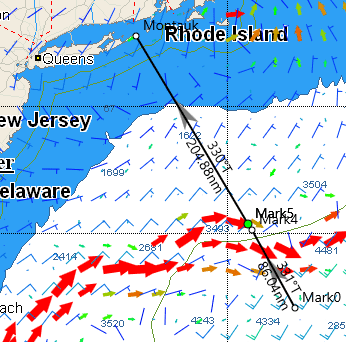
This one doesn't have the "optimized" course predicted, but the currents (Gulf Stream in Red), are shown as well as the wind feathers. You can guess what would happen if you intentionally tried to stay on the rhumb line no matter what...the Stream would set you to the East, big time. Sometimes it pays to "go with the flow", or get yourself to a point that (at the future time you get there), you'll be in a weak spot in the Stream, or even better (as we did), get yourself into an eddy that catapults you in the direction you want to go.
The software is immensely useful, not just for ocean voyages/racing, but coastal waters/inlets where tides are a major factor. The software can download all of the tide tables for any spot (or every spot) along your route and predict where you should be and when you should be there, to get to where you're going in the least amount of time. Very cool.
Posted : July 5, 2016 5:37 pm

Translate
▼
English
Spanish
French
German
Italian
Portuguese
Russian
Chinese
Japanese
Korean
Arabic
Hindi
Dutch
Polish
Turkish
Vietnamese
Thai
Swedish
Danish
Finnish
Norwegian
Czech
Hungarian
Romanian
Greek
Hebrew
Indonesian
Malay
Ukrainian
Bulgarian
Croatian
Slovak
Slovenian
Serbian
Lithuanian
Latvian
Estonian
Jealous! Although enjoyable, I don't think my weekend of canoe fishing quite matches up!
Posted : July 5, 2016 6:23 pm