Dan Patterson, post: 395803, member: 1179 wrote: NGVD 29 vs NAVD 88.......are your certain about that difference of 0.1'? I know if is different based on your location, but in my state the smallest difference I have ever seen was 0.70' and the largest was about 1.40'. Can you pull a nearby benchmark datasheet that displays the value in each datum as a check?
Actually I'm not. I used a NGS height conversion utility, which I found out isn't valid for this area.
I had a long conversation with Josh Kent at LSU C4G and he said that pretty much any benchmark in south Louisiana established before 2006 (prior to the height modernization effort) is unreliable and should not be used. So comparing old ECs to new ones is pointless. Just tell clients subsidence...
Jim in AZ, post: 395804, member: 249 wrote: You should contact FEMA and let them know that your FPA needs updating...
It was so bad after the flood. Their permit office had volunteer fire marshals from out of state come in and do half-ass inspections right after the water went down. Permit basically said dry out to x% moisture, replace sockets before installing drywall. Didn't say anything about substantial damage evaluations or anything. Eventually I believe they followed the correct process, but I promise you people got screwed over by them.

I am south of you and when the height modernization info was published we had 5 benchmarks to compare old elev. to new elev. The values dropped between 0.7' to 1.0'.
Holy Cow, post: 395805, member: 50 wrote: The old flood plain maps were based on reference monuments that were set perhaps in the 1930's my whatever method was used. Those reference monuments were golden for the old flood plain maps. However, their listed elevation and their actual 29 elevation may have never agreed but the maps were based on the listed elevation. That is part of why I issued the warning a month or two ago about being careful about GPS-derived elevations. The new elevation is probably correct and the adjustment to what the old 29 elevation should have been may be correct but that may have no relation to the listed elevations of the reference monuments used on a specific flood plain map built from those reference monuments.
While I understand the concept you're describing, the Flood Insurance Study for this area was performed in 2012. According to this study:
"Flood elevations shown in this FIS report and on the FIRM are referenced to the NAVD
88. These flood elevations must be compared to structure and ground elevations
referenced to the same vertical datum. Some of the data used in this revision were taken
from the prior effective FIS reports and FIRMs and adjusted to NAVD 88. The datum
conversion factor from NGVD 29 to NAVD 88 in Livingston Parish is ÛÒ0.07 feet.
Temporary vertical monuments are often established during the preparation of a flood
hazard analysis for the purpose of establishing local vertical control."
So all I can do is determine the current NAVD88 elevation to the best of my ability. If the benchmarks used in the flood study were suspect, that is out of my control.
Lamon Miller, post: 395846, member: 553 wrote: I am south of you and when the height modernization info was published we had 5 benchmarks to compare old elev. to new elev. The values dropped between 0.7' to 1.0'.
Perfect. Thanks!

I think I have a suggestion that no one else has given. If and of your previous elevation certificate heights were determined using static GPS data processed through OPUS as you are doing now, resubmit one of those files and see how the elevation comes back now.
I has a customer from Arkansas call shortly after Geoid 12 was released asking me about an OPUS solution that came back almost 20 feet different from what he anticipated. After chatting a while and trying not to give him a load of BS, he mentioned that he had previously did a static session on the same point that he had processed through OPUS and it had been over 19 feet different. (I don't recall whether high or low.)
I suggested he resubmit the old data that had been collected in 2007. When it came back with the new Geoid model applied, he saw about the same results as with the recently collected data. I do not know if you have such data on the same points but it would give you another point of comparison.
JerryS, post: 395853, member: 205 wrote: I think I have a suggestion that no one else has given. If and of your previous elevation certificate heights were determined using static GPS data processed through OPUS as you are doing now, resubmit one of those files and see how the elevation comes back now.
I has a customer from Arkansas call shortly after Geoid 12 was released asking me about an OPUS solution that came back almost 20 feet different from what he anticipated. After chatting a while and trying not to give him a load of BS, he mentioned that he had previously did a static session on the same point that he had processed through OPUS and it had been over 19 feet different. (I don't recall whether high or low.)
I suggested he resubmit the old data that had been collected in 2007. When it came back with the new Geoid model applied, he saw about the same results as with the recently collected data. I do not know if you have such data on the same points but it would give you another point of comparison.
I don't have any static data that old, unfortunately.
I've done some additional research on the height modernization efforts in this area. The commonly stated average rate of vertical change in this area is approximately -10mm/yr. So benchmarks established in the 70s could have subsided by 0.4m, which easily explains the 1ft difference I'm observing. Conclusions presented in NOAA technical report "Rates of Vertical Displacement at Benchmarks in the Lower Mississippi Valley and the Northern Gulf Coast", Shinkle and Dokka, July 2004 ( http://www.ngs.noaa.gov/heightmod/NOAANOSNGSTR50.pdf ), are very interesting:
1. There are no valid NAVD 88 elevation reference points in a large portion of the lower Mississippi Valley today. On the other hand, we may also have identified some areas on the periphery of this study region where vertical displacement rates are small enough to be essentially zero.
2. The old leveling data is useless for determining current elevations. The historical data, even that of only ten years ago, describes a topography and spatial relationship between benchmarks that no longer exists. Since benchmarks, even spatially adjacent benchmarks, move at different rates, their relative elevation differences have changed over time. A readjustment of old leveling data seems pointless.

Dan Patterson, post: 395803, member: 1179 wrote: NGVD 29 vs NAVD 88.......are your certain about that difference of 0.1'? I know if is different based on your location, but in my state the smallest difference I have ever seen was 0.70' and the largest was about 1.40'. Can you pull a nearby benchmark datasheet that displays the value in each datum as a check?
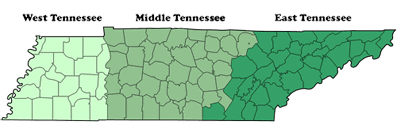
In the northeast corner of West Tennessee, the difference is about 0.14'.

"the northeast corner of West Tennessee"
I don't recall seeing West Tennessee specifically delineated on any maps commonly found at your corner gas station.:)
Mr. Cow, I believe you'll find the area Tommy is talking about if you look in the area of the intersection of the boundary between the State of Tennessee and the Commonwealth of Kentucky and the west side of the Tennessee River. Not precise, but close...
Ah. I see. So the northeastern part of West Tennessee would be near Paris, for example. My, my, my. East Tennessee is much larger than West Tennessee.

Holy Cow, post: 395990, member: 50 wrote: Ah. I see. So the northeastern part of West Tennessee would be near Paris, for example. My, my, my. East Tennessee is much larger than West Tennessee.
That's because you forgot to account for Middle Tennessee. I couldn't tell you off the top of my head where the lines run but most non-geographically challenged folks that live here know that the state is divided into three grand divisions, (East, Middle, and West). You'll see it referenced this way on the evening news, and on all things governmental.