

Larry Scott, post: 371289, member: 8766 wrote: What's the longest EDM distance you've ever shot?
About 206,852 feet.
MR0680 to MR0861 with a Cubic Electro Tape back in 1982 or 83.
Longest with a LASER, would be something over 50,000 feet (many times) with an AGA Model 78.
Ahhhh those were the days...o.O
Loyal

63800 ft slope
8500 vertical difference.
from 3 different BMs
Range master/T3
Definitely the good old days.

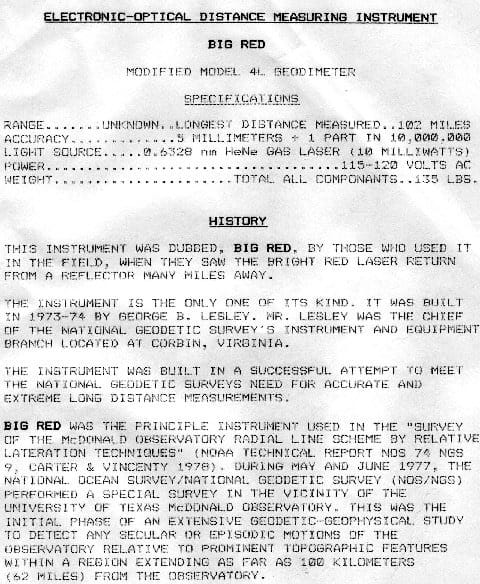
Here is the spec sheet for "Big Red" note the longest line measured: 102 miles! Heard the stories; never used it. BTW there is Technical Report describing the project on the NGS site. See: http://www.ngs.noaa.gov/PUBS_LIB/pub_alpha_list.shtml
Lots of great info and history in these publications.
Cheers,
DMM
BTW, Mr Jesse Kozlowski posted a message to him from Mr Charles Glover describing the project mentioned above. It includes a number of lovely photos of what are now known as classical geodetic techniques: https://surveyorconnect.com/threads/big-red-1977-email-from-charlie-glover.220278/

Mark O, post: 370296, member: 11591 wrote: Sorry for the newbie question, but what is an "epoch"? Is it the time period for a satellite to orbit the earth? I know it has something to do with time, lol.Also, FWIW, Shelbyville is less than 600 miles to the western portions of NY state, (per google earth) so maybe...
From Wikipedia:
"In the fields of chronology and periodization, an epoch is an instant in time chosen as the origin of a particular era. The "epoch" then serves as a reference point from which time is measured. Time measurement units are counted from the epoch so that the date and time of events can be specified unambiguously."
How it relates precisely to GPS systems, I have no idea, other than that time plays the most critical role.
Mark O, post: 370296, member: 11591 wrote: Sorry for the newbie question, but what is an "epoch"? Is it the time period for a satellite to orbit the earth? I know it has something to do with time, lol.Also, FWIW, Shelbyville is less than 600 miles to the western portions of NY state, (per google earth) so maybe...
An epoch is the time interval the user chooses to sample the GNSS signal (which is continuous). In the early days epoch intervals of 15 and 30 seconds were common defaults. Of course ASHTECH, decided on a default interval of 20 seconds. I don't know whether this decision was based on the belief that they could could provide a solution with only three epochs per minute (rather than four) or to encourage users to only use ASHTECH.
Now that memory and storage are cheap data collection intervals of 5 and even 1 second are common. The higher sampling rate means more measurements of the signal. Of course it does not allow much change in SV geometry. Given the robustness of modern integer fixing, fewer epochs are need to solve for e integer unknowns. Archiving GPS observations at high sampling rates, especially in RINEX format, remains a challenge. The Hatanaka compression software is still the tool of choice.
My old GPS professor used to say that we only need one epoch, the rest are verifying our result. Dr Yehuda Bock has devised software where positions are determined at each epoch. Search for "Epoch-epoch positioning" for more details. The Journal of Geophysical Research article describing the approach is available for free. It was written in the late 1990s. If I find the link I'll post it. A different article in the topic is here: http://geodetics.com/wp-content/uploads/2016/01/9_ITC_VectorFinal08202004.pdf
Getting back to your question, an epoch is an observation. An epoch interval is the choice of how frequently the continuous GPS signal is sampled. Only data at a common interval can be combined for the processing of observations to vectors. Tools are available to either interpolate or decimate observation data by a multiple or divisor of the collection interval. The default interval can be changed prior to data collection.
HTH,
DMM
And an epoch (a specific point in time) is also used to refer to date of the reference frame of GPS. The ITRF reference frame is temporal, continuously updated. Which is due to tectonics and their respective velocities.
The epoch of an adjustment is expressed in decimal years.
For instance from an opus solution:
REF FRAME: NAD_83(2011)
(EPOCH:2010.0000) IGS08 (EPOCH:2014.65154)
(Day 238 of 2014)
And for our purposes we hold one epoch NAD83(2011), and a new epoch will be published as NGS sees fit when errors exceed a certain noise level.
However, to determine velocities, daily epochs are used by academics, IGU, IERS. We hold on to one, and you need to know which one. And there are tools and formulary to transform older epoch positions to another.