

I guess the person is done looking for answers, and found enough. Haven't seen a latest response with any input.

Brian McEachern, post: 372486, member: 9299 wrote: I guess the person is done looking for answers, and found enough. Haven't seen a latest response with any input.
He forgot to leave his billing address:)

There are many who are much brighter than I regarding statistics.
Back when the Earth was cooling, I was at a surveying camp where a very bright professor, Bob Gunn, tried to inculcate me into higher math.
He was not overly successful as was his wont, mostly due to his student (me).
I do recall that he had statistically wrapped his head around a 'guarantee' of statistical accuracy and correctness that one could not expect +/- 0.02' agreement between parties chaining 100 feet in length even with temperature and tension handles in the mix.
Then there was another brilliant person, Benjamin Disraeli whose bon mots were:
"There are lies, damn lies and statistics".
YOS
DGG

Thank you for all the interest being taken in my question and the thoughtfulness and knowledge expressed in so many responses. I appreciate it! Please rest assured that I'm definitely not trolling. I really do just want answers. I've learned a bit about the terminology of surveying as I've researched this issue, but I realize surveying can be quite complex, which is why I'm turning to professionals to help me understand it.
Let me emphasize that I do NOT, at this point, have any reason to believe the surveyor who did the survey for the developer intentionally altered the lot measurement by 0.01' in order to allow the developer to build a three-story house. It's my impression that surveyors take pride in their profession, skills, and objectivity and one would have little to gain and much to lose from such deception (there is currently a building boom taking place in Seattle, so there is plenty of work). I've also found enough surveys online where lot widths deviate from their platted dimensions by this amount (e.g. xx.99' or xx.01') to conclude that this is a common occurrence. Finally, I've seen other surveys by the same company that performed this one and see no pattern of exaggerating lot dimensions: some are xx.00', some are xx.01', some are xx.99'. I have not actually found any other cases exactly like this (i.e. where a lot originally platted at 30' was surveyed at 30.01'), but at this point, I have no reason to believe this surveyor did anything other than act within the bounds of reasonable professional judgement to obtain this measurement. At this point, I am merely trying to understand the logic of that judgment.
I agree that, at this point, there is probably little that I or my neighbors can do to alter the course of events. Certainly, the Seattle Department of Construction and Inspections considers the matter closed, based on their emails to me. Even if we were to obtain a second survey and it showed a 30.00' lot, my sense is that it probably wouldn't change anything, because it appears that the result of the first survey reflected reasonable professional judgment of the surveyor--even if it did deviate from the original plat.
I also agree that there is a problem with our zoning law. Making a 30-foot lot width the effective cutoff point between a two and three story house when 30 feet was a common lot width for Seattle neighborhoods when originally platted seems like a poor idea. Situations like this could be avoided if the zoning law said "30 feet rounded to the nearest whole foot" or even just 31 feet.
Yes, this was a teardown. And yes, this is happening all over Seattle, as old houses are torn down and new houses replace them. I fully expected a larger house to be built when the old one was torn down, but not one as large as this. I'm posting a photo of the new house under construction so you can get a sense of the disproportion to the neighboring house.
Daniel Ralph, thank you for your detailed responses. I am aware of the Directors Rules, and had seen the one related to calculating average building height over uneven elevations. I don't think that really pertains here though, because as far as I can tell, the developer has correctly calculated the average building height.
As far as a height exception being granted because of an appropriate setback from the front property line, I don't believe that is the case here because this house actually seems to have less setback distance than required by zoning law (i.e. 20 feet). Judging by the plans, it appears to be set back only about 11 feet from the property line. However, I heard from a neighbor that they were granted a setback exception by shifting the entire house eastward in order to protect a large heritage tree at the west end of the lot.
Here are several pieces of new information:
- Today, the legal description of every property on this block is defined in terms of lots on the original plat map. Except for the northernmost lot and two lots in the center of the block (Lots 29 and 30), they are all now defined to be 40 feet wide, by allocating portions of other lots (e.g. the property of House Number 8015 is defined to be all 30 feet of Lot 24 and the northern 10 feet of Lot 23). The survey from 1981 (drawn by Brose) of House Numbers 8015 and 8019 illustrates this.
- The only two lots on the block that retain their original 30-foot widths are those of House Number 8029 (the lot in question) and 8033 (immediately to its north), corresponding to Lots 29 and 30. Which means that what will be by far the largest house on the block is currently being constructed on one of the two smallest lots on the block.
- The lot in question is zoned SF5000 (for "Single Family 5000 square feet"). But at only (approximately) 3,690 square feet, it is already undersized for a SF5000 lot.
- I searched the county recorder's office website for all surveys done on this block, but found only the three I've already posted (including the original plat). I notice none are available from about 1930 to about 1980, so they may just not have them online. It may also not be legally required to publically record surveys.
- A survey was apparently done of the property owned by House Number 8011 because it still has pins (nail in washer) set in the sidewalk in front of it. When a neighbor and I carefully measured the distance between these pins, it was exactly 40' to the center of each pin--exactly matching the measurements on the original plat as referenced in the legal description.
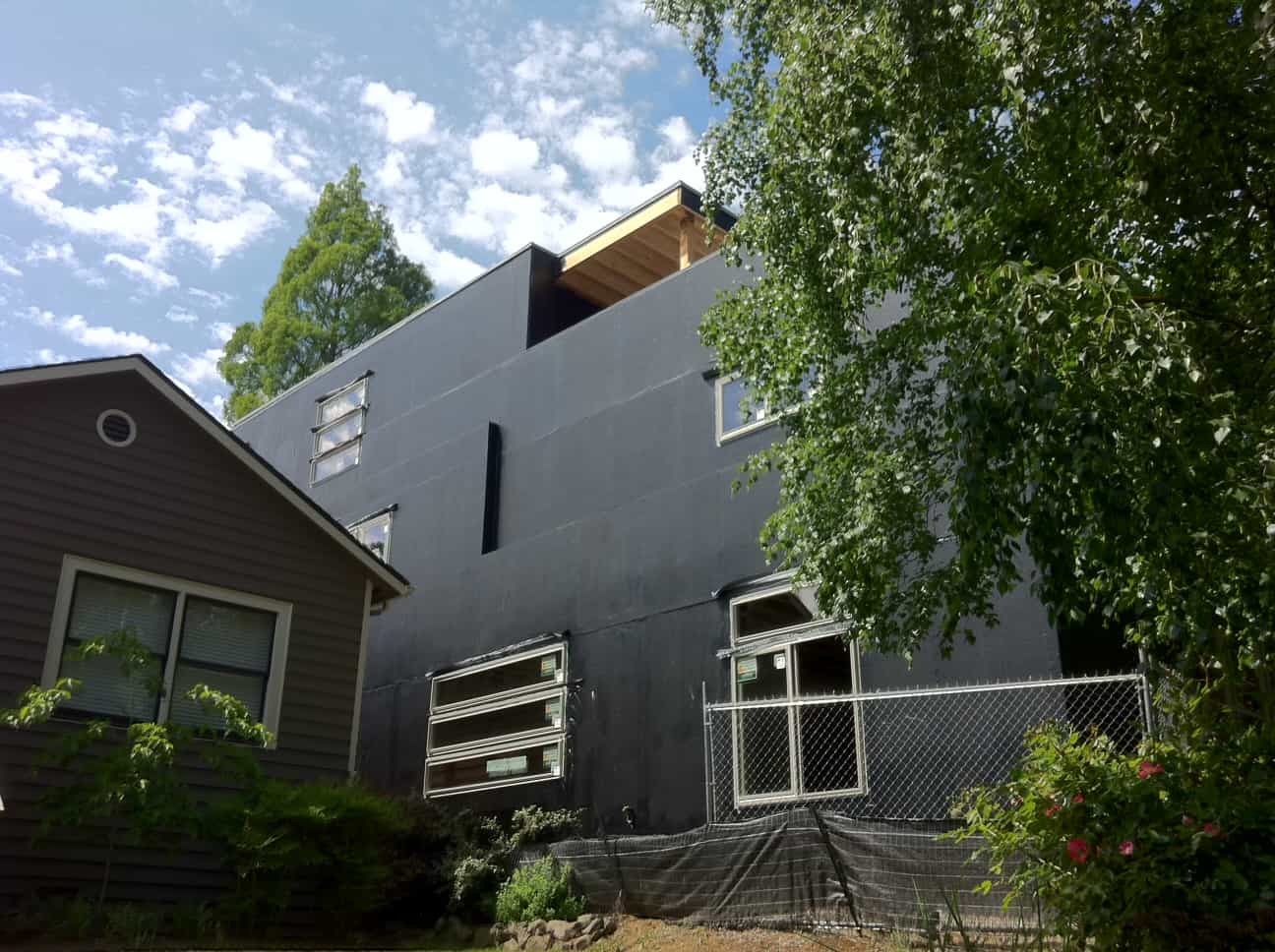
Built to the limit for sure. Not even room for siding probably, even though the contractor will put it on anyway.
It's interesting that you mention siding, because this house actually has less distance to the side property lines than required by zoning law (which is 5 feet). But my understanding is that because it was originally permitted as a remodel, they were allowed to keep the original setbacks from the side property lines. And for the first few weeks, they did in fact preserve one wall of the original house after tearing down everything else. But at some point, I believe a new permit was granted for new construction and nothing now remains of the original 880 square foot house.

I hate to say it, but "design review" would have helped that neighborhood, as in "you design something more fitting to the neighborhood, or you don't get your building permit".

Overall it sinks. It's a '30 ft' lot, exactly matching [the spirit of] the zoning reg.
When is a tree a bush?

[USER=11710]@LookingForAnswers[/USER] , I'm working on a tract right now that I miss the deed calls (plat calls) by 0.2 to 3.5 feet, BETWEEN the same corners.
The fact that you have a plat from 1907 and the deviation is 0.01 feet is miraculous in and of itself, and gives me pause to think that maybe something is amiss.
In my early days of surveying, if we were within 0.01' of the deed call, we made it the deed call. Since that time, we have evolved into showing exactly what we measured rather than what it was called to be. It was an era that was driven by mortgage inspections that I'm glad I only caught the tail end of.

It's a hard concept to get, especially for non-surveyors, that a 30' lot can measure more (or less) than 30 feet. But it was platted as a 30' lot, and that is what the planners should be calling it (that's the legal width ie: the width on the legal description).
One way some people protect themselves (if they can get it) is to get an air easement from a neighbor where they have an agreement that the neighbor can't put anything up over a certain elevation to protect their view...or access to the sun for solar panels or for whatever reason. If you get a neighbor to grant you that view easement (whatever it's called) that easement would travel with the property so that the new owner would be held to that easement.

paden cash, post: 372474, member: 20 wrote: I try to stay away from any certification on a survey that have to do with zoning ordinances. I was once asked to measure the height of a new structure. The limit as stated by ordinance was 35'. From the ground directly below to the top of the tallest chimney was 34.8' and I stated so on my survey. A neighbor hired a surveyor to measure it as opposed to the street and the building limit line...of course it was over 35' in both places.
I never got so tired of attending council meetings and listening to old wind bags argue an ambiguous ordinance.
Won't do them, nope.
[SARCASM]did any state what datum was used?[/SARCASM]
New information: I was able to scan my paper copy of the latest survey, which was done on 9/14/2015 and have attached it to this post. Because it was part of the plan set submitted to the city for permitting and made available to my neighbor when she requested it, I believe it is part of the public record. However, I have removed the name of the surveying company.
This survey also contains references to the three other recorded surveys:
1. 1907 survey (from Book 14/Page 95 of Plats)
2. 1981 survey (from Book 27/Page 254 of Plats)
3. 2007 survey (from Book 250, Pages 056-059 of Plats)

This is 110% Monday Morning Quarterbacking, but wouldn't the time to raise this very question have been when the Zoning Board (or whoever granted the permit) had their very first meeting on the subject? In most places, adjacent property owners are given legal notice, and can come to the meeting(s) to ask questions/raise concerns. Water under the bridge now.
On the bright side though, now you know that anyone on the block can do the same, just by kicking the rebar a bit before the Surveyor shows up to measure. Wouldn't take much.
If that is the survey of the lot in question, the survey shows no corners measuring 30' or even close to it. I am wondering where the .01 is coming from. I see 3 found corners and no found or set 4th. The 3 that were found were either offsets or found almost 1' off. This is typical of a crowded neighborhood with horrible fences but to narrow it down to .01, I don't see it.
How about equal treatment.
Suppose a block of 30' lots was laid out, and corners monumented with pipe with tags - original corners, with no apparent disturbance. However, some lots measure 29.95, some lots 30.05.
How could different zoning rules apply within a block?

So the 30.01 seems to be from prorating the longer measured distance against the shorter original platted distance.
Redacting the firm name doesn't help much as it's pretty easy to look up who did the work.

I live next door to what we call the Starbucks house. Flat roofed box with cement board siding fastened with stainless steel screws and painted Navy grey. However it is more than three feet from the boundary, has increased the value of my slice of the pie and I genuinely like the neighbors. Sam brews a pretty good ale and Lisa's paella is the best.
In the survey that the poster provided you note that the subject house was about three feet from the lot line before it was replaced, and it appears that the south neighbor's house (photo supplied) is only two feet which is why these two structures look to be too close together. They are. I hope the new house has cement board siding because when either of them catches fire or needs to be painted it is going to be a problem. Note how the upper area of the new house is stepped back a little bit as it goes up. This probably brings the upper levels into compliance with a portion of the setback code. Note that I said probably. I bet that the house to the south had been added onto and when doing so it also took advantage of the side yard being less than prescribed, if it was permitted at all. The house to the north appears to also be less than the prescribed five feet but the difference is probably not so photo dramatic.
New construction in residential zones have to only be set back from the street by an amount equal to the average of the neighboring structures when they are less than standard. I suppose that there may be provisions for adjusting this in order to preserve a tree under the guise of not restricting ones right to develop their lot to the fullest. Expect that the tree will die or be removed on a Sunday or holiday sometime soon.
I will not analyze the methods, style or motives of a peers work on a public forum. I appreciate the posters effort to almost entirely scrub the surveyor's name off, but there is no reason to do so. Right, Mr. Long and Mr. Hanson. We all work in the public interest and should have nothing to hide.

Same thing happened here in Salt Lake City. Complete with 'remodel' by saving one small wall, then eventual removal of that wall, further excavation and more expansion.
When the building was completed it in no way satisfied the intent of any ordinance, did not match the approved plans. When it got to the point comparable to the picture you included above, the city deemed it too late to shutdown. Was nicknamed the 'Garage Mahall' and sat empty for years:
http://www.deseretnews.com/article/600128770/Neighborhood-fights-for-identity.html?pg=all
All the controversy started several historic district designation movements:
I heard the other day that the Garage MaHall was demolished (having never been occupied) and a 'reasonable' home is being constructed there. I will drive by on the way home in 10 minutes.
So having watched this from the front porch of my sister's place (she used to live two doors east), I can say that if I lived next door (I think that would be you) I would put my home up for sale. Obviously there is a demand for it and you will be well compensated. Any time you spend fighting will be wasted. If you are successful it may take 8 years to have it removed. That is a lot of heartache with little in return.
If the resulting building is out of conformity, it might be fun to force the city to deal with it, but it will not enhance your happiness.
There are plenty of other great places to live in the West. You need to pick one and get on with your life. Whiskey may help in in the interim.
By the way, I don't think that you will like your new neighbors. But I suspect you already figured that out.
rfc, post: 372519, member: 8882 wrote: This is 110% Monday Morning Quarterbacking, but wouldn't the time to raise this very question have been when the Zoning Board (or whoever granted the permit) had their very first meeting on the subject? In most places, adjacent property owners are given legal notice, and can come to the meeting(s) to ask questions/raise concerns. Water under the bridge now.
On the bright side though, now you know that anyone on the block can do the same, just by kicking the rebar a bit before the Surveyor shows up to measure. Wouldn't take much.
Perhaps. But on the other hand, there's an excellent chance it would have made no difference at all. From the city's perspective, the survey was conducted by a licensed surveyor and the lot width measurement meets the threshold needed to build to 30 feet in height. End of story. I'm willing to accept that the surveyor acted in good faith and used reasonable professional judgment, even though the measured distance does not match the distance defined on the plat.
But to get back to my original question, what I would like to know is how surveyors usually go about measuring a lot like this one. Would they typically start from the city's survey monuments at the corners of the plat (embedded in the street intersections) and then work their way in to the lot location using measurements from the plat? Or would they typically start from the closest surveyed monuments (e.g. pins at the corners of a neighboring lot) and use those as the basis of their measurements?
Jered McGrath PLS, post: 372523, member: 794 wrote: So the 30.01 seems to be from prorating the longer measured distance against the shorter original platted distance.
But there is only a difference of 0.01' between the original platted distance (655.83') and the last surveyed measured distance (655.82')--not enough for a proration to allocate 0.01' to every lot on the block. Also, the original platted distance is slightly longer than the surveyed distance, not shorter. That is, of course, if we accept 655.83' as the original platted distance. This is the number you get if you add up all the measurements on the plat between the SE and NE corners.