

Here is one more map that the Google turned up, this one at the link below. It's a detail of a map of Warwick Township in Chester County, PA from the 1883 edition of "Breou's Official Series of Farm Maps" published by W.H. Kirk & Co..
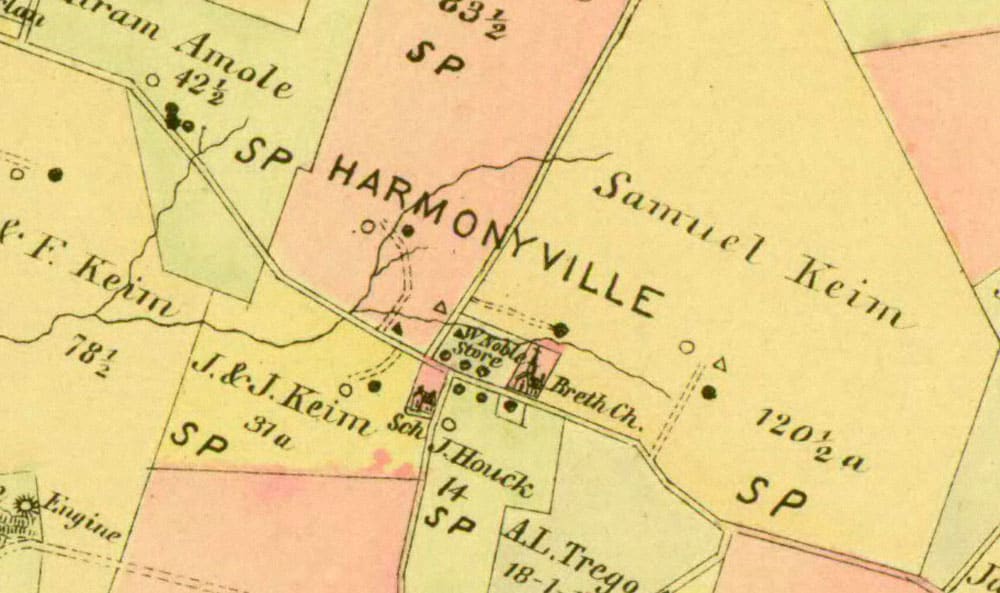
Note that the Schoolhouse labeled "Sch" is shown on place on this 1883 map and that the road that in the 1873 edition ran on the diagonal across the School tract is shown in 1883 as running along the East side of the approximately rectangular parcel the two triangles comprised, and making a dogleg at Harmonyville Road. What I get out of that is that following or contemporaneously with the purchase of the Western Triangle "B", what is now S Hill Camp Road was probably relocated to abandon the diagonal route that appears on the 1873 mapping,
Note that the names of landowners Nobles and Keim agree with the calls for adjoining owners in the description of Triangle "B"
The curving connection that exists between S Hill Camp Road and Hill Camp Road North of Harmonyville Road likely came about after 1883.
https://www.philageohistory.org/rdic-images/view-image.cfm/WHK1883.ChesterCounty.030.Warwick

As one who has dug up plenty of stones in roads, I can assure you digging a hole about 20' by 20' and two to three feet in depth is not welcomed by most owners of the roadways being torn up. Yes, that is a fairly common excavation zone when searching for monuments allegedly set over 150 years ago. Narrowing the search to a far smaller target zone is rare without some very strong information being available. Assuming anything is poor practice. Obtaining permission to excavate can be nearly impossible in certain circumstances. When permission is granted, there can be a very high cost involved in putting the road back in a manner that will satisfy the powers that be. Explaining that potential cost to the client normally removes the project from the to do list rather quickly.
Holy Cow, post: 445056, member: 50 wrote: As one who has dug up plenty of stones in roads, I can assure you digging a hole about 20' by 20' and two to three feet in depth is not welcomed by most owners of the roadways being torn up.
As a point of interest, do you own a sturdy probe with a tee-handle similar to the one that appears in the background of the photo below? It's probably among the most useful tools in my truck.
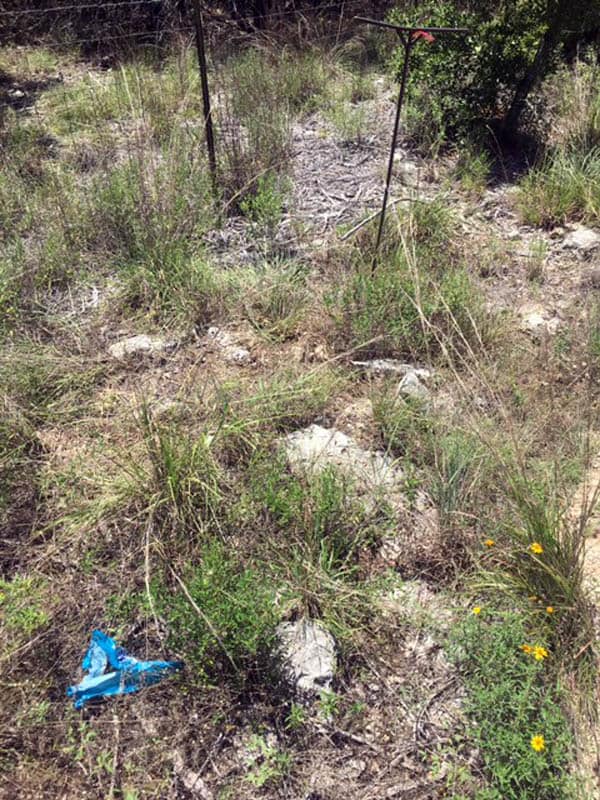
There are stones...............and then there is the correct stone. Winnowing the chaff is essential. That is impossible with a probe such as that. Would be a fool's folly to attempt to do so.
Holy Cow, post: 445066, member: 50 wrote: There are stones...............and then there is the correct stone. Winnowing the chaff is essential. That is impossible with a probe such as that. Would be a fool's folly to attempt to do so.
Well, what is the frequency of random occurence of stones of the size typically described as PLSS corners in your neck of the woods. What that means as a practical matter is in a square 20 ft. x 20 ft., how many stones of eligible size would you expect to find at a depth of about 24 inches? Would it be three or would it be fewer?

Kent McMillan, post: 445063, member: 3 wrote: As a point of interest, do you own a sturdy probe with a tee-handle similar to the one that appears in the background of the photo below? It's probably among the most useful tools in my truck.
An Estwing, no doubt.
paden cash, post: 445071, member: 20 wrote: An Estwing, no doubt.
That probe was donated to me by a plumbing company that had unintentionally left it on my premises. I kept it safe for them for awhile and then the storage fees added up so much that I sold it to myself. It's a much better probe than I've found for sale at the hardware store, and simple to make out of 1/2 in. smooth steel rod if you have a welder. If I lose that one, I'll have a welding shop make me another. The key dimension is the length of the same since a gentleman would want the handle about belt buckle height for ordinary use and you might also.

MightyMoe, post: 445050, member: 700 wrote: Help probably left the building, especially since the posted solution is to move the line closer to her house.
And that after many thousands of dollars just to give her the bad news. Can't blame her for that.
deadbeats get no respect
Kent McMillan, post: 445072, member: 3 wrote: That probe was donated to me by a plumbing company that had unintentionally left it on my premises. I kept it safe for them for awhile and then the storage fees added up so much that I sold it to myself. It's a much better probe than I've found for sale at the hardware store, and simple to make out of 1/2 in. smooth steel rod if you have a welder. If I lose that one, I'll have a welding shop make me another. The key dimension is the length of the same since a gentleman would want the handle about belt buckle height for ordinary use and you might also.
I prefer mine a wee bit shorter to allow the legs and knees to work a little more efficiently. Working with a taller probe will eventually kill your sciatic. But I can understand using a taller one, most ladies do prefer such because of their taller pelvic bone.
But now you've confused me. Do you drill a pilot hole to use your probe? You posted a few days ago (and I quote):
"I'm going to guess that you mostly work in loose soils or talus if you can drive a #6 rebar 24 inches or longer with a 3-lb. sledge. I don't see a rock drill among the field equipment, which would be needed in most of the Hill Country of Central Texas. Must be nice to have it so easy."
I'm logically assuming you either drill pilot holes to probe or only use your probe outside of the Hill Country of Central Texas...where one cannot penetrate the surface to a depth of 24" without a rock drill.
Just out of curiosity, where was your picture taken?
paden cash, post: 445077, member: 20 wrote: Do you drill a pilot hole to use your probe?
i have a hammer drill with a 5/8" x 20" bit that is perfect for punching small holes through pavement to be able to probe the subgrade. You can drill one hole and then drill holes splayed out from it. That is when the drill is used. Otherwise, in a soil that can be probed, there isn't any need for a pilot hole.
Just out of curiosity, where was your picture taken?
I took that photo within a few feet of where I snapped this one later:
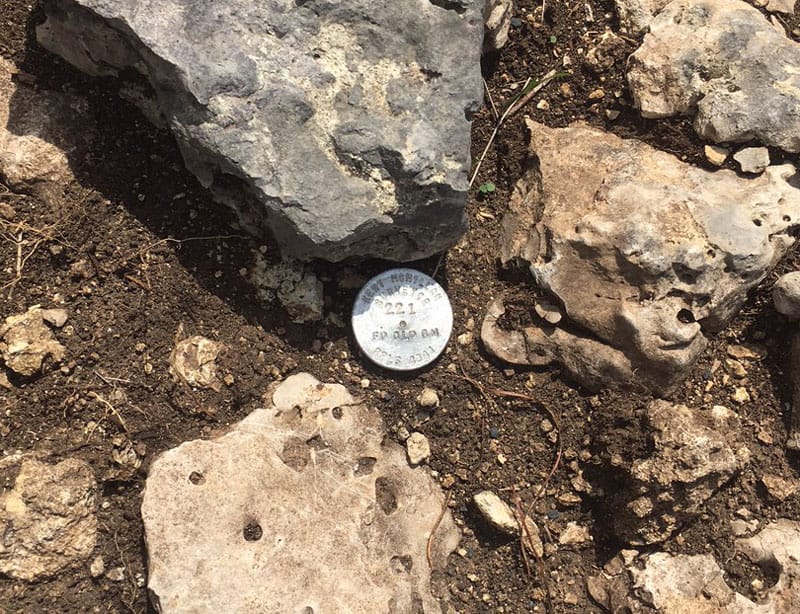
(I use the probe also for probing in shallow soils. It's an easy way to do a quick search from a standing position, which is also best when searching for post and stump holes.)
paden cash, post: 445077, member: 20 wrote: I prefer mine a wee bit shorter to allow the legs and knees to work a little more efficiently. Working with a taller probe will eventually kill your sciatic.
BTW, on the subject of probe length, you should find that the position where you can use your weight most easily works best. A skeptic could have three probes of different lengths made up and decide which worked best for various tasks. For probing locations starting about 18 inches below pavement grade through a 5/8 in. drill hole in the pavement, waist height plus about 18 inches may well work best. It would be too specialized for my general use, and the plumbers weren't accommodating enough to leave TWO probes of different lengths. Nonethelss, it would be worth finding the optimum length for probing under road pavements.
" how many stones of eligible size would you expect to find at a depth of about 24 inches?"
Anyone working this region knows the answer. Anyone not familiar with this region has absolutely no idea. Local knowledge is absolutely essential when seeking these out.
A true story from 1991. I had the client accompany me to what he thought might be his southeast corner. He asked what I was searching for. I told him a limestone rock. He replied that he had millions of them to choose from. I told him I would know it if I saw it.. As I looked out over an acre or two of ground with limestone rocks strewn everywhere, with a hundred or more of the potential size in view I pointed to one not far from a tree and said, "I think that might be it." It was the only one standing upright, happened to have a short length of pipe on the back side helping it to stay erect and had a CS carved into it.
Cover that up with a foot or two of top soil. Your probe is worthless.
Digging out potential stones is not the problem. Knowing which one is the correct one is where the surveyor applies their knowledge.
Today, I needed to leave a permanent monument near the center of a county road for a property corner. The same layer of exposed rock ran entirely across the road and was about six to 12 feet in width as it did so. Once upon a time the original road had been about two feet higher but they had cut down the hill until they hit the rock that goes to China. That could have just as easily been at a section corner or quarter corner with the soil still in place, again reducing the value of the probe to zero.

I found one like that, a lava rock among miles of lava rocks (from Mt. Lassen) everywhere. It's about 50' west of the north south fence. I was walking North along the fence when I looked over, hmm that one looks different, naw can't be that easy. I walk 10 chains north to a big blob of lava called for in the notes (15x20 feet), locate that then walk back down line until the meter hits 660'. The rock I had spotted earlier is about 5 feet further. Look at it, big 1/4 chiseled on it, in a shy almost flush stone mound. There is a row of stone mounds running north and south but those are much larger and obvious than the 1870 GLO stone mound, they once held up the fence posts running on the section line (also it is the Mt. Diablo Meridian).
Holy Cow, post: 445085, member: 50 wrote: As I looked out over an acre or two of ground with limestone rocks strewn everywhere, with a hundred or more of the potential size in view I pointed to one not far from a tree and said, "I think that might be it." It was the only one standing upright, happened to have a short length of pipe on the back side helping it to stay erect and had a CS carved into it.
Cover that up with a foot or two of top soil. Your probe is worthless.
There are a million excuses for not doing a thorough job of searching for old survey evidence. Anecdotes about stones buried under 27 ft of road fill and examples where a roadbed was basically graded out instead of built up will do fine, but shouldn't one want a larger repertoire? I mean, when another surveyor actually finds the corner in a road bed that supposedly could not be found, what's the fall-back story?

Please, Kent. While you are looking for piles of rocks that "look old" but may not be, HC and Dave are looking among a field of rocks for that singular stone set by a GLO surveyor. If like yourself, a surveyor has no experience looking for those "odd stones" that stand out from a field, hillside or mountainside of rocks, the experience is often fruitless. Both HC and Dave have that practiced eye to find a stone and you have a practiced eye to find splattered rock cairns.
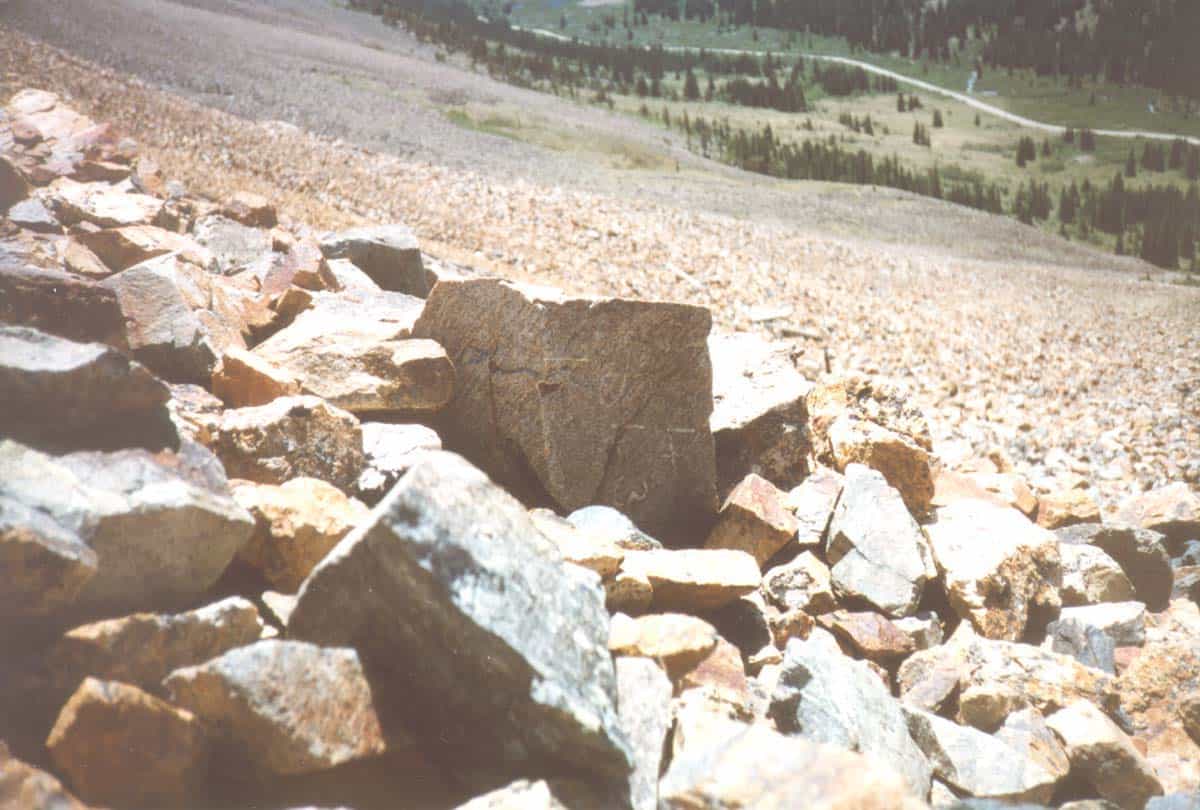
The below stone is in a large scree slope. In 1932, a mineral surveyor ran a line within 100 feet to the left of the stone and ran another line within 85 feet to the right of the stone. I'm sure he searched for the stone. The "Other Corner Descriptions" section of his field notes stated that it had been destroyed in the slide rock, a plight not uncommon in that scree slope. Some will think that I was lucky to have found it, but luck often rewards the surveyor that makes a diligent search.
Cor. No. 4 of the Magnet Lode, Sur. No. 6437, set by U.S. Deputy Mineral Surveyor W.H. Powless on August 12, 1890.
The chiseling is vertical, with the "4" for the corner number to the right and "643" of the Sur. No. 6437 in the center of the vertical face.
Gene Kooper, post: 445091, member: 9850 wrote: The below stone is in a large scree slope.
I must have missed a key bit of information in your post, Gene. What part of Kansas is that where the colors are so washed out?

Ultimately the client has to pay for the survey.
Explain how you professionaly tell the client he owes x thousands of dollars for excavation to look for a particular stone that has no identifying marks and could not be separated from a world of stones to possibly prove exactly where the original property corner might have been prior to 250 years of acquiessence and possible road relocation which point would prove to some exactitude the limits of land that the client had no beneficial use of per public rights from an original deed with a 33' misclosure.
Paul in PA

Paul in PA, post: 445100, member: 236 wrote: Ultimately the client has to pay for the survey.
Explain how you professionaly tell the client he owes x thousands of dollars for excavation to look for a particular stone that has no identifying marks and could not be separated from a world of stones to possibly prove exactly where the original property corner might have been prior to 250 years of acquiessence and possible road relocation which point would prove to some exactitude the limits of land that the client had no beneficial use of per public rights from an original deed with a 33' misclosure.
Paul in PA
There must be a way in PA to handle situations like this, a statutory way to correct boundaries in dispute without involving court action,

It'd be great to hear from any surveyors, familiar with this property.
Or, the provider of the most recent survey.
Someone licensed in the subject State.
Someone familiar with these lands.
Someone who practices the area.
N
This part.......................