Reading RPLS is free for the whole profession. Members post, reply, and get the members-only rooms.

Notifications
Clear all

Topic starter
Translate
▼
English
Spanish
French
German
Italian
Portuguese
Russian
Chinese
Japanese
Korean
Arabic
Hindi
Dutch
Polish
Turkish
Vietnamese
Thai
Swedish
Danish
Finnish
Norwegian
Czech
Hungarian
Romanian
Greek
Hebrew
Indonesian
Malay
Ukrainian
Bulgarian
Croatian
Slovak
Slovenian
Serbian
Lithuanian
Latvian
Estonian
Does anyone use mark to mark distances from GPS vectors in a ground based (scale factor = 1.0) least squares adjustment? I've checked a few mark to mark distances to slope distances on control points that were traversed through (using a total station) and the results have been well within error estimates. I'd like to hear the pros and cons of using mark to mark distances to help tie together distant legs of a traverse.
Thanks.
Posted : October 20, 2016 7:28 am

Translate
▼
English
Spanish
French
German
Italian
Portuguese
Russian
Chinese
Japanese
Korean
Arabic
Hindi
Dutch
Polish
Turkish
Vietnamese
Thai
Swedish
Danish
Finnish
Norwegian
Czech
Hungarian
Romanian
Greek
Hebrew
Indonesian
Malay
Ukrainian
Bulgarian
Croatian
Slovak
Slovenian
Serbian
Lithuanian
Latvian
Estonian
I use mark to mark slope distances as an early check, but because that slope distance is not something I directly measured, in an adjustment I use my GPS positions. That way I can use a more appropriate different precision for locations relative to elevations.
Since I know the terrain I traversed and the care used in height measurements, I will sometimes hold my GPS elevations over traversed elevations.
Paul in PA
Posted : October 20, 2016 8:02 am

Translate
▼
English
Spanish
French
German
Italian
Portuguese
Russian
Chinese
Japanese
Korean
Arabic
Hindi
Dutch
Polish
Turkish
Vietnamese
Thai
Swedish
Danish
Finnish
Norwegian
Czech
Hungarian
Romanian
Greek
Hebrew
Indonesian
Malay
Ukrainian
Bulgarian
Croatian
Slovak
Slovenian
Serbian
Lithuanian
Latvian
Estonian
I don't know how many people use ground-mark (GM) to ground-mark vectors vs. phase-center (PC) to phase-center vectors. And I would love to know what percentage of GNSS users are even using vectors to combine GPS observations and adjusting.
However, I did write a slick little tool for converting Carlson RW5 G vectors (GM to GM) to PC-PC vectors so that errant HI's can be modified. It takes a RW5 file and converts it so a GPS file suitable for import to StarNet. You can get a copy and a short user manual [ http://x9gps.com/Tools/Utilities/RW52GPS/index.html&apos ;">here ].
As far as I know, this tool has a current audience of three.
Posted : October 20, 2016 9:35 am

Translate
▼
English
Spanish
French
German
Italian
Portuguese
Russian
Chinese
Japanese
Korean
Arabic
Hindi
Dutch
Polish
Turkish
Vietnamese
Thai
Swedish
Danish
Finnish
Norwegian
Czech
Hungarian
Romanian
Greek
Hebrew
Indonesian
Malay
Ukrainian
Bulgarian
Croatian
Slovak
Slovenian
Serbian
Lithuanian
Latvian
Estonian
Mark-to-mark distances are the same on both the ellipsoid and the geoid. As such, they are the common elements between the abstract mathematical model and the on-the-ground physical reality. I adjust accordingly: mark-to-mark. Only then do I perform transformations or projections.
For Mark: Out of curiosity, does your "little tool" identify and discern between measurement error for an instrument and an antenna phase center height?
Posted : October 20, 2016 11:15 am
Translate
▼
English
Spanish
French
German
Italian
Portuguese
Russian
Chinese
Japanese
Korean
Arabic
Hindi
Dutch
Polish
Turkish
Vietnamese
Thai
Swedish
Danish
Finnish
Norwegian
Czech
Hungarian
Romanian
Greek
Hebrew
Indonesian
Malay
Ukrainian
Bulgarian
Croatian
Slovak
Slovenian
Serbian
Lithuanian
Latvian
Estonian
Nope. It just transfers the PC-PC down the HI+L1Offset to the GM. The instrument proffered G2 and G3's are kept as is.
It could, but my primary concern was fixing HI blunders. (Of course, no one ever does that.)
Posted : October 20, 2016 11:34 am
Translate
▼
English
Spanish
French
German
Italian
Portuguese
Russian
Chinese
Japanese
Korean
Arabic
Hindi
Dutch
Polish
Turkish
Vietnamese
Thai
Swedish
Danish
Finnish
Norwegian
Czech
Hungarian
Romanian
Greek
Hebrew
Indonesian
Malay
Ukrainian
Bulgarian
Croatian
Slovak
Slovenian
Serbian
Lithuanian
Latvian
Estonian
MLSchumann, post: 396168, member: 471 wrote: Mark-to-mark distances are the same on both the ellipsoid and the geoid. As such, they are the common elements between the abstract mathematical model and the on-the-ground physical reality. I adjust accordingly: mark-to-mark. Only then do I perform transformations or projections.
For Mark: Out of curiosity, does your "little tool" identify and discern between measurement error for an instrument and an antenna phase center height?
Mark to Mark distances are in the form of XYZ coordinates, they are earth centered and earth fixed. They are the absolute mathematical model and are independent from ellipsoids, geoids or any other evolved system
Mark. there are users out there that are totally unaware how a wrong antenna height can blow up a multiply observed GPS network solution. I learned the hard way, on my first network project.
Paul in PA
Posted : October 20, 2016 11:42 am

Translate
▼
English
Spanish
French
German
Italian
Portuguese
Russian
Chinese
Japanese
Korean
Arabic
Hindi
Dutch
Polish
Turkish
Vietnamese
Thai
Swedish
Danish
Finnish
Norwegian
Czech
Hungarian
Romanian
Greek
Hebrew
Indonesian
Malay
Ukrainian
Bulgarian
Croatian
Slovak
Slovenian
Serbian
Lithuanian
Latvian
Estonian
I have been a long time (30+years) advocate of mark to mark reductions. Mark to mark distances are the best format for computing and storing data. I reduce all edm distances (and zenith distances) to mark to mark. All of my comps and adjustments are done using these values. This also makes it very easy to compare GPS and EDM, no worries about whether the distances are horizontal (and at what elevation?), slope, reduced to the ellipsoid, etc. They are INDEPENDENT of ellipsoid.
Posted : October 20, 2016 12:19 pm

Translate
▼
English
Spanish
French
German
Italian
Portuguese
Russian
Chinese
Japanese
Korean
Arabic
Hindi
Dutch
Polish
Turkish
Vietnamese
Thai
Swedish
Danish
Finnish
Norwegian
Czech
Hungarian
Romanian
Greek
Hebrew
Indonesian
Malay
Ukrainian
Bulgarian
Croatian
Slovak
Slovenian
Serbian
Lithuanian
Latvian
Estonian
I'm scratching my head wondering why anyone would want to use PC-to-PC vectors for anything. I don't think I've ever done it.
Posted : October 20, 2016 3:22 pm
Translate
▼
English
Spanish
French
German
Italian
Portuguese
Russian
Chinese
Japanese
Korean
Arabic
Hindi
Dutch
Polish
Turkish
Vietnamese
Thai
Swedish
Danish
Finnish
Norwegian
Czech
Hungarian
Romanian
Greek
Hebrew
Indonesian
Malay
Ukrainian
Bulgarian
Croatian
Slovak
Slovenian
Serbian
Lithuanian
Latvian
Estonian
Jim Frame, post: 396195, member: 10 wrote: I'm scratching my head wondering why anyone would want to use PC-to-PC vectors for anything. I don't think I've ever done it.
The pc-to-pc vector is the best way to store in a data collector, for example. Then the two hi's can be used to reduce to mark-to-mark. It makes it easier to change the hi when needed. But not good for adjustments or archiving.
Posted : October 20, 2016 3:52 pm
Topic starter
Translate
▼
English
Spanish
French
German
Italian
Portuguese
Russian
Chinese
Japanese
Korean
Arabic
Hindi
Dutch
Polish
Turkish
Vietnamese
Thai
Swedish
Danish
Finnish
Norwegian
Czech
Hungarian
Romanian
Greek
Hebrew
Indonesian
Malay
Ukrainian
Bulgarian
Croatian
Slovak
Slovenian
Serbian
Lithuanian
Latvian
Estonian
Thank you all for the replies.
To John Hamilton and MLSchumann, which adjustment software do you use? I currently have access to Starnet Pro. I am assuming that the in line command utilized in Starnet would be the same as for slope distances (DV).
Also, is anyone aware of any publications available on the subject matter?
Thanks
Posted : October 20, 2016 5:47 pm
Translate
▼
English
Spanish
French
German
Italian
Portuguese
Russian
Chinese
Japanese
Korean
Arabic
Hindi
Dutch
Polish
Turkish
Vietnamese
Thai
Swedish
Danish
Finnish
Norwegian
Czech
Hungarian
Romanian
Greek
Hebrew
Indonesian
Malay
Ukrainian
Bulgarian
Croatian
Slovak
Slovenian
Serbian
Lithuanian
Latvian
Estonian
HICALS, post: 396223, member: 6788 wrote: I am assuming that the in line command utilized in Starnet would be the same as for slope distances (DV).
Star*Net Pro can import GPS vector files directly, so that you get the vector dX, dY and dZ along with the covariance or standard error/correlation associated with each.
Posted : October 20, 2016 7:06 pm
Translate
▼
English
Spanish
French
German
Italian
Portuguese
Russian
Chinese
Japanese
Korean
Arabic
Hindi
Dutch
Polish
Turkish
Vietnamese
Thai
Swedish
Danish
Finnish
Norwegian
Czech
Hungarian
Romanian
Greek
Hebrew
Indonesian
Malay
Ukrainian
Bulgarian
Croatian
Slovak
Slovenian
Serbian
Lithuanian
Latvian
Estonian
HICALS, post: 396223, member: 6788 wrote: Also, is anyone aware of any publications available on the subject matter?
If you mean dealing with GPS vectors in Star*Net, you can find a lot of information in the Star*Net Pro manual. If you don't already have it, you can probably get it by downloading the Star*Net demo.
Posted : October 20, 2016 7:09 pm
Topic starter
Translate
▼
English
Spanish
French
German
Italian
Portuguese
Russian
Chinese
Japanese
Korean
Arabic
Hindi
Dutch
Polish
Turkish
Vietnamese
Thai
Swedish
Danish
Finnish
Norwegian
Czech
Hungarian
Romanian
Greek
Hebrew
Indonesian
Malay
Ukrainian
Bulgarian
Croatian
Slovak
Slovenian
Serbian
Lithuanian
Latvian
Estonian
Jim Frame, post: 396227, member: 10 wrote: Star*Net Pro can import GPS vector files directly, so that you get the vector dX, dY and dZ along with the covariance or standard error/correlation associated with each.
I've brought in vectors exported from Leica before, for grid jobs in CCS83, and adjusted them successfully with terrestrial measurements. I was under the impression ,however, that the G1-G3 lines could only be adjusted in a grid system and not in a ground based local project. As my project is ground based, I wanted to see if there was a way to incorporate the dx, dy, dz mark to mark distance to help better connect any free legs in a traverse or improve on any overly linear error ellipse. I hope I am making sense. Thanks
Posted : October 20, 2016 9:27 pm
Translate
▼
English
Spanish
French
German
Italian
Portuguese
Russian
Chinese
Japanese
Korean
Arabic
Hindi
Dutch
Polish
Turkish
Vietnamese
Thai
Swedish
Danish
Finnish
Norwegian
Czech
Hungarian
Romanian
Greek
Hebrew
Indonesian
Malay
Ukrainian
Bulgarian
Croatian
Slovak
Slovenian
Serbian
Lithuanian
Latvian
Estonian
I would think it'd be simpler and more statistically valid to adjust the project on the grid and then export ground coordinates afterward.
Posted : October 20, 2016 9:44 pm
Topic starter
Translate
▼
English
Spanish
French
German
Italian
Portuguese
Russian
Chinese
Japanese
Korean
Arabic
Hindi
Dutch
Polish
Turkish
Vietnamese
Thai
Swedish
Danish
Finnish
Norwegian
Czech
Hungarian
Romanian
Greek
Hebrew
Indonesian
Malay
Ukrainian
Bulgarian
Croatian
Slovak
Slovenian
Serbian
Lithuanian
Latvian
Estonian
Jim Frame, post: 396228, member: 1Thanks0 wrote: If you mean dealing with GPS vectors in Star*Net, you can find a lot of information in the Star*Net Pro manual. If you don't already have it, you can probably get it by downloading the Star*Net demo.
I should have been clearer, but with regard to publications, I was referring to mark to mark distances.
Posted : October 20, 2016 9:57 pm
Topic starter
Translate
▼
English
Spanish
French
German
Italian
Portuguese
Russian
Chinese
Japanese
Korean
Arabic
Hindi
Dutch
Polish
Turkish
Vietnamese
Thai
Swedish
Danish
Finnish
Norwegian
Czech
Hungarian
Romanian
Greek
Hebrew
Indonesian
Malay
Ukrainian
Bulgarian
Croatian
Slovak
Slovenian
Serbian
Lithuanian
Latvian
Estonian
Jim Frame, post: 396257, member: 10 wrote: I would think it'd be simpler and more statistically valid to adjust the project on the grid and then export ground coordinates afterward.
That was my original plan, but then i started wondering if incorporating mark to mark distances would reduce the distortion from using the combined grid factor to go from grid to ground.
Posted : October 20, 2016 10:11 pm

Translate
▼
English
Spanish
French
German
Italian
Portuguese
Russian
Chinese
Japanese
Korean
Arabic
Hindi
Dutch
Polish
Turkish
Vietnamese
Thai
Swedish
Danish
Finnish
Norwegian
Czech
Hungarian
Romanian
Greek
Hebrew
Indonesian
Malay
Ukrainian
Bulgarian
Croatian
Slovak
Slovenian
Serbian
Lithuanian
Latvian
Estonian
HICALS, post: 396267, member: 6788 wrote: That was my original plan, but then i started wondering if incorporating mark to mark distances would reduce the distortion from using the combined grid factor to go from grid to ground.
One option, if you don't have enough conventional data to derive the elevations of all points positioned conventionally, is to pick estimates of the elevations from topographic maps. An error of 20 ft. in elevation only introduces a scale error of about 1ppm in the reduction of measured distances to grid and in many areas that elevation error should be much less. This won't be a good plain in extremely mountainout terrain, but if you are surveying in an area mapped with 10 ft. contour interval or less, it should be a snap.
Just specify the elevations of the conventional points and let the adjustment solve their horizontal coordinates.
I would myself do the adjustment in a projection such as the SPCS and, if you want to end up with surface coordinates for some reason, just transform the coordinates to some alternate system in which SF = (almost) 1.000000.
Posted : October 20, 2016 10:49 pm
Translate
▼
English
Spanish
French
German
Italian
Portuguese
Russian
Chinese
Japanese
Korean
Arabic
Hindi
Dutch
Polish
Turkish
Vietnamese
Thai
Swedish
Danish
Finnish
Norwegian
Czech
Hungarian
Romanian
Greek
Hebrew
Indonesian
Malay
Ukrainian
Bulgarian
Croatian
Slovak
Slovenian
Serbian
Lithuanian
Latvian
Estonian
HICALS: I use both geolab (for 30 years) and starnet (more recently). In either software, you can use slope distances (which is what a mark-to-mark distance is) along with HI and HT. By setting HI and HT to zero (which is what happens if you leave it out), the distance is a mark-to-mark.
As for publications, I have three books in my library that are specific to distance measurements:
1) Electronic Distance Measurement by J M Rueger; ISBN: 3-540-51523-2
2) Electronic Surveying in Theory and Practice by Simo H Laurila; ISBN: 0-471-09021-2
3) EDM Traverses-Measurement, Computation, and Adjustment by R G Bird; ISBN: 0-582-02379-3
A more recent book, which I highly recommend, has a lot of information about transforming between various coordinate systems and data types.
4) The 3-D Global Spatial Data Model-Foundation of the Spatial Data Infrastructure by Earl F Burkholder; ISBN=978-1-4200-6301-1
Hopefully Earl (who sometimes posts here) won't mind if I post a diagram from his book. The book is very usful in that it explains all of this very well, and gives formulas for all of the transformations. 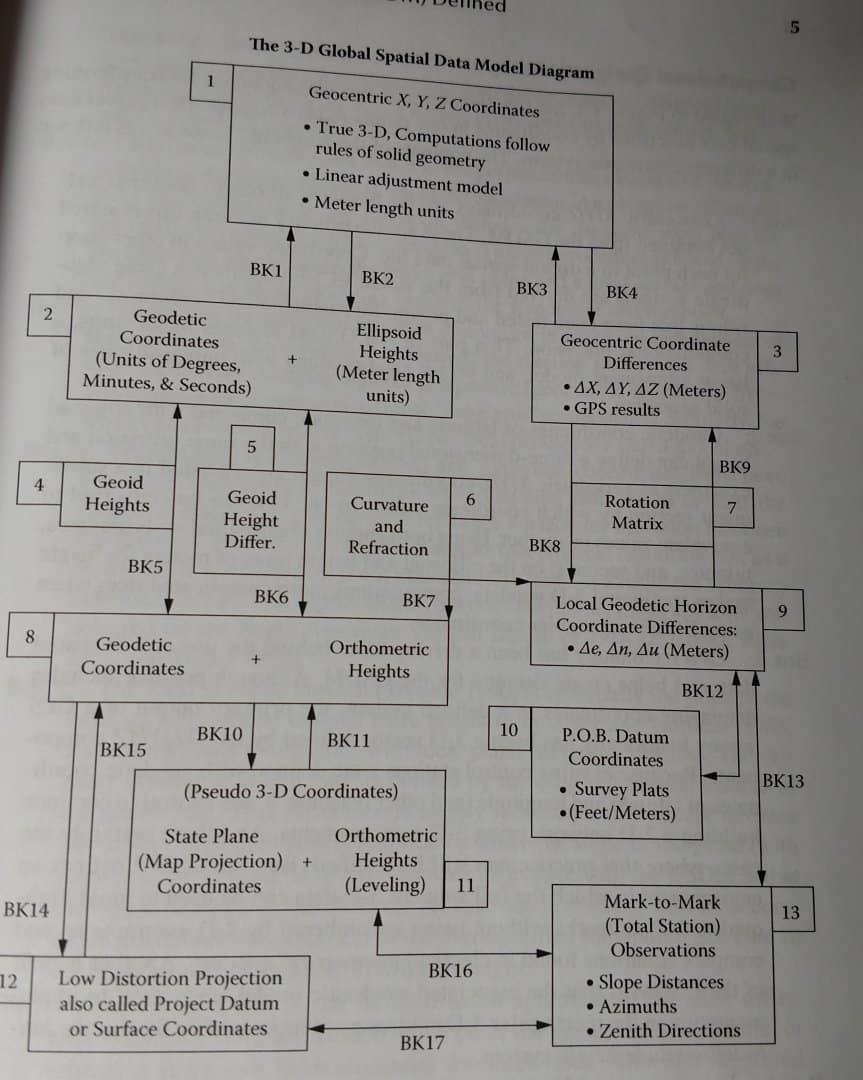
Posted : October 21, 2016 5:07 am
Translate
▼
English
Spanish
French
German
Italian
Portuguese
Russian
Chinese
Japanese
Korean
Arabic
Hindi
Dutch
Polish
Turkish
Vietnamese
Thai
Swedish
Danish
Finnish
Norwegian
Czech
Hungarian
Romanian
Greek
Hebrew
Indonesian
Malay
Ukrainian
Bulgarian
Croatian
Slovak
Slovenian
Serbian
Lithuanian
Latvian
Estonian
From a lot of post processing, I see vectors and positions not well solved from raw data and broadcast ephemeris. I could see immediate improvement if I set one point on a ground elevation, i.e. only fixing height, most often derived from USGS quads and saw immediate improvement. Some times the difference in elevation from raw to approximate control was significant.
These days I don't really look at raw positions or positions without a control point as I am sending off for OPUS ASAP and downloading ultrafast orbits. Changes these days from ultrafast to rapid orbits are in the mm range.With improvements in orbits I would expect raw to be better than in the past, but I now cut right to the chase.
Mark to mark vectors are ground to ground vectors, so if you are confident of your control point, it is not really necessary to establish other elevations for your solution. Hence mark to mark vectors being on the project elevation, they require no adjustment.
Paul in PA
Posted : October 21, 2016 5:39 am
Topic starter
Translate
▼
English
Spanish
French
German
Italian
Portuguese
Russian
Chinese
Japanese
Korean
Arabic
Hindi
Dutch
Polish
Turkish
Vietnamese
Thai
Swedish
Danish
Finnish
Norwegian
Czech
Hungarian
Romanian
Greek
Hebrew
Indonesian
Malay
Ukrainian
Bulgarian
Croatian
Slovak
Slovenian
Serbian
Lithuanian
Latvian
Estonian
John Hamilton, post: 396284, member: 640 wrote: HICALS: I use both geolab (for 30 years) and starnet (more recently). In either software, you can use slope distances (which is what a mark-to-mark distance is) along with HI and HT. By setting HI and HT to zero (which is what happens if you leave it out), the distance is a mark-to-mark.
As for publications, I have three books in my library that are specific to distance measurements:
1) Electronic Distance Measurement by J M Rueger; ISBN: 3-540-51523-2
2) Electronic Surveying in Theory and Practice by Simo H Laurila; ISBN: 0-471-09021-2
3) EDM Traverses-Measurement, Computation, and Adjustment by R G Bird; ISBN: 0-582-02379-3A more recent book, which I highly recommend, has a lot of information about transforming between various coordinate systems and data types.
4) The 3-D Global Spatial Data Model-Foundation of the Spatial Data Infrastructure by Earl F Burkholder; ISBN=978-1-4200-6301-1Hopefully Earl (who sometimes posts here) won't mind if I post a diagram from his book. The book is very usful in that it explains all of this very well, and gives formulas for all of the transformations.
Looks like Earl Burholder's book may be just what I need to expand my knowedge on the subject. Thanks for the suggestion.
Posted : October 21, 2016 7:21 am