Reading RPLS is free for the whole profession. Members post, reply, and get the members-only rooms.

Notifications
Clear all
Strictly Surveying
19
Posts
7
Users
0
Reactions
1,013
Views

Topic starter
Translate
▼
English
Spanish
French
German
Italian
Portuguese
Russian
Chinese
Japanese
Korean
Arabic
Hindi
Dutch
Polish
Turkish
Vietnamese
Thai
Swedish
Danish
Finnish
Norwegian
Czech
Hungarian
Romanian
Greek
Hebrew
Indonesian
Malay
Ukrainian
Bulgarian
Croatian
Slovak
Slovenian
Serbian
Lithuanian
Latvian
Estonian
Ongoing "Grasshopper Eduction in Process" alert....
Some time ago, I converted my practice survey to SPC. As there were no known local SPC points to use for horizontal control, I picked a point visibly close to my starting point on Google Earth, noted the Latitude and Longitude, and converted it to SPC.
The point I picked was 43-40-30.54 N x -72-34-56.98 W, and the coordinates I came up with were 428317.201 northing x 1618591.509 easting.
I wanted to check back in with some of my distant (couple thousand feet away) points traversed to, and while doing so, put the above coordinates back into this "calculator":
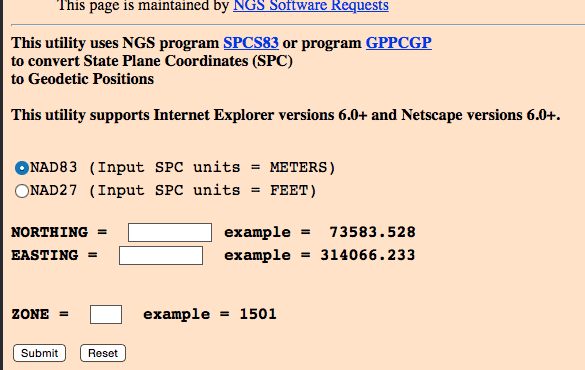
and got absolutely whacko numbers:
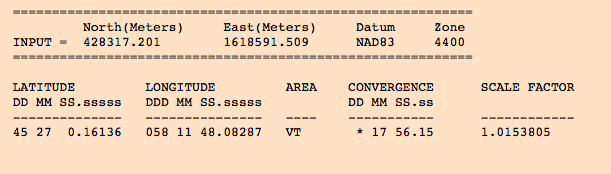
I'm seeing that by definition NAD 83 SPC units are in meters; I thought I've been dealing in US Survey feet all along, but would that error account for whatever is wrong?
How'd my survey get moved to the fishing banks off Nova Scotia?:-S:-S:-S
Posted : August 14, 2015 11:41 am

Translate
▼
English
Spanish
French
German
Italian
Portuguese
Russian
Chinese
Japanese
Korean
Arabic
Hindi
Dutch
Polish
Turkish
Vietnamese
Thai
Swedish
Danish
Finnish
Norwegian
Czech
Hungarian
Romanian
Greek
Hebrew
Indonesian
Malay
Ukrainian
Bulgarian
Croatian
Slovak
Slovenian
Serbian
Lithuanian
Latvian
Estonian
I haven't tried to repeat the calculations, but it looks at first glance like you put in feet when the button was selected for meters input.
Posted : August 14, 2015 11:52 am
Topic starter
Translate
▼
English
Spanish
French
German
Italian
Portuguese
Russian
Chinese
Japanese
Korean
Arabic
Hindi
Dutch
Polish
Turkish
Vietnamese
Thai
Swedish
Danish
Finnish
Norwegian
Czech
Hungarian
Romanian
Greek
Hebrew
Indonesian
Malay
Ukrainian
Bulgarian
Croatian
Slovak
Slovenian
Serbian
Lithuanian
Latvian
Estonian
Bill93, post: 331901, member: 87 wrote: I haven't tried to repeat the calculations, but it looks at first glance like you put in feet when the button was selected for meters input.
You have no choice in the matter. NAD83 is meters, NAD27 is feet.
I could have just screwed up the numbers when I first input them into my survey. I'm looking for the NGS, or Vermont SPC converter I first used to "go the other way".
Posted : August 14, 2015 12:44 pm

Translate
▼
English
Spanish
French
German
Italian
Portuguese
Russian
Chinese
Japanese
Korean
Arabic
Hindi
Dutch
Polish
Turkish
Vietnamese
Thai
Swedish
Danish
Finnish
Norwegian
Czech
Hungarian
Romanian
Greek
Hebrew
Indonesian
Malay
Ukrainian
Bulgarian
Croatian
Slovak
Slovenian
Serbian
Lithuanian
Latvian
Estonian
When you get coordinates on other side ofcworld, nost likely caused when you enter the Longitudinal wrong. It must have a minus sign, for West. Otherwise it assumes East Longitudinal.
Try meterss. Also check the Zone ID for Vermont.
Posted : August 14, 2015 12:53 pm
Translate
▼
English
Spanish
French
German
Italian
Portuguese
Russian
Chinese
Japanese
Korean
Arabic
Hindi
Dutch
Polish
Turkish
Vietnamese
Thai
Swedish
Danish
Finnish
Norwegian
Czech
Hungarian
Romanian
Greek
Hebrew
Indonesian
Malay
Ukrainian
Bulgarian
Croatian
Slovak
Slovenian
Serbian
Lithuanian
Latvian
Estonian
If the program wants meters, then convert your feet numbers to meters before entering.
I don't know if you have survey feet or international feet, which will make a few feet difference in the coordinate values (what did you use to get the original coordinates?), but if you divide the given coordinates by the conversion factor to meters before entering, you will get reasonable lat lon values. Using survey feet should get around 43 40 30.54200 72 34 56.97999 which is a hundred yards SE of your driveway and 25 yards SW of the middle of the highway.
Posted : August 14, 2015 1:20 pm

Translate
▼
English
Spanish
French
German
Italian
Portuguese
Russian
Chinese
Japanese
Korean
Arabic
Hindi
Dutch
Polish
Turkish
Vietnamese
Thai
Swedish
Danish
Finnish
Norwegian
Czech
Hungarian
Romanian
Greek
Hebrew
Indonesian
Malay
Ukrainian
Bulgarian
Croatian
Slovak
Slovenian
Serbian
Lithuanian
Latvian
Estonian
The general convention, as I understand it, is that State Plane Coordinates for NAD'83 is expressed in Meters, and for NAD'27 is feet.
Posted : August 14, 2015 1:28 pm
Topic starter
Translate
▼
English
Spanish
French
German
Italian
Portuguese
Russian
Chinese
Japanese
Korean
Arabic
Hindi
Dutch
Polish
Turkish
Vietnamese
Thai
Swedish
Danish
Finnish
Norwegian
Czech
Hungarian
Romanian
Greek
Hebrew
Indonesian
Malay
Ukrainian
Bulgarian
Croatian
Slovak
Slovenian
Serbian
Lithuanian
Latvian
Estonian
Bill93, post: 331931, member: 87 wrote: If the program wants meters, then convert your feet numbers to meters before entering.
I don't know if you have survey feet or international feet, which will make a few feet difference in the coordinate values (what did you use to get the original coordinates?), but if you divide the given coordinates by the conversion factor to meters before entering, you will get reasonable lat lon values. Using survey feet should get around 43 40 30.54200 72 34 56.97999 which is a hundred yards SE of your driveway and 25 yards SW of the middle of the highway.
I think you're onto it! I'm still looking for the other converter--it might have been on VT's web site, but I bet you're right...I got these numbers, entered them in my CRS dialog box; translated the survey to those coordinates, never thinking they were meters. My survey's in survey feet.
I'll make the adjustment. Thanks!
Posted : August 14, 2015 1:39 pm

Translate
▼
English
Spanish
French
German
Italian
Portuguese
Russian
Chinese
Japanese
Korean
Arabic
Hindi
Dutch
Polish
Turkish
Vietnamese
Thai
Swedish
Danish
Finnish
Norwegian
Czech
Hungarian
Romanian
Greek
Hebrew
Indonesian
Malay
Ukrainian
Bulgarian
Croatian
Slovak
Slovenian
Serbian
Lithuanian
Latvian
Estonian
rfc, post: 331938, member: 8882 wrote: I think you're onto it! I'm still looking for the other converter--it might have been on VT's web site, but I bet you're right...I got these numbers, entered them in my CRS dialog box; translated the survey to those coordinates, never thinking they were meters. My survey's in survey feet.
I'll make the adjustment. Thanks!
Lat Long puts me near highway 12 back East. I would suggest that you drop the - sign, Google knows what W is.
Posted : August 14, 2015 1:58 pm
Topic starter
Translate
▼
English
Spanish
French
German
Italian
Portuguese
Russian
Chinese
Japanese
Korean
Arabic
Hindi
Dutch
Polish
Turkish
Vietnamese
Thai
Swedish
Danish
Finnish
Norwegian
Czech
Hungarian
Romanian
Greek
Hebrew
Indonesian
Malay
Ukrainian
Bulgarian
Croatian
Slovak
Slovenian
Serbian
Lithuanian
Latvian
Estonian
Bill93, post: 331931, member: 87 wrote: If the program wants meters, then convert your feet numbers to meters before entering.
I don't know if you have survey feet or international feet, which will make a few feet difference in the coordinate values (what did you use to get the original coordinates?), but if you divide the given coordinates by the conversion factor to meters before entering, you will get reasonable lat lon values. Using survey feet should get around 43 40 30.54200 72 34 56.97999 which is a hundred yards SE of your driveway and 25 yards SW of the middle of the highway.
So, if one's survey is on State Plane Coordinates, using NAD83, which is metric, does that mean that all the field and office work now happens in meters? Is this a function of settings in the DC? Office software?
Can I pick my one point in SPC, which is in NAD83 metric Northing and Easting, convert those two numbers to Survey Feet, and then translate my entire survey, and just keep everything in feet?
Posted : August 15, 2015 12:02 pm

Translate
▼
English
Spanish
French
German
Italian
Portuguese
Russian
Chinese
Japanese
Korean
Arabic
Hindi
Dutch
Polish
Turkish
Vietnamese
Thai
Swedish
Danish
Finnish
Norwegian
Czech
Hungarian
Romanian
Greek
Hebrew
Indonesian
Malay
Ukrainian
Bulgarian
Croatian
Slovak
Slovenian
Serbian
Lithuanian
Latvian
Estonian
U.S. survey feet x 1200/3937 = meters.
This is not the same as 2.54 cm = 1 inch !!!
It makes a significant difference when converting SPC coordinates.
Posted : August 15, 2015 1:06 pm
Topic starter
Translate
▼
English
Spanish
French
German
Italian
Portuguese
Russian
Chinese
Japanese
Korean
Arabic
Hindi
Dutch
Polish
Turkish
Vietnamese
Thai
Swedish
Danish
Finnish
Norwegian
Czech
Hungarian
Romanian
Greek
Hebrew
Indonesian
Malay
Ukrainian
Bulgarian
Croatian
Slovak
Slovenian
Serbian
Lithuanian
Latvian
Estonian
Dave Karoly, post: 332007, member: 94 wrote: U.S. survey feet x 1200/3937 = meters.
This is not the same as 2.54 cm = 1 inch !!!
It makes a significant difference when converting SPC coordinates.
So, is that a "yes", lol?
All my measurements have been in feet (total station only). I guess the question I'm asking is: will the software do the math, but show all the coordinates in meters (and include the appropriate scale factors of course). Once I have one known good NAD83 coordinate, do I even need to worry about this?
Posted : August 15, 2015 3:25 pm
Translate
▼
English
Spanish
French
German
Italian
Portuguese
Russian
Chinese
Japanese
Korean
Arabic
Hindi
Dutch
Polish
Turkish
Vietnamese
Thai
Swedish
Danish
Finnish
Norwegian
Czech
Hungarian
Romanian
Greek
Hebrew
Indonesian
Malay
Ukrainian
Bulgarian
Croatian
Slovak
Slovenian
Serbian
Lithuanian
Latvian
Estonian
Keep the project in an assumed datum with units in us feet. If you don't have GPS or NGS monuments nearby, then you can not get to SPC. You are just fooling yourself and others by using fake SPC. We have to decipher through crap surveys like this all the time. It is a real pita.
You are trying to put way too many eggs in one basket. Just focus on your measurements, angle distances. No need for a residential topographic survey by a novice to be on SPC. Forget about scale factors, latitude, longitude, and meters.
Posted : August 15, 2015 3:48 pm
Topic starter
Translate
▼
English
Spanish
French
German
Italian
Portuguese
Russian
Chinese
Japanese
Korean
Arabic
Hindi
Dutch
Polish
Turkish
Vietnamese
Thai
Swedish
Danish
Finnish
Norwegian
Czech
Hungarian
Romanian
Greek
Hebrew
Indonesian
Malay
Ukrainian
Bulgarian
Croatian
Slovak
Slovenian
Serbian
Lithuanian
Latvian
Estonian
leegreen, post: 332020, member: 2332 wrote: Keep the project in an assumed datum with units in us feet. If you don't have GPS or NGS monuments nearby, then you can not get to SPC. You are just fooling yourself and others by using fake SPC. We have to decipher through crap surveys like this all the time. It is a real pita.
You are trying to put way too many eggs in one basket. Just focus on your measurements, angle distances. No need for a residential topographic survey by a novice to be on SPC. Forget about scale factors, latitude, longitude, and meters.
Great advice, Lee, but i want to learn how to do it.
I'm getting warmer though...Cayuga Lake:-D
I found the NGS site where I originally converted Lat/Long to SPC. It was here:
http://www.ngs.noaa.gov/TOOLS/spc.shtml
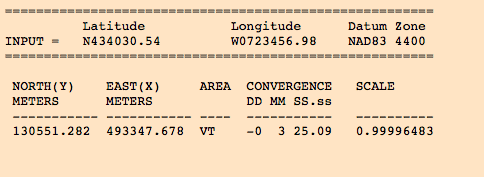
But when I moved everything, I ended up near Cayuga Lake. If nothing else, I'm getting in some armchair traveling around the north east.
I'll keep hammering away at it.
Posted : August 15, 2015 4:01 pm
Translate
▼
English
Spanish
French
German
Italian
Portuguese
Russian
Chinese
Japanese
Korean
Arabic
Hindi
Dutch
Polish
Turkish
Vietnamese
Thai
Swedish
Danish
Finnish
Norwegian
Czech
Hungarian
Romanian
Greek
Hebrew
Indonesian
Malay
Ukrainian
Bulgarian
Croatian
Slovak
Slovenian
Serbian
Lithuanian
Latvian
Estonian
If you must, then I suggest you use Google Earth.
In settings you can configure the datum and units.
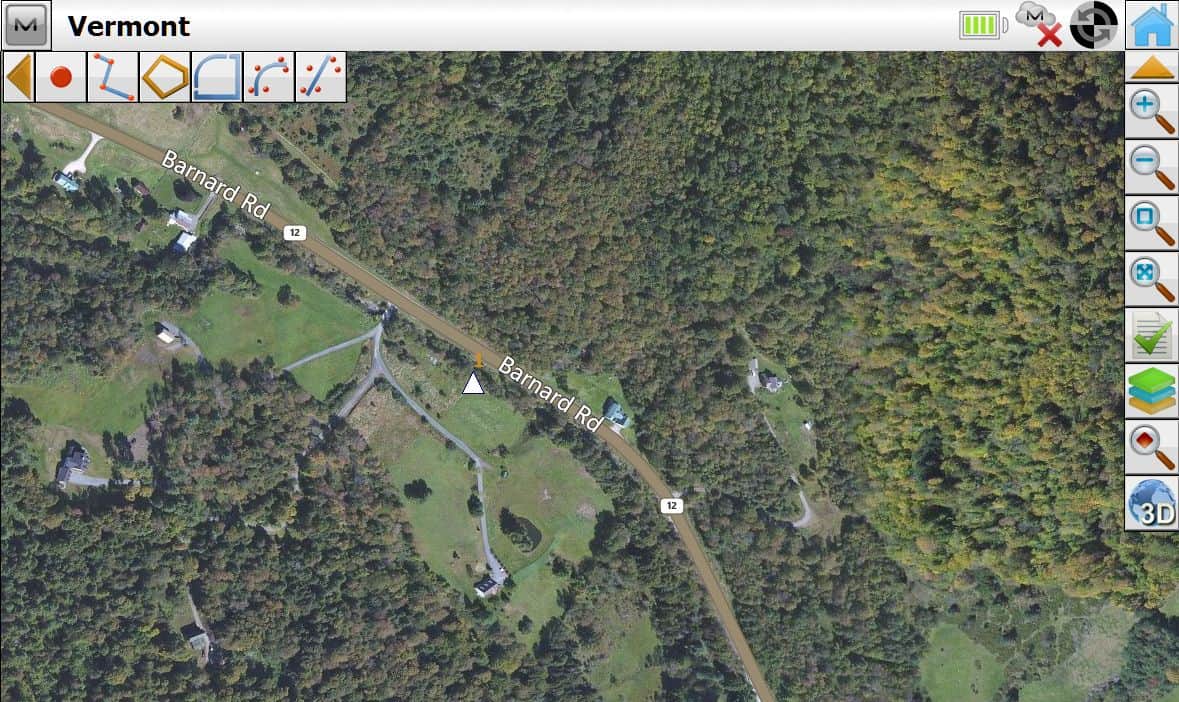
Also Magnet can convert Lat/Lon to SPC. Plus you can load Bing background map for check.
Posted : August 15, 2015 4:14 pm
Translate
▼
English
Spanish
French
German
Italian
Portuguese
Russian
Chinese
Japanese
Korean
Arabic
Hindi
Dutch
Polish
Turkish
Vietnamese
Thai
Swedish
Danish
Finnish
Norwegian
Czech
Hungarian
Romanian
Greek
Hebrew
Indonesian
Malay
Ukrainian
Bulgarian
Croatian
Slovak
Slovenian
Serbian
Lithuanian
Latvian
Estonian
This is what I come up with from your data.
Geographic Coordinates
N43å¡40'30.54"
W72å¡'34'56.98"
Cartesian Coordinates
Northing 130551.282m
Easting 493347.678m
Northing 428317.00UsFt
Easting 1618591.51UsFt
Posted : August 15, 2015 4:37 pm
Topic starter
Translate
▼
English
Spanish
French
German
Italian
Portuguese
Russian
Chinese
Japanese
Korean
Arabic
Hindi
Dutch
Polish
Turkish
Vietnamese
Thai
Swedish
Danish
Finnish
Norwegian
Czech
Hungarian
Romanian
Greek
Hebrew
Indonesian
Malay
Ukrainian
Bulgarian
Croatian
Slovak
Slovenian
Serbian
Lithuanian
Latvian
Estonian
leegreen, post: 332023, member: 2332 wrote: This is what I come up with from your data.
Geographic Coordinates
N43å¡40'30.54"
W72å¡'34'56.98"Cartesian Coordinates
Northing 130551.282m
Easting 493347.678mNorthing 428317.00UsFt
Easting 1618591.51UsFt
Lee:
That's the place. Is it as simple as taking the Coordinates in metric, converting them to feet, and using those numbers in the survey, thereafter keeping everything in feet? I'm seeing the error of my ways. I entered the coordinates in metric, expecting my software (TPC) to do everything.
I may well have to try this all in Magnet.:-)
Posted : August 15, 2015 4:48 pm
Translate
▼
English
Spanish
French
German
Italian
Portuguese
Russian
Chinese
Japanese
Korean
Arabic
Hindi
Dutch
Polish
Turkish
Vietnamese
Thai
Swedish
Danish
Finnish
Norwegian
Czech
Hungarian
Romanian
Greek
Hebrew
Indonesian
Malay
Ukrainian
Bulgarian
Croatian
Slovak
Slovenian
Serbian
Lithuanian
Latvian
Estonian
Yes. That's right.
UsFt divided by 3.2808333333 = Meters
Or
Meters X 3.280833333 = UsFt
Keep your survey in USfeet.
Posted : August 15, 2015 5:23 pm
Topic starter
Translate
▼
English
Spanish
French
German
Italian
Portuguese
Russian
Chinese
Japanese
Korean
Arabic
Hindi
Dutch
Polish
Turkish
Vietnamese
Thai
Swedish
Danish
Finnish
Norwegian
Czech
Hungarian
Romanian
Greek
Hebrew
Indonesian
Malay
Ukrainian
Bulgarian
Croatian
Slovak
Slovenian
Serbian
Lithuanian
Latvian
Estonian
That worked perfectly!
Thanks, Lee.
Posted : August 15, 2015 7:02 pm

Translate
▼
English
Spanish
French
German
Italian
Portuguese
Russian
Chinese
Japanese
Korean
Arabic
Hindi
Dutch
Polish
Turkish
Vietnamese
Thai
Swedish
Danish
Finnish
Norwegian
Czech
Hungarian
Romanian
Greek
Hebrew
Indonesian
Malay
Ukrainian
Bulgarian
Croatian
Slovak
Slovenian
Serbian
Lithuanian
Latvian
Estonian
rfc, post: 332031, member: 8882 wrote: That worked perfectly!
Thanks, Lee.
I may be repeating someone but....
Every single person on here started from scratch. Our curiosity was a big part of moving forward. Don't ever be shy about asking qusetions. Occasionally you will get a rude response from someone who forgot where they started. Let it roll off and keep asking. When they come to you hoping for a job you can see if thier attitude has improved.
Good luck, Tom
Posted : August 16, 2015 10:54 am