

A monument challenge that comes along in big pasture country relates to corner posts.......real corner posts. Many new corner posts being set around here today are about 18 inches or larger in diameter and placed in a backhoe created hole about five feet by five feet by three to four feet deep, temporarily braced and the hole filled with concrete straight out of a local ready-mix truck. This eliminates the need for a brace post in each direction fences pull off the corner post. Any existing monument within about three feet of the former corner post is going to disappear. The new post will be centered as close as possible to the location of the former post to keep the alignment of the fences true. The new corner post and concrete will be in place at lot longer than I will be around.

Holy Cow, post: 365597, member: 50 wrote: ...Many new corner posts being set around here today are about 18 inches or larger in diameter and placed in a backhoe created hole about five feet by five feet by three to four feet deep, temporarily braced and the hole filled with concrete straight out of a local ready-mix truck....
Working around the utility companies, I see a lot of pole salvage. Especially during the "tornado months". While a lot of the transmission line poles are getting replaced with the modular direct-bury galvanized steel, there are still plenty of Class 0, 1 & 2 (larger diameter) out there. Their life as utility pole may be over, but they get recycled quickly down here in cattle country.
A Class 1 70' pole can have a circumference at the bottom greater than four or five feet (a diameter of 18" to 24"). These used poles don't last long laying on the side of the road around repair work sites...some folks are even honest enough to ask for them. And I agree, they make simply wonderful corner posts. And at times, perfect "center-of-sections".
But that's only north of the Red. Apparently south of the river sturdy and massive corner posts are frowned upon. I guess the surveyors down there would go out of business if someone actually built a good stretch of fence.

paden cash, post: 365603, member: 20 wrote: A Class 1 70' pole can have a circumference at the bottom greater than four or five feet (a diameter of 18" to 24"). These used poles don't last long laying on the side of the road around repair work sites...some folks are even honest enough to ask for them. And I agree, they make simply wonderful corner posts. And at times, perfect "center-of-sections".
I do see sections of old treated pine utility poles used as fence posts. It's usually a safe bet that they are going to end up as hollow tubes of pressure-treated wood as the innards that weren't nearly as well saturated rot away, simultaneously removing any of the nails that various field parties of Einstein & Associates left in the tops of the posts over the years. Naturally, the large posts get pulled and replaced with 2.5" to 4" steel pipe posts, hopefully with field-welded braces. That leaves the ESL fence builders to choose where the "corner" moves to for the next crew from Einstein to find, unless someone has the foresight to provide otherwise.
Here is a fairly typical fence post. The wire has been salvaged and reused on some other fence. Fortunately, the post itself was not the boundary monument. An actual surveyor had left a monument that marked the corner, thus saving me from having to spend valuable screwing around with trying to determine exactly which point in cartesian space associated with some feature of the post was that intended when the boundary in question was created. I realize that if this were just a GIS-grade mapping effort, none of that would matter, but this was a boundary dispute.
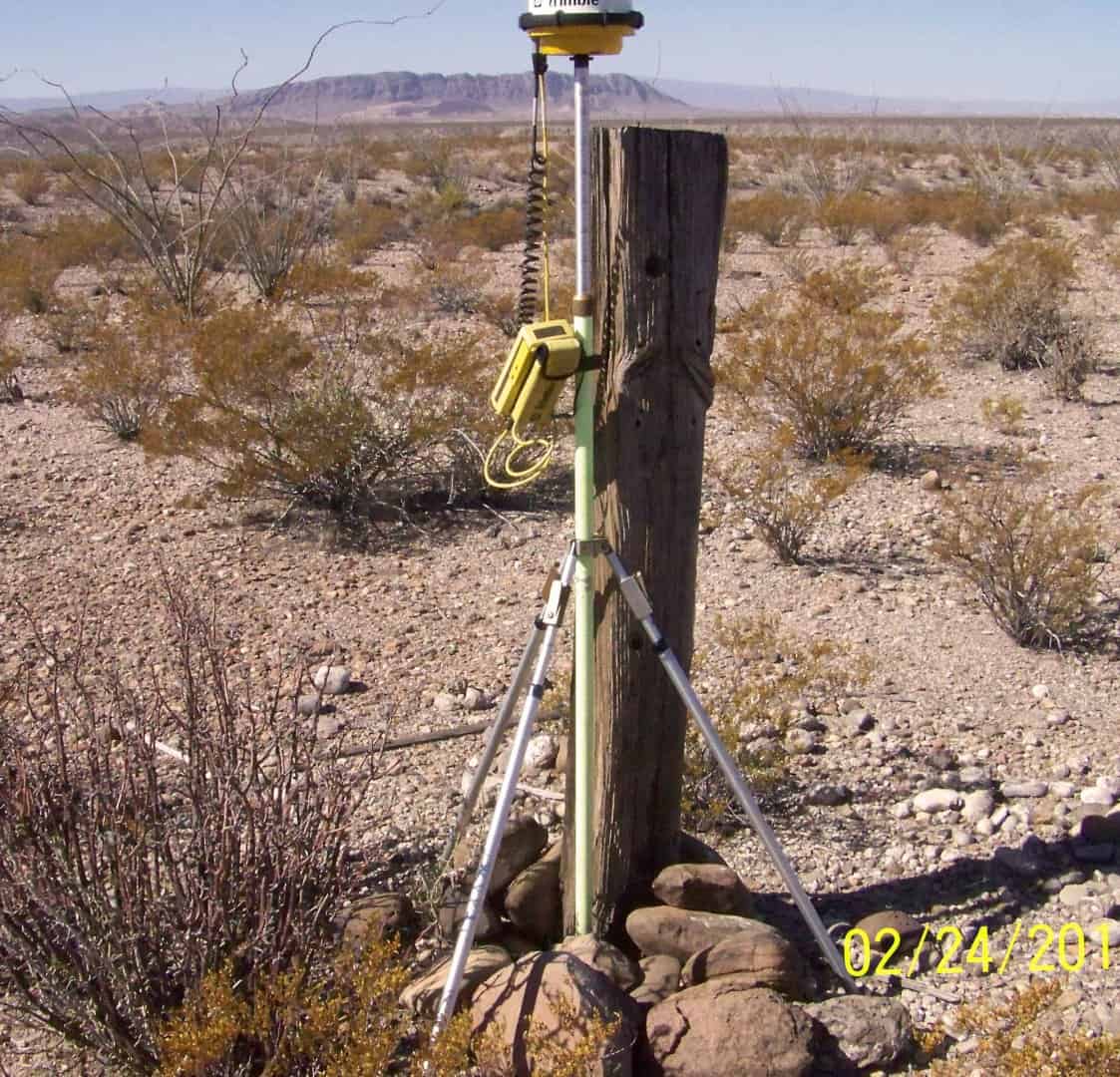
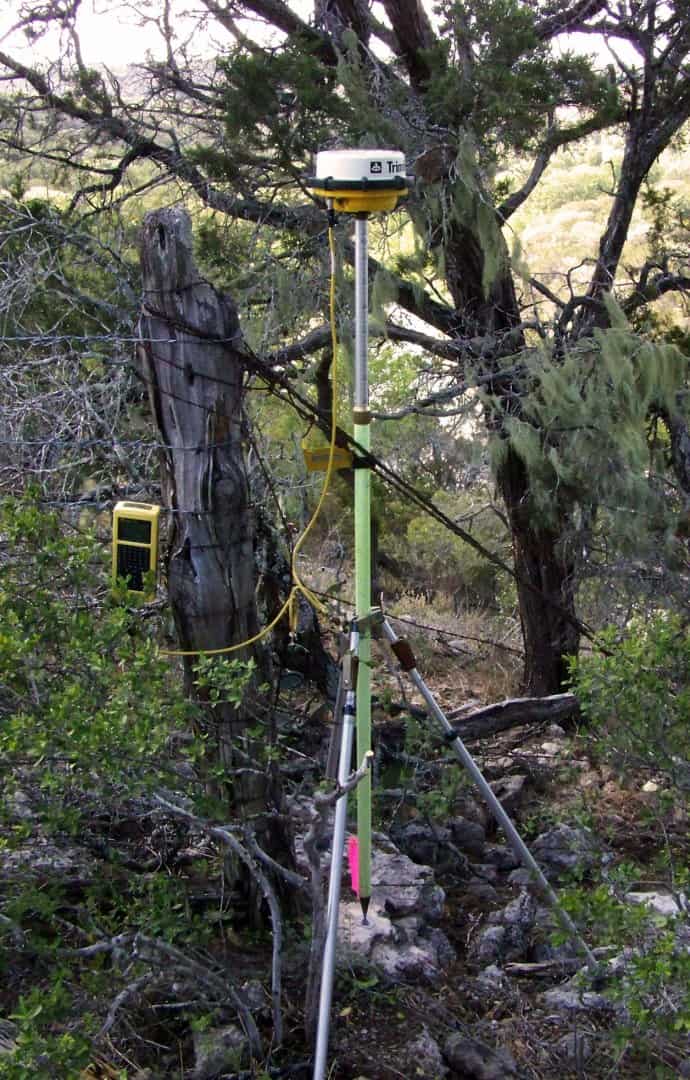
Here's another typical fence post. This one was used as a boundary monument by a surveyor who should have known better since it almost certainly looked pretty much like this when it got turned into a boundary marker after spending decades as a fence post. So, instead of him spending the time to do it, that was me figuring out where the line was and setting an actual permanent marker (the spike and washer set in a drill hole in a rock outcrop as seen in the photo) to relieve the fence post of the burden of being something for which it had no aptitude.
OMG!!!!!! PINCUSHION!!!!!!!!!!!!!!!!

Kent McMillan, post: 364991, member: 3 wrote: Well, to be a monument, a thing has to have a definite position. A 24-inch Live Oak may have made a sufficient monument for 1886, but certainly does not for 2016 since no two surveys will locate the corner marked by the tree in the same position. So, a professional surveyor would discourage landowners from wanting to create a boundary defined by ill-defined markers. Just as a professional surveyor would improve the positional uncertainty of a corner marked by a tree by adding witness or reference monuments that are free of positional ambiguity, the same problem applies to fence posts, particularly as they lean and shift out of plumb over time.
I would expect that any surveyor who has actually dealt with fence posts as boundary markers will recognize that the practical problem of how surveyors (or their help) actually locate fence posts means that as a practical matter they are not a very good choice by themselves. They need accessories to fix and define the corner in a way that defeats the multiple-guess methods for locating the post. As well, fence posts get removed in residential areas, just as they do in rural areas, so it's a very smart idea not to imagine them to be some super-permanent marking.
And therein lies the origins of the pin cushion. The called for monument is the corner, not the terminus of yours, mine or anyone else's bearing and distance. That called for 24" Live Oak carries more weight than anything a surveyor places beside it at the called for bearing and distance.
As for using the fence post as the corner, yes, if that's what they agree on then that is what I will use. If it meets the requirements for monumentation per the SC minimum standards manual then it alone will be what I use. If it doesn't (as in the case of a wooden post) then I will set reference pins that do meet those standards and note such on my plat.

This is such a wonderful discussion.
I know a surveyor who publishes his plats, rounded to the minute, and tenth. After 50 courses of that, you can accumulate a foot of error, real easily. Now, after its been calculated to 10 decimals, rounded to the tenth, rounded to the minute, run through an adjustment program, to make it close again, and we are now gonna fuss about a tenth in the middle of a post.
You see, those big posts are a good place to hide a few tenths.
And, farmer John, cares more about 100$, than 0.2 out in his salvaged 16" dia fencepost!.
Besides, it makes MORE work for the retracing surveyor, if it's all guesswork anyway!
Einstein & Associates, indeed! It's called business acumen.
0.015' Pedantry Group, meets "Good 'Nuff, & Associates".
Besides, the farmer needs a few feet of freedom, in case his neighbor won't contribute to the fence...

Regarding longevity of monuments... in my experience retracing GLO surveys in Central Oregon, marked stones make better monuments than posts.
Finding an original GLO corner post in these parts is rare; even though many were set.

Kent McMillan, post: 365606, member: 3 wrote: I do see sections of old treated pine utility poles used as fence posts. It's usually a safe bet that they are going to end up as hollow tubes of pressure-treated wood as the innards that weren't nearly as well saturated rot away, simultaneously removing any of the nails that various field parties of Einstein & Associates left in the tops of the posts over the years. Naturally, the large posts get pulled and replaced with 2.5" to 4" steel pipe posts, hopefully with field-welded braces. That leaves the ESL fence builders to choose where the "corner" moves to for the next crew from Einstein to find, unless someone has the foresight to provide otherwise.
Kent, what is an 'ESL fence builder'?

Lamon Miller, post: 365547, member: 553 wrote: a wooden fence has about a 40 year life span, that's if it's been taken care of.
I would take 40 years all day long. Last week we went back to a lot, for a new owner, we surveyed 6 years ago and out of 6 monuments "3/4" by 36" pipe" we set, only one was still existing.
I hear yah,,,,,
From your original post it looks like they want to use metal posts in concrete (I'm guessing).
Of course it's not your call at the end of the day, if the landowner wants those as their monument then that is what needs to be done.
The board doesn't get to decide, the surveyor doesn't get to decide, it's the landowners who get to decide.
I can think of any number of ways to control and mark them.
One thing I've learned is to be careful setting something near the post that isn't the actual corner (witness monuments, RM's), those tend to be used later as corners 🙁
The new fencer or new owner isn't going to the courthouse to get a record of survey he's going to see a cap and make a new line.
It's not other surveyors we survey for, it's landowners, the public and they don't care a wit about a mm's it's what they can see and touch that has meaning.
Holy Cow, post: 365611, member: 50 wrote: OMG!!!!!! PINCUSHION!!!!!!!!!!!!!!!!
Sorry, no. The line defined by the fence post was prolonged through the fence post. The line that my monument marks passes through the base of the fence post and so is just a more definite and permanent realization of the prolonged line that someone had the bad sense to use that ragged old post to mark.

Moe Shetty, post: 365630, member: 138 wrote: Kent, what is an 'ESL fence builder'?
I would think that would be a euphemism for immigrant labor fence builders in Tejas.
"cavar aquÌ?"
WGD, post: 365612, member: 8001 wrote: And therein lies the origins of the pin cushion. The called for monument is the corner, not the terminus of yours, mine or anyone else's bearing and distance. That called for 24" Live Oak carries more weight than anything a surveyor places beside it at the called for bearing and distance.
The obvious problem with the above is that in the case of the 24" Live Oak, the POSITION of the tree is the corner, not the tree. If the tree gets hit by lightning and rots to dust, the corner doesn't cease to exist. The POSITION formerly occupied by it remains the corner. So, what sort of a "monument" does something that doesn't have a definite position make? It makes no sense to agree to establish a boundary in a position supposedly defined by some object that itself would require a second boundary agreement to render certain. That was probably fine in the 19th century on rural land, but so were out houses.
As for using the fence post as the corner, yes, if that's what they agree on then that is what I will use.
How many landowners would agree to use fence posts as boundary markers if they really understood that (a) the post never should be replaced and (b) that a professional surveyor could fix the boundary to run to the POSITION of the post in a way that will survive future replacements of the post?
Moe Shetty, post: 365630, member: 138 wrote: What is an 'ESL fence builder'?
ESL = English Second Language. I suppose it could be used to describe Cajuns, too, but in Texas mostly applies to guest workers from Mexico and Guatemala.
Kent McMillan, post: 365646, member: 3 wrote: ESL = English Second Language. I suppose it could be used to describe Cajuns, too, but in Texas mostly applies to guest workers from Mexico and Guatemala.
well, all righty, then. so you can't just be a part of dialog (AND stick to the subject) without deriding others?
Moe Shetty, post: 365649, member: 138 wrote: well, all righty, then. so you can't just be a part of dialog (AND stick to the subject) without deriding others?
Hey, you were the fellow who asked what an ESL fence builder was. You're welcome.
MightyMoe, post: 365637, member: 700 wrote: It's not other surveyors we survey for, it's landowners, the public and they don't care a wit about a mm's it's what they can see and touch that has meaning.
I do realize that some surveyors work as if another surveyor will never arrive to try to figure out where the boundary of a lot is, but, amazingly enough, when there are disputes, most landowners want a professional land surveyor as an objective third party to confirm the location of the boundary of their land. An obvious fact question is whether the fence post in place is the same post, in the identical position as that described in the agreement between adjoining landowners that established the lot boundary in some specific location.
What that translates into is leaving a clear and unambiguous record of the location of the boundary of a lot that some future surveyor will be able to identify with certainty using the record left for him or her.
A landowner placed a conservation easement on his property.
The agreement between him and the easement grantee was that the easement would be contained inside his fenced pasture from angle point to angle point.
The surveyor went out and located the posts and the conservation easement was created.
Later a subdivision was done with the easement as the boundary, it was filed at the county and most of the corners are the fence posts, the county decided to waive the rules that require minimum 2" at each corner. The subdivision surveyor had no option but to accept the fence corners as the boundary, what happens years down the road? Who knows.
MightyMoe, post: 365654, member: 700 wrote: A landowner placed a conservation easement on his property.
The agreement between him and the easement grantee was that the easement would be contained inside his fenced pasture from angle point to angle point.
The surveyor went out and located the posts and the conservation easement was created.Later a subdivision was done with the easement as the boundary, it was filed at the county and most of the corners are the fence posts, the county decided to waive the rules that require minimum 2" at each corner. The subdivision surveyor had no option but to accept the fence corners as the boundary, what happens years down the road? Who knows.
The most familiar variation of that scenario would be that the fences that became the boundary of the conservation easement were surveyed by topo methods, i.e. pole up against side of post on side that doesn't lean, prism on top of leaning post, or reflectorless shot on part of post that sticks up above the brush. That was fine for an acreage calculation, but the actual point is one that is merely somewhere in the vicinity of the center of the base of the post.
Then the topo of the fenceline becomes a boundary and a mess follows from that. This isn't a purely hypothetical scenario. I've seen casually located fence posts get turned into boundary corners as an afterthought and the results are what you'd expect after a decade of what follows.