

Scotland, post: 374792, member: 559 wrote: You know... running old data through opus and compared to new data and only a few mm difference. I call that damn good with use of sats high in the sky and cors stations miles away. Better than actual traversing from a BM.
Yes, the CORS network works so well that it's been nearly twenty years since I visited a monumented horizontal control point in the NGS data base for anything other than a check on modeled elevations.
As time passes and OPUS reports solutions at different epochs, the question is how to most easily and accurately bring work that was computed at some earlier epoch to the current standard. I had thought letting OPUS do it by resubmission of old observations for a new solution to be plugged into the readjustment of the survey would be a neat way to do it, but based upon this example, just using HTDP may actually perform better.
And because I know we all like to know how these things end up, here is how I worked the problem.
I shifted the OPUS solutions at Epoch 2002.0 obtained from the observations in 2005 by 5mm North and 11mm East, which is the shift that HTDP predicts would bring them to Epoch 2010.0.
Kept the variance-covariance matrix that OPUS generated in 2005 for the solutions (using Rapid Orbits) for the shifted points and adjusted them with the two new OPUS solutions from the recent observations this month (also using Rapid Orbits).
The horizontal residuals:
355-355Day014 = 0.004 ft.
355-355Day019 = 0.003 ft.
355-355Day021 = 0.010 ft.
355-355Day149 = 0.013 ft.
355-355Day151 = 0.011 ft.
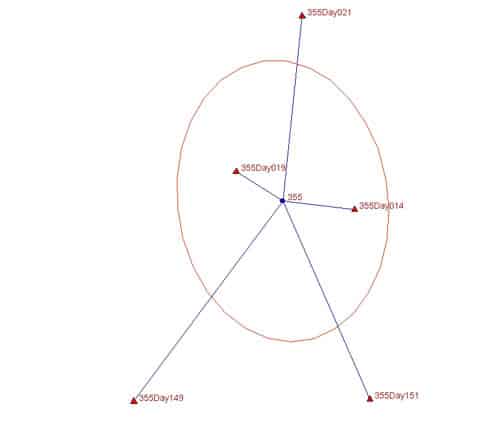
The ellipse is the 95%-confidence error ellipse of Control Point No. 355 plotted to scale. It has a semi-major axis of 0.007 ft. and a semi-minor axis of 0.005 ft. which is definitely close enough.

bay 149 is an outlier.....lol
Dane Mince, post: 374997, member: 296 wrote: bay 149 is an outlier.....lol
355Day149 was the OPUS solution based upon a short session under 3 hrs. Since uncertainty is pretty much a function of session length in OPUS Static solutions, all other things being equal, that shorter session produced a solution with more uncertainty than the solutions from more than 4 hrs. of observations. Here are the residuals:
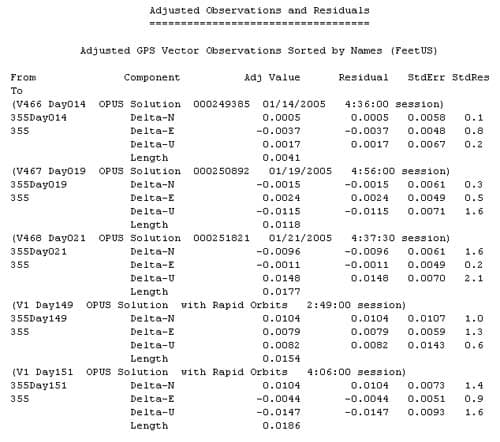

So, the standard residuals are all below 3 sigma?
So all the positions are valid for a weighted averaging?
Scott Zelenak, post: 375046, member: 327 wrote: So, the standard residuals are all below 3 sigma?
So all the positions are valid for a weighted averaging?
Yes. The vertical residuals are slightly on the high side, but the adjustment of the five positions passes the chi-squared test. The whole adjustment looks better if you assign a scale factor of 1.0 to the horizontal components of variances and 2.0 to the vertical, which isn't unreasonable in my experience. Here are the residuals from that adjustment scheme for comparison:
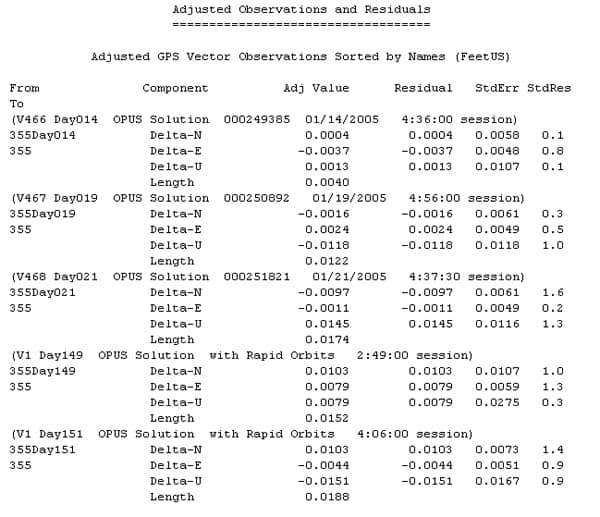
Kent McMillan, post: 375050, member: 3 wrote: Yes. The vertical residuals are slightly on the high side, but the adjustment of the five positions passes the chi-squared test. The whole adjustment looks better if you assign a scale factor of 1.0 to the horizontal components of variances and 2.0 to the vertical, which isn't unreasonable in my experience. Here are the residuals from that adjustment scheme for comparison: