Reading RPLS is free for the whole profession. Members post, reply, and get the members-only rooms.

Notifications
Clear all

Topic starter
Translate
▼
English
Spanish
French
German
Italian
Portuguese
Russian
Chinese
Japanese
Korean
Arabic
Hindi
Dutch
Polish
Turkish
Vietnamese
Thai
Swedish
Danish
Finnish
Norwegian
Czech
Hungarian
Romanian
Greek
Hebrew
Indonesian
Malay
Ukrainian
Bulgarian
Croatian
Slovak
Slovenian
Serbian
Lithuanian
Latvian
Estonian
Grasshopper needs advice again.
Background:
Currently mapping 25 acre wooded hillside; surveying control network, and doing topo. Set about learning to translate control point survey to SPC (did so successfully), but ran into trouble (I believe), moving coordinates back and forth between desktop software and DC, scale factors etc.
I was unable to close any traverses without what were on the scale of blunders (2000:1 closure ratios or less for traverses measuring 2500 feet or less), and wanted to rule out instrument errors, centering errors etc. I'm pretty sure it has to do with all the scale factors, moving stuff around etc.; I'll pick up the whole SPC thing again at some time, but in the mean time wanted to be sure there wasn't something more basic going awry either with the instrument or it's operator :angel:, so I set up a simple triangle, raw data as follows:
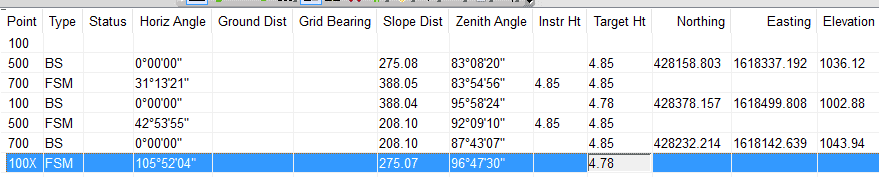
I used tripods with optical plummet prisms at all three points, set the instrument up at correct temperature and pressure, used care centering, measured heights of targets and instrument to .01 feet, etc. I did a single set BD/FD--FR/BR between each of the three points. I brought this all into the desktop software and plotted it to local (not SPC) coordinates.
Here's the error summary:

The resulting closure appears better horizontally (>10000:1). I'm using a 5" instrument. But I'm getting pretty crappy elevation closure.
Any ideas what could be causing this? Using both faces should eliminate the vertical circle error, but I'm scratching my head on what else to look for.
Posted : August 22, 2015 2:35 pm

Translate
▼
English
Spanish
French
German
Italian
Portuguese
Russian
Chinese
Japanese
Korean
Arabic
Hindi
Dutch
Polish
Turkish
Vietnamese
Thai
Swedish
Danish
Finnish
Norwegian
Czech
Hungarian
Romanian
Greek
Hebrew
Indonesian
Malay
Ukrainian
Bulgarian
Croatian
Slovak
Slovenian
Serbian
Lithuanian
Latvian
Estonian
You should read 2 faces?
Could your vertical collimation be out?
Out or not it'd be good to see what 2 faces do to your verticals.
Also reading from both ends (back and fore) should give same or very close to same.
I use both readings and mean results.
Total stations can give very accurate elevation transfers when done properly.
(your set ups are low! That'd kill my back and explain any misclose!) 😛
Posted : August 22, 2015 3:03 pm
Topic starter
Translate
▼
English
Spanish
French
German
Italian
Portuguese
Russian
Chinese
Japanese
Korean
Arabic
Hindi
Dutch
Polish
Turkish
Vietnamese
Thai
Swedish
Danish
Finnish
Norwegian
Czech
Hungarian
Romanian
Greek
Hebrew
Indonesian
Malay
Ukrainian
Bulgarian
Croatian
Slovak
Slovenian
Serbian
Lithuanian
Latvian
Estonian
Richard, post: 333073, member: 833 wrote: You should read 2 faces?
Could your vertical collimation be out?
Out or not it'd be good to see what 2 faces do to your verticals.
Also reading from both ends (back and fore) should give same or very close to same.
I use both readings and mean results.
Total stations can give very accurate elevation transfers when done properly.(your set ups are low! That'd kill my back and explain any misclose!) 😛
I've gone through the "vertical datum" setup, and never been able to get the difference very low. But I think it sees where it is on each face, and sets the zero point accordingly.
I'm still not 100% certain it's not remembering elevations from the control file that's in the data collector and using them somehow. I really can't figure out what's up. As for the low setups, I did them on purpose, lol! Lower centering errors of course.
Posted : August 22, 2015 4:30 pm

Translate
▼
English
Spanish
French
German
Italian
Portuguese
Russian
Chinese
Japanese
Korean
Arabic
Hindi
Dutch
Polish
Turkish
Vietnamese
Thai
Swedish
Danish
Finnish
Norwegian
Czech
Hungarian
Romanian
Greek
Hebrew
Indonesian
Malay
Ukrainian
Bulgarian
Croatian
Slovak
Slovenian
Serbian
Lithuanian
Latvian
Estonian
When you reduce you slope distance readings you're likely going to see one or two significant measurement errors (if i can read your table correctly) between pairs of points. I am not sure how that table is set up but, make sure you are applying the correct HIs and HRs in the correct columns
Posted : August 22, 2015 5:33 pm

Translate
▼
English
Spanish
French
German
Italian
Portuguese
Russian
Chinese
Japanese
Korean
Arabic
Hindi
Dutch
Polish
Turkish
Vietnamese
Thai
Swedish
Danish
Finnish
Norwegian
Czech
Hungarian
Romanian
Greek
Hebrew
Indonesian
Malay
Ukrainian
Bulgarian
Croatian
Slovak
Slovenian
Serbian
Lithuanian
Latvian
Estonian
Many DC routines for multiple sets per setup will record direct and indirect vertical angles.
It is always a good measure to check all instrument settings before any precise measurements.
Level bubbles for proper centering
Closing horizon for horizontal and vertical angles in direct and indirect scope positions
Check backsight and foresight distance readings at each setup.
Most modern TS have a routine that will adjust all these values considering that the instrument is adjusted within acceptable tolerances.
Using tilting prism targets is a must. Point prism directly at TS and Site the target and not the center of the prism for best results.
Do a search on this site and in the Way BAck Machine for the many discussions on this topic..........
The 4.85ft HI readings remind me of the low altitude IMen that I have worked with. 😀
:gammon:
Posted : August 22, 2015 11:55 pm
Translate
▼
English
Spanish
French
German
Italian
Portuguese
Russian
Chinese
Japanese
Korean
Arabic
Hindi
Dutch
Polish
Turkish
Vietnamese
Thai
Swedish
Danish
Finnish
Norwegian
Czech
Hungarian
Romanian
Greek
Hebrew
Indonesian
Malay
Ukrainian
Bulgarian
Croatian
Slovak
Slovenian
Serbian
Lithuanian
Latvian
Estonian
Posted : August 23, 2015 7:49 am

Translate
▼
English
Spanish
French
German
Italian
Portuguese
Russian
Chinese
Japanese
Korean
Arabic
Hindi
Dutch
Polish
Turkish
Vietnamese
Thai
Swedish
Danish
Finnish
Norwegian
Czech
Hungarian
Romanian
Greek
Hebrew
Indonesian
Malay
Ukrainian
Bulgarian
Croatian
Slovak
Slovenian
Serbian
Lithuanian
Latvian
Estonian
You need to check the vertical collimation on your instrument. It sounds like it needs adjustment, just from a quick read through your posts. I don't use SurvCE on a regular basis, so I am not familiar with it, but I do have it on one of my data collectors.
If I start getting bad vertical closures, I check the vertical collimation.
Posted : August 23, 2015 9:00 am

Translate
▼
English
Spanish
French
German
Italian
Portuguese
Russian
Chinese
Japanese
Korean
Arabic
Hindi
Dutch
Polish
Turkish
Vietnamese
Thai
Swedish
Danish
Finnish
Norwegian
Czech
Hungarian
Romanian
Greek
Hebrew
Indonesian
Malay
Ukrainian
Bulgarian
Croatian
Slovak
Slovenian
Serbian
Lithuanian
Latvian
Estonian
rfc, post: 333067, member: 8882 wrote: Grasshopper needs advice again.
Background:
Currently mapping 25 acre wooded hillside; surveying control network, and doing topo. Set about learning to translate control point survey to SPC (did so successfully), but ran into trouble (I believe), moving coordinates back and forth between desktop software and DC, scale factors etc.
I was unable to close any traverses without what were on the scale of blunders (2000:1 closure ratios or less for traverses measuring 2500 feet or less), and wanted to rule out instrument errors, centering errors etc. I'm pretty sure it has to do with all the scale factors, moving stuff around etc.; I'll pick up the whole SPC thing again at some time, but in the mean time wanted to be sure there wasn't something more basic going awry either with the instrument or it's operator :angel:, so I set up a simple triangle, raw data as follows:
I used tripods with optical plummet prisms at all three points, set the instrument up at correct temperature and pressure, used care centering, measured heights of targets and instrument to .01 feet, etc. I did a single set BD/FD--FR/BR between each of the three points. I brought this all into the desktop software and plotted it to local (not SPC) coordinates.
Here's the error summary:
The resulting closure appears better horizontally (>10000:1). I'm using a 5" instrument. But I'm getting pretty crappy elevation closure.
Any ideas what could be causing this? Using both faces should eliminate the vertical circle error, but I'm scratching my head on what else to look for.
Most vertical misses are wrong heights. Have you done a raw calculation for the traverse, just put it all down with pen paper and calculate it with sin cosine. This isn't the type of survey that needs a program. Then if it checks what the program is doing you can at least feel safe that it's field procedure.
Posted : August 23, 2015 10:40 am
Topic starter
Translate
▼
English
Spanish
French
German
Italian
Portuguese
Russian
Chinese
Japanese
Korean
Arabic
Hindi
Dutch
Polish
Turkish
Vietnamese
Thai
Swedish
Danish
Finnish
Norwegian
Czech
Hungarian
Romanian
Greek
Hebrew
Indonesian
Malay
Ukrainian
Bulgarian
Croatian
Slovak
Slovenian
Serbian
Lithuanian
Latvian
Estonian
Jimmy Cleveland, post: 333127, member: 91 wrote: You need to check the vertical collimation on your instrument. It sounds like it needs adjustment, just from a quick read through your posts. I don't use SurvCE on a regular basis, so I am not familiar with it, but I do have it on one of my data collectors.
If I start getting bad vertical closures, I check the vertical collimation.
I think you're on to it. I've never been able to successfully complete the Topcon routine...the instructions are written in some Greek dialect. I'll try again this afternoon. I do not think this is field procedure.
Posted : August 23, 2015 2:29 pm
Topic starter
Translate
▼
English
Spanish
French
German
Italian
Portuguese
Russian
Chinese
Japanese
Korean
Arabic
Hindi
Dutch
Polish
Turkish
Vietnamese
Thai
Swedish
Danish
Finnish
Norwegian
Czech
Hungarian
Romanian
Greek
Hebrew
Indonesian
Malay
Ukrainian
Bulgarian
Croatian
Slovak
Slovenian
Serbian
Lithuanian
Latvian
Estonian
Jimmy Cleveland, post: 333127, member: 91 wrote: You need to check the vertical collimation on your instrument. It sounds like it needs adjustment, just from a quick read through your posts. I don't use SurvCE on a regular basis, so I am not familiar with it, but I do have it on one of my data collectors.
If I start getting bad vertical closures, I check the vertical collimation.
I went through the routine, successfully this time, thanks to an old thread (I started), that R.L Schneider helped me out with.
The numbers didn't change much though. I got my Vertical Datum=0 down to 3", but V Co was 23'28" and now is 23' 31 sec. H Co was 13", now 10", and H Ax was 21", now 16".
I can honestly say I don't know what those numbers mean or what's good or bad. I thought I saw a diagram that explains them somewhere, but can't put my finger on it.
Perhaps someone can explain exactly what "vertical collimation" is.:-S
Posted : August 23, 2015 5:00 pm
Topic starter
Translate
▼
English
Spanish
French
German
Italian
Portuguese
Russian
Chinese
Japanese
Korean
Arabic
Hindi
Dutch
Polish
Turkish
Vietnamese
Thai
Swedish
Danish
Finnish
Norwegian
Czech
Hungarian
Romanian
Greek
Hebrew
Indonesian
Malay
Ukrainian
Bulgarian
Croatian
Slovak
Slovenian
Serbian
Lithuanian
Latvian
Estonian
R.J. Schneider, post: 333122, member: 409 wrote:
Well, I did the math manually and found that the resulting .78' bust is indeed what the angles calculate out to.
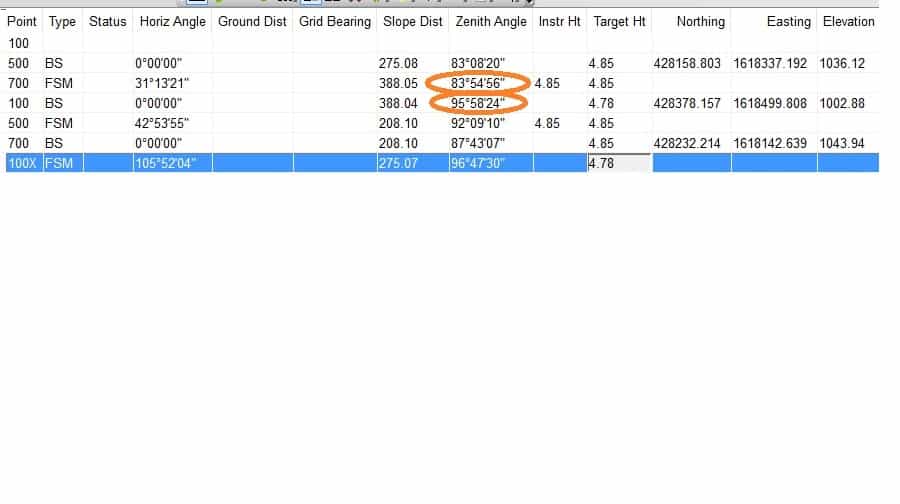
Then I added pairs of vertical angles: to 700 from 100 and to 100 from 700, to 500 from 700 and to 700 from 500 and finally to 100 from 500 and to 500 from 100 (the original back sight). These pairs should each add up to EXACTLY 180 degrees, but they don't. They're all low (less than 180). So, either there's something wrong with the instrument vertical angle calibration, or my software is not meaning the opposite face readings correctly. Finding out which is the challenge.
Posted : August 24, 2015 4:53 am

Translate
▼
English
Spanish
French
German
Italian
Portuguese
Russian
Chinese
Japanese
Korean
Arabic
Hindi
Dutch
Polish
Turkish
Vietnamese
Thai
Swedish
Danish
Finnish
Norwegian
Czech
Hungarian
Romanian
Greek
Hebrew
Indonesian
Malay
Ukrainian
Bulgarian
Croatian
Slovak
Slovenian
Serbian
Lithuanian
Latvian
Estonian
Once you think you've corrected the vertical collimation, shoot something direct (face 1) then stakeout the same point in reverse (face 2). Your cut/fill should be zero or very close to it. Try to make an observation at a distance that is within the same range as the length of your traverse legs. This will tell you right away if you've done the collimation adjustment properly and if it was, in fact, the cause of the problem.
Posted : August 24, 2015 5:40 am
Translate
▼
English
Spanish
French
German
Italian
Portuguese
Russian
Chinese
Japanese
Korean
Arabic
Hindi
Dutch
Polish
Turkish
Vietnamese
Thai
Swedish
Danish
Finnish
Norwegian
Czech
Hungarian
Romanian
Greek
Hebrew
Indonesian
Malay
Ukrainian
Bulgarian
Croatian
Slovak
Slovenian
Serbian
Lithuanian
Latvian
Estonian
I see Dan posted whilst I was messing about with this.
I'd second that.
I'd (also) suggest a simple test leg.
Set up on one end, sight to other end, record manually all details.
Instrument, target heights, horizontal and slope distance, vertical angle and height difference.
I'm assuming your instrument in total station mode can be toggled between various components in the display.
Manually calculate horizontal and vertical distance from the slope (vertical angle) and slope distance to the displayed horizontal and vertical components.
Do that on both faces.
Then repeat all from other end.
Compare results.
Calculate your vertical difference from observations at both ends.
If you chose calm, cool conditions, across ground of similar type your atmospheric issues will be negligible.
Make line 250 - 300 feet long.
That should give a good indication of your instruments capability.
I assume it has automatic compensators?
I once accidentally turned mine off, and couldn't work out why my verticals were suddenly up the creek!
With regards to instrument /target heights you could just measure up from top of legs.
Posted : August 24, 2015 5:56 am

Translate
▼
English
Spanish
French
German
Italian
Portuguese
Russian
Chinese
Japanese
Korean
Arabic
Hindi
Dutch
Polish
Turkish
Vietnamese
Thai
Swedish
Danish
Finnish
Norwegian
Czech
Hungarian
Romanian
Greek
Hebrew
Indonesian
Malay
Ukrainian
Bulgarian
Croatian
Slovak
Slovenian
Serbian
Lithuanian
Latvian
Estonian
rfc, post: 333209, member: 8882 wrote: ....Then I added pairs of vertical angles: to 700 from 100 and to 100 from 700, to 500 from 700 and to 700 from 500 and finally to 100 from 500 and to 500 from 100 (the original back sight). These pairs should each add up to EXACTLY 180 degrees, but they don't.
If your HI when you set up on 700 is the same as the HT when you aiming @ 700 (and visa-versa) you should get the vertical angles to add up to 180. (actually most instruments read zenith angle with zero being straight up, but you probably knew that. I think many of us call them "vertical" angles while knowing that they are the zenith angle.)
Do a direct and reverse zenith angle from one set up (getting an angle like 89å¡ and 271å¡ for instance) and they should add up to 360å¡. If they are short of 360 you apply a mean correction and add it to your zenith. (if it's greater than 360 subtract the mean from the zenith). What i am calling the mean is the amount you are off divided by two.
Posted : August 24, 2015 9:09 am
Topic starter
Translate
▼
English
Spanish
French
German
Italian
Portuguese
Russian
Chinese
Japanese
Korean
Arabic
Hindi
Dutch
Polish
Turkish
Vietnamese
Thai
Swedish
Danish
Finnish
Norwegian
Czech
Hungarian
Romanian
Greek
Hebrew
Indonesian
Malay
Ukrainian
Bulgarian
Croatian
Slovak
Slovenian
Serbian
Lithuanian
Latvian
Estonian
Tom Adams, post: 333237, member: 7285 wrote: If your HI when you set up on 700 is the same as the HT when you aiming @ 700 (and visa-versa) you should get the vertical angles to add up to 180. (actually most instruments read zenith angle with zero being straight up, but you probably knew that. I think many of us call them "vertical" angles while knowing that they are the zenith angle.)
Do a direct and reverse zenith angle from one set up (getting an angle like 89å¡ and 271å¡ for instance) and they should add up to 360å¡. If they are short of 360 you apply a mean correction and add it to your zenith. (if it's greater than 360 subtract the mean from the zenith). What i am calling the mean is the amount you are off divided by two.
Yes, I mistakenly said 180. they don't add up to 360. When you say "apply a mean correction and add it to your zenith", are you talking about the "compensation of systematic error" discussed in the Topcon manual? I hope so. I've got enough on my plate without having to check and double check the basic performance of the instrument, and then start applying "corrections"!
I've been looking closer at the data; I'm discovering that the software is taking the very first reading to each point, NOT the mean of the two faces. Something is definitely wrong there, so I've sent them the files to look at.
Posted : August 24, 2015 9:22 am
Translate
▼
English
Spanish
French
German
Italian
Portuguese
Russian
Chinese
Japanese
Korean
Arabic
Hindi
Dutch
Polish
Turkish
Vietnamese
Thai
Swedish
Danish
Finnish
Norwegian
Czech
Hungarian
Romanian
Greek
Hebrew
Indonesian
Malay
Ukrainian
Bulgarian
Croatian
Slovak
Slovenian
Serbian
Lithuanian
Latvian
Estonian
The machine, or software, or you should be getting the vertical (zenith) angle by meaning the direct or reverse. Maybe that is what is discussed in the topcon manual, I don't know. I am sure you can adjust this out, but even if you didn't, getting the mean of the two angles should you there. The better the instrument is levelled the closer the angles should add up to 360å¡.
I wonder if there is a setting in the software where you tell it you want it to mean the angles.
Posted : August 24, 2015 9:44 am
Topic starter
Translate
▼
English
Spanish
French
German
Italian
Portuguese
Russian
Chinese
Japanese
Korean
Arabic
Hindi
Dutch
Polish
Turkish
Vietnamese
Thai
Swedish
Danish
Finnish
Norwegian
Czech
Hungarian
Romanian
Greek
Hebrew
Indonesian
Malay
Ukrainian
Bulgarian
Croatian
Slovak
Slovenian
Serbian
Lithuanian
Latvian
Estonian
Tom Adams, post: 333247, member: 7285 wrote: The machine, or software, or you should be getting the vertical (zenith) angle by meaning the direct or reverse. Maybe that is what is discussed in the topcon manual, I don't know. I am sure you can adjust this out, but even if you didn't, getting the mean of the two angles should you there. The better the instrument is levelled the closer the angles should add up to 360å¡.
I wonder if there is a setting in the software where you tell it you want it to mean the angles.
Tom:
Sorry for not being clearer. There are three components involved here: 1. The instrument, 2. SurvCE, 3. Desktop software (TraversePC).
First, with the instrument, there are two adjustments that seem to be relevant: "Vertical Datum=0", and "Compensation of Systematic Error". I've done those.
Second, SurvCE is meaning the Direct and Reverse observations, and outputting them as a "comment" or "note" record. That said...
Traverse PC seems to be (or should be) ignoring the SurvCE math and doing it itself, with the BD, FD, FR and BR records. I'm suspecting it's not doing that correctly, or possibly some setting is not correctly set for reading the .rw5 from the DC.
That part would be dead simple to prove by looking at the .rw5 with some other software. I can't post one here, but if anyone's interested in taking a look, I could email it. (or cut and paste the text; It's only one page long).
Posted : August 24, 2015 10:06 am
Translate
▼
English
Spanish
French
German
Italian
Portuguese
Russian
Chinese
Japanese
Korean
Arabic
Hindi
Dutch
Polish
Turkish
Vietnamese
Thai
Swedish
Danish
Finnish
Norwegian
Czech
Hungarian
Romanian
Greek
Hebrew
Indonesian
Malay
Ukrainian
Bulgarian
Croatian
Slovak
Slovenian
Serbian
Lithuanian
Latvian
Estonian
I wouldn't know enough to look @ the software printout. These days you certainly have to know what you're doing. Sometimes numbers get reduced in a data collector and reduced again in the software. Also knowing if you shooting raw distances or if some settings are doing a reduction before you get your readings. My little brain likes the simple angles and raw slope distances up front.
I'm sure someone will look @ that for you. A lot of guys here really know their (er) poop.
Posted : August 24, 2015 11:22 am
Topic starter
Translate
▼
English
Spanish
French
German
Italian
Portuguese
Russian
Chinese
Japanese
Korean
Arabic
Hindi
Dutch
Polish
Turkish
Vietnamese
Thai
Swedish
Danish
Finnish
Norwegian
Czech
Hungarian
Romanian
Greek
Hebrew
Indonesian
Malay
Ukrainian
Bulgarian
Croatian
Slovak
Slovenian
Serbian
Lithuanian
Latvian
Estonian
Tom Adams, post: 333262, member: 7285 wrote: I wouldn't know enough to look @ the software printout. These days you certainly have to know what you're doing. Sometimes numbers get reduced in a data collector and reduced again in the software. Also knowing if you shooting raw distances or if some settings are doing a reduction before you get your readings. My little brain likes the simple angles and raw slope distances up front.
I'm sure someone will look @ that for you. A lot of guys here really know their (er) poop.
I would think that someone running Carlson could take a Carlson SurvCE .rw5 without problems that the software might be doing something it shouldn't be, or at least warning you that the DC did something first before the desktop software gets it.
Posted : August 24, 2015 5:38 pm

Translate
▼
English
Spanish
French
German
Italian
Portuguese
Russian
Chinese
Japanese
Korean
Arabic
Hindi
Dutch
Polish
Turkish
Vietnamese
Thai
Swedish
Danish
Finnish
Norwegian
Czech
Hungarian
Romanian
Greek
Hebrew
Indonesian
Malay
Ukrainian
Bulgarian
Croatian
Slovak
Slovenian
Serbian
Lithuanian
Latvian
Estonian
Late to the party but rfc, it strikes me that you're going about this all wrong for a grasshopper by depending too much on software. The best way to learn this stuff is to go old school and book everything, horizontal & vertical, direct and reverse, slope distances, ect. and reduce them using a calculator and sin/cos. You'll quickly learn by meaning angles and closing the horizon how to get a tight traverse on the first go around by spotting the errors whilst you are collecting the data. If you do a back sight check measurement and find a misclosure, that is the time to repeat your measurements rather than resorting to a detailed analysis of all your data trying to pinpoint the problem. (Deep sigh) Grasshopper must master the basics before moving on to scale factors and mapping angles. I'm afraid you have the cart on the wrong end of the horse my friend.
Just because I'm paranoid, doesn't mean they aren't out to get me.
Posted : August 24, 2015 7:23 pm
Page 1 / 5
Next