Reading RPLS is free for the whole profession. Members post, reply, and get the members-only rooms.

Notifications
Clear all

Topic starter
Translate
▼
English
Spanish
French
German
Italian
Portuguese
Russian
Chinese
Japanese
Korean
Arabic
Hindi
Dutch
Polish
Turkish
Vietnamese
Thai
Swedish
Danish
Finnish
Norwegian
Czech
Hungarian
Romanian
Greek
Hebrew
Indonesian
Malay
Ukrainian
Bulgarian
Croatian
Slovak
Slovenian
Serbian
Lithuanian
Latvian
Estonian
Today was the day when I dug four holes in four locations spread out over about six miles and with mixed results. The success rate was 50% overall, which isn't that bad given the nature of the problem, i.e. sitting in the office, making very good guesses about where old boundary evidence was to be found and then going out into the field to see what, if anything, was actually there.
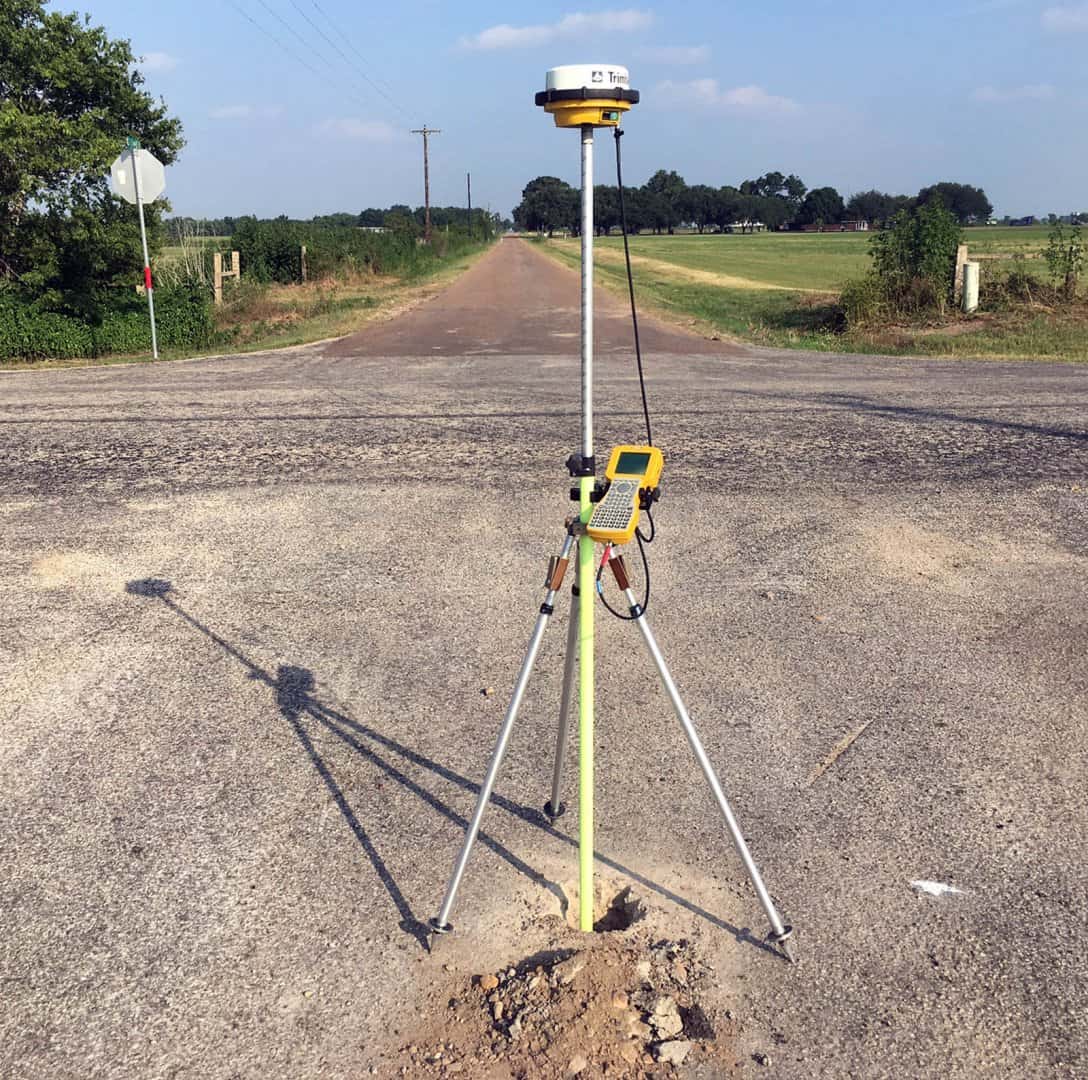
The spot of white paint on the asphalt pavement was where my initial guess was that I'd find one particular old monument on the county line placed in 1951 by the Wharton County Surveyor and described by him as "an eight inch in diameter concrete post buried in the center of two intersecting public roads". One of the roads that in 1951 had been a fifty-foot wide county road was now a 100-foot wide State Highway, but I had concluded that one line of the present right-of-way was a line of the original right-of-way of the former county road.
A quick sweep with the metal detector provided a correction and then it was me with digging bar chopping through what turned out to be 8 inches of road pavement, a couple of inches of hot-mix asphalt and the rest compacted crushed limestone road base. Unfortunately, the magnetic signature that sounded so definitely centered that I didn't cut a large hole in the road pavement turned out to be misinformation. I ended up cutting a hole the size of a small dinner plate and still missed the center of the monument slightly.
Naturally, this all took place in the hot end of the afternoon when the heat index was around 105?øF. Add in the three folks driving past who stopped to wonder what I was doing, all of whom seemed amazed to know that there was a marker on the county line just outside the windows of their vehicles, and some of whom asked "How did you FIND that?". I told them about the marker nominally six miles away from which I'd calculated the location, and even showed one guy a picture of that more distant marker on my iPhone, which he proceeded to try to take a photo of with his iPhone.
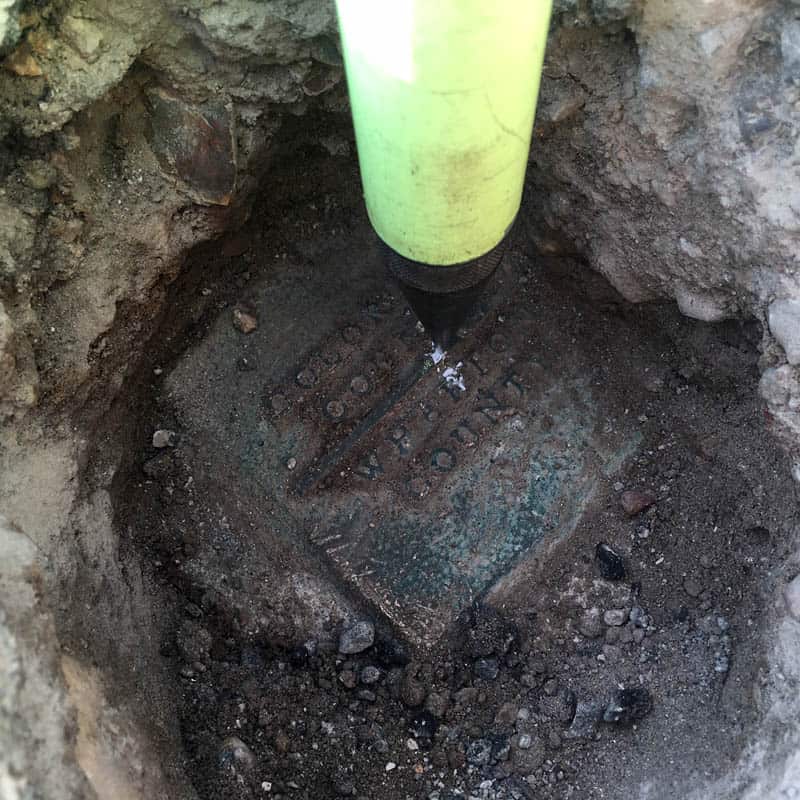
At some point, when the afternoon heat peaked, a cup of cool water on my head sounded better than continuing to chop away at the pavement with the digging bar. Afterwards, as the peak subsided to only 100?øF and falling, the further work that was required to actually uncover the bronze tablet that appears in the next photo seemed both reasonable and even possible.
Posted : June 23, 2017 11:24 pm
Topic starter
Translate
▼
English
Spanish
French
German
Italian
Portuguese
Russian
Chinese
Japanese
Korean
Arabic
Hindi
Dutch
Polish
Turkish
Vietnamese
Thai
Swedish
Danish
Finnish
Norwegian
Czech
Hungarian
Romanian
Greek
Hebrew
Indonesian
Malay
Ukrainian
Bulgarian
Croatian
Slovak
Slovenian
Serbian
Lithuanian
Latvian
Estonian
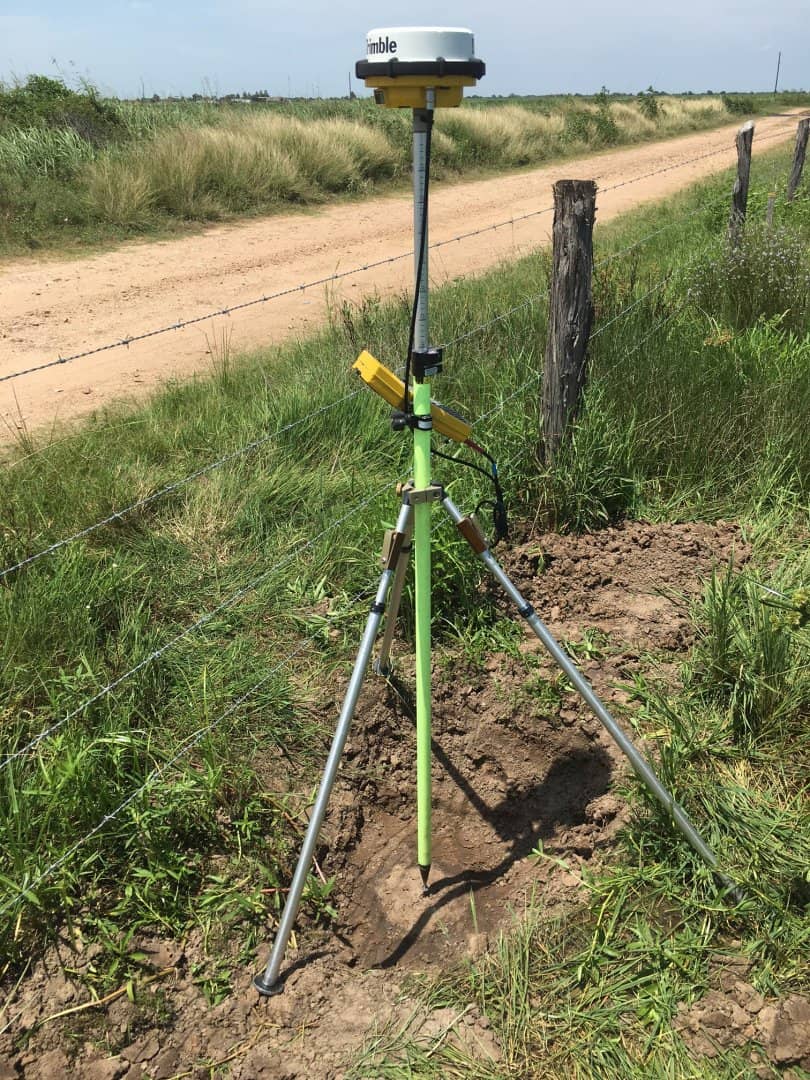
Probably my favorite, though, was the second hole of the day. Would anyone care to guess what this 8-inch dia. patch of lighter soil is into the center of which I set a spike and then located the spike?
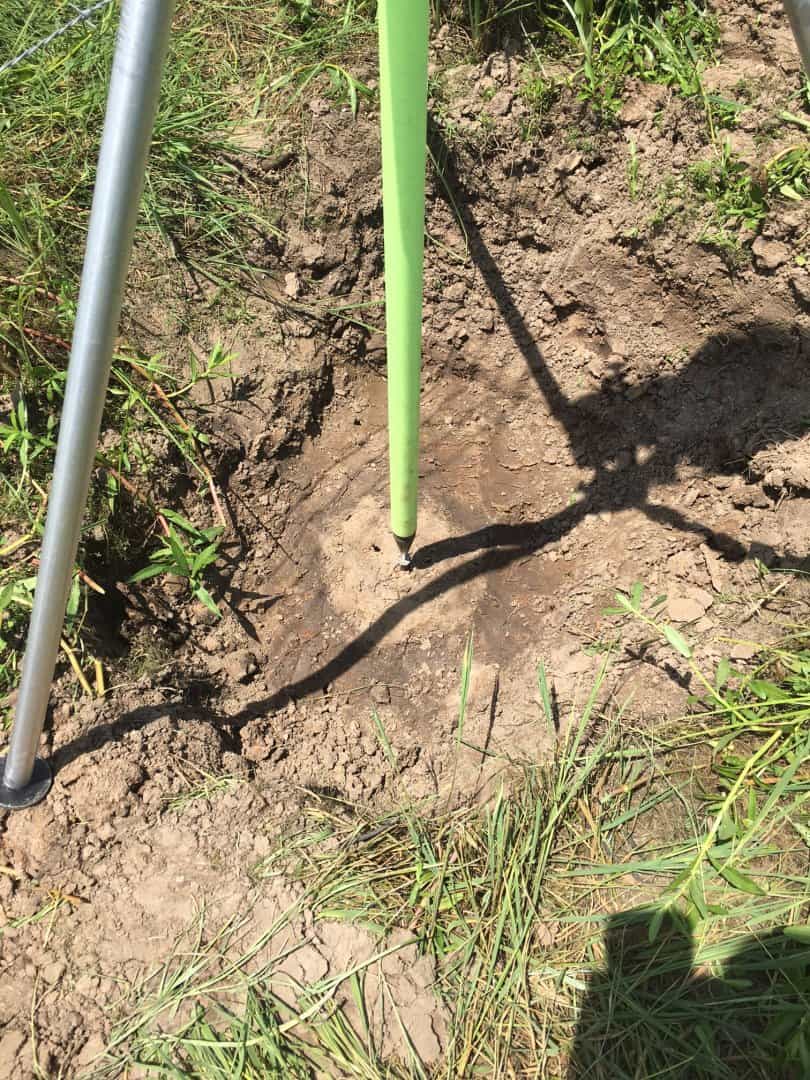
A closer view of the hole that shaving away about 8 inches of topsoil exposed:
Posted : June 23, 2017 11:26 pm

Translate
▼
English
Spanish
French
German
Italian
Portuguese
Russian
Chinese
Japanese
Korean
Arabic
Hindi
Dutch
Polish
Turkish
Vietnamese
Thai
Swedish
Danish
Finnish
Norwegian
Czech
Hungarian
Romanian
Greek
Hebrew
Indonesian
Malay
Ukrainian
Bulgarian
Croatian
Slovak
Slovenian
Serbian
Lithuanian
Latvian
Estonian
Here I'd imagine an old post long rotted, except it'd probably be darker in middle depending on if it's a vegetated area and fair amount of humus.
Do you have authority to digup the roads? What about repair to bitumen surface.
We do here, but there's always that area of rehabilitation which can be a grey area depending on who, where etc.
That's certainly an impressive find.
Common comment before I dig is a scoffing "you'll never find anything there".
Unfortunately the scoffers more often don't hang around to see the results.
Posted : June 23, 2017 11:46 pm
Topic starter
Translate
▼
English
Spanish
French
German
Italian
Portuguese
Russian
Chinese
Japanese
Korean
Arabic
Hindi
Dutch
Polish
Turkish
Vietnamese
Thai
Swedish
Danish
Finnish
Norwegian
Czech
Hungarian
Romanian
Greek
Hebrew
Indonesian
Malay
Ukrainian
Bulgarian
Croatian
Slovak
Slovenian
Serbian
Lithuanian
Latvian
Estonian
Richard, post: 433917, member: 833 wrote: Here I'd imagine an old post long rotted, except it'd probably be darker in middle depending on if it's a vegetated area and fair amount of humus.
That is almost certainly a post hole that has been filled in with a sandy material that differs from the darker silty/sandy soil in which the post had been set. The post was probably removed about eighty years ago, I'd guess.
Do you have authority to digup the roads? What about repair to bitumen surface?
I'd imagine that a person probably could apply for a permit to dig in the road pavement if he had a couple of weeks or months to kill. Normal road maintenance will probably throw a little cold patch in the hole that I backfilled with bits of asphalt on top. Naturally, the engineers who made no provision for a well or other means of accessing the survey marker without actually cutting the pavement would probably prefer that no markers ever be uncovered. Not my problem.
Posted : June 24, 2017 12:16 am

Translate
▼
English
Spanish
French
German
Italian
Portuguese
Russian
Chinese
Japanese
Korean
Arabic
Hindi
Dutch
Polish
Turkish
Vietnamese
Thai
Swedish
Danish
Finnish
Norwegian
Czech
Hungarian
Romanian
Greek
Hebrew
Indonesian
Malay
Ukrainian
Bulgarian
Croatian
Slovak
Slovenian
Serbian
Lithuanian
Latvian
Estonian
Digging in the middle of the road is always fun. Especially in the heat. Not much fun when you are flagger, digger, and modern day indian spotter all in one. Finding what you are looking for makes it all worth while.
Posted : June 24, 2017 6:13 am

Translate
▼
English
Spanish
French
German
Italian
Portuguese
Russian
Chinese
Japanese
Korean
Arabic
Hindi
Dutch
Polish
Turkish
Vietnamese
Thai
Swedish
Danish
Finnish
Norwegian
Czech
Hungarian
Romanian
Greek
Hebrew
Indonesian
Malay
Ukrainian
Bulgarian
Croatian
Slovak
Slovenian
Serbian
Lithuanian
Latvian
Estonian
Kent McMillan, post: 433913, member: 3 wrote: Naturally, this all took place in the hot end of the afternoon when the heat index was around 105?øF.
[SARCASM]It's brisk and invigorating[/SARCASM]
Posted : June 24, 2017 7:25 am
Topic starter
Translate
▼
English
Spanish
French
German
Italian
Portuguese
Russian
Chinese
Japanese
Korean
Arabic
Hindi
Dutch
Polish
Turkish
Vietnamese
Thai
Swedish
Danish
Finnish
Norwegian
Czech
Hungarian
Romanian
Greek
Hebrew
Indonesian
Malay
Ukrainian
Bulgarian
Croatian
Slovak
Slovenian
Serbian
Lithuanian
Latvian
Estonian
Darryl Beard, post: 433927, member: 11556 wrote: Digging in the middle of the road is always fun. Especially in the heat. Not much fun when you are flagger, digger, and modern day indian spotter all in one. Finding what you are looking for makes it all worth while.
Fortunately for me, that was a fairly lightly trafficked county road that I was working in, the other intersecting county road that had been there in 1951 having been shifted 25 ft. away from the monument when the state upgraded the road to a highway. It was in a rural area and probably more than half the folks driving past stopped to ask what I was looking for.
100% of them were surprised to learn that there was a survey marker indicating exactly where the county line was and most of those also asked "How did you find it?". The question was an interesting one, but in the hot afternoon "It's a long story" was the best I could muster. "The same way that you'd find any other buried treasure," I should have said.
Posted : June 24, 2017 8:51 am

Translate
▼
English
Spanish
French
German
Italian
Portuguese
Russian
Chinese
Japanese
Korean
Arabic
Hindi
Dutch
Polish
Turkish
Vietnamese
Thai
Swedish
Danish
Finnish
Norwegian
Czech
Hungarian
Romanian
Greek
Hebrew
Indonesian
Malay
Ukrainian
Bulgarian
Croatian
Slovak
Slovenian
Serbian
Lithuanian
Latvian
Estonian
The "soil shadow" is a cool pic Kent.
I've received some friction over the last couple of years for digging holes in new asphalt overlays. And I relish neither the task of digging out the corners nor listening to someone bitch and howl about 'their' road...but sometimes it's a necessity.
The nature of a lot of my work has me returning regularly to some of these corners. In a lot of places I have my own good control points I've set in convenient places tied to a number of the section corners. This keeps me out of the street and more importantly keeps me from digging holes in 100?ø heat.
Just last week I was headed out to an area I hadn't been to in a while. I made the turn off the county highway a mile from the job and was staring at a brand spanking new asphalt overlay. And this was in an area I DON'T have any extraneous control laying about....sh*t....Sure enough, I pulled over by the mailboxes near the intersection and the asphalt was untouched where the corner was buried.
The Schonstedt indicated the asphalt was probably only a couple of inches deep so I reluctantly grabbed my 3" cold chisel and favorite shop hammer to chip out a square of the new road surface. I hadn't been on my knees two minutes when a pickup pulled up and stopped (with his front tire ON one of my cones). The driver leaned out the window and started in on a foul tirade about the road getting torn up. I didn't even look up when I told him "if all you a*shole goat herders that lived out here would put your fences in the right place I wouldn't have to dig up these corners!" ....I then stood up to look into whomever's eyes had cussed me prior to a proper "good morning".
It was an old friend and retired surveyor that lived down that road. Hadn't talked to him in a few years. We laughed. He thought I was going to take a swipe at him with the hammer I had in my hand. When he told me I was getting grumpy in my old age I told him "Good! I don't ever want to lose my edge."
We had a good lunch at a little diner a few miles away. 😉
Posted : June 24, 2017 9:00 am

Translate
▼
English
Spanish
French
German
Italian
Portuguese
Russian
Chinese
Japanese
Korean
Arabic
Hindi
Dutch
Polish
Turkish
Vietnamese
Thai
Swedish
Danish
Finnish
Norwegian
Czech
Hungarian
Romanian
Greek
Hebrew
Indonesian
Malay
Ukrainian
Bulgarian
Croatian
Slovak
Slovenian
Serbian
Lithuanian
Latvian
Estonian
paden cash, post: 433937, member: 20 wrote: The nature of a lot of my work has me returning regularly to some of these corners. In a lot of places I have my own good control points I've set in convenient places tied to a number of the section corners. This keeps me out of the street and more importantly keeps me from digging holes in 100?ø heat.
If you have referenced out a section corner, with tight, well defined references, once, need you ever go out in the intersection again? With the references published in an OCCR need anybody else do so? I know you have seen some of my OCCRs. That was always my thinking when doing them.
Posted : June 24, 2017 12:39 pm
Translate
▼
English
Spanish
French
German
Italian
Portuguese
Russian
Chinese
Japanese
Korean
Arabic
Hindi
Dutch
Polish
Turkish
Vietnamese
Thai
Swedish
Danish
Finnish
Norwegian
Czech
Hungarian
Romanian
Greek
Hebrew
Indonesian
Malay
Ukrainian
Bulgarian
Croatian
Slovak
Slovenian
Serbian
Lithuanian
Latvian
Estonian
Kent McMillan, post: 433918, member: 3 wrote: I'd imagine that a person probably could apply for a permit to dig in the road pavement if he had a couple of weeks or months to kill.
The state of Washington has such a requirement. Practically nobody pays any attention to it.
In Oregon the county surveyors are tasked with maintaining the cadaster. Those that have some budget and staff will set references and file a document similar to an Oklahoman Certified Corner Record known in the "Bearing Tree Book". Which references are never trees anymore, but the name lives on. I feel no need to endanger myself or any employees by going out in a busy intersection to tie a monument when it is well referenced by nice, safe offsets, reliably tied out.
Posted : June 24, 2017 12:46 pm
Translate
▼
English
Spanish
French
German
Italian
Portuguese
Russian
Chinese
Japanese
Korean
Arabic
Hindi
Dutch
Polish
Turkish
Vietnamese
Thai
Swedish
Danish
Finnish
Norwegian
Czech
Hungarian
Romanian
Greek
Hebrew
Indonesian
Malay
Ukrainian
Bulgarian
Croatian
Slovak
Slovenian
Serbian
Lithuanian
Latvian
Estonian
Mark Mayer, post: 433983, member: 424 wrote: If you have referenced out a section corner, with tight, well defined references, once, need you ever go out in the intersection again? With the references published in an OCCR need anybody else do so? I know you have seen some of my OCCRs. That was always my thinking when doing them.
And you did file some really good refs Mark. And there a good number of filed OK CCRs by others that do keep a good number of us out of harm's way.
The trouble with a lot of the CCRs (circa 1975 from old man Holcomb or Bob Cartmill) I run into down in Purcell, Washington, Amber & Cole neighborhood is a lot of them are nails in poles (not too difficult to locate with a rover), faces of gate posts, mail boxes and the ever present gas line vent pipes. Attempting a geometric solution from some of the ambiguous references can be frustrating.
I've managed to create quite a control network in a lot of the areas. Although convenience was actually my first thought, it has proven to be a safety factor also.
Posted : June 24, 2017 12:53 pm
Topic starter
Translate
▼
English
Spanish
French
German
Italian
Portuguese
Russian
Chinese
Japanese
Korean
Arabic
Hindi
Dutch
Polish
Turkish
Vietnamese
Thai
Swedish
Danish
Finnish
Norwegian
Czech
Hungarian
Romanian
Greek
Hebrew
Indonesian
Malay
Ukrainian
Bulgarian
Croatian
Slovak
Slovenian
Serbian
Lithuanian
Latvian
Estonian
Mark Mayer, post: 433984, member: 424 wrote: In Oregon the county surveyors are tasked with maintaining the cadaster. Those that have some budget and staff will set references and file a document similar to an Oklahoman Certified Corner Record known in the "Bearing Tree Book". Which references are never trees anymore, but the name lives on. I feel no need to endanger myself or any employees by going out in a busy intersection to tie a monument when it is well referenced by nice, safe offsets, reliably tied out.
In Texas, the office of County Surveyor has pretty much withered away as the public domain was surveyed up and the oil companies arranged for a category of licensee was created who had the authority to file maps and field notes of surveys and resurveys of land grants in the Texas GLO. In a rational world, it would be understood that having some expert maintain the basic framework of land boundaries would be of significant value, but what passes for public policy in Texas cannot be called rational.
Considering that more than 90% of the Texas population live in urban areas centered in counties that have actually abolished the office of County Surveyor, a new approach is definitely warranted. My own sense is that it would make sense to divide a county into different districts and by some method select several licensees who would be paid with monies collected as a small tax upon residents in the district to perform various tasks within the district each year, the emphasis being on doing work to assist other private surveyors in carrying out surveys in the district. In the old days, when cities were more compact, that was what in effect the City Engineer or City Surveyor did in maintaining something as basic as reference points at the intersections of street and, as importantly, detailed records of surveys carried out.
Posted : June 24, 2017 1:13 pm
Topic starter
Translate
▼
English
Spanish
French
German
Italian
Portuguese
Russian
Chinese
Japanese
Korean
Arabic
Hindi
Dutch
Polish
Turkish
Vietnamese
Thai
Swedish
Danish
Finnish
Norwegian
Czech
Hungarian
Romanian
Greek
Hebrew
Indonesian
Malay
Ukrainian
Bulgarian
Croatian
Slovak
Slovenian
Serbian
Lithuanian
Latvian
Estonian
paden cash, post: 433985, member: 20 wrote: I've managed to create quite a control network in a lot of the areas. Although convenience was actually my first thought, it has proven to be a safety factor also.
Yes, there are a multitude of street intersections in Austin where the fact that some early 20th-century City Engineer's centerline monument may exist in the middle of an intersection has become a matter of largely academic interest considering that the location is as a practicl matter inaccessible 24/7. A far-sighted City Engineering Department established reference markers back in the 1960s (mostly), but failed to consult the psychic who would have informed them that the reference points on curbs fell exactly in future ADA ramps.
Posted : June 24, 2017 1:19 pm
Translate
▼
English
Spanish
French
German
Italian
Portuguese
Russian
Chinese
Japanese
Korean
Arabic
Hindi
Dutch
Polish
Turkish
Vietnamese
Thai
Swedish
Danish
Finnish
Norwegian
Czech
Hungarian
Romanian
Greek
Hebrew
Indonesian
Malay
Ukrainian
Bulgarian
Croatian
Slovak
Slovenian
Serbian
Lithuanian
Latvian
Estonian
Kent McMillan, post: 433991, member: 3 wrote: Yes, there are a multitude of street intersections in Austin where the fact that some early 20th-century City Engineer's centerline monument may exist in the middle of an intersection has become a matter of largely academic interest considering that the location is as a practicl matter inaccessible 24/7. A far-sighted City Engineering Department established reference markers back in the 1960s (mostly), but failed to consult the psychic who would have informed them that the reference points on curbs fell exactly in future ADA ramps.
I don't think anybody will ever accuse a surveyor of being able to see into the future, hard as we may try at times. Originally (around these parts) corners were witnessed by bearing trees, probably because that's what was there. And I will argue with anybody that thinks those surveyors picked trees because of their longevity. Seen too many cottonwoods listed as BTs to believe any of that.
Then as we progressed here on the fringes of the Dust Bowl the government helped out with 'lectrifying the countryside and utility poles became popular as witnesses. While not really as long-lived as some varieties of trees, they were convenient to those of us handicapped by a 100' chain. They remain popular to this day making up about 80% of all corner reference object choices around here. Corner and gate posts seem to be next. The proverbial x on a curb is a good stable location, but only in urban areas where there is such a thing as a curb. All of these physical witnesses are subject to the decay of age. And sadly most of our brethren don't have much of an imagination when it comes to referencing corners. We cling to these adjacent accessories with a numbing regularity. And I guess for the most part they work...until they don't.
But we still cling to physical objects. While I might be the first old-timer to freely admit that a corner CAN be properly re-established with merely lat-long data, the pitfalls are as obvious as the ignorance a lot of surveyors have about the use of geodetics. And to be honest I still believe a physical tie to witness marks that can re-establish a point is probably good procedure. If nothing else it can be understood by laymen.
The fact is our cadaster needs constant maintenance. I wish we had some form of instituted (government or private, I don't care) maintenance of our PLSS grid, but that will probably never happen. Until something better comes along we will keep scratching x's on headwalls and pounding nails in utility poles so the next guy can figure out where the corner's at. 😉
Posted : June 24, 2017 3:50 pm
Topic starter
Translate
▼
English
Spanish
French
German
Italian
Portuguese
Russian
Chinese
Japanese
Korean
Arabic
Hindi
Dutch
Polish
Turkish
Vietnamese
Thai
Swedish
Danish
Finnish
Norwegian
Czech
Hungarian
Romanian
Greek
Hebrew
Indonesian
Malay
Ukrainian
Bulgarian
Croatian
Slovak
Slovenian
Serbian
Lithuanian
Latvian
Estonian
paden cash, post: 433998, member: 20 wrote: But we still cling to physical objects. While I might be the first old-timer to freely admit that a corner CAN be properly re-established with merely lat-long data, the pitfalls are as obvious as the ignorance a lot of surveyors have about the use of geodetics. And to be honest I still believe a physical tie to witness marks that can re-establish a point is probably good procedure. If nothing else it can be understood by laymen.
The problem, of course, is that just as not all geodetic coordinates are created equal, neither are all physical objects. The use of geodetic coordinates is hardly completely divorced from monumented control points since they are necessary to show the stability of the coordinate system and validate methodology used in re-establishing coordinate-defined points. I'd think that it is beyond question that having a coordinate system that refers to a North direction that can be independly re-established is a major improvement over any that is based merely upon rumor or the continued existence of a suffient number of the identical monuments in completely undisturbed condition.
The practice that I see as working best is one that establishes a set of control points near (in terms of accurate ties that can be made with a total station of ordinary quality) any important cadastral corner that are chosen for permanence and GPSability, providing geodetic coordinates so that they are easy to find, and making high quality ties from them to the corner in question. Given modern life, it's a safe bet that some or all of them will be destroyed, but when you consider that you can survey six miles via GPS with accuracy that is more than adequate for many purposes, every cadastral corner and every one of its reference monuments doesn't need to survive to replace the missing corner and establish new references with confidence.
Posted : June 24, 2017 4:11 pm

Translate
▼
English
Spanish
French
German
Italian
Portuguese
Russian
Chinese
Japanese
Korean
Arabic
Hindi
Dutch
Polish
Turkish
Vietnamese
Thai
Swedish
Danish
Finnish
Norwegian
Czech
Hungarian
Romanian
Greek
Hebrew
Indonesian
Malay
Ukrainian
Bulgarian
Croatian
Slovak
Slovenian
Serbian
Lithuanian
Latvian
Estonian
Not in a cadastral context, but yesterday I investigated a line of 1935 bench marks and saw again how ephemeral are man's attempts at monumentation.
Out of 18 data seets I ignored those less than 15 ft from a very active RR (where no one is likely to ever do a static session) and those with Not Found reports by NGS or USGS, and had a half dozen to check out (plus a tri station).
I was stopped by a muddy road on the way to one, think two fell victim to regrading or are at least buried to considerable depth in areas where the RR would not appreciate me digging.
I found one at a culvert that has a quarter of the sky blocked by trees, one with good sky if I can get an antenna up nine feet, and one place that a disk very likely can be found when I feel like cutting brush and digging.
All of which shows the difficulty in finding a way to fill a gap in the NGS map of where they have GPS data on classically leveled marks.
Posted : June 25, 2017 8:46 am