Reading RPLS is free for the whole profession. Members post, reply, and get the members-only rooms.


Notifications
Clear all

Topic starter
Translate
▼
English
Spanish
French
German
Italian
Portuguese
Russian
Chinese
Japanese
Korean
Arabic
Hindi
Dutch
Polish
Turkish
Vietnamese
Thai
Swedish
Danish
Finnish
Norwegian
Czech
Hungarian
Romanian
Greek
Hebrew
Indonesian
Malay
Ukrainian
Bulgarian
Croatian
Slovak
Slovenian
Serbian
Lithuanian
Latvian
Estonian
It might be my imagination but it seemed like when I started my network, adding each additional group of observations might produce wide swings of the error factor (particularly if I made blunders). Now it seems like, with each additional triangle or quadrangle added to the network, the "volatility" is going down. Is this just a function of the shear number of observations? Am I getting better results with practice? A combination of both? 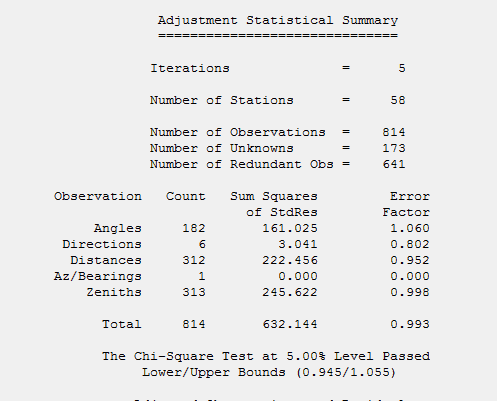
Posted : May 24, 2017 7:14 pm

Translate
▼
English
Spanish
French
German
Italian
Portuguese
Russian
Chinese
Japanese
Korean
Arabic
Hindi
Dutch
Polish
Turkish
Vietnamese
Thai
Swedish
Danish
Finnish
Norwegian
Czech
Hungarian
Romanian
Greek
Hebrew
Indonesian
Malay
Ukrainian
Bulgarian
Croatian
Slovak
Slovenian
Serbian
Lithuanian
Latvian
Estonian
First wrong assumption, StarNet is not to be used to fix blunders.
Paul in PA
Posted : May 24, 2017 7:27 pm
Topic starter
Translate
▼
English
Spanish
French
German
Italian
Portuguese
Russian
Chinese
Japanese
Korean
Arabic
Hindi
Dutch
Polish
Turkish
Vietnamese
Thai
Swedish
Danish
Finnish
Norwegian
Czech
Hungarian
Romanian
Greek
Hebrew
Indonesian
Malay
Ukrainian
Bulgarian
Croatian
Slovak
Slovenian
Serbian
Lithuanian
Latvian
Estonian
Paul in PA, post: 429831, member: 236 wrote: First wrong assumption, StarNet is not to be used to fix blunders.
Paul in PA
Yes, I understand that. I did not mean to imply I thought that. It's just that a blunder WILL swing the numbers more; I meant that blunders aside---that is, after removing them, the numbers don't seem to move as much as with fewer observations.
Posted : May 24, 2017 7:32 pm

Translate
▼
English
Spanish
French
German
Italian
Portuguese
Russian
Chinese
Japanese
Korean
Arabic
Hindi
Dutch
Polish
Turkish
Vietnamese
Thai
Swedish
Danish
Finnish
Norwegian
Czech
Hungarian
Romanian
Greek
Hebrew
Indonesian
Malay
Ukrainian
Bulgarian
Croatian
Slovak
Slovenian
Serbian
Lithuanian
Latvian
Estonian
rfc, post: 429829, member: 8882 wrote: Now it seems like, with each additional triangle or quadrangle added to the network, the "volatility" is going down. Is this just a function of the shear number of observations?
Yes it is. Which makes it more important to carefully examine the residuals for outliers.
And, no doubt, you are also getting better.
Posted : May 24, 2017 7:33 pm

Translate
▼
English
Spanish
French
German
Italian
Portuguese
Russian
Chinese
Japanese
Korean
Arabic
Hindi
Dutch
Polish
Turkish
Vietnamese
Thai
Swedish
Danish
Finnish
Norwegian
Czech
Hungarian
Romanian
Greek
Hebrew
Indonesian
Malay
Ukrainian
Bulgarian
Croatian
Slovak
Slovenian
Serbian
Lithuanian
Latvian
Estonian
The principle variable is the number of redundant observations. That drives the upper and lower bounds on the Chi-Sq test. The averaging over a lot of variables and their non-redundant observations also smooths things out so that a single wild one doesn't affect the error factor as much.
Posted : May 24, 2017 7:34 pm
Topic starter
Translate
▼
English
Spanish
French
German
Italian
Portuguese
Russian
Chinese
Japanese
Korean
Arabic
Hindi
Dutch
Polish
Turkish
Vietnamese
Thai
Swedish
Danish
Finnish
Norwegian
Czech
Hungarian
Romanian
Greek
Hebrew
Indonesian
Malay
Ukrainian
Bulgarian
Croatian
Slovak
Slovenian
Serbian
Lithuanian
Latvian
Estonian
Mark Mayer, post: 429834, member: 424 wrote: Yes it is. Which makes it more important to carefully examine the residuals for outliers.
And, no doubt, you are also getting better.
I still check them always. What determines if an observation merits an asterisk, indicating it's an outlier? Can this "window" be set by the user?
Posted : May 24, 2017 7:39 pm
Translate
▼
English
Spanish
French
German
Italian
Portuguese
Russian
Chinese
Japanese
Korean
Arabic
Hindi
Dutch
Polish
Turkish
Vietnamese
Thai
Swedish
Danish
Finnish
Norwegian
Czech
Hungarian
Romanian
Greek
Hebrew
Indonesian
Malay
Ukrainian
Bulgarian
Croatian
Slovak
Slovenian
Serbian
Lithuanian
Latvian
Estonian
rfc, post: 429836, member: 8882 wrote: What determines if an observation merits an asterisk
A residual of 3 times the standard error.
Posted : May 24, 2017 8:40 pm

Translate
▼
English
Spanish
French
German
Italian
Portuguese
Russian
Chinese
Japanese
Korean
Arabic
Hindi
Dutch
Polish
Turkish
Vietnamese
Thai
Swedish
Danish
Finnish
Norwegian
Czech
Hungarian
Romanian
Greek
Hebrew
Indonesian
Malay
Ukrainian
Bulgarian
Croatian
Slovak
Slovenian
Serbian
Lithuanian
Latvian
Estonian
rfc, post: 429836, member: 8882 wrote: I still check them always. What determines if an observation merits an asterisk, indicating it's an outlier? Can this "window" be set by the user?
In case you weren't aware it also possible to order the adjusted observations in the listing according to the standardised residual. So the suspect observations should all be listed at the top.
Posted : May 25, 2017 1:36 am