

GeeOddMike, post: 251077, member: 677 wrote: Another paper to consider
FWIW,
I like Dr. Craymer's paper on the issue: Session Versus Baseline GPS Processing. see:
ftp://geod.rncan.gc.ca/pub/GSD/craymer/pubs/gps_ion1992.pdf
For other articles of possible interest see: http://www3.sympatico.ca/craymer/geodesy/craymer-pubs.html
Enjoy,
DMM
Neither of the links in your post from 2014 seem to be available; do you know where I can find this? I read the first paper and thought I saved it but I can't find it. Any help is appreciated.

When I exclude trivial baselines, my statistics get worse and my results get better. During the brief time I convinced myself to do otherwise I was dogged by slop that I did not expect.
Some of my habits are nostalgia. Others were developed through pain, embarrassment and occasional hard work...

Lee D, post: 447657, member: 7971 wrote: Neither of the links in your post from 2014 seem to be available; do you know where I can find this? I read the first paper and thought I saved it but I can't find it. Any help is appreciated.
You might find this guideline by the Government of Alberta that lists Cramer's paper informative.
Standards, Specifications & Guidelines For GPS Surveys Of Alberta Survey Control
http://aep.alberta.ca/land/director-of-surveys/documents/StandardsGPSSurveysAlbertaSurvey-Mar2010.pdf
I wasn't able to find Cramer's paper online, but did download it in 2009. I didn't see any copyright on my copy of the paper, so hopefully it is okay to attach it.

Dr Craymer's paper mentioned above is available from his new (to me) website at: http://www.craymer.com/
Lots of good stuff.
BTW, briefly reviewing the postings, I note thebionicman mention the impact of including "trivial baselines" on adjustment statistics. That is the problem. You inflate the degrees of freedom and the statistics change...
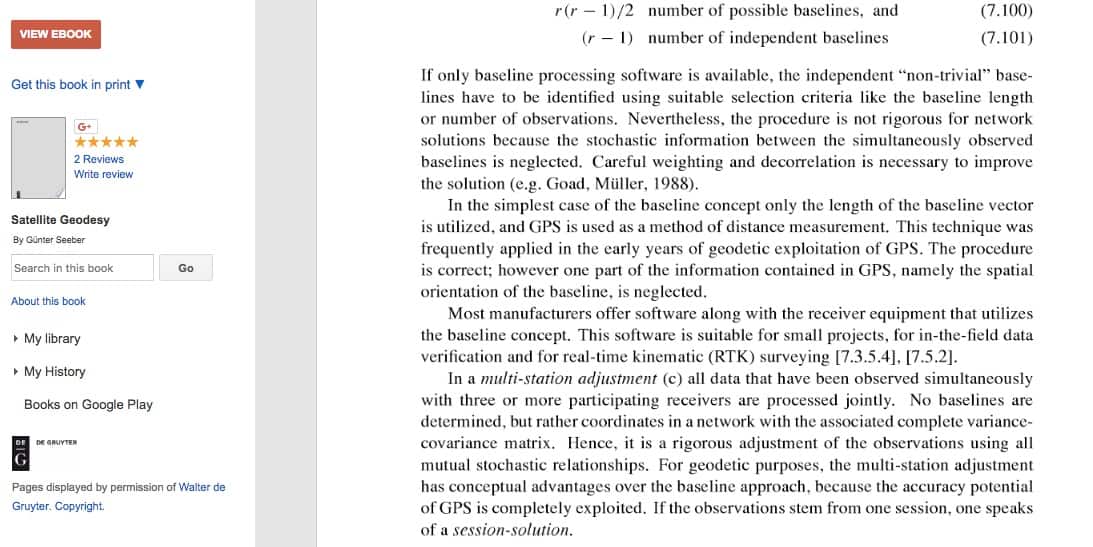

I had not previously seen this post, but I would like to comment.
The original poster has two receivers. Not sure why some kept telling him to get more receivers. Two receivers is perfectly fine for creating a network. Just connect the dots. Form a loop. Make a cross tie or two. One benefit of two receivers is that ALL lines are non trivial.
But, I do agree with Loyal that with a single baseline processor like TBC so called trivial baselines are not necessarily bad or undesirable. I understand the argument against them, but I have been doing GPS since 1986 and have often include trivial lines. They may inflate the statistics, but I believe you can often get better results if you include all lines. That said, there are also often times (frequently) when I only process the independent lines. Just depends.
I've been including the trivial lines in my last few projects. I'm getting, for the most part, sub-centimeter deviations between the TBC network adjustment and OPUS Projects, and most of the deviation that I do see is in the vertical, which I attribute to the inconsistent heights of the CORS network.

Mike Potterfield weighed in on this topic on his site, if you scroll all the way down to the bottom of the page ( http://www.geodeticsolutions.com/ ). Copied as follows:
Trivial baselines
Q: If 6 receivers are collecting data simultaneously, 2 sitting on control points & 4 "roving", how many trivial baselines (dependant vectors) per session are being observed?
A: It??s not clear that there are ever any trivial baselines when single-baseline processors are being used. The argument against trivial baselines has its origin in the days of the multi-baseline solutions (e.g. Trimble's TRIMMBP). With such solutions, the full covariance matrix with terms between all of the baseline components guarantees the uniqueness of both the geometric and stochastic solution of the baselines, so that when they are added to the network adjustment there is no loss of information. If you have any TRIMMBP solutions lying around, you can see this in action when a multi-baseline solution is included in an adjustment, and it looks like one of the baselines in the multi-baseline solution is a sideshot, but in fact you'll see residuals computed for the "sideshot" components. These residuals are based on the residuals for the geometrically over-determined baselines in the solution, in conjunction with the correlations between all the baselines.
However, when you only have a single-baseline processor -- and that includes most of the commercial processors these days -- then there is a loss of data when the "trivial" baselines are excluded from the network adjustment. In other words, the "sideshot" vector that got residuals in the multi-baseline solution won't get residuals from a single-baseline solution.
In my view the best way to make up for the loss of data is to include all of the "trivial" vectors in the adjustment. It's true that this will inflate the number of degrees of freedom in the network, but the chi-square value (sum of the weighted squares of the residuals) will also increase. I have tested this on some big networks, and I have found that the a posteriori errors are quite close to what they would have been if a multi-baseline solution with no trivial vectors had been used.
Thanks guys for the great links. Not only is this a topic that I'm interested in, but my son is a senior in Geomatics at Nicholls State and is researching a term paper on geodesy right now so this is extremely helpful.
BTW, I posted without comment an extract from Prof Dr Gunther Seeber's text: "Satellite Geodesy." I did so to highlight the advantages of session versus single baseline processing (SBP). The OPUS Static processor and PAGE-NT are session processors (where all the data is processed together yielding meaningful data not available from single baseline processing. For engineering/localized work SBP is probably fine; for geodesy it is not.

GeeOddMike, post: 447716, member: 677 wrote: For engineering/localized work SBP is probably fine; for geodesy it is not.
That's a pretty strong statement. For a sufficiently overdetermined network (e.g., one that follows NGS height mod guidelines), my gut tells me that the difference in positional accuracy between single- and multi-baseline processing is below the noise level of the technology.
I agree with Jim, I have done plenty of large networks using single baseline processors, and the results were equivalent to using a session processor. I have used PAGES, I see no advantage to using it for reasonably sized networks, in fact I think it is inferior for regular length lines. These are the kinds of lines that do not need tidal modeling, etc.
I heard yesterday that TBC 4.0 which I understand is being released soon (maybe at InterGeo?) will have improved processing for long lines. Not that it was bad before, but for longer lines and older versions it was sometimes necessary to force a float solution. I have not processed anything real long recently, so not sure how the current version is.
In the past I have had to process lines several 1000 KM long to bring in control to areas with no CORS (India from Taiwan, Egypt from Europe).

Great thread... While Jim Reilly certainly drilled the "N-1" Mantra into our heads at NMSU, the heavy hitters posting here or linked here have made me think differently. It's been a while since I've done a true PP network, though!
Great links here too ! Mike Potterfield!! haven't seen that name in a while. good stuff.
I have 4 static units and use LGO's single baseline processor to post-process the local vectors. I combine those with OPUS Projects solutions for each station. I adjust everything in Columbus. And while I understand that including trivial baselines in the adjustment will bias the statistics, I see it more as a venial sin instead of a cardinal sin (to borrow an analogy from my Catholic grade school days).
A strong statement indeed. Equally strong is the assertion that a SBP including all possible baselines (n!/2(n-2)!) baselines is equivalent to a MBP (n-1) baselines with all points correlated.
I did not intend to imply that those arguing against my view are anything but competent. Given the fact that commercial processors provide no other option, using a SBP is inevitable. Are there any commercial packages providing MBP solutions? Do any of these commercial packages detail the models used in their processing?
To the best of my knowledge, all national government level survey agencies and university groups participating in international geodetic projects use MBP tools. Is this a waste of money?
The comment that some of the modeling incorporated into some of the higher-end tools are unnecessary over "short" baseline lengths makes processing more subjective than objective.
BTW the standard deviations and correlations used as inputs into the adjustment tool are not only used to derive statistics about fit and residuals but also factor in the weighting of observations.
In summary, my point was that commercial SBP tools are perfectly adequate for local engineering projects and work supplemental to that national network. At the national and international level they are not. Most persons performing GNSS surveys do not need or require MBPs to satisfy their accuracy requirements. I do not agree that SBP and MBP are equivalent.
Have I missed the point? Yet again...
GeeOddMike, post: 447905, member: 677 wrote: In summary, my point was that commercial SBP tools are perfectly adequate for local engineering projects and work supplemental to that national network. At the national and international level they are not. Most persons performing GNSS surveys do not need or require MBPs to satisfy their accuracy requirements. I do not agree that SBP and MBP are equivalent.
I agree that a MBP is theoretically better (at least on the long lines), and that it's appropriate to use a MBP on national and international networks. Whether the theoretical margin of positional accuracy improvement is significant for any purpose (if it actually exists) is an open question in my mind.

With two receivers I'd recommend performing two radial sessions. Set base on a secure site and tie each point for 30 to 60 minutes. Move base to second secure site, which should have been tied in from first site, and tie in all points again. Tie in the control monument in both base sessions.
Unless you just want to buy TBC you could probably find someone who already has it and process the data for you.
I would send both base sessions to OPUS. You want 1991 coordinates, but you'll have the 2011 coordinates too so you can translate between them.
The trivial vector argument has been around for a long time. It's obsolete. As has been said, the commercial processors we use are baseline processors in which each vector is processed independently.
The vectors may be highly correlated but are not trivial. Repeating vectors is the best way to improve overly optimistic statistics.

Self compensating errors, of opposite direction, and identical magnitude, are self canceling. All they do, is enlarge the error estimate, without modifying the positional value.
You don't need adjustment software, if your measurements are right.
Adjustment software can be a valuable tool, for looking at error estimates.
When this is done, properly, you should end up with high confidence, and realistic error estimates.
Your choice of location, (not obstructed), and type of monument, (non moving, high stability) can be critical.
Also, the index or accuracy of your "taken for granted" parts, optical plummets, and level bubbles, can become signifigant.
High accuracy requires a serious study of all these components.
I personally like a non-plummet tribrach, with a rotating plummet, with high accuracy level bubbles. Spin it 180, and you can SEE 2x the index. (like a doubled angle).
When you want it RIGHT look at every error source, and quantify it realisticly.
Also, don't forget, a can of spray paint, can make your monuments, that you set your optical plummets over, stand out better. Also, a bright light, sprayed down vertically, can remove some error, from shadows.
Have a good time. Modern gear can yield higher accuracies than has ever been historically possible.
I'd guess that you should be capeable of performing higher accuracy work, than the contract calls for, without too much trouble.
(I don't know the specs for your contract).
Have fun!
N

Shawn Billings, post: 447950, member: 6521 wrote: With two receivers I'd recommend performing two radial sessions. Set base on a secure site and tie each point for 30 to 60 minutes. Move base to second secure site, which should have been tied in from first site, and tie in all points again. Tie in the control monument in both base sessions.
Unless you just want to buy TBC you could probably find someone who already has it and process the data for you.
I would send both base sessions to OPUS. You want 1991 coordinates, but you'll have the 2011 coordinates too so you can translate between them.
Or 3 radial sessions would even be better, but I agree this is the method to use with two GPS units. Also since one unit will be stationary for each radial session, OPUS can be used on that point, adding several OPUS solutions to the network.