Reading RPLS is free for the whole profession. Members post, reply, and get the members-only rooms.


Notifications
Clear all
GNSS & Geodesy
8
Posts
4
Users
0
Reactions
1,200
Views

Topic starter
Translate
▼
English
Spanish
French
German
Italian
Portuguese
Russian
Chinese
Japanese
Korean
Arabic
Hindi
Dutch
Polish
Turkish
Vietnamese
Thai
Swedish
Danish
Finnish
Norwegian
Czech
Hungarian
Romanian
Greek
Hebrew
Indonesian
Malay
Ukrainian
Bulgarian
Croatian
Slovak
Slovenian
Serbian
Lithuanian
Latvian
Estonian
The current Wikipedia entry https://en.wikipedia.org/wiki/Geodetic_datum&apos ;">Geodetic Datum has a statement in a paragraph discussing NAD27: "The geoidal height at Meades Ranch was assumed to be zero."
At first glance this makes no sense to me. I thought the horizontal datum was on the mathematical ellipsoid and would have no relationship to the geoid. Is there some small second order effect that causes an interaction of the vertical with NAD27 (or NAD83 either) that would need such an assumption at the time?
I didn't find a data sheet for Meades Ranch, but look at the data sheet for KG0640 Meades Ranch Reset (http://www.ngs.noaa.gov/cgi-bin/ds_mark.prl?PidBox=kg0640&apos ;">NGS) (https://www.geocaching.com/mark/details.aspx?PID=KG0640&apos ;">Geocaching has older https://www.geocaching.com/mark/datasheet.aspx?PID=KG0640&apos ;">data sheet) and note the NGVD29 elevation is within a meter of NAVD88, and the current geoid separation is more than 26 meters.
Should that Wikipedia statement be deleted?
Posted : November 9, 2016 8:52 am

Translate
▼
English
Spanish
French
German
Italian
Portuguese
Russian
Chinese
Japanese
Korean
Arabic
Hindi
Dutch
Polish
Turkish
Vietnamese
Thai
Swedish
Danish
Finnish
Norwegian
Czech
Hungarian
Romanian
Greek
Hebrew
Indonesian
Malay
Ukrainian
Bulgarian
Croatian
Slovak
Slovenian
Serbian
Lithuanian
Latvian
Estonian
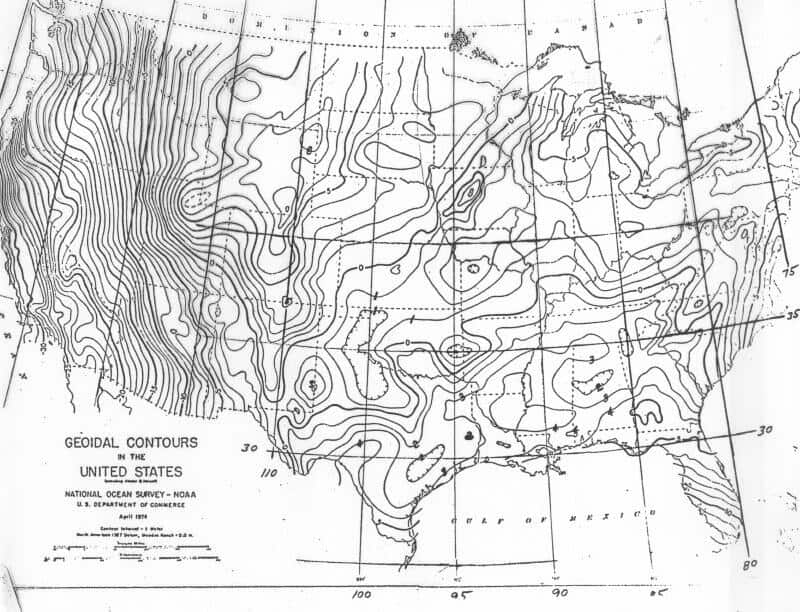
No, that is a true statement. They did not know accurately what geoid heights were. They picked an earth radius (clarke1866 ellipsoid) and then made the separation=0 at the origin. This meant that reducing a distance to the ellipsoid=reducing the distance to "sea level". As the network went away from the origin, this introduced a systematic bias in the distances, especially going west (larger differences). They also set astro lat/long=geodetic lat/long, which meant that the slope of the geoid at that point was also set to zero.
Once the space age came around, they were able to model the separations. Here is a (relatively unknown) map prepared by NOS in 1974 of the NAD27 geoidal separations:
Posted : November 9, 2016 9:04 am
Topic starter
Translate
▼
English
Spanish
French
German
Italian
Portuguese
Russian
Chinese
Japanese
Korean
Arabic
Hindi
Dutch
Polish
Turkish
Vietnamese
Thai
Swedish
Danish
Finnish
Norwegian
Czech
Hungarian
Romanian
Greek
Hebrew
Indonesian
Malay
Ukrainian
Bulgarian
Croatian
Slovak
Slovenian
Serbian
Lithuanian
Latvian
Estonian
So they could define the ellipsoid and horizontal datum origin, but to compute the horizontal position of anyplace else they needed to relate the measured distances back to the ellipsoid, and thus needed to know the elevation of those places in relation to the origin. I think I've got it.
As an aside, I also find the map you posted interesting in that it shows a serious anomaly in NW Iowa, which I believe coincides with the https://en.wikipedia.org/wiki/Manson_crater&apos ;">Manson meteor impact.
Posted : November 9, 2016 9:33 am
Translate
▼
English
Spanish
French
German
Italian
Portuguese
Russian
Chinese
Japanese
Korean
Arabic
Hindi
Dutch
Polish
Turkish
Vietnamese
Thai
Swedish
Danish
Finnish
Norwegian
Czech
Hungarian
Romanian
Greek
Hebrew
Indonesian
Malay
Ukrainian
Bulgarian
Croatian
Slovak
Slovenian
Serbian
Lithuanian
Latvian
Estonian
That map is pretty crude, but I think it shows why they chose Iowa as the second location for the geoidal profile done last year.
In order to properly reduce distances to the ellipsoid, they needed to know "where it was". So they just assumed it was equal to sea level (i.e. NGVD29=0). As I said, this created a rather large bias in distances as you went west, less so to the east, about 1 ppm per 6 m of separation. So 5-6 ppm in California, just about 1 ppm on the east coast, 2 ppm in S Florida. One of the several reasons for doing the NAD83 adjustment, they then knew where the geoid was a lot better, not nearly as well as now but well enough to minimize distance distortions.
Posted : November 9, 2016 9:41 am

Translate
▼
English
Spanish
French
German
Italian
Portuguese
Russian
Chinese
Japanese
Korean
Arabic
Hindi
Dutch
Polish
Turkish
Vietnamese
Thai
Swedish
Danish
Finnish
Norwegian
Czech
Hungarian
Romanian
Greek
Hebrew
Indonesian
Malay
Ukrainian
Bulgarian
Croatian
Slovak
Slovenian
Serbian
Lithuanian
Latvian
Estonian
This is probably redundant, but NAD83 is geocentric, whereas NAD27 best fit Clark 1866 to North America with the ellipsoid surface coincident with the ground at Meades Ranch. Or at least that's how I was taught, it may be an oversimplification.
Posted : November 9, 2016 9:54 am
Translate
▼
English
Spanish
French
German
Italian
Portuguese
Russian
Chinese
Japanese
Korean
Arabic
Hindi
Dutch
Polish
Turkish
Vietnamese
Thai
Swedish
Danish
Finnish
Norwegian
Czech
Hungarian
Romanian
Greek
Hebrew
Indonesian
Malay
Ukrainian
Bulgarian
Croatian
Slovak
Slovenian
Serbian
Lithuanian
Latvian
Estonian
Cliff Mugnier gave a very good talk at a seminar a couple years ago where he discussed, among other things, the efforts to develop a global gravity model at the advent of the Space Age.
Posted : November 9, 2016 9:57 am
Topic starter
Translate
▼
English
Spanish
French
German
Italian
Portuguese
Russian
Chinese
Japanese
Korean
Arabic
Hindi
Dutch
Polish
Turkish
Vietnamese
Thai
Swedish
Danish
Finnish
Norwegian
Czech
Hungarian
Romanian
Greek
Hebrew
Indonesian
Malay
Ukrainian
Bulgarian
Croatian
Slovak
Slovenian
Serbian
Lithuanian
Latvian
Estonian
It's curious that they chose Highway 30 for the route of that profile project, maybe 30-some miles south of the center of the anomaly, instead of Highway 20 or other that would have gone closer.
See for instance http://www.ngs.noaa.gov/cgi-bin/ds_mark.prl?PidBox=DP4499&apos ;">DP4499.
Posted : November 9, 2016 9:59 am

Translate
▼
English
Spanish
French
German
Italian
Portuguese
Russian
Chinese
Japanese
Korean
Arabic
Hindi
Dutch
Polish
Turkish
Vietnamese
Thai
Swedish
Danish
Finnish
Norwegian
Czech
Hungarian
Romanian
Greek
Hebrew
Indonesian
Malay
Ukrainian
Bulgarian
Croatian
Slovak
Slovenian
Serbian
Lithuanian
Latvian
Estonian
I am not familiar with the area at all, but from project description:
"The official survey line was approximately 200 miles (325 km) long, containing 204 survey benchmarks. This location was selected because it was a medium-high, relatively flat, and gravimetrically complex area ranging from 740 feet to 1,440 feet above sea level"
Looks like it was just better suited to the parameters of the experiment, probably the right amount of gravity weirdness vs. the vertical profile.
Posted : November 9, 2016 10:07 am