Reading RPLS is free for the whole profession. Members post, reply, and get the members-only rooms.


Notifications
Clear all
GNSS & Geodesy
9
Posts
8
Users
0
Reactions
1,208
Views

Topic starter
Translate
▼
English
Spanish
French
German
Italian
Portuguese
Russian
Chinese
Japanese
Korean
Arabic
Hindi
Dutch
Polish
Turkish
Vietnamese
Thai
Swedish
Danish
Finnish
Norwegian
Czech
Hungarian
Romanian
Greek
Hebrew
Indonesian
Malay
Ukrainian
Bulgarian
Croatian
Slovak
Slovenian
Serbian
Lithuanian
Latvian
Estonian
If you try to take OPUS-S sessions on a point with bad multipath (e.g., 20 ft from a house with aluminum siding) you will have more variability, or likely error for a given session length.
But if you take hours and hours of data, will the average converge toward the right answer or will it converge toward some biased offset?
Posted : December 8, 2015 11:04 am

Translate
▼
English
Spanish
French
German
Italian
Portuguese
Russian
Chinese
Japanese
Korean
Arabic
Hindi
Dutch
Polish
Turkish
Vietnamese
Thai
Swedish
Danish
Finnish
Norwegian
Czech
Hungarian
Romanian
Greek
Hebrew
Indonesian
Malay
Ukrainian
Bulgarian
Croatian
Slovak
Slovenian
Serbian
Lithuanian
Latvian
Estonian
Why would you keep taking hours and hours of data in a poor position?
Do you keep banging your head against the wall or do you finally admit there is a wall there?
The side of the house will not go away, any affect it has will be on every GPS signal that is properly aligned. So yes the result may be biased. However GPS antennas and receivers have a variety of filters to combat such things, some are better than others, but no one to my knowledge has gone to the expense of side by side comparisons. Why should they, the difficulty is so obvious it is easily avoided. I take it you would also want the Super Man x-ray vision so your EDM can get distances through steel walls.
OPUS has no idea of your actual field conditions and they so state in their reports to you. OPUS derives a position based on all the good data it finds in your file, if it is in fact biased, it is no skin off their butt.
All in all the worst GPS position is near a chain link fence, if you cannot get your antenna well above the fence do not observe there. Fewer antennas have large physical ground plans and now rely instead on technology. For a fact I have gotten ground locations with the antenna inverted just to see if I could be done.
The fact that you or OPUS gets a resolved GPS location is no guarantee of the quality of that position, despite what the residuals may or may not say. Sometimes we only fool ourselves.
Paul in PA
Posted : December 8, 2015 11:51 am
Topic starter
Translate
▼
English
Spanish
French
German
Italian
Portuguese
Russian
Chinese
Japanese
Korean
Arabic
Hindi
Dutch
Polish
Turkish
Vietnamese
Thai
Swedish
Danish
Finnish
Norwegian
Czech
Hungarian
Romanian
Greek
Hebrew
Indonesian
Malay
Ukrainian
Bulgarian
Croatian
Slovak
Slovenian
Serbian
Lithuanian
Latvian
Estonian
"Doctor, it hurts when I do this."
"Then don't do that."
But I'd really like to understand if there is a bias. My intuition says the reflection will be weaker than the direct signal, and due to the changing angle a reflection many wavelengths away will tend to alter the carrier phase both leading and lagging so it might look random overall.
I know that a code-derived position does get pulled by severe multipath because it can only add lagging. I demonstrated that with long-term averages using the Garmin; tilting it one way or the other caused the average position to be repeatably different by a few feet.
Posted : December 8, 2015 12:15 pm

Translate
▼
English
Spanish
French
German
Italian
Portuguese
Russian
Chinese
Japanese
Korean
Arabic
Hindi
Dutch
Polish
Turkish
Vietnamese
Thai
Swedish
Danish
Finnish
Norwegian
Czech
Hungarian
Romanian
Greek
Hebrew
Indonesian
Malay
Ukrainian
Bulgarian
Croatian
Slovak
Slovenian
Serbian
Lithuanian
Latvian
Estonian
Yeah back when I was running multiple GPS Survey crews I had guys that said- "I can get that shot if I stay here longer" Yeah all that did was waste money and time. Bad data is not overcome by lots of bad data. Time will not override physics.
Posted : December 8, 2015 1:48 pm

Translate
▼
English
Spanish
French
German
Italian
Portuguese
Russian
Chinese
Japanese
Korean
Arabic
Hindi
Dutch
Polish
Turkish
Vietnamese
Thai
Swedish
Danish
Finnish
Norwegian
Czech
Hungarian
Romanian
Greek
Hebrew
Indonesian
Malay
Ukrainian
Bulgarian
Croatian
Slovak
Slovenian
Serbian
Lithuanian
Latvian
Estonian
I doubt many people really know the answer to your question. I certainly don't, but I strongly suspect the solution will never converge towards an unbiased position. I just don't see why it would. The biases introduced by multipathing will change in magnitude and direction over the course of an extended session as satellites move around relative to the wall that is causing the multipath, but the biases will not go away, and I don't see why they would offset each other either.
Posted : December 8, 2015 3:20 pm

Translate
▼
English
Spanish
French
German
Italian
Portuguese
Russian
Chinese
Japanese
Korean
Arabic
Hindi
Dutch
Polish
Turkish
Vietnamese
Thai
Swedish
Danish
Finnish
Norwegian
Czech
Hungarian
Romanian
Greek
Hebrew
Indonesian
Malay
Ukrainian
Bulgarian
Croatian
Slovak
Slovenian
Serbian
Lithuanian
Latvian
Estonian
Bill93, post: 347933, member: 87 wrote: If you try to take OPUS-S sessions on a point with bad multipath (e.g., 20 ft from a house with aluminum siding) you will have more variability, or likely error for a given session length.
But if you take hours and hours of data, will the average converge toward the right answer or will it converge toward some biased offset?
I think the answer is "probably wpm't average out" for the reason that you will always be left without satellites in view in a particular quadrant of the sky. I don't see the compensating mechanism in the situation you describe. The nefarious effect is that the solutions you get one siderreal day later will probably agree so closely that (if you're a naturally gullible and optimistic person like so many RTK users) will lead you to conclude that you have a very good fix on the position of the station.
Posted : December 8, 2015 10:56 pm

Translate
▼
English
Spanish
French
German
Italian
Portuguese
Russian
Chinese
Japanese
Korean
Arabic
Hindi
Dutch
Polish
Turkish
Vietnamese
Thai
Swedish
Danish
Finnish
Norwegian
Czech
Hungarian
Romanian
Greek
Hebrew
Indonesian
Malay
Ukrainian
Bulgarian
Croatian
Slovak
Slovenian
Serbian
Lithuanian
Latvian
Estonian
Bear in mind that the reflections are transient -- as each SV moves along its orbit, the reflected signals will vary in strength from zero to a not-very-strong peak and back to zero. By collecting data over a period that's a significant multiple of the multipath duration, the inaccurate range values get overwhelmed by good data. That condition is at the heart of static positioning.
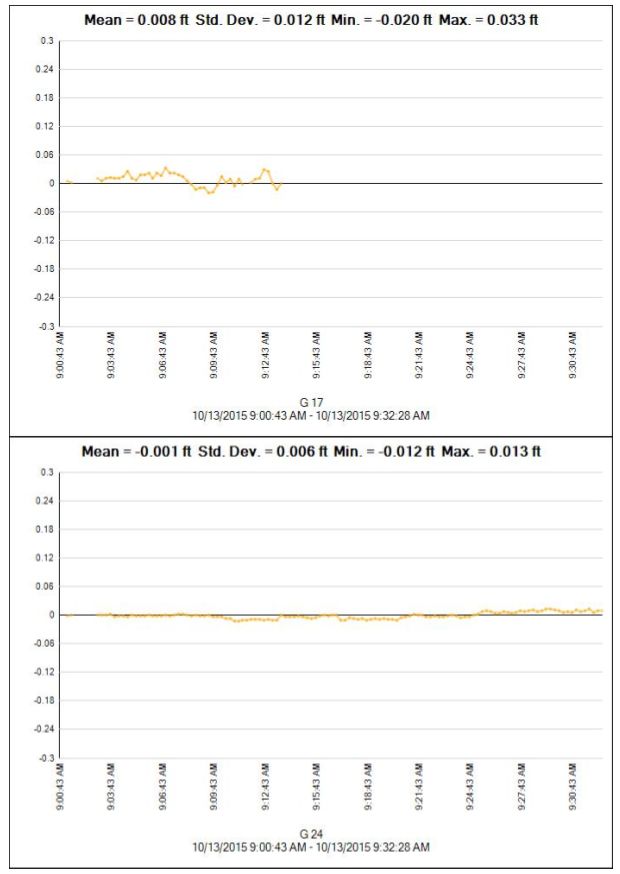
Even in a wide-open spot with no multipath reflectors, some data is cleaner than others. The two graphs below are from a half-hour session. The data from SV24 is super clean, while the data from SV17 is dirty by comparison. But the solution for SV17 is pretty good nonetheless because I had about 13 minutes of data over which to average out the solution. The same is true with modest multipath situations; with crazy multipath conditions, all bets are off.
Posted : December 8, 2015 11:16 pm

Translate
▼
English
Spanish
French
German
Italian
Portuguese
Russian
Chinese
Japanese
Korean
Arabic
Hindi
Dutch
Polish
Turkish
Vietnamese
Thai
Swedish
Danish
Finnish
Norwegian
Czech
Hungarian
Romanian
Greek
Hebrew
Indonesian
Malay
Ukrainian
Bulgarian
Croatian
Slovak
Slovenian
Serbian
Lithuanian
Latvian
Estonian
To obtain a less biased estimate, repeat the long surveys at different antenna heights above the ground; say, at +10, +20, ..., +100 cm above the original survey position. Then average the resulting marker positions. Rationale: multipath decorrelates over space.
-FGN.
Posted : December 11, 2015 5:47 pm

Translate
▼
English
Spanish
French
German
Italian
Portuguese
Russian
Chinese
Japanese
Korean
Arabic
Hindi
Dutch
Polish
Turkish
Vietnamese
Thai
Swedish
Danish
Finnish
Norwegian
Czech
Hungarian
Romanian
Greek
Hebrew
Indonesian
Malay
Ukrainian
Bulgarian
Croatian
Slovak
Slovenian
Serbian
Lithuanian
Latvian
Estonian
One man's noise is another man's data.
http://gpsworld.com/natural-resourceson-edge-multipath-measures-snow-depth-9095/&apos ;">Multipath measures Snow Depth
Posted : December 15, 2015 9:33 am