

Warren Smith, post: 402735, member: 9900 wrote: There is a 12' wide PUE along the rear of the lots on that block - with overhead power, phone, and cable lines. There should be no confusion where the common lot lines are, and where the 6' wide encumbrance is for each lot.
.
One would think...

epoch date, post: 402713, member: 485 wrote: Barry G - you keep asserting that the public is owner of the right-of-way. Please provide legal evidence that ownership of the street was transferred to the public agency when the street was accepted for dedication.
Cities and counties repave or maintain the STREETS, because they have the responsibility to not damage the public by inability to use the streets. The concept of maintenance of streets does not implore sidewalk or tree maintenance on the agency.
Please provide legal evidence that sidewalks and trees MUST be maintained through transportation tax funds.
You are receiving ample advise from may contributors. You keep repeating unfounded assertions in your postings. Please do everyone a courtesy by researching legal case law and share with us your findings (NOT JUST YOUR BELIEFS).
Thank you for this peaceful discussion:
1. Its in the dedication of the property, approved by Board of Supervisors in my housing tracts in 1961. Someone here put in a link. Its a dedication to
the Municipality. What is the purpose of this dedication, the dedication of streets/roads in housing tracts? Its for the purpose of ownership and
and maintenance. Read the Miller and Starr quote and the law Case regarding Kern. Its clear what this signing of this dedication performs.
2. The streets, sidewalks and parkways are all a part of the public rights of ways. When they sign the dedication, they are responsible to maintain
The Public Road System, which includes the parkways and the Sidewalks.
3. According to the State Controller, the letter identifies items in the transportation funds sent to the County that are earmarked for installation and/or
maintenance. There is a line item for sidewalks and parkway trees. SHC 22060 require the Board to take care of the parkway trees, same with
case law (Jones vs Deeter). All Municipalities that I know trim the parkway trees in housing tracts.
4. Parkway trees, based on Ordinance 2041, is owned by the Government, per my County. How can any Municipality take its personal ownership of
property and require an individual adjacent property owner to maintain it. Remember, transportation funds, according to Sacramento, include
sidewalks and parkway trees. Read SHC 22060. It requires the Board for maintenance of that parkway tree, not the adjacent property owner.
This is a State law, cant be ignored by local Municipalities.
Please explain a simple fee, where an adjacent property owner owns out to the middle of the street. Simple fee requires 4 things, ownership, title, possession and control. What property map or deed shows that I own, have title and possession of the public sidewalk, public parkway including trees, and middle of the street? It does not exist. Show me, as an owner of this property, the control I have over this property. Do I control who walks on this property, or modifications to this property, changes, etc. Answer is I have no control over this property. All 4 requirements have not been met, therefore I can own a simple fee. The County claims in an Ordinance that they own the parkway tree, Ordinance 2041. So they have no responsibility to maintain their own property, can assign duties and liabilities to individual property owners? Can I have my neighbors responsible for my private property, in case someone gets injured on my property, or car, I can let order them to pay repair, or maintenance or injury? My Homeowners Insurance does not include the publics right of ways. My Homeowners insurance has stated that I dont own this property, no requirement to have insurance on property I dont own or are responsible for. How can these be, if I own the fee out to the middle of the street? I should be able to insure myself in case someone gets injured, correct? Insurance Company explains that Im not responsible for a pedestrian who gets hurt over this sidewalk, parkway tree or street. Lets say, for example, there is a pot hole in the street adjacent to a property owners property. I trip over this and tear up my knee. Why cant I sue the adjacent property owner? After all, he owns out to the middle of the street, he owns the simple fee. No one has sued the adjacent property owner? Why not? Because the courts dont allow it., court decisions hold the Municipality accountable. Name one court case, where a Judge ordered an adjacent property owner to pay for the pedestrian injuries in a housing tract in California. In sure, in 150 years, a child has driven a skateboard or roller stakes over a out of repair sidewalk and filed a suit against the adjacent property owner. I guess not. Why? I'm not trying to be argumentative, just want a two way conversation, maybe I missing things. Im just not getting this, sorry.

The map.
The title sheet with dedication.
BajaOR, post: 402731, member: 9139 wrote: Well, I'll think twice before I ever label a street easement line as "property line"....
(coloring is mine).
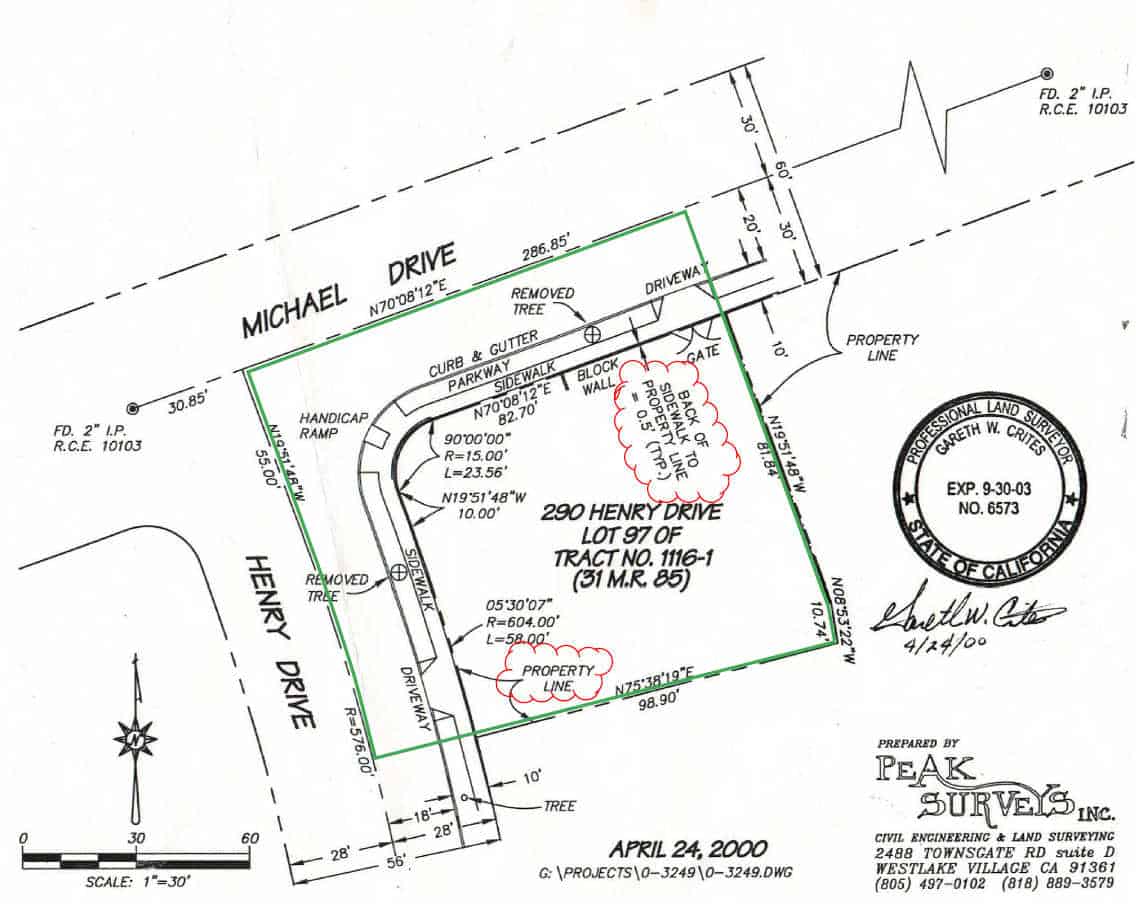
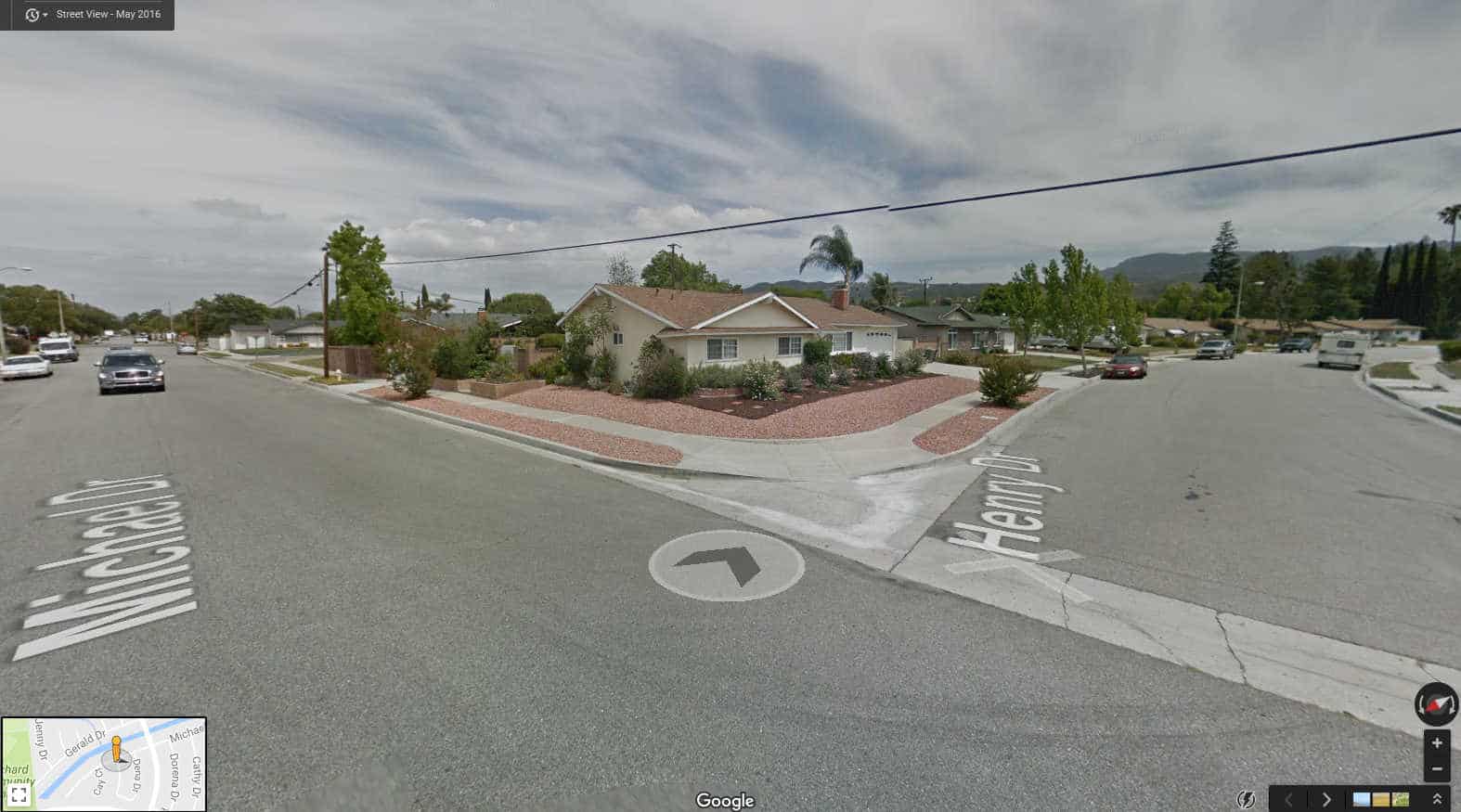
That is my property, correct. That is the land surveyor map that I paid to show my property line. My property line goes out 6" before the sidewalk. Your green line goes out to the middle of the street. Can I assume that this green line represents the easement, from both the County and Utilities. The easement is an automatic easement, when the dedication of property is approved. Easements don't define property, Land surveyor map dimensions define my property, when it starts and when it ends. That is my personal property, in my deed. I'm responsible for this property, as a private property owner, pay property taxes till the end of the property, as per the County. What am I missing?
Barry,
The term is fee defeasible. That is, should the right of the public to travel over a dedicated right of way be vacated by proceedings of record, the underlying fee title becomes unencumbered. Typically, a public utilities easement is reserved, and adjacent landowners may file for access across the premises to obtain ingress and egress to a public road. This serves for invitees, such as postal carriers, delivery vehicles, and guests. Not to mention fire protection, taxis, and ambulances.
There is a lot going on in public roadway areas, and there is a fair amount of shared obligation.

Barry G, post: 402739, member: 12296 wrote: Thank you for this peaceful discussion:
1. Its in the dedication of the property, approved by Board of Supervisors in my housing tracts in 1961. Someone here put in a link. Its a dedication to
the Municipality. What is the purpose of this dedication, the dedication of streets/roads in housing tracts? Its for the purpose of ownership and
and maintenance. Read the Miller and Starr quote and the law Case regarding Kern. Its clear what this signing of this dedication performs.
2. The streets, sidewalks and parkways are all a part of the public rights of ways. When they sign the dedication, they are responsible to maintain
The Public Road System, which includes the parkways and the Sidewalks.
3. According to the State Controller, the letter identifies items in the transportation funds sent to the County that are earmarked for installation and/or
maintenance. There is a line item for sidewalks and parkway trees. SHC 22060 require the Board to take care of the parkway trees, same with
case law (Jones vs Deeter). All Municipalities that I know trim the parkway trees in housing tracts.
4. Parkway trees, based on Ordinance 2041, is owned by the Government, per my County. How can any Municipality take its personal ownership of
property and require an individual adjacent property owner to maintain it. Remember, transportation funds, according to Sacramento, include
sidewalks and parkway trees. Read SHC 22060. It requires the Board for maintenance of that parkway tree, not the adjacent property owner.
This is a State law, cant be ignored by local Municipalities.
Please explain a simple fee, where an adjacent property owner owns out to the middle of the street. Simple fee requires 4 things, ownership, title, possession and control. What property map or deed shows that I own, have title and possession of the public sidewalk, public parkway including trees, and middle of the street? It does not exist. Show me, as an owner of this property, the control I have over this property. Do I control who walks on this property, or modifications to this property, changes, etc. Answer is I have no control over this property. All 4 requirements have not been met, therefore I can own a simple fee. The County claims in an Ordinance that they own the parkway tree, Ordinance 2041. So they have no responsibility to maintain their own property, can assign duties and liabilities to individual property owners? Can I have my neighbors responsible for my private property, in case someone gets injured on my property, or car, I can let order them to pay repair, or maintenance or injury? My Homeowners Insurance does not include the publics right of ways. My Homeowners insurance has stated that I dont own this property, no requirement to have insurance on property I dont own or are responsible for. How can these be, if I own the fee out to the middle of the street? I should be able to insure myself in case someone gets injured, correct? Insurance Company explains that Im not responsible for a pedestrian who gets hurt over this sidewalk, parkway tree or street. Lets say, for example, there is a pot hole in the street adjacent to a property owners property. I trip over this and tear up my knee. Why cant I sue the adjacent property owner? After all, he owns out to the middle of the street, he owns the simple fee. No one has sued the adjacent property owner? Why not? Because the courts dont allow it., court decisions hold the Municipality accountable. Name one court case, where a Judge ordered an adjacent property owner to pay for the pedestrian injuries in a housing tract in California. In sure, in 150 years, a child has driven a skateboard or roller stakes over a out of repair sidewalk and filed a suit against the adjacent property owner. I guess not. Why? I'm not trying to be argumentative, just want a two way conversation, maybe I missing things. Im just not getting this, sorry.
7 Miller & Starr Cal. Real Est. å¤ 22:23 (4th ed.):
Title passes on recording. Once the offer is accepted, title to the dedicated property passes to the public when the map is properly recorded (citing Gov. Code å¤å¤ 66477.1, 66477.3, also see å¤å¤ 20:41, 20:42), but the local agency is not responsible for the maintenance of dedicated streets until they have been improved by the subdivider and accepted into the street system by the governing authorities. As a general rule, upon dedication the public only receives an easement in the area designated for streets, and the adjacent lot owners retain the underlying fee title to the center of the streets (citing å¤ 8:65, 15:17, 15:43, 15:80).
Footnotes omitted, () cites added by me from the footnotes.
Odd that they say "title," I think an easement is only an interest in land, not title.
Per å¤22:1 A dedication may be an easement or fee title interest (see å¤22:31): "Since the public generally only receives an easement in a street or road, unless a different intention is indicated, it is presumed that the boundary of a lot adjacent to a street is to the center of the street, subject to the public easement." Miller & Starr cites a long list of cases supporting the proposition that a dedication of a road right-of-way is presumed to be an easement unless the contrary can be shown, "Where the property is deeded for road purposes, however, the rule is to the contrary [of other dedications which presume fee], and the public is presumed to acquire only an easement, whether the dedication is by deed or other means."
None of the above has much to do with who pays for sidewalk repairs. The Statute is clear and I haven't found any case law which says the agency can't bill the abutting property owner (per SHC å¤ 5610 etc.). The case law I have found is more concerned with who is liable for injuries to users of the sidewalk which is the agency except for the exceptions to that rule. This makes sense, usually the liability involves much larger sums than the cost of repairs and the Statute is clear. After almost 80 years you would have to prove the statutory scheme for funding sidewalk repairs by shifting the cost burden to the abutting property owner is unconstitutional or there is some as yet unknown statutory construction which prevents the agency from collecting. The likelihood of winning in court on this seems very slender.

Barry G, post: 402739, member: 12296 wrote:
1. Its in the dedication of the property, approved by Board of Supervisors in my housing tracts in 1961. Someone here put in a link. Its a dedication to
the Municipality. What is the purpose of this dedication, the dedication of streets/roads in housing tracts? Its for the purpose of ownership and
and maintenance. Read the Miller and Starr quote and the law Case regarding Kern. Its clear what this signing of this dedication performs.
2. The streets, sidewalks and parkways are all a part of the public rights of ways. When they sign the dedication, they are responsible to maintain
The Public Road System, which includes the parkways and the Sidewalks.
A dedication of a roadway is a dedication of the property for a specific purpose. It becomes a public road right of way, but it can only be used as a public road right of way. I believe that if the land has a limited purpose (ie the municipality can't tear out the asphalt and build a house in the roadway and sell it). In fact they can't do anything to it that impedes the intended purpose any more than you can. That means they don't have 'total control" outside the limitations of the purpose of the easement (for public passage).

Warren Smith, post: 402747, member: 9900 wrote: Barry,
The term is fee defeasible. That is, should the right of the public to travel over a dedicated right of way be vacated by proceedings of record, the underlying fee title becomes unencumbered. Typically, a public utilities easement is reserved, and adjacent landowners may file for access across the premises to obtain ingress and egress to a public road. This serves for invitees, such as postal carriers, delivery vehicles, and guests. Not to mention fire protection, taxis, and ambulances.
There is a lot going on in public roadway areas, and there is a fair amount of shared obligation.
Warren
I was wondering when indefeasible fee and feasible simple fee would enter this discussion.
Am I correct in understanding that Barry has an underlying indefeasible fee and county has a fee simple defeasible?
Au,
Yes, in a manner of speaking. The County's interest is one held in trust.

Barry G, post: 402743, member: 12296 wrote: That is my property, correct. That is the land surveyor map that I paid to show my property line. My property line goes out 6" before the sidewalk. Your green line goes out to the middle of the street. Can I assume that this green line represents the easement, from both the County and Utilities. The easement is an automatic easement, when the dedication of property is approved. Easements don't define property, Land surveyor map dimensions define my property, when it starts and when it ends. That is my personal property, in my deed. I'm responsible for this property, as a private property owner, pay property taxes till the end of the property, as per the County. What am I missing?
The green line represents your entire fee ownership, as has been stated multiple times. Your surveyor, in my opinion, mislabeled the edge of the county road easement as being the "property line". To the lay person, who wants to build a fence along his side property lines and wants to know where to stop building, it might get called the "property line", but it is not (for you or for the county). It's the right of way line, easement line, edge of street/easement, edge of public rights, ....etc. As has been stated several times, the extent of your ownership doesn't really matter in any of this because unless the county vacates/abandons the street easement, you can't do much of anything with the part of your property overlaid/encumbered by those public rights.
Warren Smith, post: 402756, member: 9900 wrote: Au,
Yes, in a manner of speaking. The County's interest is one held in trust.
Hello Warren. This is quite interesting. Indefeasible Definition: A right or title in property that cannot be made void, defeated or canceled by any past event, error or omission in the title. ... Often used in land titles to describe ownership. For example: "... full, absolute and indefeasible fee simple." So do I understand the the easement areas on my property map show title and ownership, not the dimension of my property lines on my property map? The property map should then show to the middle of the street, not 6" before the public sidewalk. Who decides dimension's on property lots? Would this not be the underlining indefeasible fee area, since I pay property taxes on property lines, per the County, not on the easement area, again, per the County?
A fee simple defeasible is a conveyance of property that has conditions placed on it. The holder of a fee simple defeasible possesses the property as a fee simple subject to that condition. If the condition is violated or not met, then the property will either go back to the original grantor or a specified third party. If the County owns the fee simple defeasible, this property has conditions. What would those conditions be? So the County possesses and has ownership the rights of ways (streets, sidewalks and parkways), after the dedication is approved, not the adjacent property owner? Can an adjacent property owner own an indefeasible fee with no possession, control and/or title, ownership required? The original grantor would be the Developer of the tract,who is no longer around.
Warren Smith, post: 402756, member: 9900 wrote: Au,
Yes, in a manner of speaking. The County's interest is one held in trust.
I assume you meant "The Public's interest is one held in trust."?
So this would probably be a prime example of fee simple defeasible?

The dedication certificate states that the County has accepted the dedication in fee and that the County shall reconvey the streets and roads to the subdivider upon determination that the public purpose for which the property was dedicated does not exist..."
So in this case, the adjoining land owners do not own to the center of the road, unless the subdivider is gone and has no heirs, at which time they would receive title to the center of the road. In other words "the contrary can be shown"?
This is actually a very interesting discussion for me. I hope you continue to have patience and contribute to the discussion.
The defeasible aspect is that, once extinguished properly, the underlying interest remains. The same is true for other easements, which can be merely abandoned. The difference is that level of control that the entity which manages the easement retains. In the case of most public utilities easements, landscaping and non-permanent structures can coexist within the limits. Should maintenance be performed, collateral damage needs to be minimal, and the obligation on the servient tenant is to allow reasonable access.
A right of way dedicated for public purposes needs to be unfettered. That is why encroachments are permitted under specific conditions. A sewer main would be considered a public facility, whereas the laterals serving homeowners are the responsibility of those homeowners - unless a pavement failure contributes to a failure, for instance.
Au,
Correct. When fee dedications are vacated, the individual frontage parcels are quitclaimed to adjoining property owners. Caltrans relinquishes its excess freeway properties, particularly relocated frontage roads to the local agency.
BajaOR, post: 402757, member: 9139 wrote: The green line represents your entire fee ownership, as has been stated multiple times. Your surveyor, in my opinion, mislabeled the edge of the county road easement as being the "property line". To the lay person, who wants to build a fence along his side property lines and wants to know where to stop building, it might get called the "property line", but it is not (for you or for the county). It's the right of way line, easement line, edge of street/easement, edge of public rights, ....etc. As has been stated several times, the extent of your ownership doesn't really matter in any of this because unless the county vacates/abandons the street easement, you can't do much of anything with the part of your property overlaid/encumbered by those public rights.
Im hoping to start to understand this, thank you. Can we discuss the fee simple. The Developer owns the entire property, after building the housing tract, including streets, parkways, sidewalks and home. The Developer dedicates the Streets/Roads in the housing tract, signed and approved by the Municipality for maintenance. Once the dedication is approved, the easement is created starting in the middle of the street. The simple fee transfers to the Municipality after the dedication, not to the home owners who buy the house. So the home owners own the underlying indefeasible fee. The Municipality owns fee simple defeasible, with conditions. Fee Simple: An interest in property that allows its holder and his or her heirs to own and possess the property in perpetuity. However, the fee simple itself can be subjected to various conditions and/or contingencies. Then we can conclude that the Municipality own and possesses the rights of way property (easement), based on the dedication, then it cant be owned by an adjacent property owner?
I think the term "unless the contrary can be shown" is important. Much of the information you are getting should probably be prefaced by "It depends".
In the example I provided above, the instrument states specifically that the roads and streets will be reconvened to the developer (not the abutting owners). Should that developer (and their heirs) no longer exist on this planet, then the established doctrine would kick in and the abutting owners would receive that land.
This still may not make a difference as to whom benefits and pays for the sidewalk repairs.
I would suggest consulting with an attorney which specializes in this type of work.
imaudigger, post: 402764, member: 7286 wrote: I think the term "unless the contrary can be shown" is important. Much of the information you are getting should probably be prefaced by "It depends".
In the example I provided above, the instrument states specifically that the roads and streets will be reconvened to the developer (not the abutting owners). Should that developer (and their heirs) no longer exist on this planet, then the established doctrine would kick in and the abutting owners would receive that land.
This still may not make a difference as to whom benefits and pays for the sidewalk repairs.
I would suggest consulting with an attorney which specializes in this type of work.
You are correct. I have two issues, who owns the public residential sidewalks and who is responsible to repair them, out of repair due to County owned parkway tree roots. Can any Municipality transfer to duty, responsibility and liability on Municipality owned parkway trees and public sidewalks to an adjacent property owner, in a General law County. Ownership of this property is not as important now to who is responsible to maintain it, in a housing tract in California. The battle is two SHC, one written in 1911 for towns with a business, other for housing tracts in 1955. How does a dedication in a housing tract agree/disagree with the State Constitution. There were no dedications of property in 1911, due to no housing tracts. Dedications happened in the last 1940's, when housing tracts were established, therefore the 1911 Improvement Act, SHC 5600-5630 ruling does not apply. Only farms and businesses were around in 1911, with apartments. Municipalities did not collect taxes, had to post a bond to pay for this repair, in a town, not in a residential housing tract. In many cases, in the early 1900, many towns had wooden sidewalks, adjacent to their business. The rain would rot the wood, customer would injure themselves going right through the rotten sidewalks. So the State of California legislator created the 1911 Improvement Act SHC 5600-5630 to the only purpose, to require the place of business to pay back the Municipality, who posted the bond, to pay for this repair. This act did not place liabilities on sidewalks and parkways trees, only found a way to pay back Municipalities. In 1911, a developer did not create a town, then had the Municipality sign the dedication. My Municipality believes they can use this to get adjacent property owners to pay for maintenance in the right of ways, after the Municipality signed the dedication of property, to maintain this area. They ignore the dedication, ignore current SHC and Case law in the 1950's, pretend they dont exist. They cite Gonzales vs San Jose as their authority. This was a Charter City, not General Law County. This was a street person walking in a city, not a residential housing tract, with dedications. Gonzales suit against the commercial property owner, and lost. The City paid for her injuries, not the commercial property owner. My Municipality is hoping no one challenges this in court, so the Ordinance becomes the law of the land. Then every Municipality can pass on duties, responsibilities and liabilities to all adjacent property owners, dont need to pay for any repairs in housing tracts, while collecting taxes earmarked for this event.
I think Warren's introduction of "feasible" and "indefeasible" might have confused things for you and your situation. I don't usually deal with those terms, though I understand that indefeasible is your normal, everyday fee title, aka fee simple, aka fee simple absolute. Defeasible fee "may be defeated on the happening of an event" (Black's). Someone above may have used the example of a dedication of fee street rights that revert if not used as a street. I'm not going to ponder that because it's not pertinent to your situation. In your case the county never held or gained any kind of fee title. They hold only an easement for the benefit of the public. Remember that fee = ownership = control (subject to encumbrances). Easement = a right to do a specific thing on your property.
You said "However, the fee simple itself can be subjected to various conditions and/or contingencies". Conditions yes, contigencies not so much. Ownership of fee simple is absolute, but the property can be subject to conditions (encumbrances) such as easements, tax obligations, zoning, etc. The only contingencies I can think of are not paying your taxes, mortgage, etc, which is not what I think you had in mind.
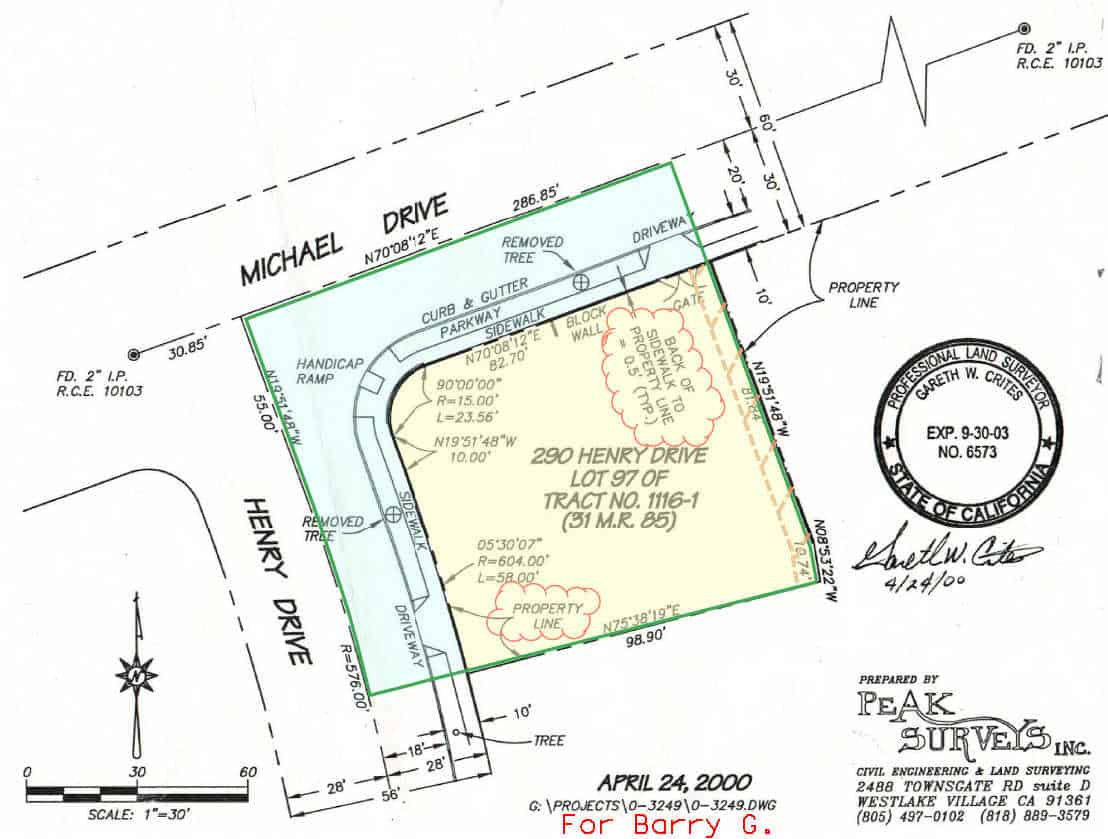
I hope I haven't confused matters. Here's a different map that might help the discussion.
BajaOR, post: 402770, member: 9139 wrote: I think Warren's introduction of "feasible" and "indefeasible" might have confused things for you and your situation. I don't usually deal with those terms, though I understand that indefeasible is your normal, everyday fee title, aka fee simple, aka fee simple absolute. Defeasible fee "may be defeated on the happening of an event" (Black's). Someone above may have used the example of a dedication of fee street rights that revert if not used as a street. I'm not going to ponder that because it's not pertinent to your situation. In your case the county never held or gained any kind of fee title. They hold only an easement for the benefit of the public. Remember that fee = ownership = control (subject to encumbrances). Easement = a right to do a specific thing on your property.
You said "However, the fee simple itself can be subjected to various conditions and/or contingencies". Conditions yes, contigencies not so much. Ownership of fee simple is absolute, but the property can be subject to conditions (encumbrances) such as easements, tax obligations, zoning, etc. The only contingencies I can think of are not paying your taxes, mortgage, etc, which is not what I think you had in mind.
I hope I haven't confused matters. Here's a different map that might help the discussion.
I agree with you. Looking at the dedication, it does not address anything to do with a fee. I was trying to understand two issues. Who owns the easement areas, to include the sidewalks, parkway trees, our the the middle of street. Who is responsible to maintain the public right of ways? Looking at my property map, I own 6'" before the sidewalk to the end of my back yard. The Ventura County owns the easement, from the 6" to the sidewalk to the middle of the street. Who is responsible to maintain the easement is another issue. On this site, I've been informed that I own the fee title, the property map dimensions don't matter. So I own property after my property dimensions, which makes my head spin. I believe at that moment, the developer owns the private property, where he builds homes, streets, sidewalks, parkways etc. The Developer then prepares a dedication, giving the duty and responsibility to the County to maintain the public right of ways. Easements are created, once the dedication is approved by the Board of Supervisors. The properties are then sold to home owners. The fee title, on private property, then transfers to the Ventura County Municipality, once they accept the dedication for maintenance. It does not get transferred from developer to home owner. The Private Roads turn into Public Roads, to include public sidewalks and parkways. Once this turns public, home owners pay property taxes and gas taxes for this maintenance of public property, not private property. Private property (rights of ways) ended when they transferred to Public Property, for public use. The easements make it ingress and egress, everyone can drive on the roads and walk over the sidewalks. Public property is owned by me, my house, paid for in a mortgage. Public property is paid in maintenance and new property in taxes, to our government, paid by the homeowner. I cant see why the community can all use it, then I pay for this maintenance, when out of repair, as an individual. Its like Im ordered to let 100 drive my car. When it needs maintenance, I pay for it, not the others who used this property. I cant see that the fee stays with the adjacent property owner, when it turns to public property. Then this is private property, not public property, if I own out to the middle of the street. I think you can understand my confusion.