Reading RPLS is free for the whole profession. Members post, reply, and get the members-only rooms.

Notifications
Clear all

Topic starter
Translate
▼
English
Spanish
French
German
Italian
Portuguese
Russian
Chinese
Japanese
Korean
Arabic
Hindi
Dutch
Polish
Turkish
Vietnamese
Thai
Swedish
Danish
Finnish
Norwegian
Czech
Hungarian
Romanian
Greek
Hebrew
Indonesian
Malay
Ukrainian
Bulgarian
Croatian
Slovak
Slovenian
Serbian
Lithuanian
Latvian
Estonian
In this I mean, transfers by means of Estoppel, Unwritten Agreements, Adverse Possession, Acquiescence, etc.
We had recently a post about a fence line deviating from a 1/16th line by approximately 9 feet. The parties on both sides of the line appeared to state that they agree to the fence being their boundary and the original poster was asking how to handle it. Myself and a few others suggested recording a boundary line adjustment to conform to the fence as the adjacent land owners wished whereas the agreed upon line would be memorialized in their respective title into the future. However, others state that the surveyor should apply the legal doctrine of the establishment of boundaries by unwritten agreement and just call it the boundary. They also cite cases where this legal doctrine has been employed. However, my question is, what is our role in this process?
I was educated in Surveying Principles and Practices in the University environment where they used the Brown/Robillard as the text books for our education in these matters. These legal text books appear to warn the surveyor that unwritten rights are questions of law, not questions of survey. And that it is the surveyor's role to collect and depict evidence (as it relates to surveying) to facilitate the judgement of a court in these matters.
Posted : September 20, 2015 6:46 pm

Translate
▼
English
Spanish
French
German
Italian
Portuguese
Russian
Chinese
Japanese
Korean
Arabic
Hindi
Dutch
Polish
Turkish
Vietnamese
Thai
Swedish
Danish
Finnish
Norwegian
Czech
Hungarian
Romanian
Greek
Hebrew
Indonesian
Malay
Ukrainian
Bulgarian
Croatian
Slovak
Slovenian
Serbian
Lithuanian
Latvian
Estonian
Bow Tie Surveyor, post: 337226, member: 6939 wrote: In this I mean, transfers by means of Estoppel, Unwritten Agreements, Adverse Possession, Acquiescence, etc.
Only one of those involves a transfer of ownership which is adverse possession (an exception to the Statute of Frauds). The others are doctrines which establish the boundary location, there is no transfer, only establishment of location. Location is not subject to the Statute of Frauds.
Location is a question of fact, not law, therefore it is within the practice of Land Surveying.
Posted : September 20, 2015 6:56 pm

Translate
▼
English
Spanish
French
German
Italian
Portuguese
Russian
Chinese
Japanese
Korean
Arabic
Hindi
Dutch
Polish
Turkish
Vietnamese
Thai
Swedish
Danish
Finnish
Norwegian
Czech
Hungarian
Romanian
Greek
Hebrew
Indonesian
Malay
Ukrainian
Bulgarian
Croatian
Slovak
Slovenian
Serbian
Lithuanian
Latvian
Estonian
Bow Tie Surveyor, post: 337226, member: 6939 wrote: In this I mean, transfers by means of Estoppel, Unwritten Agreements, Adverse Possession, Acquiescence, etc.
We had recently a post about a fence line deviating from a 1/16th line by approximately 9 feet. The parties on both sides of the line appeared to state that they agree to the fence being their boundary and the original poster was asking how to handle it. Myself and a few others suggested recording a boundary line adjustment to conform to the fence as the adjacent land owners wished whereas the agreed upon line would be memorialized in their respective title into the future. However, others state that the surveyor should apply the legal doctrine of the establishment of boundaries by unwritten agreement and just call it the boundary. They also cite cases where this legal doctrine has been employed. However, my question is, what is our role in this process?
I was educated in Surveying Principles and Practices in the University environment where they used the Brown/Robillard as the text books for our education in these matters. These legal text books appear to warn the surveyor that unwritten rights are questions of law, not questions of survey. And that it is the surveyor's role to collect and depict evidence (as it relates to surveying) to facilitate the judgement of a court in these matters.
As David said, most of the doctrines you mentioned are NOT transfers of land or changes in a boundary, they are boundary establishment doctrines. In other words, they are legal principles used by landowners to establish the location of their boundary lines. There are more establishment doctrines, varying by name, principles, use, and legal requirements depending upon which state you are in. This is why it is essential that boundary surveyors learn and know these principles inside and out. How can we properly find a boundary if we do not even understand how they are established?
I too, as probably most of us, "learned" boundary law from Robillard, Brown, Wilson and even Clark. Coupling these texts with what I learned from my "mentors", I managed to easily pass the licensing tests. That is the really sad part. I had to unlearn most of what I had used to pass the tests to begin learning what real boundary surveying is.
The books mentioned, for the most part, are a good primer for learning some of the aspects of boundary surveying, but they must be read with a basic understanding of boundary law - not surveying myths, legends, and measurement hocus-pocus, that many of us get from our "mentors".
Posted : September 20, 2015 7:27 pm
Topic starter
Translate
▼
English
Spanish
French
German
Italian
Portuguese
Russian
Chinese
Japanese
Korean
Arabic
Hindi
Dutch
Polish
Turkish
Vietnamese
Thai
Swedish
Danish
Finnish
Norwegian
Czech
Hungarian
Romanian
Greek
Hebrew
Indonesian
Malay
Ukrainian
Bulgarian
Croatian
Slovak
Slovenian
Serbian
Lithuanian
Latvian
Estonian
Dave Karoly, post: 337230, member: 94 wrote: Only one of those involves a transfer of ownership which is adverse possession (an exception to the Statute of Frauds). The others are doctrines which establish the boundary location, there is no transfer, only establishment of location. Location is not subject to the Statute of Frauds.
Location is a question of fact, not law, therefore it is within the practice of Land Surveying.
For example, on the question of the establishment of boundaries by Unwritten Agreement, Brown/Robillard's Evidence and Procedures for Boundary Location states that most states have specific requirements which usually include some or all of the following: 1) The true line described by the writings is unknown, uncertain, or unascertainable. 2) The property line between the contiguous owners is in dispute. 3) The contiguous owners agree to accept the boundary line they establish. In some jurisdictions, possession or acquiescence follows, and the line agreed upon is marked. 4) The endpoints of the line must be monumented.
Concerning the first element, is it a matter of survey that the surveyor determine that the parties were truly uncertain on the location of the true boundary? I have read that if either party was aware of the true location the agreement may not be binding. On the second element, is it a matter of survey to decide if a dispute really existed or if a mere uncertainty by the parties is sufficient to meet the element of law?
Posted : September 20, 2015 7:33 pm
Topic starter
Translate
▼
English
Spanish
French
German
Italian
Portuguese
Russian
Chinese
Japanese
Korean
Arabic
Hindi
Dutch
Polish
Turkish
Vietnamese
Thai
Swedish
Danish
Finnish
Norwegian
Czech
Hungarian
Romanian
Greek
Hebrew
Indonesian
Malay
Ukrainian
Bulgarian
Croatian
Slovak
Slovenian
Serbian
Lithuanian
Latvian
Estonian
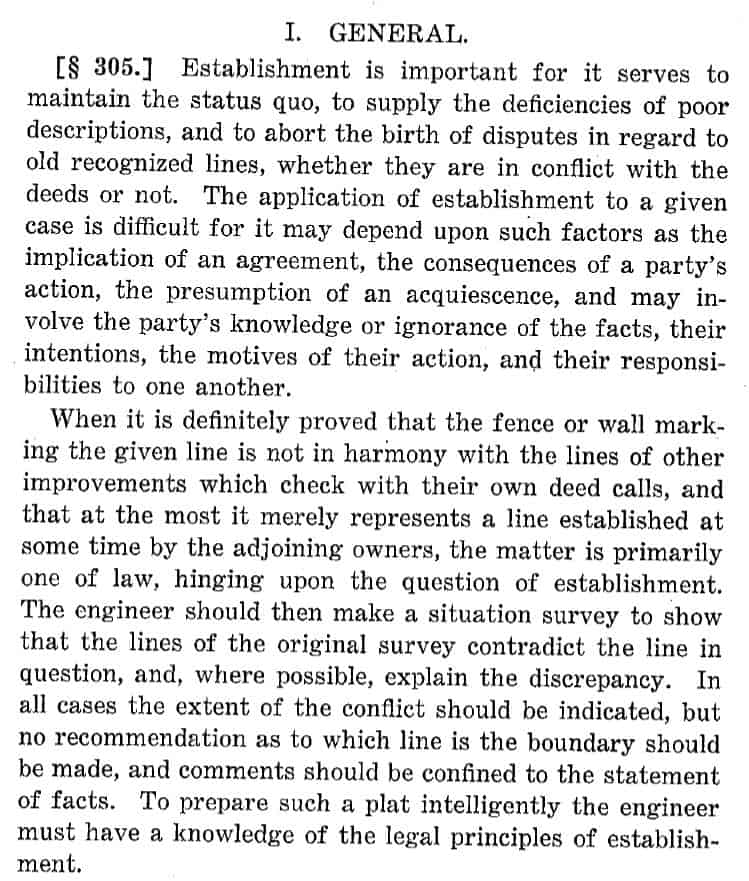
Here is a scan from Skelton's Boundaries and Adjacent Properties on the Establishment of Boundaries. He seems to have the same cautionary stance as Brown/Robillard. He even goes so far as to recommend not to commit to a boundary line until the difference is resolved.
Posted : September 20, 2015 7:47 pm
Topic starter
Translate
▼
English
Spanish
French
German
Italian
Portuguese
Russian
Chinese
Japanese
Korean
Arabic
Hindi
Dutch
Polish
Turkish
Vietnamese
Thai
Swedish
Danish
Finnish
Norwegian
Czech
Hungarian
Romanian
Greek
Hebrew
Indonesian
Malay
Ukrainian
Bulgarian
Croatian
Slovak
Slovenian
Serbian
Lithuanian
Latvian
Estonian
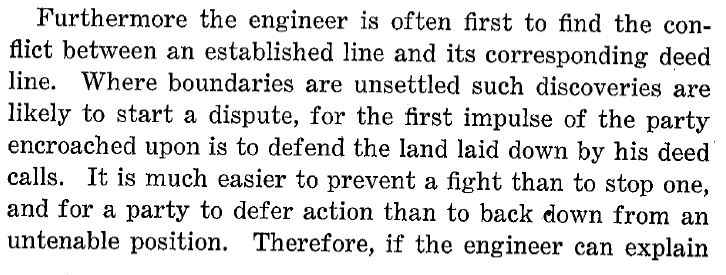
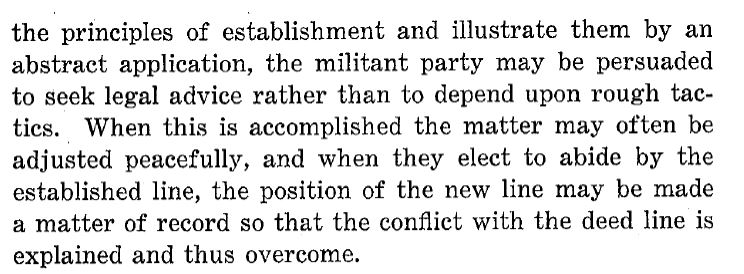
Skelton goes on with a recommended course of action in these cases:
Posted : September 20, 2015 7:52 pm
Translate
▼
English
Spanish
French
German
Italian
Portuguese
Russian
Chinese
Japanese
Korean
Arabic
Hindi
Dutch
Polish
Turkish
Vietnamese
Thai
Swedish
Danish
Finnish
Norwegian
Czech
Hungarian
Romanian
Greek
Hebrew
Indonesian
Malay
Ukrainian
Bulgarian
Croatian
Slovak
Slovenian
Serbian
Lithuanian
Latvian
Estonian
Bow Tie Surveyor, post: 337234, member: 6939 wrote: For example, on the question of the establishment of boundaries by Unwritten Agreement, Brown/Robillard's Evidence and Procedures for Boundary Location states that most states have specific requirements which usually include some or all of the following: 1) The true line described by the writings is unknown, uncertain, or unascertainable. 2) The property line between the contiguous owners is in dispute. 3) The contiguous owners agree to accept the boundary line they establish. In some jurisdictions, possession or acquiescence follows, and the line agreed upon is marked. 4) The endpoints of the line must be monumented.
Concerning the first element, is it a matter of survey that the surveyor determine that the parties were truly uncertain on the location of the true boundary? I have read that if either party was aware of the true location the agreement may not be binding. On the second element, is it a matter of survey to decide if a dispute really existed or if a mere uncertainty by the parties is sufficient to meet the element of law?
E & P is correct. However, these doctrines , the requirements, presumptions, etc. vary by state. The only place you are going to find accurate answers to your questions is in the common law (case law) as established by the courts in your state.
A short search turned this old case up - you will need to verify that it is still good law:
49 So.2d 843 (1951)
EUSE et al.
v.
GIBBS et al.
We find the law to be that where the boundary line between contiguous lands is uncertain or disputed, the owners of such lands may agree upon a certain line as the permanent boundary line; and where the agreement is followed by actual occupation according to such line as the boundary, the line will be binding upon them, and their successors in title, as the boundary. "The line becomes binding, not upon the principle that the title to real estate can be passed by parol, but for the reason that the proprietors have by such consent and conduct agreed permanently upon the limits or the extent of their respective lands or property." Watrous v. Morrison, 33 Fla. 261, 14 So. 805, 807; Kilgore v. Leary, 131 Fla. 715, 180 So. 35; Williams v. Pichard, 150 Fla. 371, 7 So.2d 468; Palm Orange Groves v. Yelvington, Fla., 41 So.2d 883.
As stated in Price v. De Reyes, 161 Cal. 484, 119 P. 893, 894: "The line so agreed on becomes in legal effect the true line, the agreement as to the line may be in parol, and it does not operate to convey title to the land which may lie between the agreed line and the true line, but it fixes the line itself and the description carries title up to the agreed line regardless of its accuracy; the agreement as to the line is not in violation of the statute of frauds, because it does not transfer title; the parties hold up to the agreed line by virtue of their original deeds and not by virtue of the parol agreement; `the division line when thus established attaches itself to the deeds of the respective parties and simply defines, not adds to, the lands described in the deeds,' and, if more is thus given to one than the calls of his deed actually require, he `holds the excess by the same tenure that he holds the main body of his land.'"
How does a surveyor use this information in during a boundary survey - we must gather evidence just like a court would do - the quasi-judicial aspect of our profession.
Posted : September 20, 2015 7:55 pm
Translate
▼
English
Spanish
French
German
Italian
Portuguese
Russian
Chinese
Japanese
Korean
Arabic
Hindi
Dutch
Polish
Turkish
Vietnamese
Thai
Swedish
Danish
Finnish
Norwegian
Czech
Hungarian
Romanian
Greek
Hebrew
Indonesian
Malay
Ukrainian
Bulgarian
Croatian
Slovak
Slovenian
Serbian
Lithuanian
Latvian
Estonian
Skelton gives very good advice.
I can comment more tomorrow.
Posted : September 20, 2015 8:10 pm

Translate
▼
English
Spanish
French
German
Italian
Portuguese
Russian
Chinese
Japanese
Korean
Arabic
Hindi
Dutch
Polish
Turkish
Vietnamese
Thai
Swedish
Danish
Finnish
Norwegian
Czech
Hungarian
Romanian
Greek
Hebrew
Indonesian
Malay
Ukrainian
Bulgarian
Croatian
Slovak
Slovenian
Serbian
Lithuanian
Latvian
Estonian
90+ percent of my work is a land title survey.
I am sent a copy of a deed and a title commitment and am ask to make a survey so the property can be transferred.
In the course of my job, I locate the monuments, show the boundaries and everything that has been placed on that property and any object or situation of record and visible use that does or appears to affect that.
I also attempt to point out those things exempted from the policies that do not have anything to do with what I am surveying.
From that point, all those things you have pointed out (Estoppel, Unwritten Agreements, Adverse Possession, Acquiescence, etc.) come into light and those in charge (buyer, seller, banker, title examiner, lawyer, etc) take over and come up with a plan.
Mostly all these people are concerned that the real property is not in conflict and usually only the buyer is concerned about the land and where the boundaries are.
I don't make the decision of who owns what and what not. I don't get paid what judges and/or lawyers make for me doing the labor part of this process.
When it comes down to all these guys asking me who or who not, then I make a call based upon experience for a FEE for that part of the process. That is rare and usually done in a court of law.
0.02
Posted : September 20, 2015 9:16 pm

Translate
▼
English
Spanish
French
German
Italian
Portuguese
Russian
Chinese
Japanese
Korean
Arabic
Hindi
Dutch
Polish
Turkish
Vietnamese
Thai
Swedish
Danish
Finnish
Norwegian
Czech
Hungarian
Romanian
Greek
Hebrew
Indonesian
Malay
Ukrainian
Bulgarian
Croatian
Slovak
Slovenian
Serbian
Lithuanian
Latvian
Estonian
Bow Tie Surveyor, post: 337226, member: 6939 wrote: In this I mean, transfers by means of Estoppel, Unwritten Agreements, Adverse Possession, Acquiescence, etc.
However, my question is, what is our role in this process?
I was educated in Surveying Principles and Practices in the University environment where they used the Brown/Robillard as the text books for our education in these matters. These legal text books appear to warn the surveyor that unwritten rights are questions of law, not questions of survey. And that it is the surveyor's role to collect and depict evidence (as it relates to surveying) to facilitate the judgement of a court in these matters.
Surveyors, most of which have been taught in the making of precise measurements, and most of the work they do not dealing with boundaries, get stuck in the logic of the math and similar concepts. They are trained in the logic and nature of mathematical based science (I was ÛÒ have an engineering degree). The law is much different. As others have said there is differences in the states common law.
I think Utah is a very progressive state in the common law concerning boundaries. I hope we are leading the way. The issue of objective uncertainty in the location of a boundary has been removed in Utah law for acquiescence to occur. Last year there was an appeals case where the court ruled that once the elements for boundary establishment were met the boundary is established. This goes against the common idea that there must be some sort of court ruling or formal agreement to finalize the establishment and location of the boundary (surveyors need to deal with unwritten rights). It will probably take a few more such cases and then a final ruling by the Utah Supreme Court to sort it all out.
But think about it. If the facts and evidence are in place to establish the boundary and the law says that at that point the boundary is established, a surveyor trying to place it in another location would be in malpractice as the surveyor is trying to move the boundary to some other location which would require a conveyance (boundary adjustment). So it might just be in reverse, the boundary adjustment is needed to put the boundary in the ÛÏdeed or titleÛ supposed location, to move it to the math location, NOT from the math location (or ancient original line) to the established location.
Now I'm sorry, this is going to really mess with the status qua, all the virtual title folks, recorders, planners, and even some surveyors that believe in some version of record title or title lines or the deed is all controlling. Accepting established boundaries that are not described correctly in their virtual paper world just really messes with there virtual, not on the ground version of reality. Maybe all these virtual paper title folks should study the boundary law also. It has never been more easy to research and find the law. What is hard is reversing all the backwards, in reverse beliefs. I mean, what is reality, what is in the recorders office or the physical nature of the land and established boundaries.
Really, title and location are not totally in sync. The title says who owns the property and you can trace that back to patent. The location of the title is not always described well in the title document. The title document is not all controlling on the location of a parcel. Its the landowners that control the location and the landowners actions, especially over time, have an effect on the location of the boundaries. The boundaries might actually move by the landowners actions and not effect the title. That's the hard concept to get over, the location moved but the same title document is just fine. Its all there in the law, study it with an open mind and think about what the words really say without the colored glasses and understanding is really not that hard.
I wish I knew how to bridge the gap between title and location in some magical fashion but I don't. I just do my best to locate the boundary, the established boundary if that has occurred. It's supposed to be the surveyors area of practice, our calling in life and our reason for licensing land surveyors. Stop letting everyone else push you around. Get the facts right and locate the established boundary. Explain and document your work. If you follow the law the courts are not going to punish you, they might even like you. The law and the courts have it sorted out. If surveyors got totally on board and applied the law correctly the courts will be happy. Maybe, just maybe, eventually everyone else will come along.
Now most boundaries are handled by surveyors, not the courts. few boundary issues go to court. Most landowners just accept what the surveyor does. So the surveyor NEEDS to get it right according to the law or the landowners get a bad deal (their established boundaries are messed up and moved to some malpractice location of a professional). If the surveyor is not going to apply the correct law, most landowners are not going to get a fair shake. I my mind it's really that simple.
Posted : September 20, 2015 9:50 pm
Translate
▼
English
Spanish
French
German
Italian
Portuguese
Russian
Chinese
Japanese
Korean
Arabic
Hindi
Dutch
Polish
Turkish
Vietnamese
Thai
Swedish
Danish
Finnish
Norwegian
Czech
Hungarian
Romanian
Greek
Hebrew
Indonesian
Malay
Ukrainian
Bulgarian
Croatian
Slovak
Slovenian
Serbian
Lithuanian
Latvian
Estonian
From reading California case law it appears that the Courts would like Land Surveyors to give an expert opinion and guidance to them on where the boundary is actually located. If the boundary is not where it is expected to be found based on the words and numbers in the Deed description then there are some options to be pursued. One option is to recognize the reality of the situation and show the boundary as found on the Survey. An example of this is when the Deed describes a parcel of a certain width and there is an old Survey on file indicating monuments set establishing that width. Suppose the old Survey monuments differ from the true width, say 199.5' instead of 200.0' given by the Deed. The parcel as established is likely 199.5'.
Most States have some version of the establishment Doctrines. Typically the Acquiescence Doctrines require longer periods of occupation to the established boundary. Evidence of an agreement is not required but all boundary doctrines are based in agreement; it's just in the case of Acquiescence the evidence of agreement is lost to time. Boundary Line Agreement doctrines obviously require evidence of an agreement but it can be oral. This is not a violation of the Parol Evidence Rule if the agreement is made after the written Deed. The Parol Evidence Rule only prohibits parol evidence from before the written agreement. California does not have a separate Acquiescence Doctrine but the agreement in the California Agreed Boundary Doctrine can be implied per many authorities.
I don't get too involved in the establishment doctrines, though. Mostly I look for physical evidence of the boundary and evidence of reliance upon the established boundary such as fences or cutting lines in the case of timber land. Evidence of an old Survey is useful too because the California Courts have said having a Survey is a sign of good faith. This is where having filed Surveys is very helpful.
Boundary location is a heavily fact dependent thing. We do boundary location, not Title. If you have a boundary for a 40 acre aliquot and the occupation is 60 acres with no good reason for it (such as a distorted Section) then there could be areas occupied over the established boundaries, that would involve a potential title transfer which is beyond the practice of Land Surveying unless the parties agree to cure it with a Boundary Line Adjustment with the help of the Surveyor. On the other hand, if the Deed says "thence North 100 poles" then I could see the established boundaries not measuring exactly 1650.00'; 1645' would be consistent with the expressed intention of the Deed. The examples could be almost endless.
Like Leon says, most boundary problems never make it into Court because the cost is prohibitive. The Judge and the Lawyer are not Surveyors. It is best for the property owners to agree but that is not always practical or possible.
Posted : September 21, 2015 9:13 am

Translate
▼
English
Spanish
French
German
Italian
Portuguese
Russian
Chinese
Japanese
Korean
Arabic
Hindi
Dutch
Polish
Turkish
Vietnamese
Thai
Swedish
Danish
Finnish
Norwegian
Czech
Hungarian
Romanian
Greek
Hebrew
Indonesian
Malay
Ukrainian
Bulgarian
Croatian
Slovak
Slovenian
Serbian
Lithuanian
Latvian
Estonian
Taking off a little farther..
Not only is it true many Courts want for our opinions, more would have us prevent thier seeing any case at all. Who is (or should be) better equipped to assist owners in resolving conflicts between boundaries and records? This is where our education, mentoring and licensure fail miserably.
Not only do our schools and tests avoid complex statutes, they all but avoid case law altogether. The closest thing to a real exam (including this content) I've seen was Washington. I left the room wanting to vomit. That made me happy. Nobody obtaining that license was given anything.
I am not so naive as to think we can school and test ourselves to competence in the law. We certainly can do better. Now back to the subject...
The measurement sciences part of this job is not especially complex. If you have an intermediate understanding of algebra and geometry you can accomplish most tasks we are called on to perform. The added ability to recognize and evaluate fact patterns while drawing solutions out of the owners is what sets us apart. Most of my memorable surveys involved more research into records and case law than field time. Another common thread in those is the owners were not left to fend for themselves when I was done. The map was not sent down as an exhibit for a lawyers feast.
The most important saying I've learned as a Surveyor is, 'If there be peace in the neighborhood when I arrive let there be a better, lasting peace when I leave'. That can't happen if we pass our findings on to those who don't understand them.
Posted : September 21, 2015 11:25 am
Translate
▼
English
Spanish
French
German
Italian
Portuguese
Russian
Chinese
Japanese
Korean
Arabic
Hindi
Dutch
Polish
Turkish
Vietnamese
Thai
Swedish
Danish
Finnish
Norwegian
Czech
Hungarian
Romanian
Greek
Hebrew
Indonesian
Malay
Ukrainian
Bulgarian
Croatian
Slovak
Slovenian
Serbian
Lithuanian
Latvian
Estonian
I can assist the Court. I cannot be the Court. I can and will show elements of possession that are not consistent with the deed but that in itself does not determine ownership. Only agreement between owners and or the court can do that.
Posted : September 21, 2015 12:02 pm
Translate
▼
English
Spanish
French
German
Italian
Portuguese
Russian
Chinese
Japanese
Korean
Arabic
Hindi
Dutch
Polish
Turkish
Vietnamese
Thai
Swedish
Danish
Finnish
Norwegian
Czech
Hungarian
Romanian
Greek
Hebrew
Indonesian
Malay
Ukrainian
Bulgarian
Croatian
Slovak
Slovenian
Serbian
Lithuanian
Latvian
Estonian
lmbrls, post: 337316, member: 6823 wrote: I can assist the Court. I cannot be the Court. I can and will show elements of possession that are not consistent with the deed but that in itself does not determine ownership. Only agreement between owners and or the court can do that.
While our posts apoear at odds, there is a thread of agreement worth noting. If we assume our Survey adjudicates the issue and move on, bad things will follow. It is incumbent on us to walk willing owners through correcting the record. That may mean a simple acknowledgment on the survey or an agreement recorded in accordance with law.
The facts that place a boundary in a particular place are true regardless of our aporoach. I contend that most disputes should be resolved well before the courts hear of it...
Posted : September 21, 2015 12:21 pm
Translate
▼
English
Spanish
French
German
Italian
Portuguese
Russian
Chinese
Japanese
Korean
Arabic
Hindi
Dutch
Polish
Turkish
Vietnamese
Thai
Swedish
Danish
Finnish
Norwegian
Czech
Hungarian
Romanian
Greek
Hebrew
Indonesian
Malay
Ukrainian
Bulgarian
Croatian
Slovak
Slovenian
Serbian
Lithuanian
Latvian
Estonian
lmbrls, post: 337316, member: 6823 wrote: I can assist the Court. I cannot be the Court. I can and will show elements of possession that are not consistent with the deed but that in itself does not determine ownership. Only agreement between owners and or the court can do that.
I used to believe this also. Is our job to locate the boundaries of the parcel we are surveying? I think we can all agree on this.
Taking Florida for example, and this will probably apply to all the states with boundary by agreement/acquiescence doctrines, as they all tend to be similar.
The case I cited above states: "The line so agreed on becomes in legal effect the true line, the agreement as to the line may be in parol, and it does not operate to convey title to the land which may lie between the agreed line and the true line, but it fixes the line itself and the description carries title up to the agreed line regardless of its accuracy; the agreement as to the line is not in violation of the statute of frauds, because it does not transfer title; the parties hold up to the agreed line by virtue of their original deeds and not by virtue of the parol agreement; `the division line when thus established attaches itself to the deeds of the respective parties and simply defines, not adds to, the lands described in the deeds,' and, if more is thus given to one than the calls of his deed actually require, he `holds the excess by the same tenure that he holds the main body of his land."
A careful and thorough reading of this reveals a few important points:
1) The line so agreed on becomes in legal effect the true line.
Isn't that what we are supposed to be finding?
2) but it fixes the line itself and the description carries title up to the agreed line regardless of its accuracy;
For those out there that believe there is a "title line" and another "property line" that has been established by some "unwritten transfer" - this is inarguably a direct "black robe" issued contradiction to your false and uniformed assertions. Plain and simple - The property carries TITLE up to the AGREED LINE. As Leon points out, this happens at the moment in time the requirements are met - not when a surveyor finds the discrepancy between what is established on the ground and what is written in the description. How can we go out 50 years AFTER the agreed line has been legally established and try and color a person title by trying to "move" the boundary from where it has been for 50 years, back to where it "should be"? Talk about taking on liability - you might want to read up on slander of title, malpractice, and negligence.
3) the agreement as to the line is not in violation of the statute of frauds, because it does not transfer title;
Pretty darn plain....
4) the parties hold up to the agreed line by virtue of their original deeds and not by virtue of the parol agreement;
Once again, the agreed line is not a "new" line.
5) the division line when thus established attaches itself to the deeds of the respective parties and simply defines, not adds to, the lands described in the deeds,' and, if more is thus given to one than the calls of his deed actually require, he `holds the excess by the same tenure that he holds the main body of his land.
So where is the "deed line/title line? I'm not sure how it can be stated any plainer.
Would we rather follow the plain and simple concepts that the courts have been telling us for well over 100 years, or should we keep rolling the dice and hoping that some sharp attorney that specializes in negligence and malpractice doesn't get a hold of our work? I'm going to continue being a professional land surveyor - not a gambler.
For those "deed stakers" out there - an agreed line is the "title line" - it is the "deed line" - it is the line called for in the description - IT IS THE BOUNDARY LINE. What lines are you finding, and what is the legal and professional justification for doing so?
Posted : September 21, 2015 12:43 pm
Translate
▼
English
Spanish
French
German
Italian
Portuguese
Russian
Chinese
Japanese
Korean
Arabic
Hindi
Dutch
Polish
Turkish
Vietnamese
Thai
Swedish
Danish
Finnish
Norwegian
Czech
Hungarian
Romanian
Greek
Hebrew
Indonesian
Malay
Ukrainian
Bulgarian
Croatian
Slovak
Slovenian
Serbian
Lithuanian
Latvian
Estonian
That sounds like a quote from Young vs. Blakeman, 153 Cal. 477, 482 (1908), an agreed boundary case in San Francisco. I wonder if the dispute was related to rebuilding after the earthquake.
Posted : September 21, 2015 12:55 pm
Translate
▼
English
Spanish
French
German
Italian
Portuguese
Russian
Chinese
Japanese
Korean
Arabic
Hindi
Dutch
Polish
Turkish
Vietnamese
Thai
Swedish
Danish
Finnish
Norwegian
Czech
Hungarian
Romanian
Greek
Hebrew
Indonesian
Malay
Ukrainian
Bulgarian
Croatian
Slovak
Slovenian
Serbian
Lithuanian
Latvian
Estonian
This is from a 1951 Florida case. Most states tend to, over the years, borrow case law concepts from each other. Yea, I know, then there is California.......... 🙂
Posted : September 21, 2015 1:08 pm

Translate
▼
English
Spanish
French
German
Italian
Portuguese
Russian
Chinese
Japanese
Korean
Arabic
Hindi
Dutch
Polish
Turkish
Vietnamese
Thai
Swedish
Danish
Finnish
Norwegian
Czech
Hungarian
Romanian
Greek
Hebrew
Indonesian
Malay
Ukrainian
Bulgarian
Croatian
Slovak
Slovenian
Serbian
Lithuanian
Latvian
Estonian
I agree that there is a line. But it is not as simple of a line as "this is where the deed puts it" and this other "is a legal matter". The deeds are fraught with errors and ambiguities. A simple example of a surveyor making a legal decision outside the "four corners of the document", might be a finding that the intent of the deed was to say North-West instead of North-East as written. No surveyor would hesitate to make that correction when found, and move on. Another example might be to truncate the parcel at a senior line even if the senior ownership was not called for. (or how about proration of subdivision lots to the block corners?) These are legal decisions, based on case law.
What we are tasked with is to come up with our opinion as to where the property described falls on the ground. It is our legal opinion after looking at all the facts in the case. Whereas it might be true, that if a property line is in dispute, it doesn't reach a final resolution until after a compromise has been made, or a court has decided, we need to advise our clients of our expert opinion. After all, we are the only ones who are licensed to come up with an expert opinion. Often we might need to advise our clients that our decision might be highly debatable, and that to get some real resolution they might need to reach a compromise or take it to court.
I would never tell someone that "they own it by adverse possession" or by "acquiescence" but I would tell them that there is definitely that signs and evidence on the ground (or parol testimony) certainly points to that, and to finalize it, they might need to sign to an agreement or to force the courts to make some kind of resolution. It's my opinion as an expert.
What I might do, @ the survey capacity, is take a fence and state that I believe that, based on the best available evidence in the field, indicates that the fence was built on the intended property line. What about when you find property pins, and the tie to the Section Corner doesn't match by 50 feet, yet the property corners seem to match all the neighboring evidence? I would be more inclined to guess that the non-original section corner monument was not in the same place as the one that was there when the properties were These are all legal decisions. We don't just do the math.
Posted : September 21, 2015 1:17 pm
Translate
▼
English
Spanish
French
German
Italian
Portuguese
Russian
Chinese
Japanese
Korean
Arabic
Hindi
Dutch
Polish
Turkish
Vietnamese
Thai
Swedish
Danish
Finnish
Norwegian
Czech
Hungarian
Romanian
Greek
Hebrew
Indonesian
Malay
Ukrainian
Bulgarian
Croatian
Slovak
Slovenian
Serbian
Lithuanian
Latvian
Estonian
Brian Allen, post: 337322, member: 1333 wrote: ......For those "deed stakers" out there - an agreed line is the "title line" - it is the "deed line" - it is the line called for in the description - IT IS THE BOUNDARY LINE. ...
So a "deed staker" is one that stakes the "deed line" called in the description. I hate the connotation put on by "deed staker" because technically (and as you argue) the property line is the deed line. (actually, I don't "hate" it and we all know exactly what you are referring to. I just find it ironic that everyone who makes these kind of decision refers to the bad guys as "deed stakers")
Posted : September 21, 2015 1:26 pm

Translate
▼
English
Spanish
French
German
Italian
Portuguese
Russian
Chinese
Japanese
Korean
Arabic
Hindi
Dutch
Polish
Turkish
Vietnamese
Thai
Swedish
Danish
Finnish
Norwegian
Czech
Hungarian
Romanian
Greek
Hebrew
Indonesian
Malay
Ukrainian
Bulgarian
Croatian
Slovak
Slovenian
Serbian
Lithuanian
Latvian
Estonian
Bow Tie Surveyor, post: 337226, member: 6939 wrote: In this I mean, transfers by means of Estoppel, Unwritten Agreements, Adverse Possession, Acquiescence, etc.
We had recently a post about a fence line deviating from a 1/16th line by approximately 9 feet. The parties on both sides of the line appeared to state that they agree to the fence being their boundary and the original poster was asking how to handle it. Myself and a few others suggested recording a boundary line adjustment to conform to the fence as the adjacent land owners wished whereas the agreed upon line would be memorialized in their respective title into the future. However, others state that the surveyor should apply the legal doctrine of the establishment of boundaries by unwritten agreement and just call it the boundary. They also cite cases where this legal doctrine has been employed. However, my question is, what is our role in this process?
I was educated in Surveying Principles and Practices in the University environment where they used the Brown/Robillard as the text books for our education in these matters. These legal text books appear to warn the surveyor that unwritten rights are questions of law, not questions of survey. And that it is the surveyor's role to collect and depict evidence (as it relates to surveying) to facilitate the judgement of a court in these matters.
"What is the Surveyor's Role in Unwritten Transfers of Land Ownership?"
John Stahl presented at our annual conference....one of the things he spoke about was the surveyors opportunity to act as a mediator in an agreement. I believe he is a member here, he may be able to add to your question.
Posted : September 21, 2015 1:47 pm
Page 1 / 2
Next