

I am of the belief that I don't know WTH is going on in this here thread and I would love to keep it that way, but the first sand hill I run across is going to get located and duly platted.

All Title is adverse, I think I read that in Holmes, The Common Law, but I have to look. I think that was Richard's point. The only instrument that conveys unassailable Title is a Patent from the Government which originated the Title (I either read that in the Common Law or a California Real Estate treatise under Adverse Possession). Title does not exist without an infrastructure of Laws and Courts to enforce it. The Deed you have only vests color of title. In our system, if the Title Company will insure it then the lender will accept a Deed of Trust on the strength of the latest Grant Deed in the Official Records of the County. If the lender will accept the Deed of Trust then it will fund the loan so the property can be acquired. So the Title Company looks to see if there are any (probably recent) defects and if there are none apparent then they are willing to insure it.
A property owner may possess an area adverse to the whole world. Whether a Court will issue a decree that title is in the possessor depends on the local rules and statutes the Court has to follow. If possession is not in accordance with record title then the property may be out of zoning compliance if this is acknowledged officially. Richard would say, we are not the police, we have no obligation to enforce the local zoning code on behalf of the local government. I don't remember what he said about a Court not being willing to enforce the occupation line as a boundary; maybe that was unconstitutional (don't forget your unconditional right of disposition).
Another Richard-ism...if your neighbor is trespassing on your lot and you call the police, the officer dispatched is going to need to know where your boundary is located, you would have to show him. You can't just stand on your porch and waive your Deed at the officer. This plays into the Courts supposedly presuming that property owners know where their boundaries are (which sometimes they enforce, and often they do not). There was a legal forum thread where the O.P. admitted he was drunk and mistakenly fell asleep in his neighbor's backyard. When this was discovered in the morning the neighbor called the police and he was arrested for criminal trespassing. How did the officer know he was actually on the neighbor's property; probably it was he was in the fenced yard.

Dave Karoly, post: 362240, member: 94 wrote: Richard would say, we are not the police, we have no obligation to enforce the local zoning code on behalf of the local government. I don't remember what he said about a Court not being willing to enforce the occupation line as a boundary; maybe that was unconstitutional (don't forget your unconditional right of disposition).
In Richard's world, an affidavit given by a landowner to the effect that he met all the tests of proving up a title by limitation to some tract of land was all that was needed for evidence of his title! Case law, as seen through Richard's glasses, was the legal system's admission of failure, or something like that. It was Walter Mitty stuff.
Kent McMillan, post: 362243, member: 3 wrote: In Richard's world, an affidavit given by a landowner to the effect that he met all the tests of proving up a title by limitation to some tract of land was all that was needed for evidence of his title! Case law, as seen through Richard's glasses, was the legal system's admission of failure, or something like that. It was Walter Mitty stuff.
All title is fleeting, and aliquot descriptions are fleeting too.
ÛÏFor over a thousand years Roman conquerors returning from the wars enjoyed the honor of triumph, a tumultuous parade. In the procession came trumpeteers, musicians and strange animals from conquered territories, together with carts laden with treasure and captured armaments. The conquerors rode in a triumphal chariot, the dazed prisoners walking in chains before him. Sometimes his children robed in white stood with him in the chariot or rode the trace horses. A slave stood behind the conqueror holding a golden crown and whispering in his ear a warning: that all glory is fleeting.Û -George S. Patton, Jr. according to the movie.
Sic transit gloria mundi.
Dave Karoly, post: 362249, member: 94 wrote: ... all glory is fleeting ...
But if a surveyor encounters a structure that MAY be a house and that MAY be a cheese factory, should he or she correctly identify it as "house and cheese factory" or as a "house OR cheese factory".
Kent McMillan, post: 362243, member: 3 wrote: In Richard's world, an affidavit given by a landowner to the effect that he met all the tests of proving up a title by limitation to some tract of land was all that was needed for evidence of his title! Case law, as seen through Richard's glasses, was the legal system's admission of failure, or something like that. It was Walter Mitty stuff.
Richard was referring to the California Courts failing in Bryant v. Blevins, 4 Cal.4th 47 (1994). The trial court made a perfectly good judgement, the 3rd District affirmed on a long settled California common law rule ignoring inaccurate commentary from two other districts, then the Supreme Court stepped in and reversed and remanded. The opinion is poorly written, hard to understand, and there is a blistering dissent (which is useful to figure out WTH the majority is trying to say). The 3rd District never took up the remand so apparently the parties gave up at that point, no one clearly won. There is no judgement recorded at the Sacramento County Recorder. The fence is still there, as far as I know.
The Supreme Court pulled the rug out and changed their well settled doctrine in order to get the result they wanted.
So Richard was correct on that point.
In California, if the judgement is reversed the parties start over; it means a new trial. The Appellate Courts rarely direct a verdict or judgement.

As much as folks like to wax nostalgic about Richard, he was very juvenile in his behavior when someone didn't agree with him. His tactics and name-calling were epic and completely unprofessional. For the record, I thought his fence-line surveying techniques were nothing short of hilarious.

Glenn Breysacher, post: 362444, member: 188 wrote: name-calling
I am among the many who earned his proclamation of "dippy idiot."
Bill93, post: 362479, member: 87 wrote: I am among the many who earned his proclamation of "dippy idiot."
Bill, I too was a "dippy idiot". IIRC, at one point he tried to insult my wife....which was very bizarre.

ditto to being proclaimed "dippy idiot"
We exchanged emails full of BOR members interpretations of the rules and the society goals and opinions and legislative rulings and court cases that declare the reasons we do what we do and he never wavered his position in support of his beliefs.
He appeared to be a constant advocate with the desire to change and add to the responsibility and active decision making position that every surveyor had background and ability to fulfill without further intervention by the courts and to add one of his formmost quotes:
"If not the surveyor, then who" - Richard Schaut
Dave Karoly, post: 362408, member: 94 wrote: Richard was referring to the California Courts failing in Bryant v. Blevins, 4 Cal.4th 47 (1994).
I think you're selling Richard Schaut short if you want to narrow the scope of his dismissal of case law to just one case. Richard was fond of the phrase "Special Master" and was of the opinion that all that was needed was for a land surveyor to tell the court where the boundary was and that would be the end of any dispute (once it all was recorded in the Miscellaneous Map Records or whatever Richard's secret means of adjudicating these things was).
Kent McMillan, post: 362096, member: 3 wrote:
http://www.co.oconto.wi.us/land_survey/record-22c0439356e7.pdf&apos ;">This early one (1977) is evidently from the pre-fence period of Richard's practice:http://www.co.oconto.wi.us/land_survey/record-010dd1343726.pdf
I'll always regret never having heard Richard's explanation for how it was that the fence shown in the map below (from the link above) in the vicinity of the East boundary of the tract that Richard was surveying did NOT determine the boundary of the tract. Do you suppose the fact that it encroached by between 6 and 10 feet onto Richard's client's land had anything to do with it?
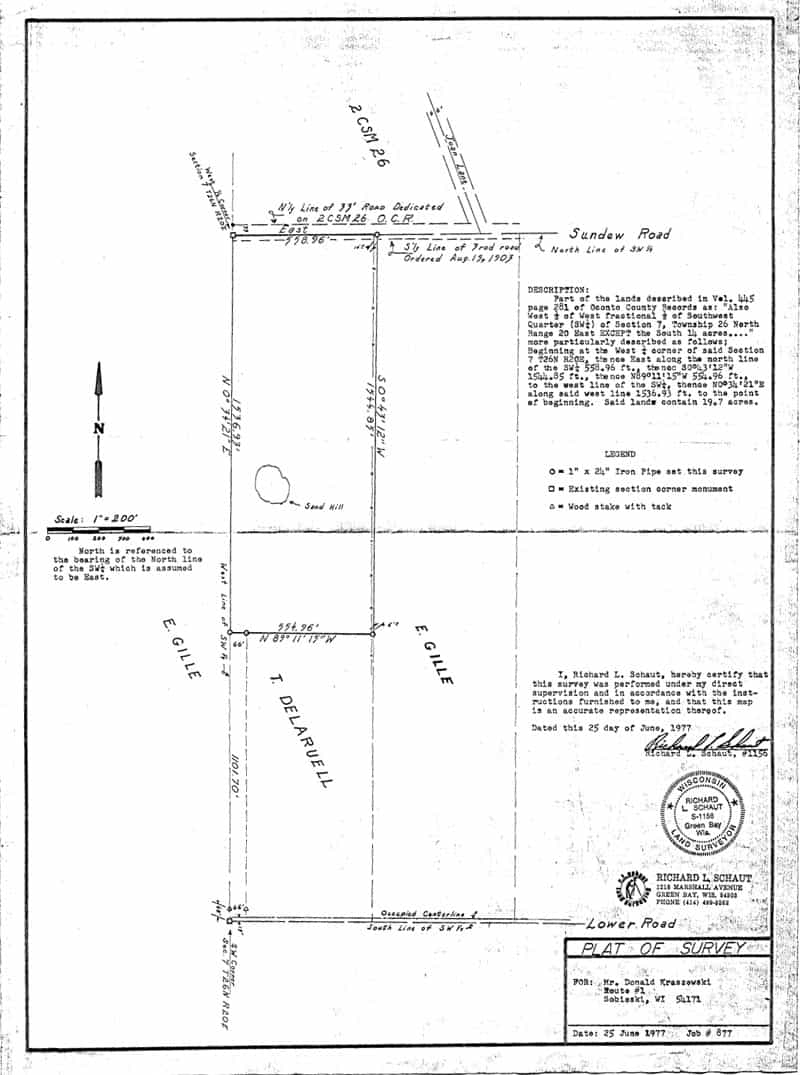
Sand Hill sighting!

Kent,
I was always a fan of his "Pre-Fence" period of work. It really spoke to me. After, you can see how the fame and notoriety diluted his essence.

Dave Karoly, post: 362240, member: 94 wrote: All Title is adverse, I think I read that in Holmes, The Common Law, but I have to look. I think that was Richard's point. The only instrument that conveys unassailable Title is a Patent from the Government which originated the Title (I either read that in the Common Law or a California Real Estate treatise under Adverse Possession). Title does not exist without an infrastructure of Laws and Courts to enforce it. The Deed you have only vests color of title. In our system, if the Title Company will insure it then the lender will accept a Deed of Trust on the strength of the latest Grant Deed in the Official Records of the County. If the lender will accept the Deed of Trust then it will fund the loan so the property can be acquired. So the Title Company looks to see if there are any (probably recent) defects and if there are none apparent then they are willing to insure it.
A property owner may possess an area adverse to the whole world. Whether a Court will issue a decree that title is in the possessor depends on the local rules and statutes the Court has to follow. If possession is not in accordance with record title then the property may be out of zoning compliance if this is acknowledged officially. Richard would say, we are not the police, we have no obligation to enforce the local zoning code on behalf of the local government. I don't remember what he said about a Court not being willing to enforce the occupation line as a boundary; maybe that was unconstitutional (don't forget your unconditional right of disposition).
Another Richard-ism...if your neighbor is trespassing on your lot and you call the police, the officer dispatched is going to need to know where your boundary is located, you would have to show him. You can't just stand on your porch and waive your Deed at the officer. This plays into the Courts supposedly presuming that property owners know where their boundaries are (which sometimes they enforce, and often they do not). There was a legal forum thread where the O.P. admitted he was drunk and mistakenly fell asleep in his neighbor's backyard. When this was discovered in the morning the neighbor called the police and he was arrested for criminal trespassing. How did the officer know he was actually on the neighbor's property; probably it was he was in the fenced yard.
If I recall, Richards definition of allodial was an absolute interpretation from legal dictionaries rather than a reality based legal interpretation. He had found something in the Wisconsin statutes declaring all title allodial and took it to mean what the dictionary said. That is, briefly, that no government control can be exercised over lands in Wisconsin once they have been transferred into private hands. It was a fun new word and theory, so I had to research it a bit and posted a short paper on my findings. In essence, there is no such thing as truly allodial lands. So, I remember him fondly and am glad for his participation and instigation. That paper I penned was required reading for my students for many years. Thanks Richard!
Andy J, post: 362583, member: 44 wrote: I was always a fan of his "Pre-Fence" period of work. It really spoke to me. After, you can see how the fame and notoriety diluted his essence.
Yes, once he began to hang around at that Michigan Bar that Cooley ran, it was pretty much fence this and control that with allodial everything 24/7. You hit a tract and spent much time digging for original evidence, you were milkin' the job, Bubba!
Duane Frymire, post: 362655, member: 110 wrote: If I recall, Richards definition of allodial was an absolute interpretation from legal dictionaries rather than a reality based legal interpretation. He had found something in the Wisconsin statutes declaring all title allodial and took it to mean what the dictionary said.
That was one of the sections of the Wisconsin Constitution that announced that feudal tenures were banned in Wisconsin. Richard made the leap from the abolition of feudal tenures and landed on the legislature not being able to restrict or regulate in any way what private land owners did with their land. In Richard's worldview, the enactment of the Statute of Frauds in Wisconsin statute was an unconstitutional infringement of property rights.

Much of the discussion so far encourages me to want to outlive every person who ever posts here. It is too easy to attack those who can no longer retaliate. Whether it be the absolute truth or not, it is unkind to the departed.
Holy Cow, post: 362663, member: 50 wrote: Much of the discussion so far encourages me to want to outlive every person who ever posts here. It is too easy to attack those who can no longer retaliate. Whether it be the absolute truth or not, it is unkind to the departed.
FWIW, I was not being sarcastic in my above post. And, Kent will be arguing with Richard in perpetuity. It will give them both something to talk about up there someday.
Duane Frymire, post: 362677, member: 110 wrote: Kent will be arguing with Richard in perpetuity. It will give them both something to talk about up there someday.
Actually, Richard subscribed to the BahÌÁÛªÌ? teachings. That would mean that he remains as immune to contrary argument was he was in mundane existence.
Having argued with Richard for years on the sci.engr.surveying newsgroup, I had to go back for a peek at a couple of summaries of his posts that I made.
https://groups.google.com/forum/#!topic/sci.engr.surveying/d1EdKn4Gp_g
https://groups.google.com/forum/#!topic/sci.engr.surveying/KYQFNfFH3ik
In fairness, this was Richard himself with his Cooley :
https://groups.google.com/forum/#!topic/sci.engr.surveying/dvoFI1Px-L0