

So, should one understand that you think that "iron rod" is a description that describes exactly the same object as "1/2 in. iron rod with 1-1/2 in. aluminum cap stamped 'Jan Lightyear, RPLS 6666' " does? How about "iron object"? Is that the same? How about "metal thing"?
The point is that only "1/2 in. iron rod with 1-1/2 in. aluminum cap stamped 'Jan Lightyear, RPLS 6666' " actually describes that object. "Iron rod" doesn't and neither do "iron object" and "metal thing". So if you are going to describe it, you have to mention the cap and its stamping.
Shawn Billings, post: 343834, member: 6521 wrote: ...optional. Is that really your view?
yes. it's good practice, but not compulsory by statute in my view.
Well, that is a tortured view of the actual rules that require descriptions of monuments which are supposed to have identifiable caps or other similar features. What in effect you believe is that registrants are required as a matter of law to set identifiable caps but can consider the caps to be optional features unworthy of mention when the same monuments are described. Fortunately, I don't know of any good surveyors who would agree with that view.

I would say that the topic needs to be clarified and possibly written in plain language by the Board.
Since my first contact with Board members in the early 1970s, the board members themselves described their Rules as "per desecration of the setting Board Members". Four times a year I saw as many as four at survey gathering and they would take a few minutes for your input and topics of interest for them to discuss among themselves.
That info and everything I have seen since had let me know that any middle ground is to be explained and decided upon by the members of the Board. The last topic that I heard a decision on was who did not need to obtain a "Firm registration".
Time to contact a board member and get an official answer........their email is on the BOR site.
I understand the verbage to mean that we must leave a cap or tag or other means of marking on the monument that will trace back to surveyor that set the monument.
I do not see where it is being ask that we describe that ID mark in our paperwork.
I will do whatever they ask of us.
BTW, probably 75% of the monuments I've set still have a cap on them and 5% of my caps have been replaced with some other's cap.
A Harris, post: 343856, member: 81 wrote:
I understand the verbage to mean that we must leave a cap or tag or other means of marking on the monument that will trace back to surveyor that set the monument. I do not see where it is being ask that we describe that ID mark in our paperwork.
But the rules as written say this:
Rule 663.19(b): "Every description prepared for the purpose of defining boundaries shall provide a definite and unambiguous identification of the location of such boundaries and shall describe all monuments found or placed."
Rule 663.19(e): "Boundary monuments found or placed by the land surveyor shall be described upon the survey drawing. The land surveyor shall note upon the survey drawing, which monuments were found, which monuments were placed as a result of his/her survey, and other monuments of record dignity relied upon to establish the corners of the property surveyed."
So, isn't the question simply whether a surveyor can actually describe a capped monument correctly without mentioning the stamping or imprint on the cap and giving other distinguishing characteristics? That seems as fundamental as describing the sizes of unidentified pipes and rebars.
I realize that some folks will want to argue that "Well, the law doesn't say you have to describe it CORRECTLY", but can't we dismiss that as nonsense?

Shawn Billings, post: 343831, member: 6521 wrote: Not one of those statutes mentions ID caps.
I'm with Shawn on this, the regulation does not even require "Caps" just a method of identifying the surveyor. I would think if you used one inch square iron bars painted red and all the local surveyors knew that was your method of making a corner wouldn't that meet the requirement. If the ruling is you "Must" cap the iron rod with name and registration number wouldn't it be redundant to require you to call out that marking on your survey plat as you would be in violation if it wasn't capped.
Why were these people there before the Board?
Their appearance in front of the Board is unique to their own doings and being from the same company the group could not get it right when they were reporting on their survey.
In creating a new document, it takes only a few minutes to correct set to found and report of actual findings rather than simply do a pure unedited cut and paste.
According to their companies surveys, each of them had set the same monuments at different dates and their reports did not distinguish who did what and when they did it.
All the decisions were at the discretion of the Board according to their actions.
I can agree that what is in writing at this time conflicts between what is written into the Rules and that of the Occupation Code.
When somebody calls me on the phone and as a group of my local peers decide that we will all do that, then that is what I'll probably do.
On, that is what we are doing, airing out our version of what we read.
Until then, I am going to work on my unique verbage to begin to find a likable means for that to find its way into my paperwork.
That amount of words added to each noted monument will increase the size of my drawings.
My solution would probably make scan an image of my cap and put that image with a notation on the drawing and as a footnote to my descriptions. I may even show that in color.
The other solution would be to create a tiff and dwg to insert at scale into my paperwork.
My work is never done...............;-)
Rule 663.17(d): "Where practical, all monuments set by a Professional Land Surveyor to delineate or witness a boundary corner shall be marked in a way that is traceable to the responsible registrant or associated employer."
Yes, the rule itself doesn't insist upon caps. Caps or the Morasse collars just happen to be the most widely used solution. I use aluminum caps for permanence and to have the ability to add pt. i.d. nos. to them, but would imagine that plastic holds up better in a coastal environment. Tablets and even spikes with stamped washers bearing the professional identification of the responsible surveyor would meet the requirements of the rule. If you're setting galvanized pipes, stamping a license number on the side of the pipe would work in theory, but would not serve the purpose or intent of the rule particularly well since it would be difficult for later surveyors to read the stamping if the pipe was driven below grade.
I don't think that some local custom like painting monuments with a particular color of paint really is traceable to the responsible registrant. How is someone fifty years from now supposed to know that Ole So-and-So's monuments can be identified because they are painted turquoise green, for example, even if traces of that paint remain on what is left of the monuments? It's better than nothing, but not much. I wouldn't want to argue with a straight face that "everyone" can trace those monuments to So-and-So if the only distinguishing feature on them is paint.
Writing descriptions like this solve the problem perfectly well, in my view.
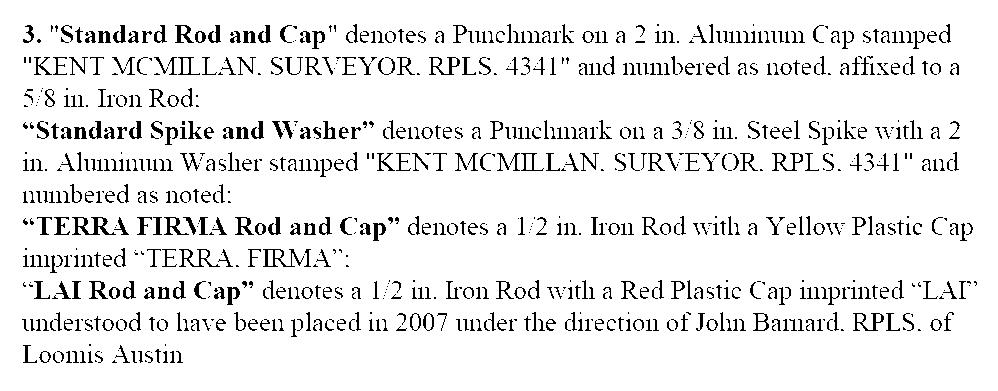

I sent an email requesting clarification on the disciplinary action taken regarding 663.17d in these complaints earlier. I received an email response indicating I'll get more information next week. I'll share what I find out then.

I love it.
Desecration = Desecration (also called desacralization or desanctification) is the act of depriving something of its sacred character, or the disrespectful, contemptuous, or destructive treatment of that which is held to be sacred or holy by a group or individual.
Discretion = the freedom to decide what should be done in a particular situation.
I trust that you'd since read the other rules of the TBPLS that do require documentation in the form of a description of monuments set and found, both on maps and in written descriptions.
I think we understand each other by now. And if we don't, I don't think restating what I've already said will help foster any additional understanding.
Shawn Billings, post: 343831, member: 6521 wrote: Not one of those statutes mentions ID caps.
The statute known as Rule 663.17(d) of the Texas Occupations Code contains the provisions for professional identification on all monuments set by a registrant, if practical. Obviously, the test of practicality is with the TBPLS, not the surveyor, so the burden of proof is on a surveyor who is able to set an iron rod but fails to place a cap or other means of professional identifcation on it.
Caps and collars of the Morasse design are widely used by Texas registrants, but tablets in concrete or stone, and even stamped washers would accomplish the same thing. I see very few tablets aside from those set to mark state highway rights-of-way and I see very few stamped washers on spikes marking boundary corners simply because in most cases they aren't practical, usually for different reasons.
The one exception I can think of where it would be so difficult to set an identified boundary monument as to be impractical is when the monument falls in an existing asphalt pavement. It it possible to set an aluminum cap on an iron rod in a pavement, but the caps tend to get severely beaten up and to seldom survive repaving unless they are countersunk below the depth that the asphalt gets milled. Plastic caps in that situation aren't worth discussing. Countersunk caps in asphalt also pretty much defeat considerations of practical use unless they are in boxes. It's much better practice to set identifiable reference monuments outside the pavement in stable, easily recoverable positions from which plain markers in the pavement can be verified.
My fumbled typing and spell check are always at odds......
Dave Karoly, post: 343770, member: 94 wrote: Stating "Set 3/4" rebar tagged LS1111" has been standard practice in California since at least the end of WWII and common before that it just doesn't occur to me someone would do otherwise. Likewise with "Found 1" iron pipe, tagged LS1111."
Yes, I've never understood why a surveyor who is obligated by law to set monuments with professional identification would not bother to mention what that professional identication was so that the next surveyor would be able to confirm it and identify the monument from it.
Which office practice, specifically, are you suggesting that we review? I've stated about 20 times in this thread that I believe it's good practice to describe ID caps on monuments (found or set). Is that more of your "logic", presuming that because I don't find it statutorily mandated that I'm not doing it at all?
Shawn Billings, post: 343939, member: 6521 wrote: Which office practice, specifically, are you suggesting that we review?
I have understood from your continued objections that you don't believe that Texas surveyors are required to fully describe the identifiable monuments that they are obligated to set on the plats and written descriptions they produce to represent the surveys that placed the monuments. That is frankly such a strange contention that it is reasonable assume that you have some vested interest in not giving full descriptions. The obvious reason that comes to mind is that you have conducted your practice according to the ideosyncratic interpretation that you've promoted.
If in fact you have just been playing Devil's Advocate to allow me to correct you, that's fine, too.



A long ... long time ago, it was determined that political & religious posts would not be allowed ... and it makes sense.
It appears that the Texas law does not specifically state that the cap needs to be identified in a map or description, but common sense dictates one to describe the cap.
Why doesn't Texas change "common sense", into a common sense addendum, through a white paper or some more official avenue, than to begin(possibly), to levy off $1500 fines for something not specifically required?
There are democrats, independents and republicans in America .... and they each seem to understand and interpret the same things very differently.
The reason a federal government recipe for a baker making chocolate chip cookies for the military is so volumous, is because if something is not specifically stated ... it's left to interpretation.
Pass a law or regulation and leave the "interpretation", activities to the judges.
I think the issue is a whole lot less unclear than that. Texas law (as quoted above) explicitly requires registrants to set markers that are traceable to either them or to the entity that employs them. Texas law requires registrants to describe boundary markers that they set, both on maps and in the descriptions they write, and it requires them to describe the boundary markers that they find, both on maps and in written descriptions.
This whole discussion really reduces to whether one can describe a rod and cap monument, or any other monument with professional identification, without actually including a description of the cap or other feature bearing the professional identification.
Until just a day or two ago, I would never have thought in my most fevered imaginings that anyone would seriously contend that a proper description of a rod and cap monument needn't actually mention the cap, that the unidentified rod would be sufficient.
I assume that it won't be long before someone insists that they aren't required to describe the caliper and species of bearing trees or any mark found in them, that a call for "a tree" meets the Texas standards.