Reading RPLS is free for the whole profession. Members post, reply, and get the members-only rooms.

Notifications
Clear all
Strictly Surveying
3
Posts
1
Users
0
Reactions
884
Views

Topic starter
Translate
▼
English
Spanish
French
German
Italian
Portuguese
Russian
Chinese
Japanese
Korean
Arabic
Hindi
Dutch
Polish
Turkish
Vietnamese
Thai
Swedish
Danish
Finnish
Norwegian
Czech
Hungarian
Romanian
Greek
Hebrew
Indonesian
Malay
Ukrainian
Bulgarian
Croatian
Slovak
Slovenian
Serbian
Lithuanian
Latvian
Estonian
Well, maybe "mixed" is a bit strong. What I meant was CORS sites with long time series and those newer sites that just haven't been in place very long. The subject came up yesterday when I was beginning a new project in the Hill Country near Austin. Typically, I prefer to find some secure and relatively unobstructed location where I can set a Rod and Cap marker to use as a base throughout the project when the size of the project and logistics of accessing the control point location allow it.
The spot that appears in the photo below is that point for this project, CP 1. Yesterday, I ran the 4000ssi with Micro-centered L1/L2 Geodetic Antenna + GP for a little over 6.5 hrs while I was doing other things elsewhere.
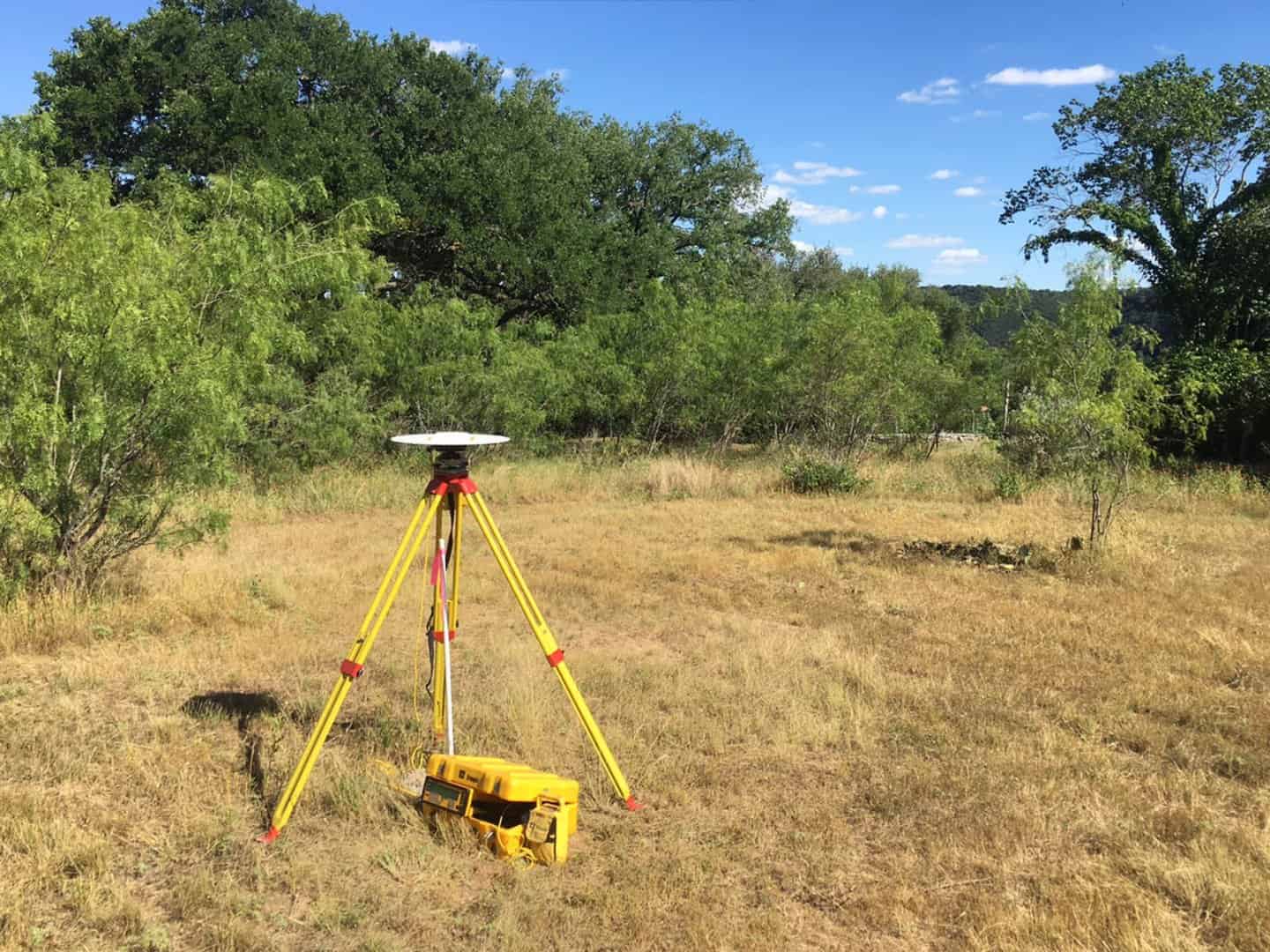
When it came time to submit the data to OPUS, because I had as long a session as I did, it was feasible to consider using more distant CORS sites that for one reason or another seemed to be good choices. I submitted the data twice, picking different sets of CORS sites for each solution, the vectors of which are plotted in red and in blue, respectively on the map below:
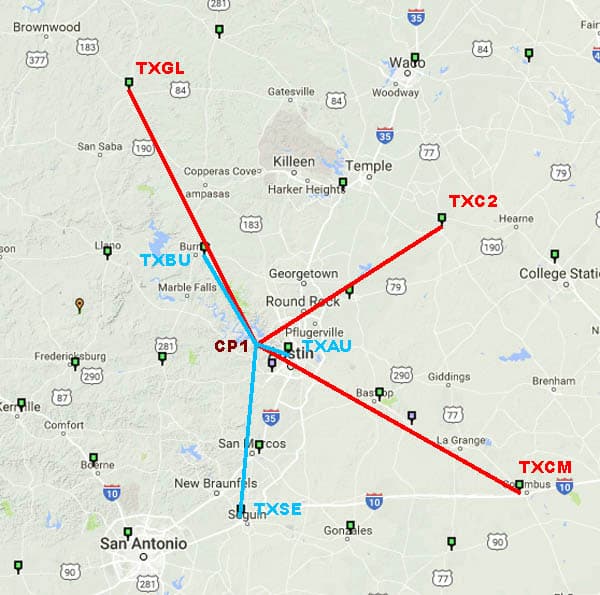
To give an idea of scale, the vector lengths for one solution were as follows:
[PRE]CP1-TXCM 149km
CP1-TXGL 139km
CP1-TXC2 110km[/PRE]
For the other, they were:
[PRE]CP1-TXSE 83km
CP1-TXBU 51km
CP1-TXAU 17km[/PRE]
Interestingly, the two solutions were nearly identical, a least squares adjustment of the two giving horizontal residuals under 5mm in N, E, and Up components of the position of CP1 (after correcting each solution by the mean dN, dE, and dUp differences of Daily - Published values shown on the Short-Term Time Series Plots).
Some of the newer TxDOT CORS sites appear to have better antenna mounts than some of the older CORS sites also maintained by TxDOT and having a longer session meant that it was possible to reach a bit further to pick and choose.
Here, for example, is a photo of the antenna mount at TXGL. I make no comment on the structural design of the mount other than to note that it does not appear to have been engineered and it's a bit mystifying what criteria figured into the design unless "looks like a rocket" was important.
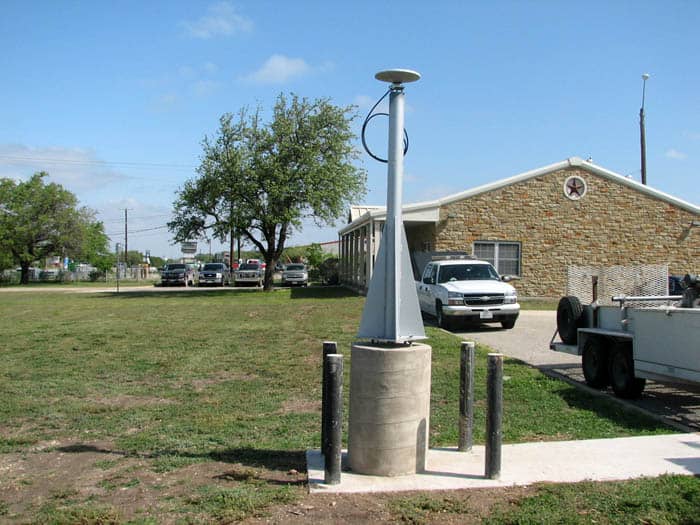
Still, it's an improvement over the generation of CORS antennas waving in the air on conduits mounted to metal buildings.
Posted : May 13, 2017 2:58 pm
Topic starter
Translate
▼
English
Spanish
French
German
Italian
Portuguese
Russian
Chinese
Japanese
Korean
Arabic
Hindi
Dutch
Polish
Turkish
Vietnamese
Thai
Swedish
Danish
Finnish
Norwegian
Czech
Hungarian
Romanian
Greek
Hebrew
Indonesian
Malay
Ukrainian
Bulgarian
Croatian
Slovak
Slovenian
Serbian
Lithuanian
Latvian
Estonian
Since there was some discussion of what residuals were recently, here's what the Star*Net listing of the adjustment of the two OPUS solutions looks like:
[PRE]
Adjusted Observations and Residuals
===================================
Adjusted GPS Vector Observations (FeetUS)
From Component Adj Value Residual StdErr StdRes
To
(V1 Day132a)
1Day132a Delta-N -0.0016 -0.0016 0.0158 0.1
1 Delta-E 0.0133 0.0133 0.0103 1.3
Delta-U -0.0108 -0.0108 0.0366 0.3
Length 0.0172
(V1 Day132b)
1Day132b Delta-N 0.0014 0.0014 0.0145 0.1
1 Delta-E -0.0139 -0.0139 0.0104 1.3
Delta-U 0.0088 0.0088 0.0323 0.3
Length 0.0165[/PRE]
Obviously, the precision of expression is a bit "enthusiastic", so don't be bothered by it.
In this case, the OPUS positions were expressed as GPS vectors of nominally 0 length with variances and covariances taken from the matrix that OPUS reported, tethered to the positions defined by the latitudes, longitudes, and ellipsoid heights that OPUS reported (corrected using the mean values taken from the short term time series).
Posted : May 13, 2017 3:19 pm
Topic starter
Translate
▼
English
Spanish
French
German
Italian
Portuguese
Russian
Chinese
Japanese
Korean
Arabic
Hindi
Dutch
Polish
Turkish
Vietnamese
Thai
Swedish
Danish
Finnish
Norwegian
Czech
Hungarian
Romanian
Greek
Hebrew
Indonesian
Malay
Ukrainian
Bulgarian
Croatian
Slovak
Slovenian
Serbian
Lithuanian
Latvian
Estonian
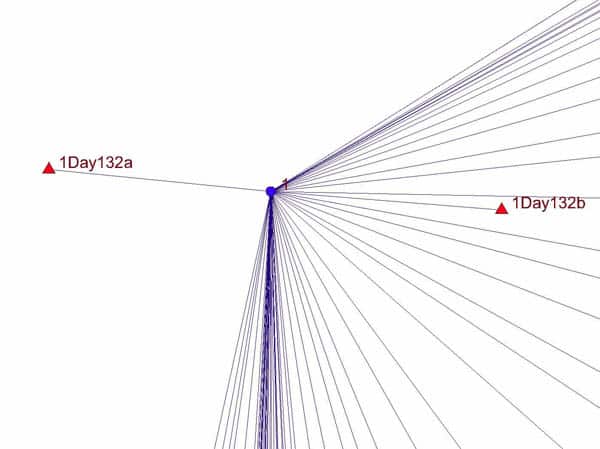
The plot below shows the two different OPUS solutions 1Day132a and 1Day132B, both coordinates with stated uncertainties on the identical point for which "1" is the least squares solution:
Posted : May 13, 2017 3:31 pm